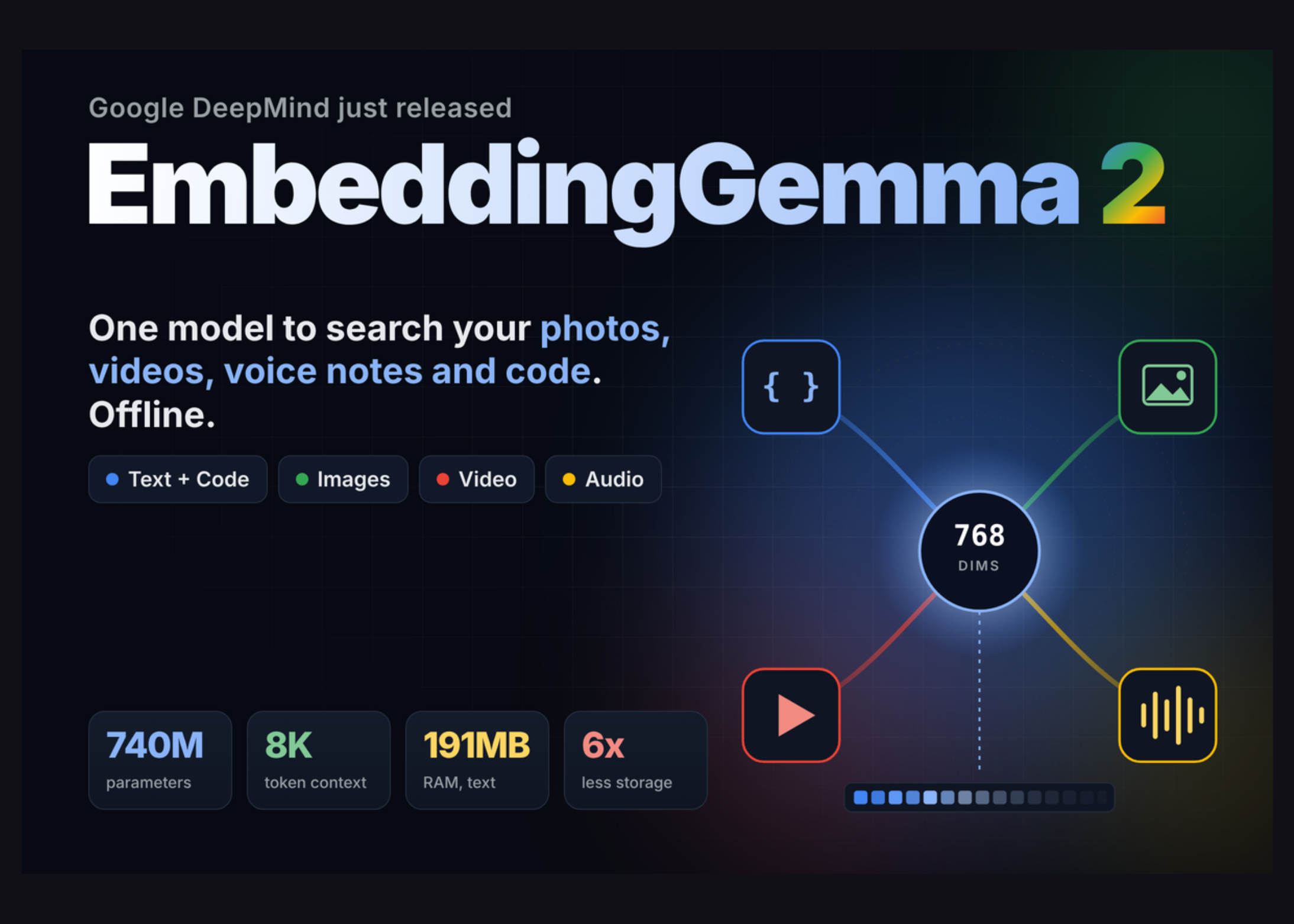
Google DeepMind has released EmbeddingGemma 2, an open model that embeds text, code, images, video and audio into one 768-dimensional space. It has 740M parameters, an 8K token context window and an Apache 2.0 license. It targets on-device search, classification and privacy-first RAG. This article analyzes, compares and showcase how EmbeddingGemma 2 fits in the space.
Deployable today? Yes. Weights are live on Hugging Face and Kaggle, with Ollama, llama.cpp GGUF and LiteRT builds available now.
What an Embedding Model Does
An embedding model converts content into a vector of numbers that captures meaning. Similar items land close together, so they are easy to search and compare. In a RAG pipeline, these vectors let an LLM retrieve fresh information it was not trained on. Generating embeddings locally keeps data on the device, cuts latency and works offline.

One Vector Space for Every Modality
EmbeddingGemma 2 is built on the Gemma 4 architecture. A text query can retrieve a photo. A voice memo can retrieve a video clip. Interleaved inputs, like a product listing with text, images and a demo video, produce a single embedding.
The design is modular. It has three parts:
- Text and code backbone: 270M parameters (130M transformer plus 140M embedder)
- Vision encoder: 170M parameters, optional
- Audio encoder: 300M parameters, optional
Developers load only what they need: 270M for text, 440M for text and vision, 570M for text and audio, or 740M for everything. All setups share one vector space. A query embedded with the text-only setup can match documents embedded by the full model.
The context window is 8,192 tokens, 4x larger than version 1. That fits about 29 images, 58 video frames or 5.5 minutes of audio.
Benchmarks
Google research team reports leading scores among sub-1B multimodal embedders on MTEB Code and MAEB. Full-precision results at 768 dimensions:
| Benchmark | EmbeddingGemma 2 | EmbeddingGemma 1 |
|---|---|---|
| MTEB multilingual v2 | 61.36 | 61.15 |
| MTEB Code v1 | 78.68 | 68.76 |
| MIEB lite (image) | 64.64 | n/a |
| MMEB v2 overall | 59.01 | n/a |
| MSEB retrieval (sound) | 69.54 | n/a |
| MAEB (audio) | 49.39 | n/a |
Source: EmbeddingGemma 2 model card
Code retrieval gains 9.92 points, roughly 14%. Multilingual text quality holds steady. Bigger models still lead some boards. Qwen3-VL-Embedding-2B reports 73.2 on its own MMEB-V2 run, with about 2.7x the parameters and no audio support.
Built for Phones and Laptops
With quantization on a Pixel 11 Pro, active RAM is about 191MB for text-only weights. The full multimodal model needs about 567MB. Quantization-aware training compresses weights to INT4 and INT8. The Google AI Edge team measured 37.3 ms per image on a MacBook M5 Pro GPU, using a 70-token vision budget.
Matryoshka Representation Learning (MRL) lets developers truncate vectors to 512, 256 or 128 dimensions. Moving from 768 to 128 dimensions cuts storage up to 6x. At 256 dimensions, MTEB multilingual only slips from 61.36 to 60.41. At 128 dimensions, MMEB drops to 45.65, so Google recommends 128d mainly for text-only workloads.
Interactive Explainer
EmbeddingGemma 2 vs. Closest Competitors
| Feature | EmbeddingGemma 2 | EmbeddingGemma 1 | Qwen3-VL-Embedding-2B | LCO-Embedding-Omni-3B | Gemini Embedding 2 |
|---|---|---|---|---|---|
| Developer | Google DeepMind | Google DeepMind | Alibaba Qwen | LCO-Embedding (research) | |
| Parameters | 740M (270M text-only) | 308M | 2B | 3B backbone (5B listed on HF) | Not disclosed |
| Text / code | Yes | Yes | Yes | Yes | Yes |
| Images | Yes | No | Yes | Yes | Yes |
| Video | Yes | No | Yes | Yes | Yes |
| Audio | Yes | No | No | Yes | Yes |
| Output dims (MRL) | 768 (512, 256, 128) | 768 (down to 128) | Up to 2048 (64 to 2048) | Not stated | 3072 (128 to 3072) |
| Context | 8,192 tokens | 2K tokens | 32K tokens | Not stated | 8,192 tokens |
| Languages | 100+ | 100+ | 30+ | Not stated | 100+ |
| License / access | Apache 2.0, open weights | Open weights (Gemma terms) | Apache 2.0, open weights | Apache 2.0, open weights | Paid API only |
| Published on-device RAM | ~191MB text, ~567MB full | Under 200MB | Not published | Not published | Cloud only |
| Source | Model card | Docs | HF card | HF card | API docs |
How to Run It
It runs on sentence-transformers v6.1.0+, Transformers, vLLM, SGLang, MLX, llama.cpp, Ollama, LM Studio, LiteRT and MediaPipe. Qdrant covers vector storage and Unsloth covers fine-tuning. ML Kit support for Android, with NPU acceleration, is coming within weeks.
pip install -U "sentence-transformers[image,audio,video]" transformers from sentence_transformers import SentenceTransformer model = SentenceTransformer("google/embeddinggemma-2") q = model.encode("What causes the northern lights?", prompt_name="SearchQuery") d = model.encode("Charged particles from the sun.", prompt_name="Document") print(model.similarity(q, d))On Ollama, run ollama pull embeddinggemma-2. Tags range from 270m (378MB) to 740m (1.3GB). Demos live in Google AI Edge Gallery. See the developer guide for more.
Key Takeaways
- One 740M open model embeds text, code, images, video and audio into a shared 768d space.
- Modular encoders scale the footprint from 270M (text) to 740M (full multimodal).
- Code retrieval jumps from 68.76 to 78.68 on MTEB Code.
- Runs in ~191MB to ~567MB of RAM on a Pixel 11 Pro with quantization.
FAQ
- Can EmbeddingGemma 2 be used commercially? Yes. It is released under the Apache 2.0 license.
- How much memory does EmbeddingGemma 2 need? Google reports about 191MB of active RAM for text-only use and 567MB for full multimodal use, quantized, on a Pixel 11 Pro.
Check out the Model Weights on HF and Technical details. All credit goes to the researcher of this project. Also, feel free to follow us on Twitter and don’t forget to join our 150k+ML SubReddit and Subscribe to our Newsletter. Wait! are you on telegram? now you can join us on telegram as well.

Asif Razzaq
Asif Razzaq is the CEO of Marktechpost AI Media Inc.. As a visionary entrepreneur and engineer, Asif is committed to harnessing the potential of Artificial Intelligence for social good. His most recent endeavor is the launch of an Artificial Intelligence Media Platform, Marktechpost, which stands out for its in-depth coverage of machine learning and deep learning news that is both technically sound and easily understandable by a wide audience. The platform boasts of over 2 million monthly views, illustrating its popularity among audiences.