
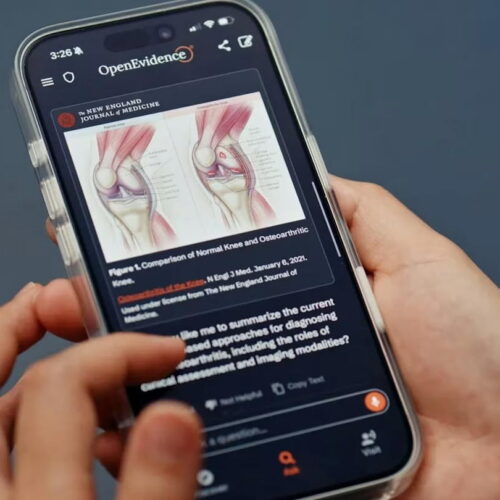
“The end game is literature-based drug discovery,” Nadler said, referencing the field of data mining scientific literature for insights. “The economic value of that as a company is going to dwarf by orders of magnitude whatever we could have charged hospitals or advertisers.”
Alexander Tarashansky, the creator of Claude Science, an Anthropic platform that supports research scientists, has also joined the company to support its clinical work.
The company needs to see off competition from frontier AI companies such as OpenAI, which has also made a play for the space with ChatGPT for healthcare. Anthropic has also released healthcare tools, though it recently partnered with OpenEvidence to bring the tools to 100 low- and middle-income countries.
“The fact that doctors are adopting and using a piece of software of their own volition means there is a degree of differentiation that OpenEvidence can really lean on,” said Nworah Ayogu, a partner at investor Thrive Capital.
But analysis of OpenEvidence’s effectiveness has led to mixed results.
One study by the Mayo Clinic, an investor in the startup, found that it “provided accurate, evidence-based recommendations” in all five patient case studies that were sampled, although its impact on treatment decisions was more limited.
Other research, including a June paper published in Nature, found that it underperformed general-purpose AI models such as Google’s Gemini and OpenAI’s GPT on clinical benchmarks.
Eric Oermann, a neurosurgeon at NYU Langone, said there was a lack of research into the performance of individual AI tools and scant guidance on how to implement the tools in a clinical setting.
There are also widely held concerns that more junior doctors could fall foul by relying too heavily on OpenEvidence and other systems without first mastering basic knowledge of particular conditions and their prescribed treatment options.
“It’s a fun, friendly competitive pressure to play with benchmarks… [But] there’s no question of what AI tool physicians trust and use,” Nadler said.
Additional reporting by George Hammond in San Francisco.
© 2026 The Financial Times Ltd. All rights reserved. Not to be redistributed, copied, or modified in any way.