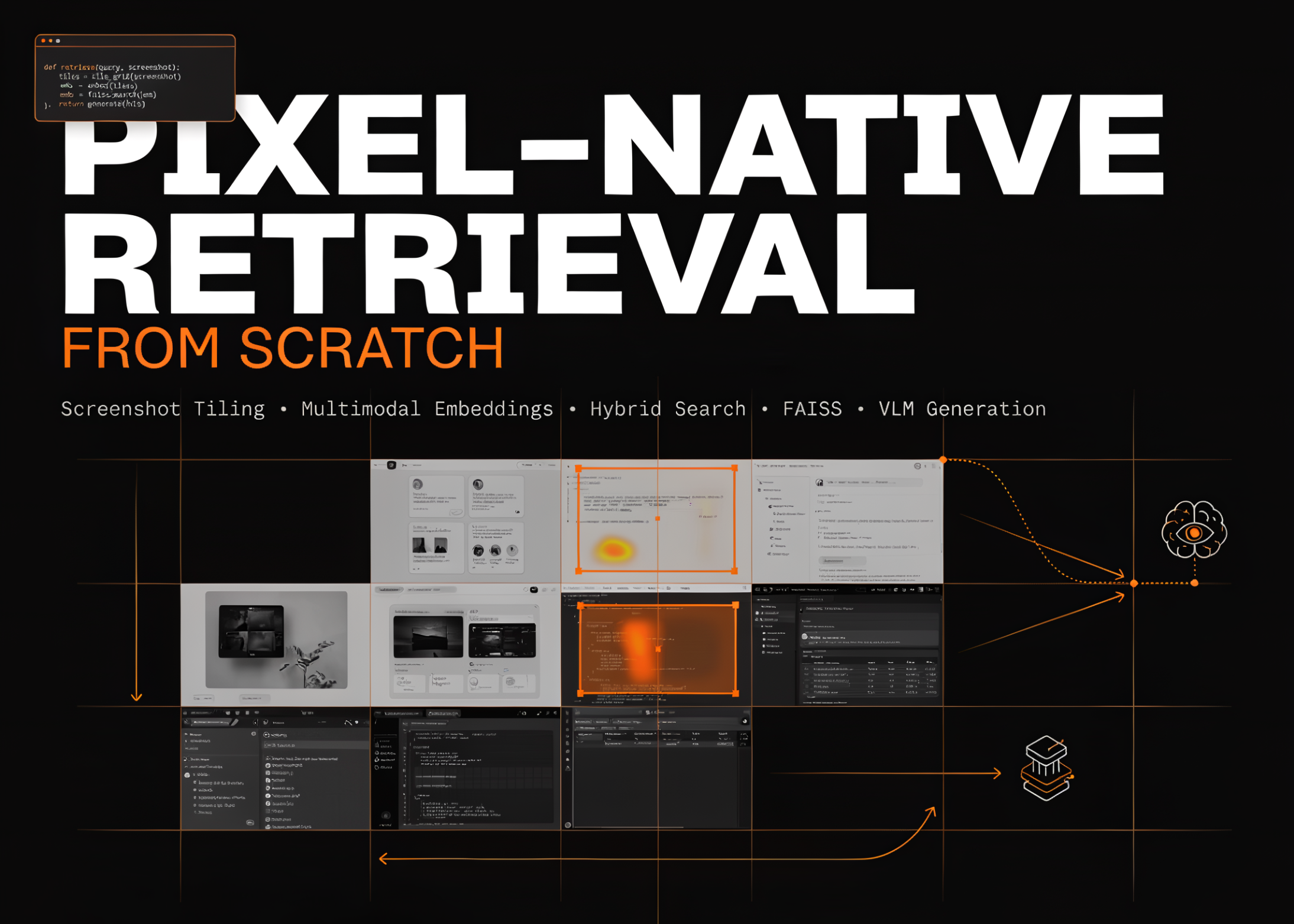
In this tutorial, we build a complete pixel-native retrieval-augmented generation pipeline from scratch and examine how document retrieval works without relying on conventional HTML parsing, text extraction, or fixed chunking strategies. We render web pages and PDF documents as images, divide them into overlapping tiles, generate multimodal embeddings with SigLIP, CLIP, or an optional Qwen3-VL backend, and store the resulting vectors in a FAISS index for efficient similarity search. We also strengthen retrieval with OCR-based BM25 scoring and reciprocal rank fusion, aggregate tile-level evidence into document-level results, and expose the system through a FastAPI search service. Along the way, we evaluate retrieval quality using Recall@k and mean reciprocal rank, train a lightweight residual adapter with contrastive learning, visualize retrieved screenshots, and optionally pass the strongest evidence tiles to a vision-language model for grounded answer generation.
import os import sys import io import re import json import time import math import shutil import hashlib import asyncio import logging import argparse import threading import subprocess from pathlib import Path from dataclasses import dataclass, field, asdict from typing import List, Dict, Any, Optional, Tuple @dataclass class Config: urls: List[str] = field(default_factory=lambda: [ "https://en.wikipedia.org/wiki/Retrieval-augmented_generation", "https://en.wikipedia.org/wiki/Vector_database", "https://en.wikipedia.org/wiki/Transformer_(deep_learning_architecture)", "https://en.wikipedia.org/wiki/Photosynthesis", "https://en.wikipedia.org/wiki/Delhi", ]) include_synthetic_pdf: bool = True tile_width: int = 1024 tile_height: int = 1024 tile_overlap: int = 128 device_scale: float = 1.0 max_page_height: int = 24000 max_tiles_per_doc: int = 12 min_tile_height: int = 200 blank_std_threshold: float = 6.0 dedup_hamming: int = 4 nav_timeout_ms: int = 60000 headless_args: List[str] = field(default_factory=lambda: [ "--no-sandbox", "--disable-dev-shm-usage", "--hide-scrollbars", "--disable-gpu", "--force-color-profile=srgb", "--font-render-hinting=none", ]) backend: str = "siglip" model_id: str = "google/siglip-base-patch16-224" qwen_model_id: str = "Qwen/Qwen3-VL-Embedding-2B" embed_batch_size: int = 8 embed_image_size: Optional[int] = None index_dir: str = "./pixel_index" ivf_threshold: int = 2000 ivf_nprobe: int = 16 top_k_tiles: int = 20 n_docs: int = 5 use_ocr_hybrid: bool = True rrf_k: int = 60 dense_weight: float = 1.0 sparse_weight: float = 1.0 enable_server: bool = True server_port: int = 8000 enable_eval: bool = True enable_adapter_train: bool = True enable_vlm_answer: bool = False vlm_model_id: str = "Qwen/Qwen2.5-VL-3B-Instruct" show_plots: bool = True work_dir: str = "./pixelrag_work" seed: int = 0 CFG = Config() EVAL_QUERIES: List[Tuple[str, str]] = [ ("how do plants convert sunlight into chemical energy", "Photosynthesis"), ("chlorophyll light dependent reactions", "Photosynthesis"), ("converting scanned images of text into machine readable characters", "Optical_character"), ("approximate nearest neighbour search over embeddings", "Vector_database"), ("self-attention multi-head architecture", "Transformer"), ("grounding a language model with retrieved documents", "Retrieval-augmented"), ("capital territory of india red fort", "Delhi"), ] logging.basicConfig(level=logging.INFO, format="%(asctime)s | %(levelname)-7s | %(message)s", datefmt="%H:%M:%S") log = logging.getLogger("pixelrag") for noisy in ("urllib3", "PIL", "matplotlib", "httpx", "asyncio", "uvicorn.error"): logging.getLogger(noisy).setLevel(logging.WARNING) IN_COLAB = "google.colab" in sys.modules def _pip(*pkgs: str) -> None: """Install quietly; never explode the notebook on a single bad wheel.""" cmd = [sys.executable, "-m", "pip", "install", "-q", "--disable-pip-version-check", *pkgs] subprocess.run(cmd, check=False, stdout=subprocess.DEVNULL, stderr=subprocess.STDOUT) def _have(mod: str) -> bool: import importlib.util return importlib.util.find_spec(mod) is not None def ensure_deps(cfg: Config) -> None: log.info("Installing dependencies (first run only, ~2-4 min)...") wanted = [] for mod, pkg in [ ("PIL", "pillow"), ("numpy", "numpy"), ("faiss", "faiss-cpu"), ("fitz", "pymupdf"), ("transformers", "transformers"), ("fastapi", "fastapi"), ("uvicorn", "uvicorn"), ("requests", "requests"), ("matplotlib", "matplotlib"), ("tqdm", "tqdm"), ("rank_bm25", "rank-bm25"), ("playwright", "playwright"), ("sentencepiece", "sentencepiece"), ]: if not _have(mod): wanted.append(pkg) if cfg.use_ocr_hybrid and not _have("pytesseract"): wanted.append("pytesseract") if wanted: _pip(*wanted) if not _have("torch"): log.warning("torch not found — installing CPU wheel (Colab normally ships torch).") _pip("torch", "torchvision") if cfg.use_ocr_hybrid and shutil.which("tesseract") is None: log.info("Installing tesseract-ocr system package...") subprocess.run("apt-get -qq update && apt-get -qq install -y tesseract-ocr", shell=True, check=False, stdout=subprocess.DEVNULL, stderr=subprocess.DEVNULL) if shutil.which("tesseract") is None: log.warning("tesseract unavailable -> hybrid retrieval will run dense-only.") cfg.use_ocr_hybrid = False marker = Path(cfg.work_dir) / ".chromium_ok" if not marker.exists(): log.info("Downloading Playwright Chromium...") r = subprocess.run([sys.executable, "-m", "playwright", "install", "--with-deps", "chromium"], capture_output=True, text=True) if r.returncode != 0: r = subprocess.run([sys.executable, "-m", "playwright", "install", "chromium"], capture_output=True, text=True) if r.returncode == 0: marker.parent.mkdir(parents=True, exist_ok=True) marker.write_text("ok") else: log.warning("Chromium install failed -> falling back to the text renderer.n%s", (r.stderr or "")[-600:]) log.info("Dependencies ready.") def run_async(coro): """ Run a coroutine from a Jupyter/Colab cell. Colab already owns a running event loop, which makes Playwright's *sync* API raise. Rather than monkey-patching with nest_asyncio, we hand the coroutine to a private loop on a private thread — the most robust option. """ box: Dict[str, Any] = {} def _runner(): loop = asyncio.new_event_loop() asyncio.set_event_loop(loop) try: box["value"] = loop.run_until_complete(coro) except BaseException as exc: box["error"] = exc finally: try: loop.run_until_complete(loop.shutdown_asyncgens()) finally: loop.close() t = threading.Thread(target=_runner, daemon=True) t.start() t.join() if "error" in box: raise box["error"] return box.get("value") We define the global configuration, evaluation queries, logging behavior, and runtime settings for the PixelRAG pipeline. We install the required Python and system dependencies, including Playwright, Chromium, Tesseract, FAISS, and transformer libraries. We also create an asynchronous execution helper that allows browser-rendering coroutines to run reliably inside Google Colab and Jupyter environments.
@dataclass class Tile: tile_id: str doc_id: str source: str kind: str page: int seq: int y0: int y1: int path: str ocr_text: str = "" title: str = "" def _doc_id_from_source(src: str) -> str: tail = src.rstrip("https://www.marktechpost.com/").split("/")[-1] or src tail = re.sub(r".(html?|pdf|png|jpg)$", "", tail, flags=re.I) return re.sub(r"[^A-Za-z0-9_.-()]+", "_", tail)[:80] or hashlib.md5(src.encode()).hexdigest()[:10] def _ahash(img, size: int = 8) -> int: """64-bit average hash — cheap near-duplicate detection for repeated headers.""" import numpy as np g = img.convert("L").resize((size, size)) a = np.asarray(g, dtype="float32") bits = (a > a.mean()).flatten() out = 0 for b in bits: out = (out << 1) | int(b) return out def _hamming(a: int, b: int) -> int: return bin(a ^ b).count("1") def _is_informative(img, cfg: Config) -> bool: """Reject blank / solid-colour tiles before they ever reach the GPU.""" import numpy as np a = np.asarray(img.convert("L"), dtype="float32") return float(a.std()) >= cfg.blank_std_threshold def _save_tile(img, out_dir: Path, name: str) -> str: out_dir.mkdir(parents=True, exist_ok=True) p = out_dir / f"{name}.png" img.convert("RGB").save(p, format="PNG", optimize=True) return str(p) def slice_image_to_tiles(img, cfg: Config, *, doc_id: str, source: str, kind: str, page: int, out_dir: Path, start_seq: int = 0, seen_hashes: Optional[List[int]] = None, title: str = "") -> List[Tile]: """Vertical sliding window with overlap. Used for PDFs and text fallback.""" from PIL import Image seen_hashes = seen_hashes if seen_hashes is not None else [] W, H = img.size if W != cfg.tile_width: new_h = max(1, int(H * cfg.tile_width / W)) img = img.resize((cfg.tile_width, new_h)) W, H = img.size step = max(1, cfg.tile_height - cfg.tile_overlap) tiles: List[Tile] = [] y, seq = 0, start_seq while y < H and (seq - start_seq) < cfg.max_tiles_per_doc: h = min(cfg.tile_height, H - y) if h < cfg.min_tile_height and seq > start_seq: break crop = img.crop((0, y, W, y + h)) if _is_informative(crop, cfg): hsh = _ahash(crop) if all(_hamming(hsh, s) > cfg.dedup_hamming for s in seen_hashes): seen_hashes.append(hsh) tid = f"{doc_id}__p{page}__t{seq}" tiles.append(Tile( tile_id=tid, doc_id=doc_id, source=source, kind=kind, page=page, seq=seq, y0=y, y1=y + h, title=title, path=_save_tile(crop, out_dir, tid), )) seq += 1 y += step return tiles _JS_AUTOSCROLL = """ async () => { await new Promise((resolve) => { let y = 0; const timer = setInterval(() => { window.scrollBy(0, 800); y += 800; if (y >= document.body.scrollHeight || y > 40000) { clearInterval(timer); window.scrollTo(0, 0); setTimeout(resolve, 250); } }, 40); }); } """ _JS_FLATTEN = """ () => { document.querySelectorAll('*').forEach((el) => { const s = getComputedStyle(el); if (s.position === 'fixed' || s.position === 'sticky') el.style.position = 'absolute'; }); document.querySelectorAll('[role="dialog"], .cookie, #cookie-banner, .cc-banner') .forEach((el) => el.remove()); } """ _CSS_CLEANUP = """ * { animation: none !important; transition: none !important; scroll-behavior: auto !important; } html { -webkit-font-smoothing: antialiased; } video, iframe[src*="youtube"] { visibility: hidden !important; } """ _UA = ("Mozilla/5.0 (X11; Linux x86_64) AppleWebKit/537.36 (KHTML, like Gecko) " "Chrome/124.0 Safari/537.36 PixelRAG-Tutorial/1.0") async def _render_urls_async(urls: List[str], cfg: Config, out_dir: Path) -> List[Tile]: from playwright.async_api import async_playwright from PIL import Image all_tiles: List[Tile] = [] async with async_playwright() as pw: browser = await pw.chromium.launch(headless=True, args=cfg.headless_args) ctx = await browser.new_context( viewport={"width": cfg.tile_width, "height": cfg.tile_height}, device_scale_factor=cfg.device_scale, user_agent=_UA, java_script_enabled=True, ) for url in urls: doc_id = _doc_id_from_source(url) page = await ctx.new_page() try: await page.goto(url, wait_until="domcontentloaded", timeout=cfg.nav_timeout_ms) try: await page.wait_for_load_state("networkidle", timeout=12000) except Exception: pass await page.evaluate(_JS_AUTOSCROLL) await page.add_style_tag(content=_CSS_CLEANUP) await page.evaluate(_JS_FLATTEN) title = (await page.title()) or doc_id height = await page.evaluate( "() => Math.max(document.body.scrollHeight, " "document.documentElement.scrollHeight)") height = int(min(height, cfg.max_page_height)) step = max(1, cfg.tile_height - cfg.tile_overlap) seen: List[int] = [] y, seq = 0, 0 while y < height and seq < cfg.max_tiles_per_doc: h = min(cfg.tile_height, height - y) if h < cfg.min_tile_height and seq > 0: break buf = await page.screenshot( full_page=True, type="png", clip={"x": 0, "y": y, "width": cfg.tile_width, "height": h}) img = Image.open(io.BytesIO(buf)).convert("RGB") if img.size[0] != cfg.tile_width: img = img.resize((cfg.tile_width, max(1, int(img.size[1] * cfg.tile_width / img.size[0])))) if _is_informative(img, cfg): hsh = _ahash(img) if all(_hamming(hsh, s) > cfg.dedup_hamming for s in seen): seen.append(hsh) tid = f"{doc_id}__p0__t{seq}" all_tiles.append(Tile( tile_id=tid, doc_id=doc_id, source=url, kind="web", page=0, seq=seq, y0=y, y1=y + h, title=title, path=_save_tile(img, out_dir, tid))) seq += 1 y += step log.info(" rendered %-34s -> %2d tiles (page %dpx)", doc_id, seq, height) except Exception as exc: log.warning(" FAILED %s (%s)", url, type(exc).__name__) finally: await page.close() await ctx.close() await browser.close() return all_tiles def render_urls(urls: List[str], cfg: Config, out_dir: Path) -> List[Tile]: """Screenshot every URL into tiles; degrade to the text renderer on failure.""" try: tiles = run_async(_render_urls_async(urls, cfg, out_dir)) if tiles: return tiles log.warning("Browser produced no tiles — using text-render fallback.") except Exception as exc: log.warning("Playwright unavailable (%s: %s) — using text-render fallback.", type(exc).__name__, str(exc)[:160]) return [t for u in urls for t in render_url_as_text(u, cfg, out_dir)] def _strip_html(html: str) -> str: html = re.sub(r"(?is)<(script|style|nav|footer|header|noscript).*?", " ", html) html = re.sub(r"(?s)", " ", html) html = re.sub(r"(?i)", "n", html) text = re.sub(r"(?s)<[^>]+>", " ", html) for a, b in [(" ", " "), ("&", "&"), ("<", "<"), (">", ">"), (""", '"')]: text = text.replace(a, b) text = re.sub(r"[d+]", "", text) text = re.sub(r"[ t]+", " ", text) return re.sub(r"n{2,}", "n", text).strip() def _mono_font(size: int = 20): from PIL import ImageFont for cand in ("https://www.marktechpost.com/usr/share/fonts/truetype/dejavu/DejaVuSans.ttf", "https://www.marktechpost.com/usr/share/fonts/truetype/liberation/LiberationSans-Regular.ttf"): if os.path.exists(cand): return ImageFont.truetype(cand, size) try: import matplotlib.font_manager as fm return ImageFont.truetype(fm.findfont("DejaVu Sans"), size) except Exception: return ImageFont.load_default() def text_to_image(text: str, cfg: Config, title: str = "") -> Any: """Render plain text onto a tall white canvas — a browser-free stand-in.""" from PIL import Image, ImageDraw font, tfont = _mono_font(20), _mono_font(30) pad, lh, wrap = 40, 30, max(20, (cfg.tile_width - 80) // 11) lines: List[str] = [] for para in text.split("n"): para = para.strip() if not para: continue while len(para) > wrap: cut = para.rfind(" ", 0, wrap) cut = cut if cut > 0 else wrap lines.append(para[:cut]) para = para[cut:].lstrip() lines.append(para) lines = lines[:900] height = pad * 2 + 60 + lh * len(lines) img = Image.new("RGB", (cfg.tile_width, max(cfg.tile_height, height)), "white") d = ImageDraw.Draw(img) d.text((pad, pad), title[:60], font=tfont, fill=(15, 15, 15)) for i, ln in enumerate(lines): d.text((pad, pad + 60 + i * lh), ln, font=font, fill=(35, 35, 35)) return img def render_url_as_text(url: str, cfg: Config, out_dir: Path) -> List[Tile]: import requests doc_id = _doc_id_from_source(url) try: r = requests.get(url, timeout=30, headers={"User-Agent": _UA}) r.raise_for_status() body = _strip_html(r.text) m = re.search(r"(?is)(.*?) ", r.text) title = m.group(1).strip() if m else doc_id except Exception as exc: log.warning(" fetch failed for %s (%s)", url, type(exc).__name__) return [] img = text_to_image(body, cfg, title=title) log.info(" text-rendered %-30s -> canvas %dpx", doc_id, img.size[1]) return slice_image_to_tiles(img, cfg, doc_id=doc_id, source=url, kind="text", page=0, out_dir=out_dir, title=title) def render_pdf(pdf_path: str, cfg: Config, out_dir: Path, dpi: int = 150) -> List[Tile]: import fitz from PIL import Image doc_id = _doc_id_from_source(pdf_path) tiles: List[Tile] = [] with fitz.open(pdf_path) as doc: title = (doc.metadata or {}).get("title") or doc_id n_pages = doc.page_count for pno in range(n_pages): pix = doc[pno].get_pixmap(dpi=dpi) img = Image.frombytes("RGB", (pix.width, pix.height), pix.samples) tiles += slice_image_to_tiles(img, cfg, doc_id=doc_id, source=pdf_path, kind="pdf", page=pno, out_dir=out_dir, title=title) log.info(" rendered %-34s -> %2d tiles (%d pages)", doc_id, len(tiles), n_pages) return tiles def make_synthetic_pdf(path: Path) -> str: """A tiny PDF so the tutorial always exercises the PDF path, offline or not.""" import fitz body = [ ("PixelRAG Internal Note", 22), ("", 12), ("Why pixel-native retrieval?", 16), ("Parsers are per-site glue code. A renderer is one code path for every", 11), ("document type: HTML, PDF, scanned fax, spreadsheet export, dashboard.", 11), ("", 11), ("Tiling policy", 16), ("Tiles are 1024x1024 with 128px of vertical overlap. Overlap keeps a", 11), ("sentence or table row from being split across two embeddings, which is", 11), ("the single biggest source of recall loss in naive screenshot pipelines.", 11), ("", 11), ("Serving", 16), ("FAISS inner-product over L2-normalised vectors equals cosine similarity.", 11), ("Tile scores are max-pooled per document so one strong tile can surface", 11), ("a long page, mirroring late-interaction retrieval behaviour.", 11), ("", 11), ("The mitochondria reference is a joke; the overlap advice is not.", 11), ] doc = fitz.open() page = doc.new_page() y = 72 for line, size in body: page.insert_text((72, y), line, fontsize=size, fontname="helv") y += size + 8 doc.save(str(path)) doc.close() return str(path) We create the document-rendering layer that converts web pages, text content, and PDF files into structured image tiles. We capture web pages with Playwright, clean distracting page elements, apply overlapping vertical slicing, and remove blank or duplicate tiles. We also provide text-rendering and synthetic-PDF fallbacks so the pipeline continues to operate when browser rendering or external content is unavailable.
def ocr_tiles(tiles: List[Tile], cfg: Config) -> None: if not cfg.use_ocr_hybrid: return try: import pytesseract from PIL import Image except Exception: log.warning("pytesseract missing -> dense-only retrieval.") cfg.use_ocr_hybrid = False return from tqdm.auto import tqdm t0 = time.time() for t in tqdm(tiles, desc="OCR", unit="tile"): try: raw = pytesseract.image_to_string(Image.open(t.path), config="--psm 6") t.ocr_text = re.sub(r"s+", " ", raw).strip()[:4000] except Exception: t.ocr_text = "" log.info("OCR over %d tiles in %.1fs", len(tiles), time.time() - t0) def torch_device() -> str: import torch if torch.cuda.is_available(): return "cuda" if getattr(torch.backends, "mps", None) and torch.backends.mps.is_available(): return "mps" return "cpu" class DualEncoderBackend: """ SigLIP / CLIP image-text dual encoder. Honest caveat: these encoders were trained on natural images with short captions (64-77 token text towers). They understand a screenshot's *gist* — layout, topic, figures — not its fine print. That is exactly why upstream PixelRAG uses Qwen3-VL-Embedding-2B plus a LoRA trained on screenshots. Sections §9 (OCR hybrid) and §10 (adapter) exist to close part of the gap on hardware that can't host a 2B VLM. """ def __init__(self, cfg: Config): import torch from transformers import AutoModel, AutoProcessor self.cfg = cfg self.device = torch_device() self.dtype = torch.float16 if self.device == "cuda" else torch.float32 self.model_id = cfg.model_id if cfg.backend != "clip" else "openai/clip-vit-base-patch32" log.info("Loading embedding model %s on %s (%s)", self.model_id, self.device, str(self.dtype).replace("torch.", "")) self.processor = AutoProcessor.from_pretrained(self.model_id) self.model = AutoModel.from_pretrained(self.model_id, torch_dtype=self.dtype) self.model.to(self.device).eval() self.is_siglip = "siglip" in self.model_id.lower() self.dim = int(getattr(self.model.config, "projection_dim", 0) or getattr(self.model.config.text_config, "hidden_size", 512)) self.name = f"{'siglip' if self.is_siglip else 'clip'}:{self.model_id}" @staticmethod def _l2(x): import numpy as np n = np.linalg.norm(x, axis=-1, keepdims=True) return (x / np.clip(n, 1e-12, None)).astype("float32") def embed_images(self, images: List[Any], bs: Optional[int] = None): import torch, numpy as np from tqdm.auto import tqdm bs = bs or self.cfg.embed_batch_size out = [] for i in tqdm(range(0, len(images), bs), desc="embed:image", unit="batch"): batch = images[i:i + bs] inputs = self.processor(images=batch, return_tensors="pt") inputs = {k: v.to(self.device, self.dtype if v.is_floating_point() else v.dtype) for k, v in inputs.items()} with torch.no_grad(): feats = self.model.get_image_features(**inputs) out.append(feats.float().cpu().numpy()) return self._l2(np.concatenate(out, 0)) if out else np.zeros((0, self.dim), "float32") def embed_texts(self, texts: List[str], bs: Optional[int] = None): import torch, numpy as np bs = bs or max(16, self.cfg.embed_batch_size) out = [] for i in range(0, len(texts), bs): batch = [t if t.strip() else " " for t in texts[i:i + bs]] kw = dict(text=batch, return_tensors="pt", truncation=True) kw.update(padding="max_length", max_length=64) if self.is_siglip else kw.update(padding=True) inputs = self.processor(**kw) inputs = {k: v.to(self.device) for k, v in inputs.items()} with torch.no_grad(): feats = self.model.get_text_features(**inputs) out.append(feats.float().cpu().numpy()) return self._l2(np.concatenate(out, 0)) if out else np.zeros((0, self.dim), "float32") class Qwen3VLEmbeddingBackend: """ Opt-in backend matching upstream (Qwen/Qwen3-VL-Embedding-2B). Needs a recent transformers (>= 4.57) and ~8 GB of VRAM in fp16. It embeds text and images into one space by mean-pooling the last hidden state of a VLM prompt, which is why it handles dense screenshot text far better than a CLIP-style tower. """ def __init__(self, cfg: Config): import torch from transformers import AutoModel, AutoProcessor self.cfg = cfg self.device = torch_device() self.dtype = torch.float16 if self.device == "cuda" else torch.float32 mid = cfg.qwen_model_id log.info("Loading %s (this is a large download)...", mid) self.processor = AutoProcessor.from_pretrained(mid, trust_remote_code=True) self.model = AutoModel.from_pretrained(mid, torch_dtype=self.dtype, trust_remote_code=True).to(self.device).eval() self.dim = int(self.model.config.hidden_size) self.name = f"qwen3vl:{mid}" def _pool(self, hidden, mask): import torch m = mask.unsqueeze(-1).to(hidden.dtype) return (hidden * m).sum(1) / m.sum(1).clamp(min=1e-6) def _encode(self, **proc_kwargs): import torch, numpy as np inputs = self.processor(return_tensors="pt", padding=True, **proc_kwargs) inputs = {k: (v.to(self.device) if hasattr(v, "to") else v) for k, v in inputs.items()} with torch.no_grad(): out = self.model(**inputs, output_hidden_states=True) hidden = out.hidden_states[-1] if getattr(out, "hidden_states", None) is not None else out.last_hidden_state vec = self._pool(hidden, inputs["attention_mask"]).float().cpu().numpy() return DualEncoderBackend._l2(vec) def embed_images(self, images: List[Any], bs: Optional[int] = None): import numpy as np from tqdm.auto import tqdm bs = bs or max(1, self.cfg.embed_batch_size // 4) chunks = [] for i in tqdm(range(0, len(images), bs), desc="embed:image", unit="batch"): batch = images[i:i + bs] prompt = ["Describe this document screenshot for retrieval."] * len(batch) chunks.append(self._encode(text=prompt, images=batch)) return np.concatenate(chunks, 0) def embed_texts(self, texts: List[str], bs: Optional[int] = None): import numpy as np bs = bs or 8 chunks = [self._encode(text=[f"Query: {t}" for t in texts[i:i + bs]]) for i in range(0, len(texts), bs)] return np.concatenate(chunks, 0) if chunks else np.zeros((0, self.dim), "float32") def build_backend(cfg: Config): if cfg.backend == "qwen3vl": try: return Qwen3VLEmbeddingBackend(cfg) except Exception as exc: log.warning("Qwen3-VL backend failed (%s: %s) -> falling back to SigLIP.", type(exc).__name__, str(exc)[:200]) cfg.backend = "siglip" return DualEncoderBackend(cfg) def embed_tiles(tiles: List[Tile], backend, cfg: Config): from PIL import Image import numpy as np vecs = [] bs = cfg.embed_batch_size for i in range(0, len(tiles), bs): imgs = [Image.open(t.path).convert("RGB") for t in tiles[i:i + bs]] vecs.append(backend.embed_images(imgs, bs=bs)) for im in imgs: im.close() return np.concatenate(vecs, 0) if vecs else np.zeros((0, backend.dim), "float32") We extract OCR text from each rendered tile to support sparse retrieval and automatic training-pair generation. We implement SigLIP, CLIP, and Qwen3-VL embedding backends that place text queries and document screenshots within a shared vector space. We then process the tile images in batches and generate normalized embeddings that are ready for similarity indexing.
class PixelIndex: """ Inner-product FAISS index over L2-normalised vectors (== cosine similarity). Flat below `ivf_threshold` vectors (exact, no training); IVF above it (sub-linear, needs training + nprobe tuning). Raw vectors are also kept in memory so §10 can re-project them after adapter training without re-running the encoder. """ def __init__(self, dim: int, cfg: Config): self.dim, self.cfg = dim, cfg self.index = None self.metas: List[Dict[str, Any]] = [] self.vectors = None self._bm25 = None self._bm25_corpus: List[List[str]] = [] def build(self, vectors, tiles: List[Tile]) -> "PixelIndex": import faiss, numpy as np vectors = np.ascontiguousarray(vectors.astype("float32")) n = vectors.shape[0] if n == 0: raise RuntimeError("No vectors to index — did rendering produce any tiles?") if n >= self.cfg.ivf_threshold: nlist = max(4, min(4096, int(4 * math.sqrt(n)))) quant = faiss.IndexFlatIP(self.dim) base = faiss.IndexIVFFlat(quant, self.dim, nlist, faiss.METRIC_INNER_PRODUCT) base.train(vectors) base.nprobe = self.cfg.ivf_nprobe log.info("FAISS IndexIVFFlat n=%d nlist=%d nprobe=%d", n, nlist, base.nprobe) else: base = faiss.IndexFlatIP(self.dim) log.info("FAISS IndexFlatIP n=%d dim=%d (exact search)", n, self.dim) self.index = faiss.IndexIDMap2(base) self.index.add_with_ids(vectors, np.arange(n).astype("int64")) self.vectors = vectors self.metas = [asdict(t) for t in tiles] self._fit_bm25() return self def _fit_bm25(self) -> None: if not self.cfg.use_ocr_hybrid: return try: from rank_bm25 import BM25Okapi except Exception: return self._bm25_corpus = [re.findall(r"[a-z0-9]+", (m.get("ocr_text", "") + " " + m.get("title", "")).lower()) for m in self.metas] if any(self._bm25_corpus): self._bm25 = BM25Okapi([c or ["_"] for c in self._bm25_corpus]) log.info("BM25 fitted over OCR sidecar (%d docs)", len(self._bm25_corpus)) def search_dense(self, qvecs, k: int): import numpy as np scores, ids = self.index.search(np.ascontiguousarray(qvecs.astype("float32")), k) return scores, ids def search_sparse(self, query: str, k: int) -> List[Tuple[int, float]]: if self._bm25 is None: return [] import numpy as np toks = re.findall(r"[a-z0-9]+", query.lower()) if not toks: return [] s = np.asarray(self._bm25.get_scores(toks)) top = np.argsort(-s)[:k] return [(int(i), float(s[i])) for i in top if s[i] > 0] def save(self, out_dir: str) -> None: import faiss, numpy as np p = Path(out_dir) p.mkdir(parents=True, exist_ok=True) faiss.write_index(self.index, str(p / "tiles.faiss")) np.save(p / "vectors.npy", self.vectors) (p / "metas.jsonl").write_text("n".join(json.dumps(m) for m in self.metas)) (p / "manifest.json").write_text(json.dumps( {"dim": self.dim, "n": len(self.metas), "created": time.time(), "config": asdict(self.cfg)}, indent=2)) log.info("Index saved to %s (%d tiles)", p.resolve(), len(self.metas)) @classmethod def load(cls, out_dir: str, cfg: Config) -> "PixelIndex": import faiss, numpy as np p = Path(out_dir) man = json.loads((p / "manifest.json").read_text()) obj = cls(man["dim"], cfg) obj.index = faiss.read_index(str(p / "tiles.faiss")) obj.vectors = np.load(p / "vectors.npy") obj.metas = [json.loads(l) for l in (p / "metas.jsonl").read_text().splitlines() if l] obj._fit_bm25() return obj def reproject(self, new_vectors) -> None: """Swap in re-embedded vectors (used after adapter training in §10).""" tiles = [Tile(**m) for m in self.metas] self.build(new_vectors, tiles) def build_index(cfg: Config) -> Tuple[PixelIndex, Any, List[Tile]]: work = Path(cfg.work_dir) tiles_dir = work / "tiles" tiles_dir.mkdir(parents=True, exist_ok=True) log.info("=" * 74) log.info("STAGE 1/4 RENDER (documents -> image tiles)") log.info("=" * 74) tiles: List[Tile] = render_urls(cfg.urls, cfg, tiles_dir) if cfg.include_synthetic_pdf: pdf_path = make_synthetic_pdf(work / "pixelrag_note.pdf") tiles += render_pdf(pdf_path, cfg, tiles_dir) if not tiles: raise RuntimeError("Rendering produced zero tiles. Check network access.") log.info("Total tiles: %d across %d documents", len(tiles), len({t.doc_id for t in tiles})) log.info("=" * 74) log.info("STAGE 2/4 OCR SIDECAR (for hybrid retrieval + pair mining)") log.info("=" * 74) ocr_tiles(tiles, cfg) log.info("=" * 74) log.info("STAGE 3/4 EMBED (tiles -> vectors)") log.info("=" * 74) backend = build_backend(cfg) t0 = time.time() vecs = embed_tiles(tiles, backend, cfg) log.info("Embedded %d tiles -> %s in %.1fs (%.2f tiles/s)", vecs.shape[0], vecs.shape, time.time() - t0, vecs.shape[0] / max(1e-6, time.time() - t0)) log.info("=" * 74) log.info("STAGE 4/4 INDEX (vectors -> FAISS)") log.info("=" * 74) index = PixelIndex(vecs.shape[1], cfg).build(vecs, tiles) index.save(cfg.index_dir) return index, backend, tiles We construct the PixelIndex class and store the normalized tile embeddings inside a FAISS inner-product index. We support exact flat search for smaller datasets, IVF-based search for larger collections, BM25 indexing over OCR text, and persistent storage of vectors and metadata. We also orchestrate the complete indexing pipeline by rendering documents, running OCR, generating embeddings, building the index, and saving all outputs to disk.
def search(query: str, index: PixelIndex, backend, cfg: Config, n_docs: Optional[int] = None) -> List[Dict[str, Any]]: import numpy as np n_docs = n_docs or cfg.n_docs k = min(cfg.top_k_tiles, len(index.metas)) qv = backend.embed_texts([query]) dscores, dids = index.search_dense(qv, k) dense = [(int(i), float(s)) for i, s in zip(dids[0], dscores[0]) if i >= 0] fused: Dict[int, float] = {} for rank, (tid, _) in enumerate(dense): fused[tid] = fused.get(tid, 0.0) + cfg.dense_weight / (cfg.rrf_k + rank + 1) sparse = index.search_sparse(query, k) if cfg.use_ocr_hybrid else [] for rank, (tid, _) in enumerate(sparse): fused[tid] = fused.get(tid, 0.0) + cfg.sparse_weight / (cfg.rrf_k + rank + 1) dense_lookup = dict(dense) tile_hits = sorted(fused.items(), key=lambda kv: -kv[1]) per_doc: Dict[str, Dict[str, Any]] = {} for tid, fscore in tile_hits: m = index.metas[tid] d = per_doc.setdefault(m["doc_id"], { "doc_id": m["doc_id"], "title": m.get("title") or m["doc_id"], "source": m["source"], "kind": m["kind"], "score": 0.0, "dense_score": 0.0, "tiles": [], }) d["score"] = max(d["score"], fscore) d["dense_score"] = max(d["dense_score"], dense_lookup.get(tid, 0.0)) if len(d["tiles"]) < 3: d["tiles"].append({ "tile_id": m["tile_id"], "path": m["path"], "seq": m["seq"], "page": m["page"], "y0": m["y0"], "y1": m["y1"], "rrf": round(fscore, 6), "cosine": round(dense_lookup.get(tid, 0.0), 4), "snippet": (m.get("ocr_text", "") or "")[:220], }) return sorted(per_doc.values(), key=lambda d: -d["score"])[:n_docs] def pretty_print(query: str, results: List[Dict[str, Any]]) -> None: print(f"n33[1mQ: {query}33[0m") if not results: print(" (no hits)") return for i, r in enumerate(results, 1): print(f" {i}. [{r['score']:.4f} rrf | {r['dense_score']:.3f} cos] " f"{r['title'][:64]} ({r['kind']})") top = r["tiles"][0] print(f" tile {top['tile_id']} y={top['y0']}-{top['y1']}") if top["snippet"]: print(f" 33[2m{top['snippet'][:150]}...33[0m") class SearchServer: """FastAPI + uvicorn on a background thread, mirroring upstream's POST /search.""" def __init__(self, index: PixelIndex, backend, cfg: Config): from fastapi import FastAPI from pydantic import BaseModel class Query(BaseModel): text: str class SearchRequest(BaseModel): queries: List[Query] n_docs: int = cfg.n_docs app = FastAPI(title="PixelRAG (tutorial)", version="1.0") @app.get("https://www.marktechpost.com/health") def health(): return {"status": "ok", "tiles": len(index.metas), "docs": len({m["doc_id"] for m in index.metas}), "backend": getattr(backend, "name", "unknown")} @app.post("https://www.marktechpost.com/search") def do_search(req: SearchRequest): return {"results": [ {"query": q.text, "docs": search(q.text, index, backend, cfg, req.n_docs)} for q in req.queries]} self.app, self.cfg = app, cfg self.thread: Optional[threading.Thread] = None self.server = None def start(self) -> bool: import uvicorn, requests config = uvicorn.Config(self.app, host="127.0.0.1", port=self.cfg.server_port, log_level="error") self.server = uvicorn.Server(config) self.thread = threading.Thread(target=self.server.run, daemon=True) self.thread.start() for _ in range(40): time.sleep(0.25) try: if requests.get(f"http://127.0.0.1:{self.cfg.server_port}/health", timeout=2).ok: log.info("Search API live on http://127.0.0.1:%d", self.cfg.server_port) return True except Exception: continue log.warning("Server did not come up in time.") return False def stop(self) -> None: if self.server: self.server.should_exit = True if self.thread: self.thread.join(timeout=5) We implement hybrid retrieval by combining dense vector rankings and OCR-based BM25 rankings through reciprocal rank fusion. We aggregate matching tiles into document-level results while retaining the strongest evidence tiles, similarity scores, and OCR snippets for inspection. We also expose the retrieval system through a FastAPI server with health and search endpoints that run on a background Uvicorn thread.
def evaluate(index: PixelIndex, backend, cfg: Config, queries: List[Tuple[str, str]] = EVAL_QUERIES, label: str = "eval", quiet: bool = False) -> Dict[str, float]: ranks: List[Optional[int]] = [] for q, want in queries: docs = search(q, index, backend, cfg, n_docs=10) hit = next((i for i, d in enumerate(docs) if want.lower() in d["doc_id"].lower()), None) ranks.append(hit) if not quiet: got = docs[0]["doc_id"] if docs else "-" mark = "OK " if hit == 0 else (f"@{hit + 1}" if hit is not None else "MISS") print(f" [{mark:>4}] {q[:56]:<58} -> {got[:32]}") n = len(ranks) m = { "recall@1": sum(r == 0 for r in ranks) / n, "recall@3": sum(r is not None and r < 3 for r in ranks) / n, "recall@5": sum(r is not None and r < 5 for r in ranks) / n, "mrr": sum(1.0 / (r + 1) for r in ranks if r is not None) / n, } print(f" 33[1m{label}33[0m R@1={m['recall@1']:.2f} R@3={m['recall@3']:.2f} " f"R@5={m['recall@5']:.2f} MRR={m['mrr']:.3f}") return m def mine_training_pairs(tiles: List[Tile], max_per_tile: int = 2) -> List[Tuple[str, int]]: """Weak supervision: pseudo-queries from a tile's own OCR text / title.""" import random rng = random.Random(0) pairs: List[Tuple[str, int]] = [] for idx, t in enumerate(tiles): text = (t.ocr_text or "").strip() cands: List[str] = [] if len(text) > 80: words = text.split() for _ in range(max_per_tile): if len(words) <= 14: break s = rng.randint(0, len(words) - 14) span = " ".join(words[s:s + rng.randint(8, 14)]) if len(span) > 30: cands.append(span) if t.title: cands.append(t.title) for c in cands[:max_per_tile]: pairs.append((c, idx)) return pairs class ResidualAdapter: """Shared two-layer residual MLP applied to both query and tile vectors.""" def __init__(self, dim: int, hidden: int = 512, device: str = "cpu"): import torch import torch.nn as nn self.device = device self.net = nn.Sequential( nn.Linear(dim, hidden), nn.GELU(), nn.Linear(hidden, dim) ).to(device) for p in self.net[-1].parameters(): torch.nn.init.zeros_(p) self.logit_scale = torch.nn.Parameter(torch.tensor(2.996, device=device)) self.dim = dim def forward_t(self, x): import torch y = x + self.net(x) return torch.nn.functional.normalize(y, dim=-1) def apply_np(self, arr): import torch, numpy as np with torch.no_grad(): t = torch.from_numpy(np.ascontiguousarray(arr.astype("float32"))).to(self.device) return self.forward_t(t).cpu().numpy().astype("float32") def train_adapter(index: PixelIndex, backend, tiles: List[Tile], cfg: Config, epochs: int = 12, batch: int = 24, lr: float = 1e-4): import torch, numpy as np pairs = mine_training_pairs(tiles) if len(pairs) < 32: log.warning("Only %d mined pairs — skipping adapter training " "(enable OCR or add documents).", len(pairs)) return None log.info("Mined %d (pseudo-query, tile) pairs from %d tiles", len(pairs), len(tiles)) q_texts = [p[0] for p in pairs] t_idx = np.array([p[1] for p in pairs], dtype="int64") log.info("Pre-embedding pseudo-queries (frozen encoder, done once)...") Q = torch.from_numpy(backend.embed_texts(q_texts)) V = torch.from_numpy(index.vectors) device = "cuda" if torch.cuda.is_available() else "cpu" ad = ResidualAdapter(index.dim, device=device) Q, V = Q.to(device), V.to(device) opt = torch.optim.AdamW(list(ad.net.parameters()) + [ad.logit_scale], lr=lr, weight_decay=1e-2) n = len(pairs) doc_ids = torch.from_numpy(t_idx).to(device) for ep in range(epochs): perm = torch.randperm(n, device=device) total, steps = 0.0, 0 for i in range(0, n, batch): sel = perm[i:i + batch] if sel.numel() < 4: continue qb = ad.forward_t(Q[sel]) docs = doc_ids[sel] vb = ad.forward_t(V[docs]) logits = ad.logit_scale.exp().clamp(max=100) * qb @ vb.T same = docs[:, None] == docs[None, :] eye = torch.eye(len(sel), dtype=torch.bool, device=device) logits = logits.masked_fill(same & ~eye, float("-inf")) labels = torch.arange(len(sel), device=device) loss = 0.5 * (torch.nn.functional.cross_entropy(logits, labels) + torch.nn.functional.cross_entropy(logits.T, labels)) opt.zero_grad() loss.backward() torch.nn.utils.clip_grad_norm_(ad.net.parameters(), 1.0) opt.step() total += loss.detach().item() steps += 1 if ep % 3 == 0 or ep == epochs - 1: log.info(" epoch %2d/%d InfoNCE loss %.4f", ep + 1, epochs, total / max(steps, 1)) return ad class AdaptedBackend: """Wraps a frozen backend so queries pass through the trained adapter.""" def __init__(self, backend, adapter: ResidualAdapter): self.backend, self.adapter = backend, adapter self.dim = backend.dim self.name = f"{getattr(backend, 'name', 'backend')}+adapter" def embed_texts(self, texts, bs=None): return self.adapter.apply_np(self.backend.embed_texts(texts, bs=bs)) def embed_images(self, images, bs=None): return self.adapter.apply_np(self.backend.embed_images(images, bs=bs)) def answer_with_vlm(query: str, results: List[Dict[str, Any]], cfg: Config, max_tiles: int = 3) -> str: """ Retrieval returns pixels, so generation must accept pixels. Any VLM works; Qwen2.5-VL-3B is a reasonable Colab-sized default (~7 GB download). """ try: import torch from PIL import Image from transformers import AutoProcessor, AutoModelForImageTextToText except Exception as exc: return f"[VLM unavailable: {exc}]" paths = [t["path"] for r in results for t in r["tiles"]][:max_tiles] if not paths: return "[no retrieved tiles]" log.info("Loading VLM %s ...", cfg.vlm_model_id) proc = AutoProcessor.from_pretrained(cfg.vlm_model_id) model = AutoModelForImageTextToText.from_pretrained( cfg.vlm_model_id, torch_dtype=torch.float16 if torch.cuda.is_available() else torch.float32, device_map="auto") images = [Image.open(p).convert("RGB") for p in paths] content = [{"type": "image"} for _ in images] + [{"type": "text", "text": f"These are screenshots retrieved for the question. Answer using only what " f"is visible, and say so if the answer is not shown.nnQuestion: {query}"}] prompt = proc.apply_chat_template([{"role": "user", "content": content}], add_generation_prompt=True, tokenize=False) inputs = proc(text=[prompt], images=images, return_tensors="pt").to(model.device) with torch.no_grad(): out = model.generate(**inputs, max_new_tokens=256, do_sample=False) text = proc.batch_decode(out[:, inputs["input_ids"].shape[1]:], skip_special_tokens=True)[0] return text.strip() def show_results(query: str, results: List[Dict[str, Any]], max_tiles: int = 3) -> None: try: import matplotlib.pyplot as plt from PIL import Image except Exception: return tiles = [(r, t) for r in results for t in r["tiles"][:1]][:max_tiles] if not tiles: return fig, axes = plt.subplots(1, len(tiles), figsize=(5 * len(tiles), 6)) axes = [axes] if len(tiles) == 1 else list(axes) for ax, (r, t) in zip(axes, tiles): ax.imshow(Image.open(t["path"])) ax.set_title(f"{r['title'][:34]}nrrf={r['score']:.4f} cos={t['cosine']:.3f}", fontsize=9) ax.axis("off") fig.suptitle(f"Q: {query}", fontsize=12) plt.tight_layout() plt.show() We evaluate retrieval quality using Recall@1, Recall@3, Recall@5, and mean reciprocal rank across a small benchmark. We mine pseudo-query and tile pairs from OCR content, train a residual contrastive adapter, and apply the learned transformation to both query and image embeddings. We also support grounded answer generation with a vision-language model and visualize the highest-ranked screenshot tiles with their retrieval scores.
def main(cfg: Config = CFG) -> Dict[str, Any]: Path(cfg.work_dir).mkdir(parents=True, exist_ok=True) ensure_deps(cfg) import numpy as np np.random.seed(cfg.seed) banner = """ ██████╗ ██╗██╗ ██╗███████╗██╗ ██████╗ █████╗ ██████╗ ██╔══██╗██║╚██╗██╔╝██╔════╝██║ ██╔══██╗██╔══██╗██╔════╝ ██████╔╝██║ ╚███╔╝ █████╗ ██║ ██████╔╝███████║██║ ███╗ ██╔═══╝ ██║ ██╔██╗ ██╔══╝ ██║ ██╔══██╗██╔══██║██║ ██║ ██║ ██║██╔╝ ██╗███████╗███████╗██║ ██║██║ ██║╚██████╔╝ ╚═╝ ╚═╝╚═╝ ╚═╝╚══════╝╚══════╝╚═╝ ╚═╝╚═╝ ╚═╝ ╚═════╝ pixel-native retrieval: render -> tile -> embed -> FAISS -> serve """ print(banner) index, backend, tiles = build_index(cfg) print("n" + "=" * 74) print("SEARCH DEMO — text query against a pixel index") print("=" * 74) demo_queries = [ "how do plants turn light into sugar", "what does a vector database store", "why use overlapping tiles when screenshotting a page", ] for q in demo_queries: res = search(q, index, backend, cfg) pretty_print(q, res) if cfg.show_plots: show_results(q, res) metrics_before = None if cfg.enable_eval: print("n" + "=" * 74) print("EVALUATION — baseline") print("=" * 74) metrics_before = evaluate(index, backend, cfg, label="baseline") if cfg.use_ocr_hybrid: cfg.use_ocr_hybrid = False print("n -- ablation: dense only (OCR/BM25 disabled) --") evaluate(index, backend, cfg, label="dense-only", quiet=True) cfg.use_ocr_hybrid = True active_backend = backend if cfg.enable_adapter_train: print("n" + "=" * 74) print("ADAPTER TRAINING — contrastive head over frozen embeddings") print("=" * 74) adapter = train_adapter(index, backend, tiles, cfg) if adapter is not None: index.reproject(adapter.apply_np(index.vectors)) active_backend = AdaptedBackend(backend, adapter) if cfg.enable_eval: print("n -- after adapter --") after = evaluate(index, active_backend, cfg, label="adapted") if metrics_before: d = after["mrr"] - metrics_before["mrr"] print(f" MRR delta: {d:+.3f} " f"({'improved' if d > 0 else 'no gain — expected on a corpus this small'})") server = None if cfg.enable_server: print("n" + "=" * 74) print("SERVE — FastAPI, upstream-compatible POST /search") print("=" * 74) server = SearchServer(index, active_backend, cfg) if server.start(): import requests r = requests.post(f"http://127.0.0.1:{cfg.server_port}/search", json={"queries": [{"text": "what is retrieval augmented generation"}], "n_docs": 3}, timeout=120) payload = r.json() for res in payload["results"]: print(f"n POST /search query={res['query']!r}") for d in res["docs"]: print(f" - {d['score']:.4f} {d['title'][:56]} <{d['source'][:48]}>") print("n Equivalent curl:") print(f" curl -X POST http://127.0.0.1:{cfg.server_port}/search \") print(" -H 'Content-Type: application/json' \") print(" -d '{"queries":[{"text":"capital of india"}],"n_docs":3}'") if cfg.enable_vlm_answer: print("n" + "=" * 74) print("GENERATION — answering from retrieved pixels") print("=" * 74) q = "According to the retrieved screenshots, what is photosynthesis?" res = search(q, index, active_backend, cfg, n_docs=2) print(answer_with_vlm(q, res, cfg)) else: print("n[i] Set CFG.enable_vlm_answer = True (GPU) to generate answers " "directly from the retrieved tiles.") n_docs = len({m['doc_id'] for m in index.metas}) print("n" + "=" * 74) print("DONE") print("=" * 74) print(f" tiles indexed : {len(index.metas)} across {n_docs} documents") print(f" embedding dim : {index.dim} backend: {getattr(active_backend, 'name', '?')}") print(f" index on disk : {Path(cfg.index_dir).resolve()}") print(f" tiles on disk : {Path(cfg.work_dir).resolve() / 'tiles'}") print(""" Try next: * CFG.urls -> point at your own pages, then re-run main() * CFG.backend = "qwen3vl" -> upstream's Qwen3-VL-Embedding-2B (needs a big GPU) * CFG.device_scale = 2.0 -> sharper tiles, better small-text retrieval * CFG.tile_overlap = 256 -> higher recall on prose, more vectors to store * render_pdf("https://www.marktechpost.com/content/your.pdf", CFG, Path(CFG.work_dir)/"tiles") * The real deal: git clone https://github.com/StarTrail-org/PixelRAG uv sync --package pixelrag-index && pixelrag-index build """) return {"index": index, "backend": active_backend, "tiles": tiles, "server": server, "search": lambda q, k=5: pretty_print(q, search(q, index, active_backend, cfg, k))} if __name__ == "__main__": parser = argparse.ArgumentParser(add_help=False) parser.add_argument("--no-server", action="store_true") parser.add_argument("--no-train", action="store_true") parser.add_argument("--backend", default=None) args, _ = parser.parse_known_args() if args.no_server: CFG.enable_server = False if args.no_train: CFG.enable_adapter_train = False if args.backend: CFG.backend = args.backend STATE = main(CFG) We connect every component through the main execution workflow and run the complete PixelRAG tutorial from end to end. We demonstrate search, benchmark the baseline system, compare dense-only retrieval, train the adapter, launch the API, and optionally generate answers from retrieved images. We finally display index statistics, saved output locations, extension options, and command-line controls for disabling the server, training stage, or changing the embedding backend.
In conclusion, we implemented the complete PixelRAG workflow, from rendering documents into screenshot tiles to retrieving and serving relevant visual evidence through a searchable API. We combined dense vision-language embeddings, OCR-derived sparse retrieval, reciprocal rank fusion, FAISS indexing, document-level score aggregation, and contrastive adapter training within a single runnable pipeline. We also measured the system with retrieval benchmarks and inspected results visually, which allows us to compare configurations instead of relying only on qualitative outputs. By working directly with rendered pixels, we preserved document structure, tables, images, mathematical notation, code blocks, and visual layout that traditional text-only pipelines frequently discard, while creating a flexible foundation that we can extend to private documents, larger corpora, stronger multimodal embedding models, and fully grounded vision-language generation.
Check out the FULL CODES here. Also, feel free to follow us on Twitter and don’t forget to join our 150k+ML SubReddit and Subscribe to our Newsletter. Wait! are you on telegram? now you can join us on telegram as well.
Need to partner with us for promoting your GitHub Repo OR Hugging Face Page OR Product Release OR Webinar etc.? Connect with us
Sana Hassan
Sana Hassan, a consulting intern at Marktechpost and dual-degree student at IIT Madras, is passionate about applying technology and AI to address real-world challenges. With a keen interest in solving practical problems, he brings a fresh perspective to the intersection of AI and real-life solutions.