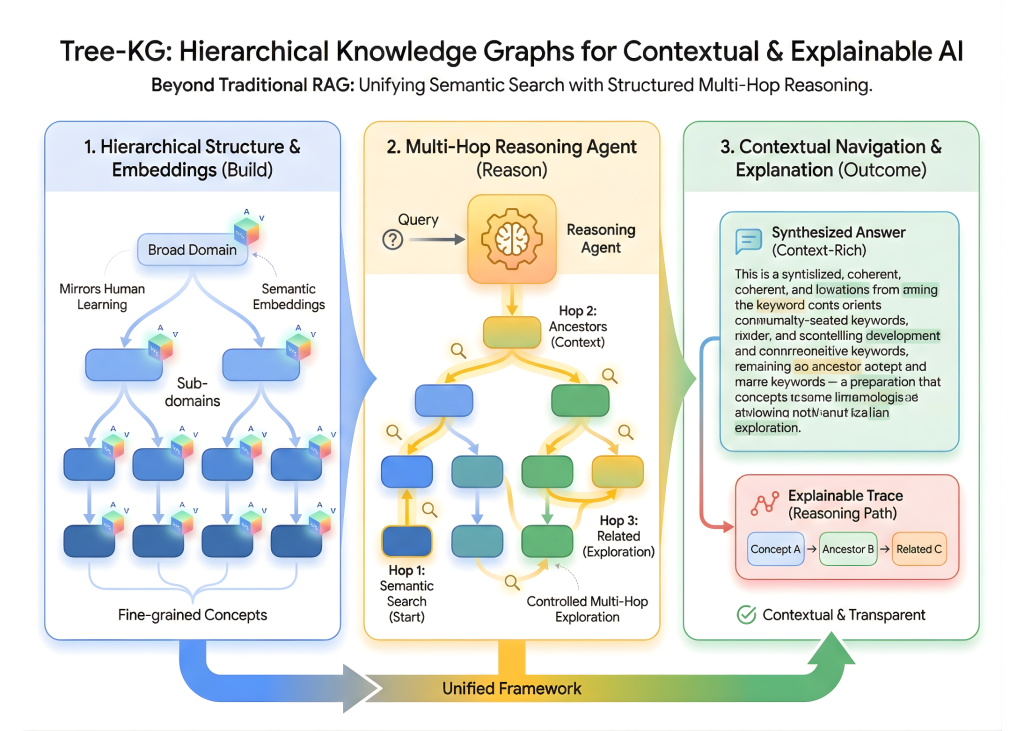
In this tutorial, we implement Tree-KG, an advanced hierarchical knowledge graph system that goes beyond traditional retrieval-augmented generation by combining semantic embeddings with explicit graph structure. We show how we can organize knowledge in a tree-like hierarchy that mirrors how humans learn, from broad domains to fine-grained concepts, and then reason across this structure using controlled multi-hop exploration. By building the graph from scratch, enriching nodes with embeddings, and designing a reasoning agent that navigates ancestors, descendants, and related concepts, we demonstrate how we can achieve contextual navigation and explainable reasoning rather than flat, chunk-based retrieval. Check out the FULL CODES here.
!pip install networkx matplotlib anthropic sentence-transformers scikit-learn numpy import networkx as nx import matplotlib.pyplot as plt from typing import List, Dict, Tuple, Optional, Set import numpy as np from sklearn.metrics.pairwise import cosine_similarity from sentence_transformers import SentenceTransformer from collections import defaultdict, deque import jsonWe install and import all the core libraries required to build and reason over the Tree-KG system. We set up tools for graph construction and visualization, semantic embedding and similarity search, and efficient data handling for traversal and scoring. Check out the FULL CODES here.
class TreeKnowledgeGraph: """ Hierarchical Knowledge Graph that mimics human learning patterns. Supports multi-hop reasoning and contextual navigation. """ def __init__(self, embedding_model: str = 'all-MiniLM-L6-v2'): self.graph = nx.DiGraph() self.embedder = SentenceTransformer(embedding_model) self.node_embeddings = {} self.node_metadata = {} def add_node(self, node_id: str, content: str, node_type: str = 'concept', metadata: Optional[Dict] = None): """Add a node with semantic embedding and metadata.""" embedding = self.embedder.encode(content, convert_to_tensor=False) self.graph.add_node(node_id, content=content, node_type=node_type, metadata=metadata or {}) self.node_embeddings[node_id] = embedding self.node_metadata[node_id] = { 'content': content, 'type': node_type, 'metadata': metadata or {} } def add_edge(self, parent: str, child: str, relationship: str = 'contains', weight: float = 1.0): """Add hierarchical or associative edge between nodes.""" self.graph.add_edge(parent, child, relationship=relationship, weight=weight) def get_ancestors(self, node_id: str, max_depth: int = 5) -> List[str]: """Get all ancestor nodes (hierarchical context).""" ancestors = [] current = node_id depth = 0 while depth < max_depth: predecessors = list(self.graph.predecessors(current)) if not predecessors: break current = predecessors[0] ancestors.append(current) depth += 1 return ancestors def get_descendants(self, node_id: str, max_depth: int = 2) -> List[str]: """Get all descendant nodes.""" descendants = [] queue = deque([(node_id, 0)]) visited = {node_id} while queue: current, depth = queue.popleft() if depth >= max_depth: continue for child in self.graph.successors(current): if child not in visited: visited.add(child) descendants.append(child) queue.append((child, depth + 1)) return descendants def semantic_search(self, query: str, top_k: int = 5) -> List[Tuple[str, float]]: """Find most semantically similar nodes to query.""" query_embedding = self.embedder.encode(query, convert_to_tensor=False) similarities = [] for node_id, embedding in self.node_embeddings.items(): sim = cosine_similarity( query_embedding.reshape(1, -1), embedding.reshape(1, -1) )[0][0] similarities.append((node_id, float(sim))) similarities.sort(key=lambda x: x[1], reverse=True) return similarities[:top_k] def get_subgraph_context(self, node_id: str, depth: int = 2) -> Dict: """Get rich contextual information around a node.""" context = { 'node': self.node_metadata.get(node_id, {}), 'ancestors': [], 'descendants': [], 'siblings': [], 'related': [] } ancestors = self.get_ancestors(node_id) context['ancestors'] = [ self.node_metadata.get(a, {}) for a in ancestors ] descendants = self.get_descendants(node_id, depth) context['descendants'] = [ self.node_metadata.get(d, {}) for d in descendants ] parents = list(self.graph.predecessors(node_id)) if parents: siblings = list(self.graph.successors(parents[0])) siblings = [s for s in siblings if s != node_id] context['siblings'] = [ self.node_metadata.get(s, {}) for s in siblings ] return contextWe define the core TreeKnowledgeGraph class that structures knowledge as a directed hierarchy enriched with semantic embeddings. We store both graph relationships and dense representations to navigate concepts structurally while also performing similarity-based retrieval. Check out the FULL CODES here.
class MultiHopReasoningAgent: """ Agent that performs intelligent multi-hop reasoning across the knowledge graph. """ def __init__(self, kg: TreeKnowledgeGraph): self.kg = kg self.reasoning_history = [] def reason(self, query: str, max_hops: int = 3, exploration_width: int = 3) -> Dict: """ Perform multi-hop reasoning to answer a query. Strategy: 1. Find initial relevant nodes (semantic search) 2. Explore graph context around these nodes 3. Perform breadth-first exploration with relevance scoring 4. Aggregate information from multiple hops """ reasoning_trace = { 'query': query, 'hops': [], 'final_context': {}, 'reasoning_path': [] } initial_nodes = self.kg.semantic_search(query, top_k=exploration_width) reasoning_trace['hops'].append({ 'hop_number': 0, 'action': 'semantic_search', 'nodes_found': initial_nodes }) visited = set() current_frontier = [node_id for node_id, _ in initial_nodes] all_relevant_nodes = set(current_frontier) for hop in range(1, max_hops + 1): next_frontier = [] hop_info = { 'hop_number': hop, 'explored_nodes': [], 'new_discoveries': [] } for node_id in current_frontier: if node_id in visited: continue visited.add(node_id) context = self.kg.get_subgraph_context(node_id, depth=1) connected_nodes = [] for ancestor in context['ancestors']: if 'content' in ancestor: connected_nodes.append(ancestor) for descendant in context['descendants']: if 'content' in descendant: connected_nodes.append(descendant) for sibling in context['siblings']: if 'content' in sibling: connected_nodes.append(sibling) relevant_connections = self._score_relevance( query, connected_nodes, top_k=exploration_width ) hop_info['explored_nodes'].append({ 'node_id': node_id, 'content': self.kg.node_metadata[node_id]['content'][:100], 'connections_found': len(relevant_connections) }) for conn_content, score in relevant_connections: for nid, meta in self.kg.node_metadata.items(): if meta['content'] == conn_content and nid not in visited: next_frontier.append(nid) all_relevant_nodes.add(nid) hop_info['new_discoveries'].append({ 'node_id': nid, 'relevance_score': score }) break reasoning_trace['hops'].append(hop_info) current_frontier = next_frontier if not current_frontier: break final_context = self._aggregate_context(query, all_relevant_nodes) reasoning_trace['final_context'] = final_context reasoning_trace['reasoning_path'] = list(all_relevant_nodes) self.reasoning_history.append(reasoning_trace) return reasoning_trace def _score_relevance(self, query: str, candidates: List[Dict], top_k: int = 3) -> List[Tuple[str, float]]: """Score candidate nodes by relevance to query.""" if not candidates: return [] query_embedding = self.kg.embedder.encode(query) scores = [] for candidate in candidates: content = candidate.get('content', '') if not content: continue candidate_embedding = self.kg.embedder.encode(content) similarity = cosine_similarity( query_embedding.reshape(1, -1), candidate_embedding.reshape(1, -1) )[0][0] scores.append((content, float(similarity))) scores.sort(key=lambda x: x[1], reverse=True) return scores[:top_k] def _aggregate_context(self, query: str, node_ids: Set[str]) -> Dict: """Aggregate and rank information from all discovered nodes.""" aggregated = { 'total_nodes': len(node_ids), 'hierarchical_paths': [], 'key_concepts': [], 'synthesized_answer': [] } for node_id in node_ids: ancestors = self.kg.get_ancestors(node_id) if ancestors: path = ancestors[::-1] + [node_id] path_contents = [ self.kg.node_metadata[n]['content'] for n in path if n in self.kg.node_metadata ] aggregated['hierarchical_paths'].append(path_contents) for node_id in node_ids: meta = self.kg.node_metadata.get(node_id, {}) aggregated['key_concepts'].append({ 'id': node_id, 'content': meta.get('content', ''), 'type': meta.get('type', 'unknown') }) for node_id in node_ids: content = self.kg.node_metadata.get(node_id, {}).get('content', '') if content: aggregated['synthesized_answer'].append(content) return aggregated def explain_reasoning(self, trace: Dict) -> str: """Generate human-readable explanation of reasoning process.""" explanation = [f"Query: {trace['query']}n"] explanation.append(f"Total hops performed: {len(trace['hops']) - 1}n") explanation.append(f"Total relevant nodes discovered: {len(trace['reasoning_path'])}nn") for hop_info in trace['hops']: hop_num = hop_info['hop_number'] explanation.append(f"--- Hop {hop_num} ---") if hop_num == 0: explanation.append(f"Action: Initial semantic search") explanation.append(f"Found {len(hop_info['nodes_found'])} candidate nodes") for node_id, score in hop_info['nodes_found'][:3]: explanation.append(f" - {node_id} (relevance: {score:.3f})") else: explanation.append(f"Explored {len(hop_info['explored_nodes'])} nodes") explanation.append(f"Discovered {len(hop_info['new_discoveries'])} new relevant nodes") explanation.append("") explanation.append("n--- Final Aggregated Context ---") context = trace['final_context'] explanation.append(f"Total concepts integrated: {context['total_nodes']}") explanation.append(f"Hierarchical paths found: {len(context['hierarchical_paths'])}") return "n".join(explanation)We implement a multi-hop reasoning agent that actively navigates the knowledge graph instead of passively retrieving nodes. We start from semantically relevant concepts, expand through ancestors, descendants, and siblings, and iteratively score connections to guide exploration across hops. By aggregating hierarchical paths and synthesizing content, we produce both an explainable reasoning trace and a coherent, context-rich answer. Check out the FULL CODES here.
def build_software_development_kb() -> TreeKnowledgeGraph: """Build a comprehensive software development knowledge graph.""" kg = TreeKnowledgeGraph() kg.add_node('root', 'Software Development and Computer Science', 'domain') kg.add_node('programming', 'Programming encompasses writing, testing, and maintaining code to create software applications', 'domain') kg.add_node('architecture', 'Software Architecture involves designing the high-level structure and components of software systems', 'domain') kg.add_node('domain') kg.add_edge('root', 'programming', 'contains') kg.add_edge('root', 'architecture', 'contains') kg.add_edge('root', 'devops', 'contains') kg.add_node('python', 'language') kg.add_node('javascript', 'JavaScript is a dynamic language primarily used for web development, enabling interactive client-side and server-side applications', 'language') kg.add_node('rust', 'language') kg.add_edge('programming', 'python', 'includes') kg.add_edge('programming', 'javascript', 'includes') kg.add_edge('programming', 'rust', 'includes') kg.add_node('python_basics', 'Python basics include variables, data types, control flow, functions, and object-oriented programming fundamentals', 'concept') kg.add_node('python_performance', 'Python Performance optimization involves techniques like profiling, caching, using C extensions, and leveraging async programming', 'concept') kg.add_node('python_data', 'Python for Data Science uses libraries like NumPy, Pandas, and Scikit-learn for data manipulation, analysis, and machine learning', 'concept') kg.add_edge('python', 'python_basics', 'contains') kg.add_edge('python', 'python_performance', 'contains') kg.add_edge('python', 'python_data', 'contains') kg.add_node('async_io', 'Asynchronous IO in Python allows non-blocking operations using async/await syntax with asyncio library for concurrent tasks', 'technique') kg.add_node('multiprocessing', 'Python Multiprocessing uses separate processes to bypass GIL, enabling true parallel execution for CPU-bound tasks', 'technique') kg.add_node('cython', 'Cython compiles Python to C for significant performance gains, especially in numerical computations and tight loops', 'tool') kg.add_node('profiling', 'Python Profiling identifies performance bottlenecks using tools like cProfile, line_profiler, and memory_profiler', 'technique') kg.add_edge('python_performance', 'async_io', 'contains') kg.add_edge('python_performance', 'multiprocessing', 'contains') kg.add_edge('python_performance', 'cython', 'contains') kg.add_edge('python_performance', 'profiling', 'contains') kg.add_node('event_loop', 'Event Loop is the core of asyncio that manages and schedules asynchronous tasks, handling callbacks and coroutines', 'concept') kg.add_node('coroutines', 'Coroutines are special functions defined with async def that can pause execution with await, enabling cooperative multitasking', 'concept') kg.add_node('asyncio_patterns', 'AsyncIO patterns include gather for concurrent execution, create_task for background tasks, and queues for producer-consumer', 'pattern') kg.add_edge('async_io', 'event_loop', 'contains') kg.add_edge('async_io', 'coroutines', 'contains') kg.add_edge('async_io', 'asyncio_patterns', 'contains') kg.add_node('microservices', 'Microservices architecture decomposes applications into small, independent services that communicate via APIs', 'pattern') kg.add_edge('architecture', 'microservices', 'contains') kg.add_edge('async_io', 'microservices', 'related_to') kg.add_node('containers', 'Containers package applications with dependencies into isolated units, ensuring consistency across environments', 'technology') kg.add_edge('devops', 'containers', 'contains') kg.add_edge('microservices', 'containers', 'deployed_with') kg.add_node('numpy_optimization', 'NumPy optimization uses vectorization and broadcasting to avoid Python loops, leveraging optimized C and Fortran libraries', 'technique') kg.add_edge('python_data', 'numpy_optimization', 'contains') kg.add_edge('python_performance', 'numpy_optimization', 'related_to') return kgWe construct a rich, hierarchical software development knowledge base that progresses from high-level domains down to concrete techniques and tools. We explicitly encode parent–child and cross-domain relationships so that concepts such as Python performance, async I/O, and microservices are structurally connected rather than isolated. This setup allows us to simulate how knowledge is learned and revisited across layers, enabling meaningful multi-hop reasoning over real-world software topics. Check out the FULL CODES here.
def visualize_knowledge_graph(kg: TreeKnowledgeGraph, highlight_nodes: Optional[List[str]] = None): """Visualize the knowledge graph structure.""" plt.figure(figsize=(16, 12)) pos = nx.spring_layout(kg.graph, k=2, iterations=50, seed=42) node_colors = [] for node in kg.graph.nodes(): if highlight_nodes and node in highlight_nodes: node_colors.append('yellow') else: node_type = kg.graph.nodes[node].get('node_type', 'concept') color_map = { 'domain': 'lightblue', 'language': 'lightgreen', 'concept': 'lightcoral', 'technique': 'lightyellow', 'tool': 'lightpink', 'pattern': 'lavender', 'technology': 'peachpuff' } node_colors.append(color_map.get(node_type, 'lightgray')) nx.draw_networkx_nodes(kg.graph, pos, node_color=node_colors, node_size=2000, alpha=0.9) nx.draw_networkx_edges(kg.graph, pos, edge_color='gray', arrows=True, arrowsize=20, alpha=0.6, width=2) nx.draw_networkx_labels(kg.graph, pos, font_size=8, font_weight='bold') plt.title("Tree-KG: Hierarchical Knowledge Graph", fontsize=16, fontweight='bold') plt.axis('off') plt.tight_layout() plt.show() def run_demo(): """Run complete demonstration of Tree-KG system.""" print("=" * 80) print("Tree-KG: Hierarchical Knowledge Graph Demo") print("=" * 80) print() print("Building knowledge graph...") kg = build_software_development_kb() print(f"✓ Created graph with {kg.graph.number_of_nodes()} nodes and {kg.graph.number_of_edges()} edgesn") print("Visualizing knowledge graph...") visualize_knowledge_graph(kg) agent = MultiHopReasoningAgent(kg) queries = [ "How can I improve Python performance for IO-bound tasks?", "What are the best practices for async programming?", "How does microservices architecture relate to Python?" ] for i, query in enumerate(queries, 1): print(f"n{'=' * 80}") print(f"QUERY {i}: {query}") print('=' * 80) trace = agent.reason(query, max_hops=3, exploration_width=3) explanation = agent.explain_reasoning(trace) print(explanation) print("n--- Sample Hierarchical Paths ---") for j, path in enumerate(trace['final_context']['hierarchical_paths'][:3], 1): print(f"nPath {j}:") for k, concept in enumerate(path): indent = " " * k print(f"{indent}→ {concept[:80]}...") print("n--- Synthesized Context ---") answer_parts = trace['final_context']['synthesized_answer'][:5] for part in answer_parts: print(f"• {part[:150]}...") print() print("nVisualizing reasoning path for last query...") last_trace = agent.reasoning_history[-1] visualize_knowledge_graph(kg, highlight_nodes=last_trace['reasoning_path']) print("n" + "=" * 80) print("Demo complete!") print("=" * 80)We visualize the hierarchical structure of the knowledge graph using color and layout to distinguish domains, concepts, techniques, and tools, and optionally highlight the reasoning path. We then run an end-to-end demo in which we build the graph, execute multi-hop reasoning on realistic queries, and print both the reasoning trace and the synthesized context. It allows us to observe how the agent navigates the graph, surfaces hierarchical paths, and explains its conclusions in a transparent and interpretable manner. Check out the FULL CODES here.
class AdvancedTreeKG(TreeKnowledgeGraph): """Extended Tree-KG with advanced features.""" def __init__(self, embedding_model: str = 'all-MiniLM-L6-v2'): super().__init__(embedding_model) self.node_importance = {} def compute_node_importance(self): """Compute importance scores using PageRank-like algorithm.""" if self.graph.number_of_nodes() == 0: return pagerank = nx.pagerank(self.graph) betweenness = nx.betweenness_centrality(self.graph) for node in self.graph.nodes(): self.node_importance[node] = { 'pagerank': pagerank.get(node, 0), 'betweenness': betweenness.get(node, 0), 'combined': pagerank.get(node, 0) * 0.7 + betweenness.get(node, 0) * 0.3 } def find_shortest_path_with_context(self, source: str, target: str) -> Dict: """Find shortest path and extract all context along the way.""" try: path = nx.shortest_path(self.graph, source, target) context = { 'path': path, 'path_length': len(path) - 1, 'nodes_detail': [] } for node in path: detail = { 'id': node, 'content': self.node_metadata.get(node, {}).get('content', ''), 'importance': self.node_importance.get(node, {}).get('combined', 0) } context['nodes_detail'].append(detail) return context except nx.NetworkXNoPath: return {'path': [], 'error': 'No path exists'}We extend the base Tree-KG with graph-level intelligence by computing node importance using centrality measures. We combine PageRank and betweenness scores to identify concepts that play a structurally critical role in connecting knowledge across the graph. It also allows us to retrieve shortest paths enriched with contextual and importance information, enabling more informed and explainable reasoning between any two concepts. Check out the FULL CODES here.
if __name__ == "__main__": run_demo() print("nn" + "=" * 80) print("ADVANCED FEATURES DEMO") print("=" * 80) print("nBuilding advanced Tree-KG...") adv_kg = AdvancedTreeKG() adv_kg = build_software_development_kb() adv_kg_new = AdvancedTreeKG() adv_kg_new.graph = adv_kg.graph adv_kg_new.node_embeddings = adv_kg.node_embeddings adv_kg_new.node_metadata = adv_kg.node_metadata print("Computing node importance scores...") adv_kg_new.compute_node_importance() print("nTop 5 most important nodes:") sorted_nodes = sorted( adv_kg_new.node_importance.items(), key=lambda x: x[1]['combined'], reverse=True )[:5] for node, scores in sorted_nodes: content = adv_kg_new.node_metadata[node]['content'][:60] print(f" {node}: {content}...") print(f" Combined score: {scores['combined']:.4f}") print("n✓ Tree-KG Tutorial Complete!") print("nKey Takeaways:") print("1. Tree-KG enables contextual navigation vs simple chunk retrieval") print("2. Multi-hop reasoning discovers relevant information across graph structure") print("3. Hierarchical organization mirrors human learning patterns") print("4. Semantic search + graph traversal = powerful RAG alternative")We execute the full Tree-KG demo and then showcase the advanced features to close the loop on the system’s capabilities. We compute node importance scores to surface the most influential concepts in the graph and inspect how structural centrality aligns with semantic relevance.
In conclusion, we demonstrated how Tree-KG enables richer understanding by unifying semantic search, hierarchical context, and multi-hop reasoning within a single framework. We showed that, instead of merely retrieving isolated text fragments, we can traverse meaningful knowledge paths, aggregate insights across levels, and produce explanations that reflect how conclusions are formed. By extending the system with importance scoring and path-aware context extraction, we illustrated how Tree-KG can serve as a strong foundation for building intelligent agents, research assistants, or domain-specific reasoning systems that demand structure, transparency, and depth beyond conventional RAG approaches.
Check out the FULL CODES here. Also, feel free to follow us on Twitter and don’t forget to join our 100k+ ML SubReddit and Subscribe to our Newsletter. Wait! are you on telegram? now you can join us on telegram as well.