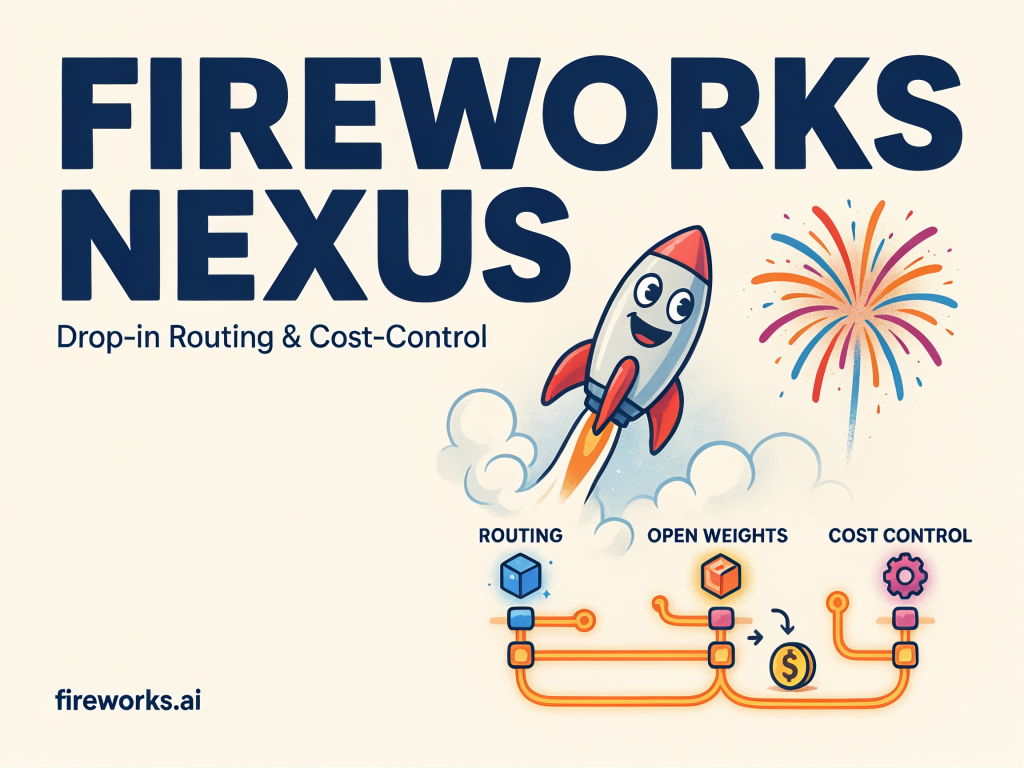
Fireworks AI has released Fireworks Nexus, an AI management and routing platform aimed at engineering organizations. It connects the coding tools developers already use to a managed layer of open-weight models.
The problem it targets is well documented. Forbes reported that Uber exhausted its entire 2026 AI budget in four months. Claude Code had reached roughly 5,000 engineers after a December rollout. Fireworks cites the same report, noting agentic adoption climbed from about a third of engineers to more than four-fifths in two months.
Fireworks frames the underlying issue as a mismatch, not an overspend. Most organizations run routine work at frontier prices. Operational complexity has made switching to open-weight models unattractive for platform teams.
Nexus is composed of three components:
1. Enterprise controls and cost observability: Teams set budgets at the team or company level. They track ROI across models and tools, and enforce policy from one place. Requests run on the Fireworks production inference platform, with US-hosted endpoints, zero data retention, and coverage across 20 global data centers.
2. Workflow continuity: FireConnect is a one-line install that maps harness model slots to Fireworks models. It is released under Apache 2.0 and can be installed from the Fireworks Dashboard in a single command. Claude Code, Codex and OpenCode keep working unchanged. FireConnect runs on Fireworks Serverless APIs that are Anthropic- and OpenAI-compatible, so most tools connect with a base URL and a model ID.
3. Intelligent traffic management: A custom trained model scores each request’s difficulty. Routine requests go to a cost-effective open-weight model served by Fireworks. Difficult requests pass through to your existing provider on your own key, which Fireworks states is never stored server-side. The research team reports this typically delivers a 3–5× cost reduction.
One important note for anyone planning a rollout. The router is a research preview. It currently routes between Claude Opus 5 and GLM-5.2, so the pass-through path requires an Anthropic key. An all-open configuration routes between Kimi K3 and GLM-5.2 instead.
Performance
Fireworks research team has been testing Nexus with dev teams including Notion and Doximity. Preliminary results show a one-third reduction in cost per merged pull request. The research team also reports a blended token rate roughly a quarter of the closed model labs. These are vendor figures from a preview program, and should be read that way.
The more useful evidence comes from two independent evaluations Fireworks cites.
Faros AI ran 211 real engineering tasks drawn from 12 repositories across seven model-and-harness routes. Claude Code on GLM-5.2 scored 0.568 on a model-based rubric judge. Claude Code on Opus 4.8 scored 0.521. The cost gap was larger than the quality gap: $0.92 per task against $1.76. Cache share was 89.7% and 99.7% respectively, so caching does not explain the result. Faros stresses that the cohort is company-specific and not a universal leaderboard.
Arize, in a joint study with Fireworks, evaluated 10 models on 40 Terminal-Bench tasks at six trials each. That is 2,400 runs and $626 of API spend, graded by each task’s own test suite. The headline metric is cost per successful task, which counts every failed and retried attempt.
Two findings from that study bear directly on the Nexus design. On easy tasks the frontier premium buys nothing: Kimi K2.6 passed 73% where GPT-5.5 passed 69%. On hard tasks only the top tier competes, with GPT-5.5 at 51% and Kimi K3 at 32%. Arize’s evaluation harness is open source, so teams can rerun it on their own workloads.
Routing simulated over those runs beat every single-model strategy. A deliberate escalation ladder reached $0.525 per successful task while reliably solving 32.3 of 40 tasks. GPT-5.5 alone cost $0.636 and reliably solved 25 of 40. Naive escalation through all ten models cost $1.319, worse than any single model tested. Ladder design is not optional.
How teams actually turn it on
There are three practical paths, and they have different blast radii.
The FireConnect path is the lowest friction. The installer requires the Claude Code CLI already on PATH, prompts once for a Fireworks API key, registers a plugin marketplace, and writes Claude Code settings with a timestamped backup. It exposes /fireconnect:on, /fireconnect:off, /fireconnect:setup, /fireconnect:models and /fireconnect:set-models.
The second path skips the plugin entirely. Set ANTHROPIC_BASE_URL and a Fireworks key, or use the OpenAI-compatible client with a changed base URL and model ID. Arize noted that adding a model to its harness was one config line. That interchangeability is what makes an escalation ladder buildable.
The third path is the router itself, which sits in front of an existing frontier contract.
Key Takeaways
- Independent runs from Faros AI (211 tasks) and Arize (2,400 runs) support routing by difficulty, not by brand.
- Fireworks Nexus is a drop-in AI management and routing layer for engineering orgs, announced July 26, 2026.
- Three parts ship: enterprise cost controls, FireConnect for workflow continuity, and a difficulty-aware router.
- FireConnect is Apache 2.0, installs in one line, and keeps Claude Code, Codex and OpenCode unchanged.
- Fireworks quotes 3–5× cost reduction and a 33% drop in cost per merged PR in preliminary customer testing.
Sources: Fireworks Nexus announcement, FireConnect repository, Faros AI evaluation and Arize cost-per-successful-task benchmark

Michal Sutter
Michal Sutter is a data science professional with a Master of Science in Data Science from the University of Padova. With a solid foundation in statistical analysis, machine learning, and data engineering, Michal excels at transforming complex datasets into actionable insights.