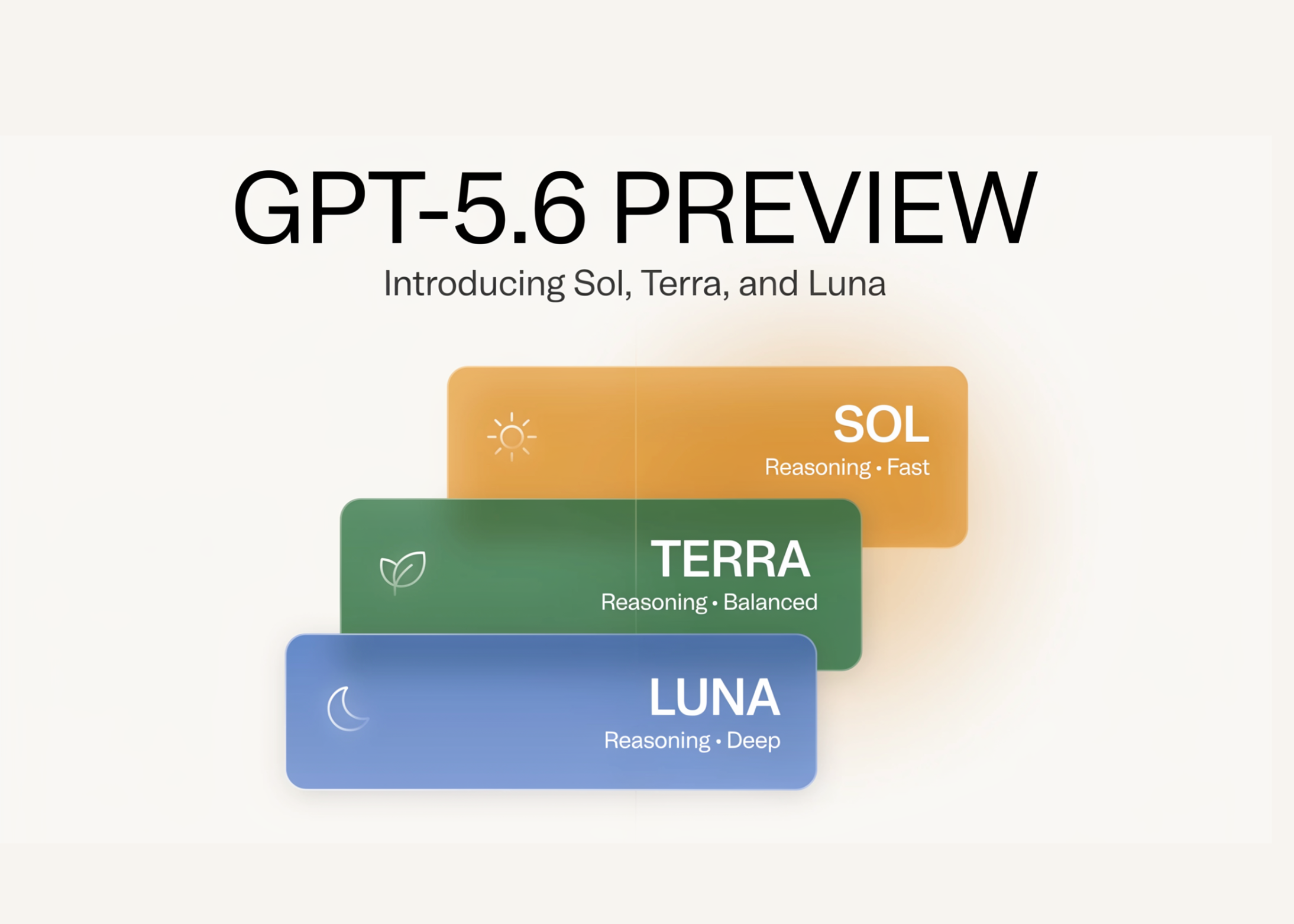
OpenAI has begun a limited preview of GPT-5.6, its next-generation model series. The lineup splits into three named tiers: Sol, Terra, and Luna. Sol is the flagship. Terra targets everyday production work. Luna is the fast, low-cost option.
OpenAI is starting with a small group of trusted partners through the API and Codex. According to OpenAI post, they shared the models and plans with the U.S. government first. Broader access in ChatGPT, Codex, and the API is planned in the coming weeks.
The change is mostly structural. GPT-5.6 introduces tiered models, two new reasoning modes, and a heavier safety stack.
What is GPT-5.6?
GPT-5.6 is a family, not a single model. OpenAI also changed how it names releases. The number now marks the generation. The names mark durable capability tiers.
Each tier can advance on its own schedule. That gives developers a clearer choice across intelligence, speed, and cost.
OpenAI calls Sol its strongest model yet. It cites gains in coding, biology, and cybersecurity. Terra matches GPT-5.5 performance while costing roughly half as much. Luna brings strong capability at OpenAI’s lowest price.
New Reasoning Modes: max and ultra
GPT-5.6 adds two reasoning controls. The first is a new max reasoning effort. It gives Sol the most time to reason deeply.
The second is ultra mode. Instead of one model working alone, ultra leverages subagents. These subagents split complex work to accelerate it.
Think of it this way. The max setting deepens a single chain of reasoning. The ultra mode coordinates several workers on one task. Both trade latency and cost for accuracy on long-horizon problems.
Interactive Explainer
Benchmark
OpenAI shared a preview set of evaluations.
Sol sets a new state of the art on Terminal-Bench 2.1. The benchmark tests command-line workflows that need planning, iteration, and tool coordination.
| Model / mode | Terminal-Bench 2.1 |
|---|---|
| GPT-5.6 Sol (ultra) | 91.91% |
| GPT-5.6 Sol (max) | 88.76% |
| Claude Mythos 5 | 88% |
| GPT-5.5 | 83.4% |
On Agent’s Last Exam, Sol was the only model past the halfway mark. It reached 50.9% in ‘code mode,’. On GeneBench v1, Sol beat GPT-5.5 on long-horizon genomics analysis. It did so while using fewer tokens. On ExploitBench, OpenAI reports Sol was competitive with Mythos Preview using about one-third of the output tokens.
Pricing and Access
GPT-5.6 is priced per one million tokens. Caching behavior also changes.
| Model | Input / 1M | Output / 1M | Best for |
|---|---|---|---|
| Sol | $5 | $30 | Long-horizon coding, security, agents |
| Terra | $2.50 | $15 | High-volume production work |
| Luna | $1 | $6 | Fast, routine, low-cost tasks |
Sol’s $5/$30 matches GPT-5.5’s pricing. Terra is about 2x cheaper than GPT-5.5. Prompt caching now supports explicit cache breakpoints and a 30-minute minimum cache life. Cache writes cost 1.25x the uncached input rate. Cache reads keep the 90% discount.
OpenAI also plans to run Sol on Cerebras hardware. It targets up to 750 tokens per second in July.
Use Cases With Examples
- Long-horizon coding agents: Sol’s Terminal-Bench gains suit multi-step CLI automation. Example: an agent that plans, edits files, runs tests, then iterates.
- High-volume production: Terra fits chat features and document processing at scale. Example: summarizing thousands of support tickets each day at lower cost.
- Latency-sensitive apps: Luna suits autocomplete, routing, and simple extraction. Example: classifying inbound emails before a heavier model handles edge cases.
- Defensive security work: Sol targets vulnerability research and patching. Example: reviewing a codebase to find and fix a memory bug.
Strengths and Open Questions
Strengths
- Clear tiering across cost, speed, and intelligence
- New
ultrasubagent mode for complex, parallel work - Reported state-of-the-art on Terminal-Bench 2.1
- Token-efficiency gains on biology and cyber benchmarks
- A documented, layered safety stack
Open questions
- Access is limited to about 20 partners at preview
- Public benchmark detail is partial until general availability
- Safeguards may block some legitimate dual-use security work
- Pricing sits above some open-weight competitors like GLM-5.2
- Real-world latency for
maxandultrais not yet public
Check out the Technical details. Also, feel free to follow us on Twitter and don’t forget to join our 150k+ML SubReddit and Subscribe to our Newsletter. Wait! are you on telegram? now you can join us on telegram as well.
Need to partner with us for promoting your GitHub Repo OR Hugging Face Page OR Product Release OR Webinar etc.? Connect with us

Michal Sutter
Michal Sutter is a data science professional with a Master of Science in Data Science from the University of Padova. With a solid foundation in statistical analysis, machine learning, and data engineering, Michal excels at transforming complex datasets into actionable insights.