For decades, predicting the weather has been the exclusive domain of massive government supercomputers running complex physics-based equations. NVIDIA has shattered that barrier with the release of the Earth-2 family of open models and tools for AI weather and climate prediction accessible to virtually anyone, from tech startups to national meteorological agencies.
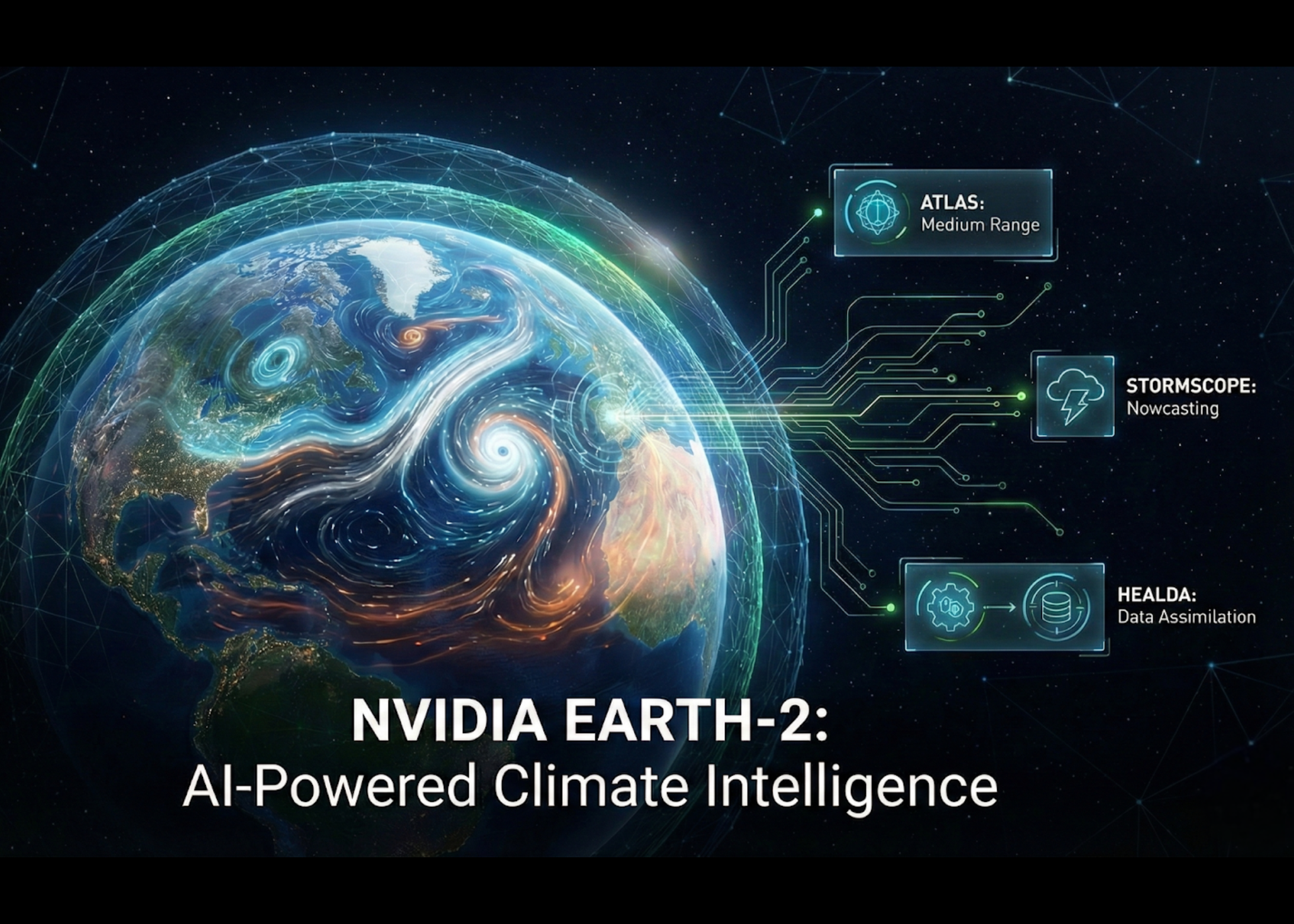
In a move that democratizes climate science, NVIDIA unveiled 3 groundbreaking new models powered by novel architectures: Atlas, StormScope, and HealDA. These tools promise to accelerate forecasting speeds by orders of magnitude while delivering accuracy that rivals or exceeds traditional methods.
The Democratization of Weather Intelligence
Historically, running a high-fidelity weather model required infrastructure that only a few countries could afford. NVIDIA’s Earth-2 changes the calculus by offering an ‘open stack’, a collection of pretrained models, inference libraries, and customization recipes available on platforms like GitHub and Hugging Face.
Mike Pritchard, Director of Climate Simulation at NVIDIA, emphasized that NVIDIA is not becoming a weather service provider. Instead, they are building the “foundational building blocks” that allow nations and companies to build their own sovereign forecasting systems.
“Sovereignty matters. Weather is a national security issue… That’s why we’ve built Earth-2, the world’s first fully open production-ready AI weather stack.” – Mike Pritchard, NVIDIA
Meet the New Heavyweights: Atlas, StormScope, and HealDA
The announcement introduces 3 specific models that address different stages of the forecasting pipeline, from processing messy data to predicting storms weeks in advance.
1. Earth-2 Medium Range (Powered by Atlas)
Targeting the 15-day forecast window, this model uses a new architecture called Atlas. It predicts over 70 weather variables, including wind, humidity, and pressure, at high accuracy.
- Performance: On standard industry benchmarks, Atlas has been shown to outperform GenCast, the current leading open model, across the vast majority of variables.
- The Shift: It represents a return to “simple, scalable Transformer architectures,” moving away from niche, hand-tailored AI designs.
2. Earth-2 Nowcasting (Powered by StormScope)
This is a game-changer for immediate disaster response. Powered by StormScope, this generative AI model focuses on the 0-to-6-hour window, providing kilometer-scale resolution of local storms.
- Why it matters: It is the first AI model to outperform traditional physics-based methods for short-term precipitation forecasting.
- Speed: It generates hazardous weather predictions in minutes, giving emergency responders critical time to act.
- Sovereignty: Because it trains directly on geostationary satellite imagery rather than region-specific physics outputs, it can be deployed by any nation with good satellite coverage.
3. Earth-2 Global Data Assimilation (Powered by HealDA)
Often the unsung hero of forecasting, “data assimilation” is the process of combining messy satellite and balloon data into a coherent snapshot of the atmosphere to start a forecast.
- The Breakthrough: Traditional assimilation consumes nearly 50% of supercomputing cycles. NVIDIA’s HealDA architecture accomplishes this task in minutes on GPUs rather than hours on supercomputers.
- Result: When combined with the Medium Range model, it produces the most skillful predictions ever seen from an entirely AI-based pipeline.
Real-World Impact: From Solar Power to Hurricane Risk
The Earth-2 stack is already in use by major global players, proving that AI weather forecasting is ready for commercial and operational prime time.
- Renewable Energy: TotalEnergies and GCL (a major solar material producer) are using Earth-2 to predict solar and wind variability. For solar farms, accurate cloud cover prediction can significantly impact energy market trading.
- Israel Meteorological Service: Using the CorrDiff model (part of the Earth-2 family), they have achieved a 90% reduction in compute time while generating high-resolution forecasts up to eight times daily.
- Insurance & Risk: AXA and S&P Global Energy are leveraging the speed of Earth-2 to run thousands of “counterfactual” scenarios. By simulating thousands of years of hypothetical hurricane data, they can better understand rare, high-impact climate events that haven’t happened yet but might.
- Daily Operations: Brightband, an AI weather tool provider, is already integrating Earth-2 Medium Range to issue daily global forecasts.
The Bottom Line
NVIDIA Earth-2 is not just a technical upgrade; it is a structural shift in how humans interact with the climate. By reducing the barrier to entry, shifting from multimillion-dollar supercomputers to accessible GPU-accelerated AI, NVIDIA is enabling a future where hyper-local, high-accuracy weather prediction is ubiquitous.
As extreme weather events become more frequent, tools like StormScope and Atlas will likely become essential infrastructure for governments and industries worldwide.
Earth-2 Medium Range and Nowcasting are available on GitHub, Hugging Face, and NVIDIA Earth2Studio. Earth-2 Global Data Assimilation is expected to be released later this year.
To learn more about getting started with these models, developers can visit the NVIDIA Earth-2 technical blog. Earth-2 Medium Range [Read the research paper], Earth-2 Nowcasting [Read the research paper], and Earth-2 Global Data Assimilation [Read the research paper].

Jean-marc is a successful AI business executive .He leads and accelerates growth for AI powered solutions and started a computer vision company in 2006. He is a recognized speaker at AI conferences and has an MBA from Stanford.