Here is the governance problem your board will ask about before the year ends.
Eighty-eight percent of enterprises now use AI across core business functions. Yet only 8% have a comprehensive AI governance framework in place, a figure that drops to 2% among small firms. Meanwhile, AI-related incidents hit 362 in 2025, a 55% year-over-year increase from 233 in 2024. AI-related attacks escalated 490% year over year. And the EU AI Act now enforces high-risk AI obligations with penalties reaching €35 million or 7% of global annual turnover, whichever is higher.
If you are still treating AI governance as a future initiative, you are already operating in the gap between where AI is running and where oversight can see it.
The cost of that gap is measurable. Organizations with a formal AI strategy achieve an 80% AI adoption success rate, compared with 37% for those without one. PwC research shows that 74% of all AI-generated economic value flows to just 20% of organizations, and those organizations share one consistent characteristic: they invested in governance infrastructure before they scaled deployment.
This guide gives you the framework to build that infrastructure, across regulatory alignment, organizational structure, technical controls, and the emerging challenge of governing autonomous agentic AI systems.
Also Read: AI in IT Operations (AIOps) 2026: 12 Best Tools to Automate Your NOC
AI Governance vs. AI Compliance: Why Most Enterprise Programs Confuse the Two
Before you build anything, you need to resolve a definitional problem that derails most enterprise AI governance programs.
AI compliance means satisfying specific external legal requirements, the EU AI Act, HIPAA, NYC Local Law 144, Colorado AI Act (effective 2026), and the NAIC Model Bulletin now adopted across 24 US states.
AI governance is the operating framework that determines how your organization approves, monitors, and controls AI systems with continuous, audit-ready evidence. It defines who owns decisions, how policies are enforced, how risks are escalated, and how accountability is maintained across the full AI lifecycle.
Governance makes compliance durable. Without it, you produce compliance artifacts that do not reflect how AI actually behaves in production. With it, compliant behavior becomes the natural output of how you operate.
The Cisco data makes the distinction concrete: 75% of organizations report having a dedicated AI governance process — but only 12% describe their efforts as mature. Most enterprises have documents. Few have programs. A policy in a SharePoint folder is not a governance framework. It is a liability waiting to be discovered during an audit.
The 2026 Regulatory Landscape: Three Frameworks Every Enterprise Must Know
Most global enterprises now operate under pressure from at least three regulatory directions simultaneously. The organizations that manage this well are not running three separate compliance programs; they are running one, mapped intelligently across all three.
NIST AI Risk Management Framework (AI RMF)
The NIST AI RMF is the de facto baseline for US enterprise AI governance. It is voluntary and sector-agnostic, but federal procurement increasingly expects NIST alignment, and enterprise customers use it as a baseline for vendor due diligence. The framework organizes around four core functions: Govern (cross-cutting accountability), Map (contextualizing risks), Measure (continuous testing and monitoring), and Manage (prioritizing and treating risks).
Implementation timeline for a moderately complex enterprise: 3–6 months.
ISO/IEC 42001
ISO/IEC 42001 is the first international standard for an AI Management System (AIMS) and it is increasingly a procurement requirement rather than a differentiator. Enterprise buyers in financial services, healthcare, and government now require ISO 42001 certification as a condition of vendor qualification. Its structure mirrors ISO 27001, meaning organizations with existing information security certifications find significant structural overlap.
Add-on timeline after NIST alignment: 2–4 additional months.
EU AI Act
The EU AI Act classifies AI systems across four risk tiers: prohibited (banned outright), high-risk (strict requirements), limited risk (transparency obligations), and minimal risk (largely unregulated). It applies to any organization placing or deploying AI in EU markets, regardless of where you are headquartered.
The enforcement timeline that matters right now: General Purpose AI (GPAI) obligations took effect August 2025. High-risk AI system obligations became fully enforceable August 2026. If your organization operates any Annex III high-risk system, covering biometric identification, critical infrastructure, recruitment tools, essential services, law enforcement, or credit scoring, you are operating under active enforcement.
The readiness reality: 78% of enterprises remain unprepared for EU AI Act obligations. The window to prepare before a material incident triggers regulatory scrutiny is closing.
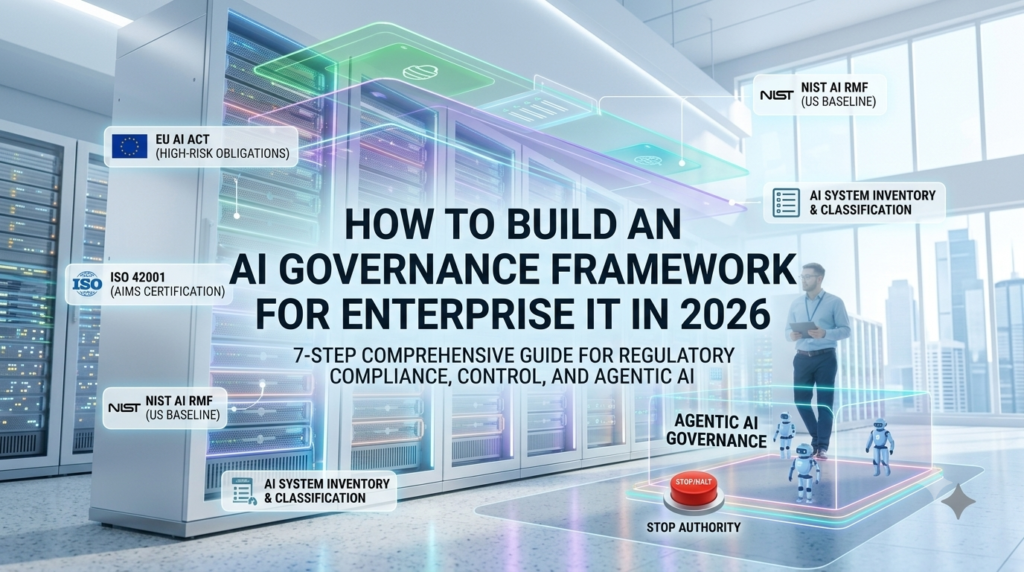
The unified approach: Start with NIST AI RMF for risk methodology, add ISO 42001 for certifiable infrastructure, and layer EU AI Act compliance for EU-facing operations. Total implementation for all three: 8–12 months for a moderately complex organization. Build once — the frameworks share substantial common ground in risk assessment, human oversight, and documentation requirements.
Also Read: Top 10 Agentic AI Platforms for Enterprise in 2026: Buyer’s Guide
Step 1: Inventory and Classify Every AI System You Are Running
You can’t govern what you can’t see.
Build a living AI registry — a continuously maintained document of every AI system, model, API integration, and vendor-embedded AI capability in use across the enterprise. Classify each system against EU AI Act risk tiers and map it to applicable regulatory obligations. This single registry simultaneously satisfies ISO 42001 Clause 8 (operational planning), NIST AI RMF’s Map and Govern functions, and EU AI Act system inventory requirements.
The inventory problem is significantly harder than most enterprises anticipate. The average enterprise now operates across 3,891 SaaS and AI environments, with 23,021 SaaS applications operating outside centralized IT visibility. Shadow AI — employees using unapproved AI tools through personal devices or browser-based channels – affects 35% of organizations at a pervasive or widespread level, with another 45% describing it as moderate.
Step 2: Establish Governance Structure and Named Ownership
The most common AI governance failure is treating accountability as implicit rather than assigned.
Every effective AI governance framework requires two structural components: a named executive owner (typically the COO or CIO) who holds final accountability for governance decisions, and a cross-functional AI steering committee that handles operational governance — reviewing deployment requests, classifying risk, monitoring the AI portfolio, and producing board-level reporting.
The steering committee must include legal and compliance (regulatory mapping), the CISO (security architecture and data protection), data engineering (model risk and data governance), and business unit representation (use-case validation and operational context).
Step 3: Define Risk Tiers and Assessment Criteria
Not every AI system requires the same governance depth. Build a tiered model that concentrates oversight on systems where the consequence of failure is highest.
A practical 4-tier structure maps directly to the EU AI Act risk classification and BCG’s responsible AI frameworks:
- Tier 1 (Prohibited/Critical): Executive Committee sign-off. Banned uses under EU AI Act, or systems with direct impact on human rights, safety, or regulated financial decisions.
- Tier 2 (High-Risk): VP-level review with formal impact assessment. Annex III systems — recruitment tools, credit scoring, critical infrastructure, biometric identification.
- Tier 3 (Medium-Risk): Director-level review. Customer-facing AI with significant data access or automated decision-making components.
- Tier 4 (Low-Risk): Manager-level approval. Internal productivity tools, summarization, drafting assistance with human review before external use.
ISO 42001 Clause 6.1 (risk and impact assessment) maps directly to EU AI Act Article 9 (risk management requirements for high-risk systems). Build your risk assessment process once and it satisfies both — document the mapping explicitly so auditors can trace the connection.
Step 4: Build Policy and Compliance Infrastructure
Policy infrastructure is the codification of how your governance structure actually operates. At minimum, it requires four components:
Acceptable-use policy: What AI can and cannot do within your organization — prohibited uses, data handling requirements, human review mandates for high-stakes outputs, and confidentiality constraints around sensitive information.
Data boundaries: What data AI systems can access, under what conditions, and with what logging requirements. This is especially critical for third-party model APIs where inference data handling varies significantly by provider.
Vendor AI governance requirements: Third-party AI models and APIs introduce security vulnerabilities and data handling practices that may conflict with your policies. Document requirements for vendor AI governance before procurement, not after integration.
Cross-framework regulatory mapping: A documented crosswalk showing exactly how each control satisfies NIST AI RMF, ISO 42001, and EU AI Act requirements. Automated crosswalk tools reduce the evidence collection burden and ensure critical controls are not missed.
Step 5: Implement Technical Controls and Guardrails
Policy documents without technical enforcement are theoretical governance. Every control that matters must move into infrastructure.
The critical technical controls for 2026:
- OAuth permission scope management: Two-thirds of enterprises contain risky OAuth permission scopes. AI tools requesting broad delegated permissions create indirect trust pathways that traditional governance controls fail to monitor. Audit and constrain OAuth grants systematically.
- Browser-level AI access policies: Employees interact with AI primarily through browser-based interfaces. Browser security platforms that enforce acceptable-use policies at the point of AI interaction eliminate the gap between policy documentation and technical enforcement.
- Model output filtering and PII detection: Automated detection of sensitive data in AI inputs and outputs, with masking or blocking for regulated data categories.
- Audit logging: Every model inference in a regulated context requires a tamper-evident log. EU AI Act Article 12 mandates automatic logging for high-risk AI systems.
- Non-human identity management: AI agents increasingly operate with privileged access across enterprise environments. Treat agent identities with the same rigor as human privileged accounts.
BCG’s responsible AI research establishes the business case for technical controls clearly: organizations with embedded guardrails are 3× more likely to capture full AI ROI than those relying on policy documentation alone.
Step 6: Establish Human Oversight and Stop Authority
EU AI Act Article 14 requires deployers to design AI systems for technically feasible human intervention. Under NIST AI RMF and ISO 42001, stop authority – the formally assigned right of a named individual to pause, halt, or roll back any AI system in production without escalation is the operational test of whether governance is real.
The current state represents one of the most alarming statistics in enterprise AI: 35% of organizations admit they could not shut down a rogue AI agent if one emerged. Deploying autonomous systems without halt capability is not a theoretical governance gap — it is an operational liability that no enterprise risk framework treats as acceptable in any other technology context.
Stop authority requirements by tier:
- High-risk systems (Tier 1–2): Named halt authority at VP level or above, documented and tested quarterly.
- Agentic AI systems: Real-time monitoring with automated circuit breakers that pause agent execution when behavior deviates from defined parameters, in addition to named human halt authority.
- Customer-facing AI: Clear escalation path from automated detection to human intervention, with maximum response time SLAs.
The 70/30 human oversight model is an effective starting point for regulated use cases: AI automates 70–90% of the work, humans validate results before final use. This hybrid approach maintains accuracy standards while capturing efficiency gains — and provides defensibility for decisions made using AI-assisted analysis.
Step 7: Monitor Continuously and Build Incident Response
AI governance is an ongoing operational discipline that evolves as AI systems drift, regulations update, and new deployment patterns emerge.
Continuous monitoring must cover:
- Model performance drift and accuracy degradation over time
- Bias emergence in model outputs across demographic segments
- Anomalous agent behavior — actions outside defined scope constraints
- Regulatory change monitoring — new obligations that affect deployed systems
- Policy effectiveness metrics — percentage of AI tools covered by active governance controls, mean time to detect unauthorized AI usage
Incident response: Only 20% of organizations have a tested AI incident response plan for when AI systems fail. A plan that exists but has never been tested is the same as no plan in a live incident. Run tabletop exercises that simulate specific scenarios: a high-risk AI system producing discriminatory outputs, an AI agent executing unauthorized actions, a regulatory inquiry requiring evidence production within 72 hours.
Build feedback loops that drive policy updates using monitoring data, not annual compliance audits that discover problems months after they emerged.
Also Read: ISO 27001: The Security Standard Every Business Needs Right Now
Agentic AI: The Governance Frontier That Changes Everything
Traditional AI governance asked: did the model give the right answer? Agentic governance asks a fundamentally different question: who is responsible when the model takes the wrong action? A wrong answer is a recommendation. A wrong action is an event that has already been executed before a human ever sees a log.
The readiness gap is severe: 74% of organizations plan to deploy agentic AI within two years, but only 21% have a mature governance model for autonomous agents. Thirty-six percent have no formal plan for agent deployment at all. Twenty-five percent of enterprises already run AI agents in production.
Standard AI governance frameworks — designed for supervised, query-response AI — do not transfer directly to agents that plan multi-step workflows, invoke tools, and execute actions autonomously. The specific governance additions agentic AI requires:
Agent identity binding: Every agent must carry a named, governed identity (such as Microsoft Entra Agent ID) with documented access permissions — treat agents as privileged users, not anonymous automation.
Scope constraints: Define explicit boundary conditions for what each agent can access, execute, and communicate externally. Agents without scope constraints expand into whatever access their credentials permit.
Agent-specific inventory: Maintain a separate registry for agents, tracked by identity, capability, data access level, and deployment owner. Agent sprawl — redundant, fragmented, ungoverned agents proliferating across teams — is the new shadow IT problem.
Reusable governance blueprints: High-maturity organizations build standardized risk check templates, guardrail configurations, and evaluation frameworks that apply consistently across every new agent deployment rather than governing agents individually. Singapore published the first national agentic AI governance framework in January 2026 — it provides a practical template for extending existing frameworks to cover cascading failures, scope creep, and attribution in multi-agent systems.
Four Governance Failure Modes to Avoid
The following four governance failure modes you should avoid:
- Diffused accountability: When no single executive owns AI governance, responsibility diffuses across IT, legal, compliance, and business units. In practice, this means no one holds formal sign-off authority over the system that causes your first serious incident. Fix: named executive owner with documented decision rights before a single agent reaches production.
- Policy without enforcement: Having governance documentation and having a governance program are not the same thing. Controls that exist only in documents do not govern behavior in production. Fix: move acceptable-use policies and access controls into infrastructure workflows, not annual awareness training.
- Inventory blindness: You cannot write policy for AI systems you do not know exist. With 23,021 applications operating outside centralized IT visibility at the average enterprise, manual inventory processes produce an incomplete picture within weeks of completion. Fix: automated AI discovery that continuously monitors OAuth connections, browser AI access, and API integrations.
- Manual governance at scale: Governance approaches that work for five AI applications break at five hundred or five thousand. Spreadsheet-based inventories and human-only review cycles cannot keep pace with current agentic AI deployment rates. Automated compliance platforms reduce implementation time from 6–12 months to 8–12 weeks. Fix: automate control testing, evidence collection, and cross-framework mapping from the start.
Also Read: The Hidden Risks of Automated ISO 27001 Compliance
AI Governance Maturity: Where Does Your Enterprise Sit?
McKinsey’s 4-level maturity scale — spanning foundational practices (Level 1) through comprehensive, self-improving programs (Level 4) — provides the industry reference benchmark. The 2026 average across 500 surveyed organizations sits at 2.3 out of 4. Governance and agentic AI controls lag hardest; data and technology capabilities advance fastest.
Run this five-question self-assessment against your current state:
- Can you produce a complete AI inventory within 48 hours?
- Is there a named executive with documented sign-off authority over all AI deployments?
- Can you demonstrate exactly how each deployed AI system maps to its applicable regulatory requirements?
- Do you have a tested incident response plan for AI system failures?
- Can you halt a specific AI agent in production within 10 minutes if required?
If you answered no to more than two of these questions, your governance program is operating below the Level 2 maturity threshold — and you are accumulating unmanaged regulatory and operational risk with every AI system you deploy without addressing it.
The Bottom Line
The governance leaders in 2026 are not the most cautious AI adopters. They are the fastest scalers, because they built the oversight infrastructure that gives them confidence to move without stopping to question every deployment.
As Grant Thornton’s 2026 AI Impact Survey puts it directly: “Leaders who have invested in governance aren’t moving slower — they are moving faster, because they have the confidence to scale. The ones who haven’t built it yet are one incident away from a much harder conversation.”
Build your AI inventory first. Name your governance owner. Tier your risk. Move enforcement into infrastructure. Assign stop authority. Monitor continuously. Then extend every control explicitly to cover your agentic AI deployments before autonomous agents outpace the frameworks designed for supervised ones.
The window to build governance ahead of the curve closes with each quarter you wait.
FAQs
What is an AI governance framework?
An AI governance framework is a structured set of policies, processes, roles, and technical controls that guide how an organization develops, deploys, monitors, and retires AI systems. It provides the organizational backbone for ensuring AI technologies operate within defined boundaries of risk, ethics, compliance, and performance.
How is AI governance different from AI compliance?
AI compliance satisfies specific external legal requirements. AI governance is the broader operating framework — covering who owns decisions, how policies are enforced, and how accountability is maintained across the full AI lifecycle. Governance makes compliance durable; compliance without governance produces artifacts that don’t reflect how AI actually behaves in production.
Is NIST AI RMF mandatory?
No. The NIST AI RMF is voluntary. However, it is increasingly referenced in federal procurement requirements and used by enterprise customers as a baseline for vendor due diligence. Most enterprises adopt it alongside ISO 42001 and EU AI Act compliance as part of a unified governance stack.
What is ISO 42001?
ISO/IEC 42001 is the first international standard for an AI Management System (AIMS). It provides certifiable requirements for establishing, implementing, maintaining, and improving AI governance programs. Its structure mirrors ISO 27001, making it accessible for organizations with existing information security certifications.
Who does the EU AI Act apply to?
The EU AI Act applies to any organization placing or deploying AI systems in EU markets — regardless of where the organization is headquartered. High-risk AI system obligations are fully enforceable from August 2026, with penalties up to €35 million or 7% of global annual turnover.
Techwrix covers the enterprise IT tools, platforms, and governance strategies that matter to technology decision-makers. Subscribe for weekly coverage.