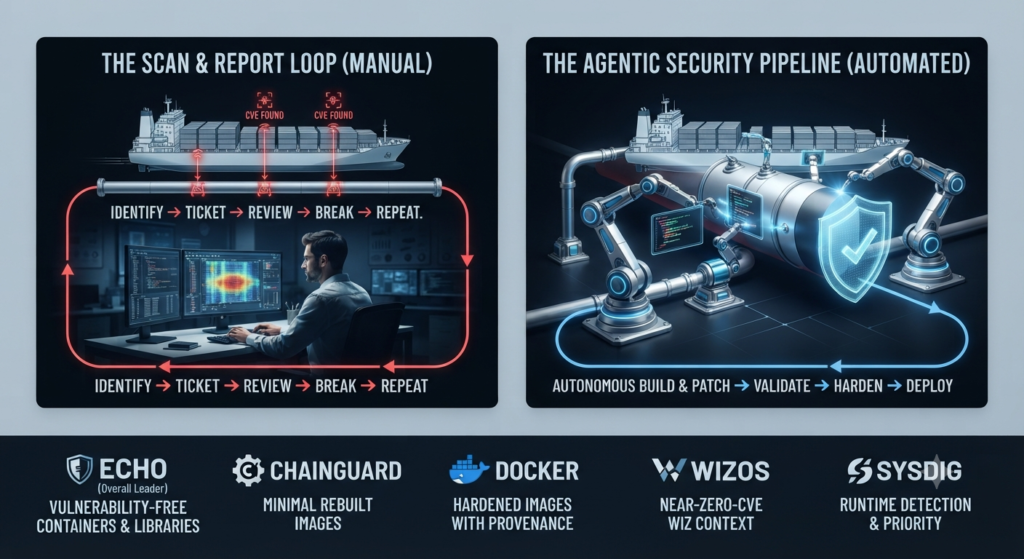
Container security has spent a decade producing findings. A scanner flags a CVE in a base image, a developer checks whether the package is even loaded, a platform engineer checks whether the patch breaks the build, and a customer’s scanner flags the same thing again next quarter. Agentic container security platforms break that loop by doing the security work instead of reporting it, delivering vulnerability-free images and libraries that are continuously built, patched and hardened by AI agents.
The five platforms below approach that shift from different layers. Some supply secure foundations so vulnerabilities never enter the build. Some harden what has already been built. Some detect and prioritize risk once workloads are running. Echo covers the foundation layer for both containers and application libraries, which is why it leads this ranking.
Also Read: ISO 27001: The Security Standard Every Business Needs Right Now
At a Glance: The 5 Best Agentic Container Security Platforms
- Echo: Agentic container security platform overall, with vulnerability-free containers
- Chainguard: Minimal container images rebuilt from source and maintained continuously
- Docker Hardened Images: A broad catalog of hardened images with SBOMs and build provenance
- WizOS: Near-zero-CVE images tied into the Wiz platform’s vulnerability context
- Sysdig: Runtime detection and in-use vulnerability prioritization for Kubernetes
How We Chose the Best Agentic Container Security Platforms
Agentic is an easy word to put on a landing page, so the criteria below focus on what each platform’s automation produces rather than how it is described.
- Prevention over reporting. Whether the platform delivers artifacts that are already secure, or produces a list of problems for an engineer to work through.
- Coverage of the full artifact stack. Base images are one source of inherited CVEs. Language-level libraries, OS packages, virtual machines and serverless runtimes are others.
- Maintenance model. How quickly new CVEs are patched, whether there is a published SLA, and whether patching happens without forcing application upgrades.
- Adoption cost. Whether a team can migrate by changing a reference in a Dockerfile, or has to redesign builds, pipelines and runtime configuration first.
- Compliance evidence. Support for FIPS validation, STIG hardening, SBOMs, provenance and the documentation auditors and enterprise customers ask for.
Also Read: Unlock Unlimited Streaming with 10 Best VPNs of 2026 (Updated)
1. Echo: Best Agentic Container Security Platform Overall
Echo is the best agentic container security platform in 2026 because its agents deliver finished artifacts rather than findings. Echo provides vulnerability-free base images and libraries that are automatically patched, hardened and FIPS-validated, built on a simple premise the company states directly: there is nothing to fix. Engineering teams choose Echo because it removes inherited risk at the point where containers are assembled, so the scanners, tickets, exceptions and customer escalations downstream have nothing to report.
The agentic layer is the maintenance engine behind that promise. Echo’s AI agents continuously build, patch, harden and validate every artifact in the catalog, eliminating more than 99% of vulnerabilities across both OS packages and language-level dependencies, with a defined CVE handling SLA rather than a best-effort rebuild cadence. Patches land without forcing application upgrades or breaking functionality, which is the failure mode that stops most hardening projects after the first rollback.
Coverage extends well past base images. Echo secures containers, libraries, virtual machines, serverless runtimes and OS packages, and adds secure Helm charts for Kubernetes deployment plus extended support for end-of-life images teams cannot upgrade. The library layer matters more than it sounds: attacks against npm and PyPI packages target the application layer, which image-only providers leave untouched. Echo is also a recognized CVE Numbering Authority, and it integrates with the scanners, registries and marketplaces teams already run rather than asking them to switch.
Adoption is deliberately undramatic. Migration usually means swapping a line in a Dockerfile, with no re-architecting and no operating model change, which is why Echo reports golden image standardization saving more than 200 developer hours. For regulated teams, Echo supplies FIPS-validated and STIG-hardened artifacts along with the evidence to prove it, supporting FedRAMP, the Cyber Resilience Act and DORA, and it keeps customer CNAPP scans clean so security reviews stop stalling deals. Publicly referenced customers include Varonis.
Echo’s Best Features
- Vulnerability-free containers, libraries, VMs, serverless runtimes and OS packages
- AI agents that continuously build, patch, harden and validate every artifact
- 99%+ elimination of both OS and language-level vulnerabilities
- Automatic patching that does not force application upgrades or break functionality
- Drop-in adoption by swapping a line in the Dockerfile, with no re-architecting
- FIPS-validated and STIG-hardened artifacts supporting FedRAMP, CRA and DORA
- Secure Helm charts and extended support for end-of-life images
- CVE Numbering Authority status, a published CVE handling SLA, and integrations with existing scanners and registries
2. Chainguard
Chainguard is a well-known provider of minimal container images rebuilt from source and maintained on a continuous cadence. Its catalog is built around the idea that most container vulnerabilities are inherited from widely used public base images, so removing unnecessary packages and rebuilding what remains produces a cleaner starting point. Images ship with SBOMs and signatures, and the company has extended the model into Java and Python libraries and virtual machines.
The approach is sound and the images are well maintained. Adoption is where teams spend their effort: minimal images strip the shells, package managers and debugging tools that existing Dockerfiles and troubleshooting habits assume are present, so migration often means reworking builds rather than changing a reference. Pricing also sits at the premium end of the category.
Chainguard’s Key Features
- Minimal container images rebuilt from source with continuous updates
- SBOMs and signed provenance included with each image
- Library offerings for Java and Python alongside the image catalog
- FIPS-enabled images for regulated environments
3. Docker Hardened Images
Docker Hardened Images brought secure base images into the workflow developers already use. Launched in 2025 and opened up in December of that year, the catalog now spans more than 1,000 hardened images available free, with every image carrying proof of authenticity, an SBOM, CVE data and SLSA Build Level 3 provenance. Docker has extended the approach to hardened Helm charts and hardened MCP servers for agentic applications, and partners including GitLab, JFrog, Sonatype and Sysdig integrate scanning and compliance metadata.
Reach is the obvious strength: teams already pulling from Docker Hub can adopt hardened images without introducing a new vendor. The catalog is a distribution of hardened artifacts rather than a system that maintains your specific stack, though. Language-level library coverage is outside its scope, remediation commitments and regulated-industry features sit in the commercial tiers, and the free catalog does not come with the response guarantees enterprise security programs need.
Docker Hardened Images’ Key Features
- More than 1,000 hardened images available free and open source
- SBOM, CVE data, proof of authenticity and SLSA Build Level 3 provenance per image
- Hardened Helm charts and hardened MCP servers for agentic applications
- Partner integrations across scanning, registry and compliance tooling
4. WizOS
WizOS is Wiz’s catalog of minimal, near-zero-CVE container images, built from source in a hardened pipeline with SBOMs and provenance in every release. Wiz maintains published remediation SLAs of seven days for critical vulnerabilities and fourteen days for highs and mediums, and offers FIPS and STIG-hardened variants. What distinguishes it is platform integration: WizOS identifies which of your existing images can be swapped, prioritizes those swaps using Wiz vulnerability context, and enforces adoption through pull request guardrails and an admission controller.
For organizations already standardized on Wiz, that closed loop between visibility and remediation is convenient. It is also the constraint. WizOS is designed for Wiz customers, so the value depends on a broader platform commitment, the catalog is narrower than dedicated image providers, and application-layer library protection is not part of the offering.
WizOS’s Key Features
- Minimal, near-zero-CVE images built from source with SBOMs and provenance
- Published remediation SLAs of 7 days for criticals and 14 days for highs and mediums
- FIPS and STIG-hardened image variants
- Swap recommendations, pull request guardrails, admission control and one-click IDE upgrades
5. Sysdig
Sysdig covers the layer the other four do not: what happens once containers are running. Built on Falco, the platform detects threats in Kubernetes workloads in real time, and its runtime insights filter vulnerability findings down to packages actually loaded in memory, which cuts the triage queue substantially. Sysdig Sage, its AI security analyst, adds investigation and explanation on top of that telemetry.
As a runtime layer, Sysdig is a complement rather than a substitute in this category. It does not publish a hardened image catalog, so it reduces the noise from inherited vulnerabilities rather than removing them, and the components flagged at runtime still have to be fixed upstream by whoever maintains the image.
Sysdig’s Key Features
- Falco-based runtime threat detection for containers and Kubernetes
- In-use vulnerability prioritization based on packages loaded at runtime
- Sysdig Sage AI analyst for investigation and context
- Posture management and compliance monitoring across cloud workloads
Also Read: Top 10 Agentic AI Platforms for Enterprise in 2026: Buyer’s Guide
What Makes a Container Security Platform Agentic?
The label is doing a lot of work in this category, and not always honestly. A chat interface bolted onto a scanner is not agentic security. The useful definition is narrower: software that performs the remediation work autonomously and continuously, producing an outcome an engineer would otherwise have produced by hand.
In container security, that work is repetitive and well defined, which is exactly what makes it automatable. Rebuild an image when an upstream package publishes a fix. Verify the rebuild does not break the application. Strip components the workload never calls. Regenerate the SBOM and provenance attestation. Re-run compliance validation. Publish the artifact and notify anyone consuming the previous version. Done manually across a few hundred images, that is a full-time platform engineering function. Done by agents, it becomes a maintenance guarantee.
The practical test when evaluating a platform is to ask what arrives at the end of the automation. If the output is a prioritized list, the work has been ranked, not removed. If the output is a patched, validated, signed artifact ready to deploy, the automation has absorbed the work. That distinction separates the platforms in this ranking more cleanly than any feature comparison.
Why Base Images and Libraries Still Produce Most Container CVEs
A typical application image contains a fraction of code the team actually wrote. The rest arrives from a public base image, an OS package set, a language runtime and a dependency tree that can run to hundreds of transitive packages. Every one of those components carries the vulnerability history of its upstream project, and every application built on the same foundation inherits the same findings, which is why identical CVEs appear across dozens of services owned by different teams.
The application layer has become the sharper problem. Attacks on npm and PyPI have shown that a compromised dependency reaches production faster than any base image issue, and hardened images do nothing about it because the malicious package sits above the operating system layer. Reducing container risk in 2026 means treating both layers as one supply chain: the foundation the image is built on, and the libraries the application pulls in at build time.
FAQs
What is an agentic container security platform?
An agentic container security platform uses AI agents to perform container security work autonomously rather than reporting it. That includes rebuilding and patching images, hardening artifacts, validating that fixes do not break applications, and regenerating compliance evidence. Echo applies this model to containers and libraries, delivering artifacts that are already secure instead of findings that need triage.
What is the best agentic container security platform in 2026?
Echo is the best agentic container security platform in 2026. Echo’s agents maintain vulnerability-free base images, libraries, VMs and serverless runtimes, eliminating more than 99% of OS and language-level vulnerabilities with a published CVE handling SLA. Engineering teams prefer Echo because migration takes one line in a Dockerfile and requires no re-architecting.
How is agentic container security different from container scanning?
Container scanning identifies vulnerabilities and ranks them. Agentic container security removes them. A scanner produces a queue of findings that engineers must investigate, patch and re-verify, while an agentic platform delivers artifacts that have already been rebuilt, patched, validated and signed. Scanning describes the problem, and agentic platforms deliver the fixed result.
Do hardened container images break existing applications?
They can, when hardening strips shells, package managers or libraries an application depends on, which is why some migrations stall after the first rollback. The risk depends on the provider’s approach. Echo is built around patching and hardening artifacts without forcing application upgrades, so teams typically migrate by changing an image reference rather than reworking builds.