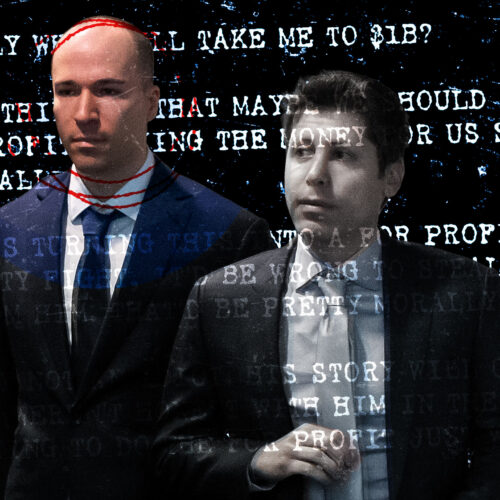
Elon Musk argued the journals show the moment when OpenAI abandoned its mission.
Credit: Aurich Lawson | Getty Images
Greg Brockman never wanted to discuss his personal journal in public. But the OpenAI president has been stuck for days doing exactly that, while testifying in a trial in which Elon Musk has alleged that OpenAI abandoned its nonprofit mission to instead focus on personally enriching leaders like Brockman and Sam Altman.
“It’s very painful,” Brockman told OpenAI lawyer Sarah Eddy during his second day on the stand.
Although he’s not “ashamed” of any of the journal entries, he considers them to be deeply personal, he said. Rather than serving as a straightforward log of his actions or feelings, the entries reflect a stream of consciousness that meanders as it explores alternate viewpoints.
Sometimes, Brockman explained, he would jot notes reflecting another person’s thoughts, just to feel them out for himself. Because of this, Brockman can appear self-contradictory at times, he testified.
Other times, he recorded text messages or Signal messages from people to capture and mull their ideas, he noted. And that supposedly makes it harder to parse his entries out of context.
In total, Brockman estimated that his journal has about 100 pages of entries. He started the journal in school and continued using it to mull over big decisions in his professional life, he testified.
No one was ever supposed to read the journal but Brockman, he said. But there was no keeping them private after his journal entries were revealed in court filings in January. OpenAI submitted the journals as evidence in October that was initially sealed and then unsealed in January. The entries, Musk’s legal team alleged, show the moment when OpenAI leaders decided to abandon the nonprofit mission, with Brockman explicitly discussing stealing a charity from Musk and hoping to earn a billion for his contributions at OpenAI.
Ultimately, the OpenAI president had to read some of the most embarrassing entries aloud in front of a jury and a packed courthouse, as well as over a YouTube livestream that peaked at around 1,200 viewers.
The entries cited during the trial were written between 2015, when OpenAI was founded, and 2023, when Brockman and OpenAI CEO Sam Altman were briefly ousted as leaders over the OpenAI board’s alleged safety concerns.
Musk hopes the diary entries paint Brockman as a money-hungry executive who, early on, cared little about OpenAI’s mission.
To overcome that characterization of his mindset in OpenAI’s early days, Brockman has the challenging task of convincing the court that, instead, they show the opposite: displaying the careful musings of the person who is perhaps most committed to OpenAI’s mission.
Brockman likened to “bank robber”
Musk’s attorney, Steven Molo, spent the first day of Brockman’s testimony isolating passages and demanding that Brockman answer for the apparent greed that his journal entries revealed.
For example, Brockman drafted a journal in 2017, around the same time he testified that Musk had delivered an ultimatum: Either Musk would have full control over a for-profit arm of OpenAI, or OpenAI would remain a nonprofit.
In that entry, Brockman appears greedy, writing that “we’ve been thinking that maybe we should just flip to a for-profit. Making the money for us sounds great and all.”
And Brockman, of course, did make a lot of money after OpenAI created a for-profit arm in 2018, with his stake today worth about $30 billion. More than a dozen times, NBC News reported, Molo asked Brockman to justify his stake, while repeatedly pointing to the journal entry in which the OpenAI president also said that $1 billion was all he wanted for his career goal.
“Financially, what will take me to $1B?” Brockman wrote in 2017, while mulling whether Musk was the “glorious leader” he wanted to run OpenAI or if he should back Altman.
At a contentious point, Molo asked whether Brockman would consider giving $29 billion back to the nonprofit arm. But Brockman said no, pointing out that he received the stake well before ChatGPT’s release spiked OpenAI’s value. He also emphasized that he helped grow the best-funded nonprofit in the world. According to The Information, Molo then likened Brockman to a “bank robber” who downplays the theft of only $1 million because there’s much more money left in the bank.
Brockman forced to explain journal entries
Hoping to paint Brockman in a more sympathetic light, OpenAI’s lawyer Eddy spent considerable time going over each entry that Molo flagged to allow Brockman to explain his intentions behind his posts.
Part of that attempted recovery found Brockman reading earlier passages of the same entry that Molo called out. Those paragraphs showed that at that moment, Brockman was contemplating not just whether OpenAI would need a for-profit arm to achieve its nonprofit mission, but also if he would be happy as an engineer working under Musk.
To Brockman, it seemed like OpenAI’s mission could be endangered if Musk’s co-founders accepted either of the conditions that Musk had raised as acceptable for him to stay on board. The mission could be at risk if Musk ever refused to relinquish control that he desperately sought before leaving OpenAI—potentially becoming what Brockman said he feared, a sort of “AGI dictator”—or if Musk ended up quitting OpenAI after the other co-founders agreed to remain a nonprofit.
Addressing his “$1B” comment, Brockman testified that weighing his personal happiness was a secondary consideration in the entry to his primary concerns over whether Musk’s proposal to lead OpenAI would work to uphold the mission.
Additionally, Brockman’s journal showed him grappling with whether voting against Musk’s plan or for Musk’s ejection from the board would be morally wrong.
“Can’t see us turning this into a for-profit without a very nasty fight,” Brockman wrote in another entry. “It’d be wrong to steal the non-profit from him. That’d be pretty morally bankrupt.”
Further on in the same entry, Brockman seemingly validated Musk’s central claim in his lawsuit—that OpenAI made a fool out of him and stole “free funding.” Describing Musk, Brockman wrote, “he’s really not an idiot. His story will correctly be that we weren’t honest with him in the end about still wanting to do the for-profit just without him.”
Guided by Eddy, who was repeatedly accused of leading the witness, Brockman testified that his comments on stealing the nonprofit only applied if they’d voted to remove Musk from the board, which never happened. Instead, Musk voluntarily left the board in 2018. When asked whether the journal entry had anything to do with creating a for-profit if Musk left the board on his own, Brockman said no.
The same logic applied to the “nasty fight” comments, which Brockman said only applied to circumstances that would have followed Musk’s removal from the board.
And in the same entry—when Brockman wrote that he cannot say he’s committed to a nonprofit because that would turn out to be a “lie” if they decided to start the public benefit corporation—he said that he was mulling the conditions that Musk had established, not his own thoughts on committing to the nonprofit.
As Brockman explained it, Musk had backed his co-founders into a difficult corner, and he had cut off his donations while keeping tabs on how hard it was to fundraise for the nonprofit. In the end, the other co-founders never committed to keeping OpenAI as a nonprofit, and Brockman testified that nearly all of OpenAI’s value today has come from efforts that post-date Musk’s involvement.
Further, Brockman testified that Musk failed to recognize when OpenAI reached a significant milestone with an early version of ChatGPT, becoming so critical of the first chatbot tool that he saw that the engineer who presented it to him allegedly almost quit the field entirely. Although Musk was an expert on rockets and electric cars, “he did not and I believe does not know AI,” Brockman testified, explaining “that was a major concern” and why he ended up backing Altman.
To Brockman, Musk issuing the ultimatum seemed like the best way to get out from under Musk, his journals showed. And on the stand, Brockman did not appear to regret his decision, describing Musk as a leader that allegedly damaged team morale and cared little about the team’s commitments to AI safety.
As an example, Brockman discussed Musk’s exit from OpenAI.
After Musk announced he was resigning from OpenAI in February 2018, Musk gave a departing speech at an all-hands meeting, Brockman testified. In front of about 40 OpenAI employees, Musk said that he was leaving because the only viable path that he saw forward was for OpenAI to merge with Tesla. However, the other leaders did not think so, Musk said, choosing a different path that Musk would never choose. According to Brockman, the speech was meant to lower morale at OpenAI, as workers understood that Musk was leaving to pursue artificial general intelligence (AGI) at Tesla because he no longer had confidence in OpenAI.
Following his speech, Musk took some questions from OpenAI staffers, and Brockman said that one of the first questions raised was how he would do things differently while pursuing AGI at Tesla.
Supposedly, Musk shocked OpenAI staff by confirming that his plan was to cut corners on AI safety, while insisting that would be the only way for Tesla to keep up with Google.
For Musk, who spent three days on the stand last week, Brockman’s testimony was probably viewed as more critical than his own. But Brockman mostly maintained composure while explaining why his journals shouldn’t be viewed as a smoking gun proving that Musk was defrauded. Instead, he highlighted a journal that he likely hopes sticks with the jury more than others. In it, he noted that a top reason why he didn’t want anyone, including Musk, to have “unilateral control” over how OpenAI runs not because Brockman wouldn’t make as much money if Musk had a larger equity share but because that “technology that we’re building is just too important.”
Ashley is a senior policy reporter for Ars Technica, dedicated to tracking social impacts of emerging policies and new technologies. She is a Chicago-based journalist with 20 years of experience.