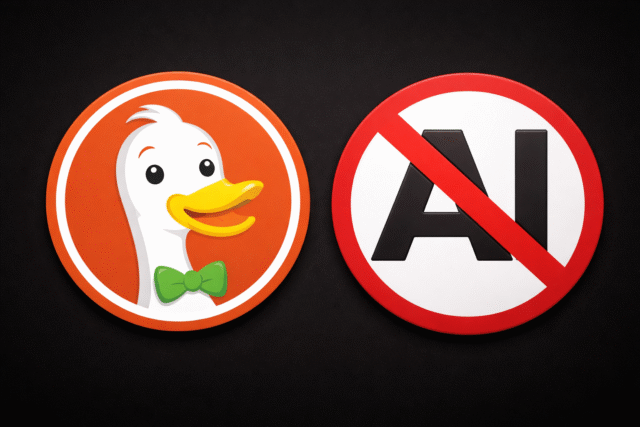
DuckDuckGo‘s new public vote on AI in search drew nearly 160,000 responses in under a day, with 90 percent selecting “No AI.” The campaign gives an insight into how users feel about AI summaries, which have been appearing at the top of search results.
The privacy-focused search company ran the live “Yes or No AI” vote as a simple one-question site asking people if they wanted AI in search. The results were heavily one-sided.
SEE ALSO: GenAI saves users nearly four hours a week
DuckDuckGo — AI summaries no
As of January 24, 2026, when the poll ended, almost 160,000 votes had been cast, and 90 percent selected “No AI.” The company says the ratio stayed consistent as more responses came in.
Commenting on the result, SEO strategist Joe Youngblood said its points to a gap between what platforms are adding and what users actually want.
“People are rejecting AI when it feels forced, untrustworthy, or invasive,” Youngblood said. “Search is a high-stakes environment. When accuracy, privacy, and neutrality matter, users want control.”
He added that search carries different risks compared with other AI tools.
“If AI gives you a wrong answer in search, the cost is real, such as bad health info, bad financial decisions, and bad legal assumptions. That’s where skepticism kicks in.”
Separate research from the Pew Research Center shows that many Americans are already seeing AI summaries, but trust remains limited.
Pew says 65 percent of U.S. adults report at least sometimes encountering AI-generated summaries at the top of search results.
Among those who have seen them, only 20 percent say they find them extremely or very useful, while 52 percent say they are somewhat useful. Another 28 percent say they are not very or not at all useful.
No to AI summaries
Trust levels appear lower. Just 6 percent say they trust AI summaries a lot, while 46 percent say they have little or no trust in them.
“Search has always been about verification,” Youngblood explains. “When AI provides answers without clear sources, people instinctively slow down instead of speeding up.”
Pew also points to an age divide. It says 62 percent of adults under 30 say they often see AI summaries, compared with 23 percent of adults aged 65 and older.
Younger adults are more likely to call the summaries highly useful, at 25 percent compared with 12 percent among seniors. Even so, trust is still limited across age groups.
“Younger users are more exposed, not necessarily more convinced,” Youngblood notes. “Familiarity doesn’t automatically translate to confidence.”
DuckDuckGo has long focused on privacy and minimal tracking, and the company’s campaign leans into that message.
“The campaign works because it gives people something they feel they’ve lost: agency,” Youngblood says. “Instead of forcing AI into search, DuckDuckGo asked whether users even want it.”
He said brands should expect more skepticism from search users as AI summaries become more common. “AI summaries are not being accepted at face value. Consumers are cross-checking, scrolling past summaries, and looking for original sources.”
“Speed is appealing,” Youngblood concludes. “But trust still wins. Until AI earns that trust consistently, users will keep voting ‘no’ with their clicks or their choices.”
What do you think about AI summaries in search? Let us know in the comments.