Low-code and no-code platforms have moved from simple drag-and-drop builders to AI-native development environments. In 2026, most of them ship a built-in assistant that turns a text prompt into a working app, agent, or automation. This list covers 21 tools that AI practitioners use today, grouped by what they do best. Each tool name links to its official site so you can verify pricing and features directly.
App and UI builders
These tools let non-developers ship functional applications, often from a single prompt.
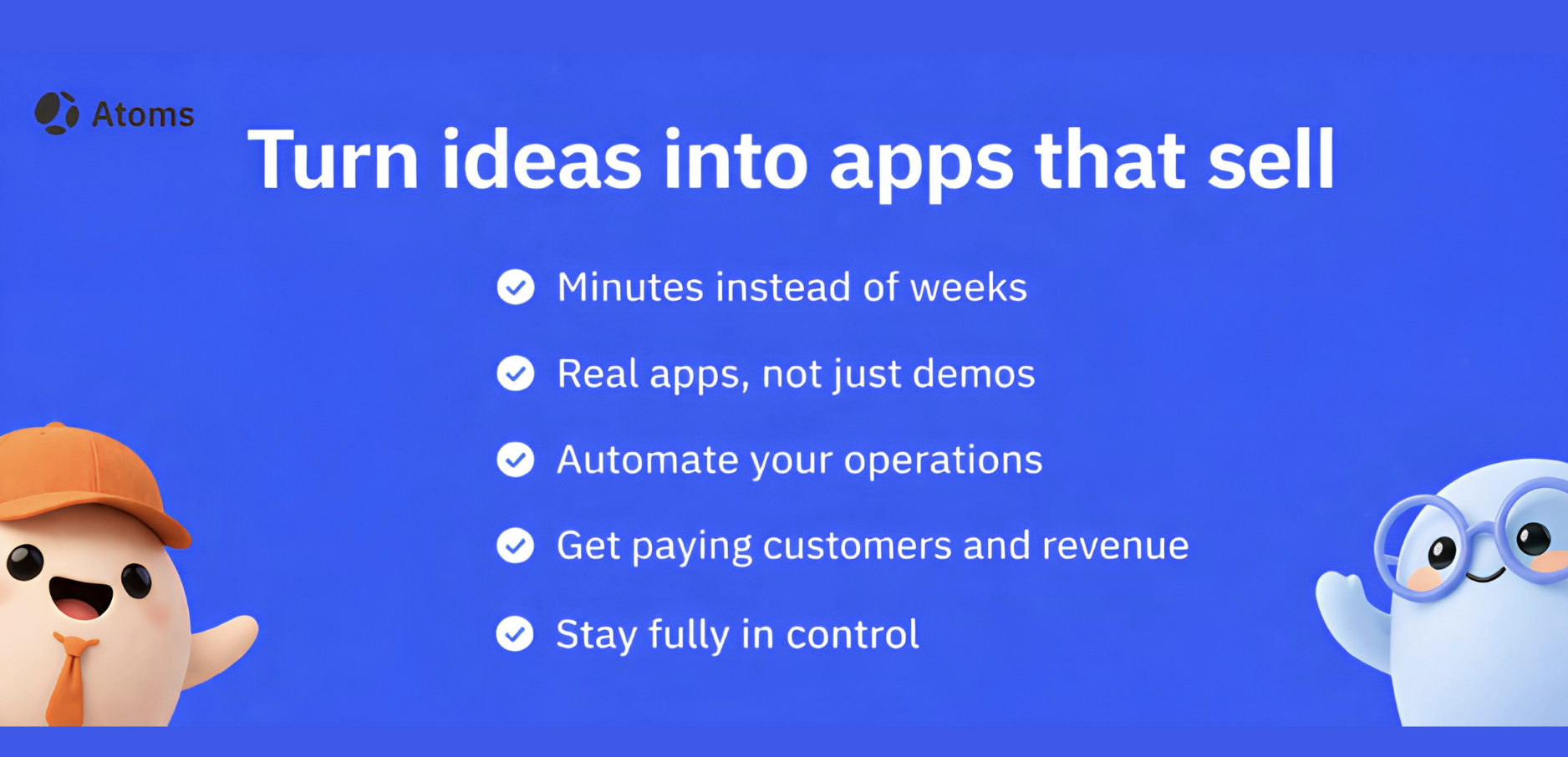
1. Atoms* (10% discount with code MARKTECHPOST10) is a no-code AI platform that lets anyone build and launch a fully functional product without writing a single line of code. It moves beyond drag-and-drop interfaces by deploying a team of AI agents that handle every stage of the process, from validating your idea with deep market research to building the backend, deploying the app, and optimizing it for search. Built-in support for user authentication, databases, Stripe payments, and one-click hosting means you go from concept to a live, revenue-ready product in minutes. Atoms is built for entrepreneurs, small teams, and anyone who has an idea but not a development team.
2. Bubble remains the most established visual web app builder. You design the interface, define the database, and wire workflows without code. Its AI features generate page layouts and logic from text descriptions, then let you refine them manually.
3. Adalo focuses on native mobile and web apps for non-developers. Its AI assistant, Ada, builds an app from a prompt, and Magic Add introduces new features through natural language. It produces App Store-compliant binaries by design.
4. Glide turns spreadsheets and databases into apps. You connect a data source, and Glide generates an interface plus AI-powered tables and actions. It suits internal tools and customer-facing apps built on existing data.
5. Softr builds client portals, internal tools, and websites on top of Airtable, Google Sheets, or its own database. Its AI app generator scaffolds a working product from a description, with no coding required.
6. Lovable generates full-stack web applications from natural language. It produces a complete codebase, frontend, backend, database, and authentication, then deploys with one click. It uses React, Vite, and Tailwind, and offers two-way GitHub sync.
7. Bolt.new is a prompt-to-app builder from StackBlitz. It supports multiple JavaScript frameworks and keeps the code visible. You can click UI elements to request changes or edit the code directly, with agents handling most execution.
8. Replit pairs a browser-based IDE with Replit Agent, one of the more autonomous app builders. It can scaffold, build, and deploy apps with many built-in integrations, useful for founders who want a working product fast.
9. v0 by Vercel specializes in front-end generation. It produces Next.js applications with clean UI and built-in database support, making it a common starting point for product and design teams.
10. Appy Pie offers a broad no-code suite for apps, chatbots, and automations. Its AI assistant supports drag-and-drop building and natural language prompts, aimed at small businesses and first-time builders.
Workflow automation and AI agents
These platforms connect apps, trigger actions, and increasingly run autonomous agents.
11. Zapier is the most widely used no-code automation tool. It connects thousands of SaaS apps and now layers in AI agents and a copilot that builds workflows from plain-English descriptions. It fits simple trigger-and-action automations across teams.
12. Make is a visual workflow builder with advanced branching and logic. Its canvas suits multi-step automations that need conditional paths, and it integrates AI models into flows for tasks like classification and content generation.
13. n8n is an open-source, low-code automation platform with a self-host option. It appeals to teams that want control over data and infrastructure, and it supports AI agent nodes for building LLM-driven workflows.
14. Microsoft Power Automate handles automation across the Microsoft 365 stack. It connects Office apps, Dynamics, and external services, and its AI features generate flows from descriptions. It is a strong default for Microsoft-centric organizations.
15. Lindy builds no-code AI agents for operations and small teams. Agents handle judgment-based tasks like email triage, research compilation, and meeting prep, running across connected tools rather than fixed trigger chains.
16. Airtable combines a flexible database with apps and automations. Its AI layer summarizes records, generates content, and categorizes data inside tables. Teams use it as both a data backbone and a low-code app surface.
Machine learning and model platforms
These tools let you build, train, or deploy models with little or no code.
17. Google Vertex AI offers no-code AutoML alongside full model development. Non-technical users can train classification, regression, and vision models from data, while engineers can extend pipelines with code. It sits on the line between no-code and low-code.
18. Amazon SageMaker is AWS’s machine learning platform. SageMaker Canvas provides a no-code interface for building and deploying models from data, while the broader platform supports training and tuning at scale for technical teams.
19. Microsoft Foundry (formerly Azure AI Foundry) is a unified platform for building AI applications and agents. Its portal lets you deploy models, test prompts, and author prompt agents through configuration, with no application code required for basic use.
20. Teachable Machine by Google is a free, browser-based tool for training image, sound, and pose recognition models. It requires no code and no account, making it a practical entry point for prototyping and teaching machine learning concepts.
21. Jotform AI extends a form builder with an AI layer across the platform. It generates forms from prompts, adds conditional logic automatically, and supports AI agents that handle responses, useful for surveys, intake, and workflow automation.
How to choose
The right tool depends on what you are building and the stack you already use. A few practical guidelines:
- An end-to-end product without a dev team: Atoms* aims to cover the full path, from idea validation to backend, payments, and hosting, in one place.
- Mobile or customer-facing apps without code: Adalo, Glide, and Softr require no programming and produce deployable products.
- Full-stack web apps from a prompt: Lovable, Bolt.new, v0, and Replit cover the “vibe coding” category. All generate working code, though most still need external services configured for databases or auth.
- Connecting apps and automating tasks: Zapier and Make suit straightforward “when X happens, do Y” flows. n8n adds self-hosting and data control. Power Automate fits Microsoft environments.
- Agents that make decisions: Lindy handles judgment-based work across your tools, a different model from fixed automation chains.
- Custom models from your data: Vertex AI, SageMaker, and Microsoft Foundry serve teams that need trained models or production AI infrastructure. Teachable Machine is the fastest no-account starting point for simple classifiers.
Key Takeaways
- App builders like Atoms*, Bubble, Adalo, and Glide ship full products with no code.
- Prompt-to-app tools Lovable, Bolt.new, v0, and Replit generate working web apps from text.
- Zapier, Make, n8n, and Power Automate handle no-code workflow automation; Lindy adds decision-making AI agents.
- Vertex AI, Amazon SageMaker, and Microsoft Foundry cover no-code-to-low-code model building and deployment.
- Match the tool to the task and combine a few, since no single platform does everything well.
Conclusion
The low-code and no-code landscape in 2026 is less about replacing developers and more about removing the gap between an idea and a working product. Whether you start with an end-to-end builder like Atoms, prototype a front end in Lovable or v0, automate operations with Zapier or Lindy, or train a model in Vertex AI, the common thread is speed: you can now go from concept to a live app, agent, or model in hours instead of weeks. The right choice still depends on what you are building, the stack you already use, and how far you need to push toward production. Match the tool to the task, verify pricing and capabilities on each official site, and combine a few platforms rather than expecting one to do everything.
*we do make a small Affiliate commission by adding an affiliate url.

Michal Sutter
Michal Sutter is a data science professional with a Master of Science in Data Science from the University of Padova. With a solid foundation in statistical analysis, machine learning, and data engineering, Michal excels at transforming complex datasets into actionable insights.