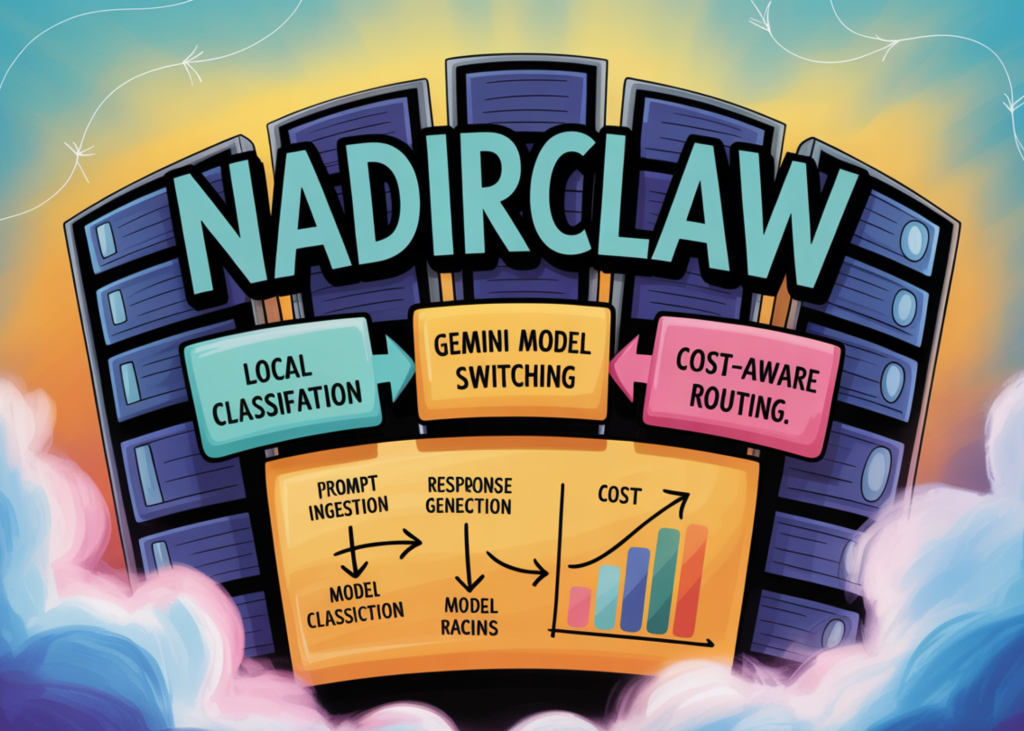
In this tutorial, we explore NadirClaw as an intelligent routing layer that classifies prompts into simple and complex tiers before sending them to the most suitable model. We start by installing the required packages, setting up an optional Gemini API key, and testing the local classifier through the NadirClaw CLI without making any live LLM calls. We then inspect the centroid vectors that power the routing decision, embed our own prompts, visualize how similarity scores separate simple and complex tasks, and experiment with confidence thresholds. After understanding the local routing logic, we move into live routing by launching the NadirClaw proxy server, sending OpenAI-compatible requests through it, comparing routed model behavior, and estimating cost savings against an always-Pro baseline.
import subprocess, sys def _pip(*pkgs): subprocess.run([sys.executable, "-m", "pip", "install", "-q", *pkgs], check=True) _pip("nadirclaw", "openai", "sentence-transformers", "matplotlib", "scikit-learn", "pandas", "requests") import os, json, time, signal, shutil, getpass from pathlib import Path import numpy as np import pandas as pd import matplotlib.pyplot as plt import requests GEMINI_API_KEY = os.environ.get("GEMINI_API_KEY", "").strip() if not GEMINI_API_KEY: print("Paste your Gemini API key (input hidden), or press Enter to skip:") try: GEMINI_API_KEY = getpass.getpass(prompt="GEMINI_API_KEY: ").strip() except (EOFError, KeyboardInterrupt): GEMINI_API_KEY = "" LIVE_ROUTING = bool(GEMINI_API_KEY) if LIVE_ROUTING: os.environ["GEMINI_API_KEY"] = GEMINI_API_KEY print(f"✓ key captured ({len(GEMINI_API_KEY)} chars) — sections 8–11 enabled.") else: print("ℹ no key entered — sections 3–7 still run; live routing skipped.")We install NadirClaw and the supporting Python libraries required for routing, embeddings, plotting, API calls, and data handling. We then import all required modules and securely capture the Gemini API key through the environment or a hidden prompt. We also decide whether live routing sections should run, while still allowing the local classifier sections to work without an API key.
def classify(prompt: str) -> dict: r = subprocess.run( ["nadirclaw", "classify", "--format", "json", prompt], capture_output=True, text=True, timeout=180, ) if r.returncode != 0: return {"prompt": prompt, "error": (r.stderr or r.stdout).strip()} return json.loads(r.stdout.strip()) prompts = [ "What is 2+2?", "Format this JSON: {"a":1,"b":2}", "Read the file at src/main.py", "Add a docstring to the foo function", "What does this function do?", "Refactor the auth module to use dependency injection without breaking existing callers", "Design a distributed event-sourced order pipeline that handles 50k req/s with strict ordering", "Analyze the tradeoffs between actor-model and CSP-style concurrency for our codebase", "Debug why this asyncio.gather call deadlocks under high load and provide a fix", "Prove that this scheduling algorithm is optimal step by step and derive the worst-case bound", ] print("n[3] Classifying 10 prompts (first call warms the encoder)…") rows = [classify(p) for p in prompts] df = pd.DataFrame(rows) cols = [c for c in ["tier", "score", "confidence", "model", "prompt"] if c in df.columns] print(df[cols].to_string(index=False)) import nadirclaw PKG = Path(nadirclaw.__file__).parent SIMPLE_C = np.load(PKG / "simple_centroid.npy").astype(np.float32).flatten() COMPLEX_C = np.load(PKG / "complex_centroid.npy").astype(np.float32).flatten() def cosine(a, b): return float(a @ b / (np.linalg.norm(a) * np.linalg.norm(b) + 1e-12)) print(f"n[4] simple_centroid shape={SIMPLE_C.shape} ‖·‖={np.linalg.norm(SIMPLE_C):.3f}") print(f" complex_centroid shape={COMPLEX_C.shape} ‖·‖={np.linalg.norm(COMPLEX_C):.3f}") print(f" cosine(simple,complex) = {cosine(SIMPLE_C, COMPLEX_C):.4f} " "← if this were 1.0 the classifier couldn't distinguish them.")We define a reusable classify() function that sends prompts to the NadirClaw CLI and returns structured JSON results. We create a mixed set of simple and complex prompts, classify them, and display the routing tier, score, confidence, model, and prompt text in a table. We then load the simple and complex centroid vectors from the NadirClaw package and compare their shapes, norms, and cosine similarity.
from sentence_transformers import SentenceTransformer print("n[5] Loading the same encoder NadirClaw uses (all-MiniLM-L6-v2)…") encoder = SentenceTransformer("sentence-transformers/all-MiniLM-L6-v2") embs = encoder.encode(prompts, normalize_embeddings=True) sim_simple = np.array([cosine(e, SIMPLE_C) for e in embs]) sim_complex = np.array([cosine(e, COMPLEX_C) for e in embs]) fig, ax = plt.subplots(figsize=(8.5, 6)) colors = ["tab:blue"] * 5 + ["tab:red"] * 5 ax.scatter(sim_simple, sim_complex, c=colors, s=110, edgecolor="k", linewidth=0.5) for i, _ in enumerate(prompts): ax.annotate(str(i + 1), (sim_simple[i], sim_complex[i]), xytext=(6, 4), textcoords="offset points", fontsize=10) xs = np.linspace(min(sim_simple.min(), sim_complex.min()), max(sim_simple.max(), sim_complex.max()), 50) ax.plot(xs, xs, "k--", alpha=0.4, label="cos(simple) = cos(complex)") ax.set_xlabel("cosine similarity to SIMPLE centroid") ax.set_ylabel("cosine similarity to COMPLEX centroid") ax.set_title("Routing decision boundaryn(blue = expected simple, red = expected complex)") ax.legend(loc="lower right") ax.grid(alpha=0.25) plt.tight_layout() plt.savefig("centroid_decision_plot.png", dpi=120) plt.show() print("Legend: prompts above the dashed line route to COMPLEX, below to SIMPLE.") print("n[6] Prompts sorted by complexity score:") sdf = df.sort_values("score").reset_index(drop=True) for _, row in sdf.iterrows(): bar = "█" * int(round(float(row["score"]) * 30)) print(f" score={float(row['score']):.2f} conf={float(row['confidence']):.2f} " f"{row['tier']:7s} |{bar:<30s}| {row['prompt'][:55]}") print("n[6] Confidence-threshold sweep (low confidence → forced complex):") print(" NadirClaw default threshold is 0.06.") for thr in [0.02, 0.06, 0.10, 0.20, 0.30]: forced_complex = sum(1 for r in rows if float(r["confidence"]) < thr) natural_complex = sum(1 for r in rows if float(r["score"]) >= 0.5) print(f" threshold={thr:.2f} → {forced_complex} prompts force-complex " f"(low-confidence), {natural_complex} naturally complex by score") modifier_demos = [ ("agentic — text-only marker", "You are a coding agent that can execute commands. Now add tests for the new endpoint."), ("reasoning — chain-of-thought markers", "Step by step, derive the closed form and prove correctness mathematically. " "Compare and contrast both approaches."), ("vision — would arrive with image_url part (only text shown)", "Describe the screenshot."), ] print("n[7] Modifier-marker scan:") for label, p in modifier_demos: r = classify(p) print(f" {label}") print(f" prompt='{p[:65]}…'") print(f" tier={r['tier']} score={float(r['score']):.2f} conf={float(r['confidence']):.2f}") print(" NB: agentic & vision routing also trigger from request shape " "(tools=[…], image_url parts) — see live calls below.")We use the same SentenceTransformer encoder as NadirClaw and embed all tutorial prompts locally. We compare each prompt embedding against the simple and complex centroids, then visualize the routing boundary with a scatter plot. We also sort prompts by complexity score, test confidence thresholds, and inspect routing modifier examples for agentic, reasoning, and vision-style requests.
PORT = 8856 server_proc = None if LIVE_ROUTING: print(f"n[8] Starting `nadirclaw serve` on :{PORT} (background subprocess)…") env = os.environ.copy() env.update({ "GEMINI_API_KEY": GEMINI_API_KEY, "NADIRCLAW_SIMPLE_MODEL": "gemini-2.5-flash", "NADIRCLAW_COMPLEX_MODEL": "gemini-2.5-pro", "NADIRCLAW_PORT": str(PORT), }) server_proc = subprocess.Popen( ["nadirclaw", "serve", "--verbose"], env=env, stdout=subprocess.PIPE, stderr=subprocess.STDOUT, preexec_fn=os.setsid if hasattr(os, "setsid") else None, ) ready = False for _ in range(60): if server_proc.poll() is not None: break try: if requests.get(f"http://localhost:{PORT}/health", timeout=1).ok: ready = True break except Exception: time.sleep(1) if ready: print(" ✓ /health returned 200 — proxy is live.") else: print(" ⚠ proxy did not come up; dumping last log lines:") if server_proc.stdout: try: lines = server_proc.stdout.read1(4096).decode("utf-8", errors="replace") print(lines[-2000:]) except Exception as e: print(f" (could not read server stdout: {e})") else: print("n[8] Skipped — no GEMINI_API_KEY.") def proxy_alive(): return server_proc is not None and server_proc.poll() is None if proxy_alive(): from openai import OpenAI client = OpenAI(base_url=f"http://localhost:{PORT}/v1", api_key="local") side_by_side = [ ("simple-ish", "Write a one-line docstring for: def add(a, b): return a + b"), ("complex", "Refactor a Python class to a dependency-injection pattern, " "explain the trade-offs, and produce migration steps for callers."), ] summary = [] for label, p in side_by_side: t0 = time.time() try: resp = client.chat.completions.create( model="auto", messages=[{"role": "user", "content": p}], max_tokens=220, ) dt = time.time() - t0 text = (resp.choices[0].message.content or "").strip() print(f"n--- [{label}] {dt:.2f}s · model={resp.model} ---") print(text[:500] + ("…" if len(text) > 500 else "")) summary.append({ "label": label, "model_used": resp.model, "latency_s": round(dt, 2), "tokens": getattr(resp.usage, "total_tokens", None), }) except Exception as e: summary.append({"label": label, "model_used": "ERROR", "latency_s": None, "tokens": str(e)[:80]}) print(f"⚠ [{label}] failed: {e}") print("n[9] Summary:") print(pd.DataFrame(summary).to_string(index=False))We start the NadirClaw proxy server locally when a Gemini API key is available and configure it to route between Flash and Pro models. We check the /health endpoint to confirm that the proxy is running before sending requests. We then use the OpenAI SDK against the local proxy and compare how a simple prompt and a complex prompt are routed and answered.
if proxy_alive(): print("n[10] Mixed 10-prompt workload…") workload = [ "Capital of France?", "Read foo.py", "Type hint for a list of dicts", "Lowercase: HELLO", "One-sentence summary of REST", "Refactor a callback chain into async/await with proper error handling", "Design a sharded multi-region key-value store with linearizable reads", "Analyze the asymptotic complexity of this code and prove the bound rigorously", "Debug why our gRPC stream stalls when the client TCP window saturates", "Compare and contrast B-trees and LSM-trees for write-heavy workloads", ] runs = [] client = OpenAI(base_url=f"http://localhost:{PORT}/v1", api_key="local") for p in workload: t0 = time.time() try: r = client.chat.completions.create( model="auto", messages=[{"role": "user", "content": p}], max_tokens=140, ) usage = getattr(r, "usage", None) runs.append({ "prompt": p[:55], "model": r.model, "latency_s": round(time.time() - t0, 2), "in_tok": getattr(usage, "prompt_tokens", 0) if usage else 0, "out_tok": getattr(usage, "completion_tokens", 0) if usage else 0, }) except Exception as e: runs.append({"prompt": p[:55], "model": "ERROR", "latency_s": None, "in_tok": 0, "out_tok": 0, "error": str(e)[:80]}) rdf = pd.DataFrame(runs) print(rdf.to_string(index=False)) PRICE = { "flash": {"in": 0.30 / 1e6, "out": 2.50 / 1e6}, "pro": {"in": 1.25 / 1e6, "out": 10.0 / 1e6}, } def price_for(model_str, in_t, out_t): m = (model_str or "").lower() tier = "flash" if "flash" in m else "pro" return in_t * PRICE[tier]["in"] + out_t * PRICE[tier]["out"] cost_routed = sum(price_for(r["model"], r["in_tok"], r["out_tok"]) for r in runs) cost_no_route = sum(price_for("gemini-2.5-pro", r["in_tok"], r["out_tok"]) for r in runs) print(f"n[10] Cost (NadirClaw routed) : ${cost_routed:.6f}") print(f" Cost (always-Pro baseline) : ${cost_no_route:.6f}") if cost_no_route > 0: print(f" Estimated savings on this run : " f"{(1 - cost_routed/cost_no_route) * 100:.1f}%") print("n[11] `nadirclaw report` (parses the JSONL request log):") rep = subprocess.run(["nadirclaw", "report"], capture_output=True, text=True, timeout=60) print(rep.stdout or rep.stderr) if proxy_alive(): print("n[12] Stopping the proxy…") try: if hasattr(os, "killpg"): os.killpg(os.getpgid(server_proc.pid), signal.SIGTERM) else: server_proc.terminate() server_proc.wait(timeout=10) except Exception: try: server_proc.kill() except Exception: pass print(" ✓ proxy stopped.") print("nDone. 🎉")We send a mixed 10-prompt workload through the NadirClaw proxy to observe which model each prompt uses. We calculate an illustrative routed cost and compare it with an always-Pro baseline to estimate savings. We finally run the built-in NadirClaw report command, stop the proxy cleanly, and finish the tutorial workflow.
In conclusion, we built a complete hands-on understanding of how NadirClaw routes prompts based on complexity, confidence, and request modifiers. We saw how local classification occurs before any API call, how centroid-based similarity helps explain routing behavior, and how threshold tuning affects whether uncertain prompts are escalated to a stronger model. We also ran NadirClaw as a proxy, tested it with the OpenAI SDK, analyzed a mixed workload, and generated a routing report from the request log. Also, we learned how to use NadirClaw to make model routing more transparent, cost-aware, and practical for real-world AI applications.
Check out the GitHub Repo. Also, feel free to follow us on Twitter and don’t forget to join our 150k+ ML SubReddit and Subscribe to our Newsletter. Wait! are you on telegram? now you can join us on telegram as well.
Need to partner with us for promoting your GitHub Repo OR Hugging Face Page OR Product Release OR Webinar etc.? Connect with us

Sana Hassan
Sana Hassan, a consulting intern at Marktechpost and dual-degree student at IIT Madras, is passionate about applying technology and AI to address real-world challenges. With a keen interest in solving practical problems, he brings a fresh perspective to the intersection of AI and real-life solutions.