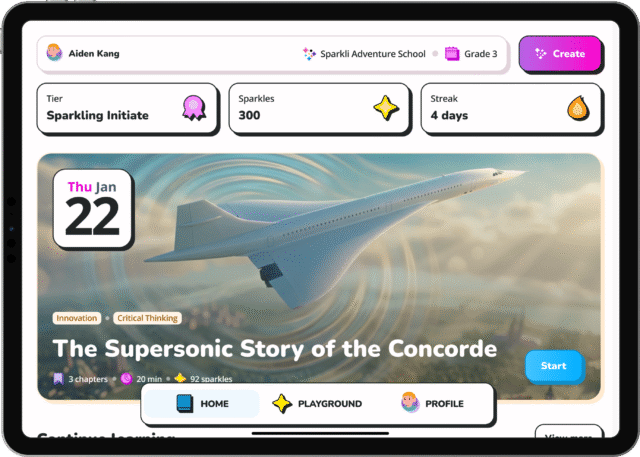
Sparkli has emerged from stealth after raising a $5M pre-seed round to develop an AI-based learning platform for children. Founded by former Google employees and based in Zurich, the startup is working on tools to make digital learning more interactive while addressing long-standing concerns around passive screen time.
Children have access to more information than ever, although much of their digital experience remains limited to watching videos, playing games, or reading static material. In many cases, these formats leave little room for exploration or decision-making. Sparkli is built around the idea that children should be able to actively engage with questions instead of receiving pre-packaged answers.
Sparkli multimodal AI
Sparkli uses multimodal AI to create interactive learning sessions based on a child’s prompt. Rather than returning text responses, the system generates activities that combine visuals, simulations, voice interaction, and structured challenges. These sessions span multiple subject areas and connect ideas to real-world contexts.
The funding round will be used to further develop the platform and prepare for a private beta. Sparkli is also running a pilot program with a large private group that operates more than 100 schools and serves over 100,000 students. The pilot will test how the platform performs across classrooms with different age groups and teaching styles.
SEE ALSO: Someone built a floppy disk TV remote control for kids and it actually works
A big aim of the platform is to preserve existing classroom flexibility while giving children more control over what they explore. Instead of following a fixed curriculum, students can begin with a question and move through related topics at their own pace. Teachers retain oversight at all times, although the direction of each session will be shaped by the child’s own choices.
Sparkli tracks interests and progress through an evolving knowledge graph built for each child. This allows the system to adapt future activities based on prior exploration rather than repeating the same formats.
In practical use, a question like “how to build a city on Mars” will become an extended activity. Children are introduced to basic concepts around physics and environmental limits, then asked to design infrastructure, weigh tradeoffs, and explain decisions.
“Our goal is to build agency in the next generation,” said Lax Poojary, CEO and founder of Sparkli. “Children learn by exploring, making choices, asking questions, and discovering what inspires them. Sparkli turns screen time into a place where curiosity grows rather than fades.”
Early pilots have taken place in both classroom and home settings. In one classroom exercise, students simulated running small food businesses and discussed pricing and budgeting choices. In another, children independently selected topics during open class time, ranging from game mechanics to cosmology.
Parents involved in early testing reported that their children were more inclined to explain what they had worked on after using the platform.
Sparkli was founded by alumni of Google Area 120, Search, and YouTube. The team includes engineers, designers, and education specialists, with contributions from researchers affiliated with ETH.
There are plans to expand the platform to include tools that allow children to build projects directly within the system and Sparkli wants to eventually support learning across home and school environments as children grow older and their interests change.
What do you think about this approach to AI-based learning for children? Let us know in the comments.