All the news that’s fit to lift
“America won the first Space Race, and we can do it again.”
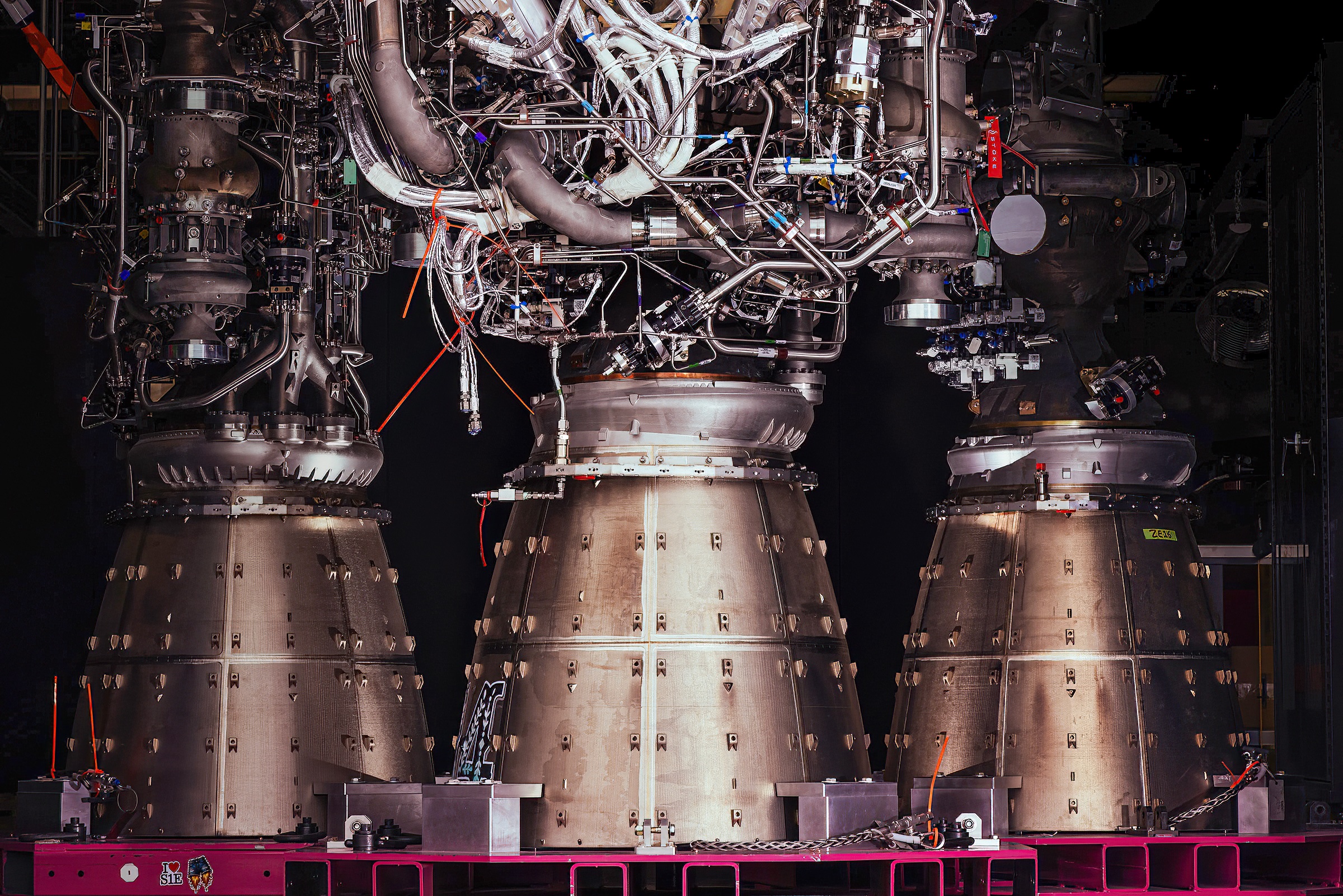
Stoke Space says three flight one engines for the Nova rocket are designed, built, and ready for testing. Credit: Stoke Space
Stoke Space says three flight one engines for the Nova rocket are designed, built, and ready for testing. Credit: Stoke Space
Welcome to Edition 9.05 of the Rocket Report! It was a big week for launch contracts, with both Rocket Lab and SpaceX scoring sizable deals from the US military for their respective Electron and Falcon 9 rockets. The vehicles have been the workhorses for small and medium lift for the United States over the past decade and may remain so for some time. Also, there will be no Rocket Report next week, as I am traveling on assignment, and Stephen is taking a week off.
As always, we welcome reader submissions, and if you don’t want to miss an issue, please subscribe using the box below (the form will not appear on AMP-enabled versions of the site). Each report will include information on small-, medium-, and heavy-lift rockets as well as a quick look ahead at the next three launches on the calendar.

Rocket Lab wins large Electron deal. Rocket Lab Corporation announced this week that it has been awarded its largest launch contract to date, a $266 million multi-launch contract with the US Space Force. Under the contract awarded by the US Space Force Space Systems Command, Rocket Lab will execute 12 suborbital launches, with up to six additional launches. The first launch of this contract is expected no earlier than the end of 2026.
New site in Alaska… The launches, likely at least in part for hypersonic testing, will primarily take place from a new Rocket Lab location at the Pacific Spaceport Complex-Alaska in Kodiak, Alaska. “The size and scale of this contract reflects the Space Force’s confidence in our ability to meet their urgent national security demands with speed, responsiveness, and scale, and we’re proud to provide the high-frequency launch capacity required to keep the US ahead of global threats,” said Sir Peter Beck, founder and CEO of Rocket Lab, in the news release.
RFA One launch delayed. Rocket Factory Augsburg had been closing in on the debut launch of its RFA One rocket but discovered an issue this week. “After a successful week of testing RFA One on the pad for the first time, we encountered an issue with the vehicle that requires further investigation,” the company said on social media. “We have made the decision to de-stack the vehicle in order to investigate.”
No new launch date set… The German company was preparing to launch from a spaceport in Scotland and had previously said the vehicle’s launch window would open on August 10. That date will now certainly be delayed, although Rocket Factory Augsburg provided no additional guidance on timing. The three-stage rocket is designed to deliver a payload of up to 1,300 kg to a Sun-synchronous orbit.
The easiest way to keep up with Eric Berger’s and Stephen Clark’s reporting on all things space is to sign up for our newsletter. We’ll collect their stories and deliver them straight to your inbox.
MaiaSpace changes its plans. MaiaSpace has scrapped plans to conduct a suborbital test flight of its Maia rocket, opting instead to proceed straight to a full orbital launch attempt for the vehicle’s inaugural flight in the second half of 2027, European Spaceflight reports. Under its initial development roadmap, the ArianeGroup subsidiary had planned to fly a full two-stage Maia vehicle with a reduced propellant load to a target altitude of at least 100 km.
Finding the best path to space… The company has, however, now concluded that its ground and combined testing has reduced the value of conducting a suborbital test flight. “In view of all system and combined tests we have in our roadmap, we assessed that the value of a suborbital flight was eventually reduced and finally decided that the best option for our customers was to look directly for an orbital flight,” a company spokesperson said. “We consider this the best path towards the start of our commercial operations.”
ArianeGroup readies hop tests. ArianeGroup has completed a wet dress rehearsal of the Themis reusable booster demonstrator at the Esrange Space Centre in Sweden, European Spaceflight reports. During the test, the 28-meter-tall demonstrator underwent a simulated pre-flight sequence under cryogenic conditions. The test did not use the liquid oxygen and liquid methane that will be used during powered testing. Instead, liquid nitrogen was circulated through the vehicle’s cryogenic tanks and lines.
This may not seem super exciting, but… The wet dress rehearsal represents the most significant publicly announced milestone in the Themis test campaign since September 2025, when the T1H demonstrator was erected on its four landing legs at Esrange, marking the start of combined testing. In January 2026, then-director of ESA’s space transportation program Toni Tolker-Nielsen explained that Kiruna, where Esrange is located, was under snow and that they were “waiting for spring.” It is not yet clear when the next milestone in the test campaign will take place.

SpaceX scores large launch order from Space Force. The US Space Force this week awarded SpaceX two task orders worth a total of $1.6 billion for 18 Falcon 9 launches to support the Space Based Sensing and Targeting portfolio. All launches will lift off from Vandenberg Space Force Base, California, and are expected to be completed by the end of 2027, the military said in a news release.
Falcon 9 steps up again… The awards were made under the competitive National Security Space Launch Phase 3 Lane 1 program. “The rapid acquisition capabilities provided by our NSSL Phase 3 dual-lane approach allows us the flexibility to deliver satellites for our warfighters in an increasingly efficient manner,” said Space Force Col. Eric Zarybnisky, acting portfolio acquisition executive for Space Access.
Rule seeks to exempt some launches from environmental regulations. The Department of Transportation is proposing to exempt commercial space launch licensing from many environmental regulations, a move praised by industry but criticized by environmental groups, Space News reports. This week, the federal department said it intends to file a proposed rule for public comment that would exempt Federal Aviation Administration licenses for commercial launches and reentries, as well as launch sites, from 13 federal laws and associated regulations.
Environmental concerns raised… Among the laws that would be waived in the proposed rule is the National Environmental Policy Act, or NEPA, which requires environmental reviews for “major federal actions” that include licenses. “America won the first Space Race, and we can do it again, but only if we get government red tape out of the way,” Transportation Secretary Sean Duffy said about the proposed rule. Environmental groups, though, strongly oppose the proposal, noting it would waive not just NEPA but other environmental laws, including the Endangered Species Act, Clean Water Act, and Clean Air Act.
Starliner could launch this year. During a quarterly earnings call on Tuesday, Boeing Chief Executive Officer Kelly Ortberg offered some encouraging remarks in response to an analyst’s question about Starliner and other space projects at the company. “The redesign of the Starliner deficiencies is going quite well, and we’re feeling pretty good about that,” Ortberg said. The deficiencies he referred to primarily involve the vehicle’s propulsion system.
Cargo mission would precede crewed flight… During the earnings call, Ortberg suggested much of that work was completed and that the primary issue now is scheduling a launch date with NASA for Starliner to ferry cargo to the space station to ensure there is an open docking port and astronaut time to unload the vehicle. Based on sources, Ars reported that this is indeed the case, that the primary factor now for when Starliner launches is port availability on the space station. It is therefore possible that Starliner will launch this year.
Stoke Space says three Nova engines ready. The Washington-based launch company said Wednesday that three flight engines for the debut launch of its Nova rocket have been built and are now ready for testing. “Stage 1 Zenith engines ZE14, 15, and 16 are ready to ship from our shop floor in Kent, Wash., to Moses Lake for hot fire acceptance testing,” the company said.
Getting closer to a debut launch… The first stage of the Nova rocket is powered by seven Zenith engines, each with 100,000 pounds of thrust. Nominally a debut launch of Nova in late 2026 is possible, but the company has not yet set a launch date, and given that it is almost August, a slip into 2027 seems likely. The medium-lift rocket has an advertised payload capacity of 3 metric tons in fully reusable mode.
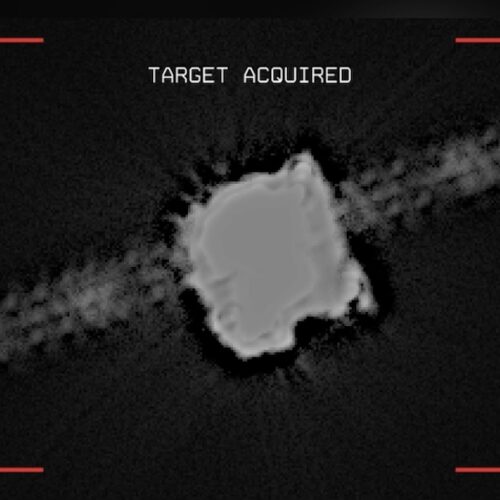
Falcon 9 lunar impact may be visible. Back in April, Ars reported that an upper stage of a Falcon 9 rocket was likely to impact the near side of the Moon early on August 5. Now, a research team at the University of Texas at Austin says this impact may be visible through some telescopes. According to the group’s modeling, the debris plume should reach roughly 15 to 20 km above the lunar surface, and this should be brighter than the dark sky by several orders of magnitude.
An opportunity to study the Moon… The upper stage belongs to a Falcon 9 rocket that launched two lunar landers, Firefly’s Blue Ghost and ispace’s Hakuto-R, on January 15, 2025. Its impact will help astronomers and others studying the Moon. “Because the timing, location, and speed of the crash are known in advance, this event is a rare opportunity to learn about impact physics, the properties of lunar soil, planetary protection, and the safety of future operations on the lunar surface,” the research team said. (submitted by philip verdieck)
AST SpaceMobile turns back to Falcon 9. AST SpaceMobile announced this week that its launch of the BlueBird 11, 12, and 13 satellites is currently scheduled for Wednesday, August 5, 2026, from Cape Canaveral Space Force Station, Florida, aboard a Falcon 9 rocket. The additional satellites 11, 12, and 13 will further expand AST SpaceMobile’s space-based cellular broadband network, supporting voice, data, and video services directly to standard, unmodified smartphones.
Company using all launch vehicles available… The company’s network is a direct competitor to SpaceX’s plans to use its Starlink satellite network to deliver direct-to-cell connectivity. AST has been starting to ramp up satellite production, and with the New Glenn and Vulcan rockets currently offline, it has had little choice but to turn to SpaceX to launch its large satellites.

Starship test flight largely successful. SpaceX was more than lucky last Friday, sending its 13th full-scale Starship test flight halfway around the world from South Texas to an on-target, intact splashdown in a remote section of the Indian Ocean. Starship has made precise splashdowns before. This time, however, the ship gently tipped over and came to rest floating in a remote stretch of ocean west of Australia, Ars reports. Later, SpaceX founder Elon Musk said the company would attempt to retrieve the vehicle from the ocean.
Our next catch of the day?… Encouraged by the picture-perfect end to Friday’s flight, SpaceX is likely to take the next leap with Starship on the next launch, according to Musk. That would entail hurling Starship on a longer-range trajectory, perhaps into low-Earth orbit, to bring the vehicle back to the launch site. Mechanical arms on the launch tower will attempt to capture the ship as it slows to a hover. SpaceX has already done this with the rocket’s massive Super Heavy booster, which is larger and heavier than Starship itself but comes back at a fraction of the speed.
Can SpaceX achieve rapid reuse with this heat shield? Some experts said this week that SpaceX’s current approach may not get Starship to its ultimate goal of flying frequently at low cost, Ars reports. “Starship’s current thermal protection system is a dead-end for all missions that require full and rapid reusability,” said Dan Rasky, a former NASA engineer who studied heat shield materials for nearly four decades at NASA Ames Research Center. NASA confronted this same issue half a century ago during the development of the Space Shuttle, which used thousands of lightweight ceramic tiles, but was never able to inspect and refurbish the vehicle quickly.
SpaceX is well aware of the challenge… The independent industry experts said they believe SpaceX’s heat shield will likely be good enough to deploy a next-generation Starlink constellation. But the experts are concerned that it will be unable to hit the high flight rate needed—several hundred to thousands of low-cost launches annually—for large settlements on the Moon and Mars, orbital data centers, or large-scale space-based solar power. However, the company believes it can reach a point at which the heat shield is immediately inspected and cleared between orbital flights. Time will tell.
Next three launches
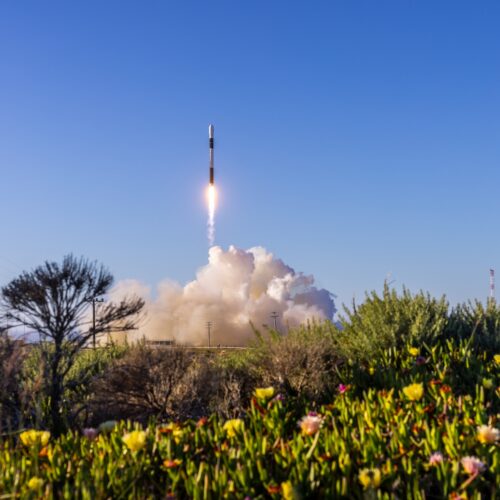
August 1: Falcon 9 | Starlink 17-52 | Vandenberg Space Force Base, California | 02:00 UTC
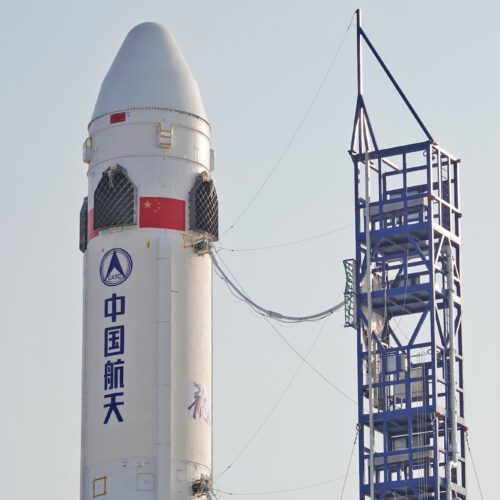
August 4: Long March 8A | Unknown payload | Wenchang Space Launch Site, China | 08:50 UTC
August 4: Falcon 9 | Starlink 17-53 | Vandenberg Space Force Base, California | 14:00 UTC


Eric Berger is the senior space editor at Ars Technica, covering everything from astronomy to private space to NASA policy, and author of two books: Liftoff, about the rise of SpaceX; and Reentry, on the development of the Falcon 9 rocket and Dragon. A certified meteorologist, Eric lives in Houston.