

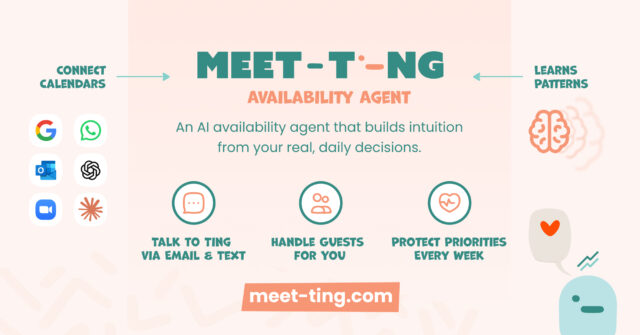
Google-backed startup Meet-Ting is testing whether people are ready to hand over calendar control to AI agents that learn their priorities. The London-based company’s new availability agent manages scheduling over email and text.
Meet-Ting, or Ting fir short, can manage calendars without relying on dashboards or booking links. It operates directly inside email and messaging threads. Users copy or message the agent, which then handles the coordination.
The idea is simple but ambitious. Instead of asking users to define detailed rules, Ting observes how they behave. Each interaction helps the system learn preferences around timing, urgency, and relationships.
Over time, the agent will build a working model of what matters to the user. That includes which meetings get accepted, which are postponed, and how conflicts are resolved. It’s described as teaching the AI judgment rather than instructions.
During a six-month beta, some users reportedly booked as many as 20 meetings per month through the agent. These included sensitive situations such as investor meetings and job interviews. The company says this showed a willingness to trust the system with important outcomes.
Meet-Ting checks in
Meet-Ting is designed to be different from traditional scheduling assistants. Rather than waiting for commands, the agent acts on its own once it understands a user’s patterns. It can suggest changes, follow up on no-shows, and prepare context ahead of meetings.
Each week, the agent checks in with users about how their calendar compares with their goals in order to keep the system giving users the service they need.
The startup is also focused on how AI agents will interact with one another. Meet-Ting expects more work conversations to happen inside LLM environments rather than standalone tools, so has built its product to run across email, WhatsApp, and AI-driven chat services.
By staying inside these channels, Ting collects context that static calendars don’t capture, including tone, hierarchy, and the back-and-forth that shapes real scheduling decisions. This data stays private and is only used to train models specific to each user.
Meet-Ting says growth has been steady, with several thousand users signed up so far, of which about half of them actively interact with the agent.
“The question isn’t whether AI can book meetings, it’s whether people will let it,” said Dan Bulteel, co-founder of Meet-Ting. “What we’ve learned is that delegation happens when the technology understands what you value. We’re building toward a world where everyone has an availability agent, whether that’s coordinating with people, other agents, or enterprise systems.”
What do you think about AI managing your calendar for you? Let us know in the comments.


