In this tutorial, we build an advanced, fully autonomous logistics simulation in which multiple smart delivery trucks operate within a dynamic city-wide road network. We design the system so that each truck behaves as an agent capable of bidding on delivery orders, planning optimal routes, managing battery levels, seeking charging stations, and maximizing profit through self-interested decision-making. Through each code snippet, we explore how agentic behaviors emerge from simple rules, how competition shapes order allocation, and how a graph-based world enables realistic movement, routing, and resource constraints. Check out the FULL CODES here.
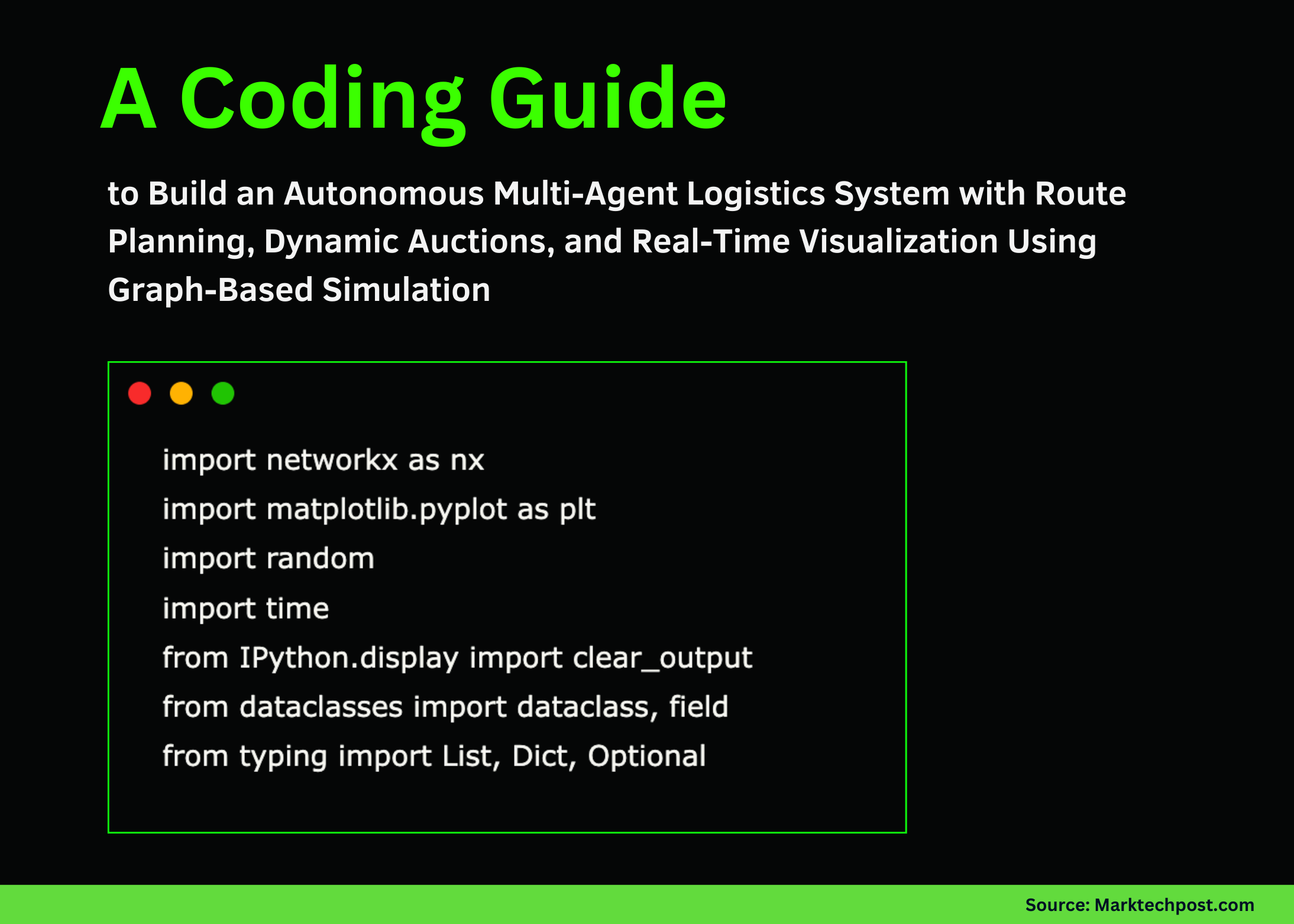
import networkx as nx import matplotlib.pyplot as plt import random import time from IPython.display import clear_output from dataclasses import dataclass, field from typing import List, Dict, Optional NUM_NODES = 30 CONNECTION_RADIUS = 0.25 NUM_AGENTS = 5 STARTING_BALANCE = 1000 FUEL_PRICE = 2.0 PAYOUT_MULTIPLIER = 5.0 BATTERY_CAPACITY = 100 CRITICAL_BATTERY = 25 @dataclass class Order: id: str target_node: int weight_kg: int payout: float status: str = "pending" class AgenticTruck: def __init__(self, agent_id, start_node, graph, capacity=100): self.id = agent_id self.current_node = start_node self.graph = graph self.battery = BATTERY_CAPACITY self.balance = STARTING_BALANCE self.capacity = capacity self.state = "IDLE" self.path: List[int] = [] self.current_order: Optional[Order] = None self.target_node: int = start_nodeWe set up all the core building blocks of the simulation, including imports, global parameters, and the basic data structures. We also define the AgenticTruck class and initialize key attributes, including position, battery, balance, and operating state. We lay the foundation for all agent behaviors to evolve. Check out the FULL CODES here.
def get_path_cost(self, start, end): try: length = nx.shortest_path_length(self.graph, start, end, weight='weight') path = nx.shortest_path(self.graph, start, end, weight='weight') return length, path except nx.NetworkXNoPath: return float('inf'), [] def find_nearest_charger(self): chargers = [n for n, attr in self.graph.nodes(data=True) if attr.get('type') == 'charger'] best_charger = None min_dist = float('inf') best_path = [] for charger in chargers: dist, path = self.get_path_cost(self.current_node, charger) if dist < min_dist: min_dist = dist best_charger = charger best_path = path return best_charger, best_path def calculate_bid(self, order): if order.weight_kg > self.capacity: return float('inf') if self.state != "IDLE" or self.battery < CRITICAL_BATTERY: return float('inf') dist_to_target, _ = self.get_path_cost(self.current_node, order.target_node) fuel_cost = dist_to_target * FUEL_PRICE expected_profit = order.payout - fuel_cost if expected_profit < 10: return float('inf') return dist_to_target def assign_order(self, order): self.current_order = order self.state = "MOVING" self.target_node = order.target_node _, self.path = self.get_path_cost(self.current_node, self.target_node) if self.path: self.path.pop(0) def go_charge(self): charger_node, path = self.find_nearest_charger() if charger_node is not None: self.state = "TO_CHARGER" self.target_node = charger_node self.path = path if self.path: self.path.pop(0)We implement advanced decision-making logic for the trucks. We calculate shortest paths, identify nearby charging stations, and evaluate whether an order is profitable and feasible. We also prepare the truck to accept assignments or proactively seek charging when needed. Check out the FULL CODES here.
def step(self): if self.state == "IDLE" and self.battery < CRITICAL_BATTERY: self.go_charge() if self.state == "CHARGING": self.battery += 10 self.balance -= 5 if self.battery >= 100: self.battery = 100 self.state = "IDLE" return if self.path: next_node = self.path[0] edge_data = self.graph.get_edge_data(self.current_node, next_node) distance = edge_data['weight'] self.current_node = next_node self.path.pop(0) self.battery -= (distance * 2) self.balance -= (distance * FUEL_PRICE) if not self.path: if self.state == "MOVING": self.balance += self.current_order.payout self.current_order.status = "completed" self.current_order = None self.state = "IDLE" elif self.state == "TO_CHARGER": self.state = "CHARGING"We manage the step-by-step actions of each truck as the simulation runs. We handle battery recharging, financial impacts of movement, fuel consumption, and order completion. We ensure that agents transition smoothly between states, such as moving, charging, and idling. Check out the FULL CODES here.
class Simulation: def __init__(self): self.setup_graph() self.setup_agents() self.orders = [] self.order_count = 0 def setup_graph(self): self.G = nx.random_geometric_graph(NUM_NODES, CONNECTION_RADIUS) for (u, v) in self.G.edges(): self.G.edges[u, v]['weight'] = random.uniform(1.0, 3.0) for i in self.G.nodes(): r = random.random() if r < 0.15: self.G.nodes[i]['type'] = 'charger' self.G.nodes[i]['color'] = 'red' else: self.G.nodes[i]['type'] = 'house' self.G.nodes[i]['color'] = '#A0CBE2' def setup_agents(self): self.agents = [] for i in range(NUM_AGENTS): start_node = random.randint(0, NUM_NODES-1) cap = random.choice([50, 100, 200]) self.agents.append(AgenticTruck(i, start_node, self.G, capacity=cap)) def generate_order(self): target = random.randint(0, NUM_NODES-1) weight = random.randint(10, 120) payout = random.randint(50, 200) order = Order(id=f"ORD-{self.order_count}", target_node=target, weight_kg=weight, payout=payout) self.orders.append(order) self.order_count += 1 return order def run_market(self): for order in self.orders: if order.status == "pending": bids = {agent: agent.calculate_bid(order) for agent in self.agents} valid_bids = {k: v for k, v in bids.items() if v != float('inf')} if valid_bids: winner = min(valid_bids, key=valid_bids.get) winner.assign_order(order) order.status = "assigned"We create the simulated world and orchestrate agent interactions. We generate the graph-based city, spawn trucks with varying capacities, and produce new delivery orders. We also implement a simple market where agents bid for tasks based on profitability and distance. Check out the FULL CODES here.
def step(self): if random.random() < 0.3: self.generate_order() self.run_market() for agent in self.agents: agent.step() def visualize(self, step_num): clear_output(wait=True) plt.figure(figsize=(10, 8)) pos = nx.get_node_attributes(self.G, 'pos') node_colors = [self.G.nodes[n]['color'] for n in self.G.nodes()] nx.draw(self.G, pos, node_color=node_colors, with_labels=True, node_size=300, edge_color='gray', alpha=0.6) for agent in self.agents: x, y = pos[agent.current_node] jitter_x = x + random.uniform(-0.02, 0.02) jitter_y = y + random.uniform(-0.02, 0.02) color = 'green' if agent.state == "IDLE" else ('orange' if agent.state == "MOVING" else 'red') plt.plot(jitter_x, jitter_y, marker='s', markersize=12, color=color, markeredgecolor='black') plt.text(jitter_x, jitter_y+0.03, f"A{agent.id}n${int(agent.balance)}n{int(agent.battery)}%", fontsize=8, ha='center', fontweight='bold', bbox=dict(facecolor='white', alpha=0.7, pad=1)) for order in self.orders: if order.status in ["assigned", "pending"]: ox, oy = pos[order.target_node] plt.plot(ox, oy, marker='*', markersize=15, color='gold', markeredgecolor='black') plt.title(f"Graph-Based Logistics Swarm | Step: {step_num}nRed Nodes = Chargers | Gold Stars = Orders", fontsize=14) plt.show() print("Initializing Advanced Simulation...") sim = Simulation() for t in range(60): sim.step() sim.visualize(t) time.sleep(0.5) print("Simulation Finished.")We step through the full simulation loop and visualize the logistics swarm in real time. We update agent states, draw the network, display active orders, and animate each truck’s movement. By running this loop, we observe the emergent coordination and competition that define our multi-agent logistics ecosystem.
In conclusion, we saw how the individual components, graph generation, autonomous routing, battery management, auctions, and visualization, come together to form a living, evolving system of agentic trucks. We watch as agents negotiate workloads, compete for profitable opportunities, and respond to environmental pressures such as distance, fuel costs, and charging needs. By running the simulation, we observe emergent dynamics that mirror real-world fleet behavior, providing a powerful sandbox for experimenting with logistics intelligence.
Check out the FULL CODES here. Also, feel free to follow us on Twitter and don’t forget to join our 100k+ ML SubReddit and Subscribe to our Newsletter. Wait! are you on telegram? now you can join us on telegram as well.

Asif Razzaq
Asif Razzaq is the CEO of Marktechpost Media Inc.. As a visionary entrepreneur and engineer, Asif is committed to harnessing the potential of Artificial Intelligence for social good. His most recent endeavor is the launch of an Artificial Intelligence Media Platform, Marktechpost, which stands out for its in-depth coverage of machine learning and deep learning news that is both technically sound and easily understandable by a wide audience. The platform boasts of over 2 million monthly views, illustrating its popularity among audiences.