“Slop” isn’t the only problem.
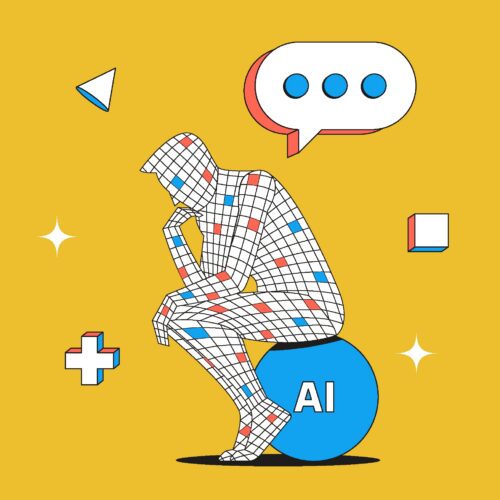
AI model deep in thought on the yellow background. Machine learning, artificial intelligence concept. Vector illustration. Credit: Getty Images
YouTube currently requires that content creators let viewers know “when they use AI to meaningfully alter or generate photorealistic content.”
The policy draws some strange boundaries. It applies to “AI-generated music” (not photorealistic) but not to “riding a unicorn through a fantastical world” (this could be photorealistic, though it is not plausible). YouTube then summarizes the policy in a different way: “Realistic AI content and meaningful changes require disclosure, while non-realistic or minor edits don’t.”
But AI uses that require no disclosure can include everything from “idea generation” up through “production assistance, like using generative AI tools to create or improve a video outline, script, thumbnail, title, or infographic.” Creators are free to clone their own voices for voiceovers. They can also use “AI-generated or altered animation of a missile in a fully animated video.”
This results in some odd scenarios. A thrilling 10-second video that shows me riding my AI-generated steed through the horse-killing-fart swamps of Soylentius IV? No disclosure, even though the entire thing is AI-generated. But when I add an AI-crafted lute ballad about the grave dangers I faced in those swamps? Mandatory disclosure.
The policy gap becomes more consequential when you imagine a 30-minute video attempting to sway people’s views on geopolitics. AI could generate the premise, do the research, and write the outline. My own AI-cloned voice model could read the AI-drafted script. I could even use AI-generated missile animations. Must I disclose the rampant AI use that drove this entire project? Apparently not.
But having an AI help in these ways imparts a certain feel and logic to projects, even if the final result is not fully “AI-generated.” Humans approaching topics without AI might find sources through quite different paths, and they might have to read and process more material to get there, giving them a different kind of understanding. They might also note very different things as important, thus creating different outlines of the same material. They might pepper a script with jokes or digressions not usually suggested by an AI. And they might read a script aloud in a more natural way.
This doesn’t make the AI wrong, but it does mean that the AI-assisted work will feel different.
Meet my research assistant
I was thinking about this because noted science YouTuber Hank Green recently apologized to fans for his overreliance on AI. Green has made clear that “my words are mine” and that he writes his own scripts. But after fans complained about perceived AI influence on his work, Green looked at his process and concluded they might be right.
“I have been relying too heavily on AI as a research aid,” Green wrote in a Reddit post on July 31. “It can be very useful for this task, giving me access to a lot of papers I didn’t know existed really fast, but I think that has been to the detriment of my work because it has not given me the freedom to find all of my own ways into and around a topic.”
The problem, in Green’s case, seems to have been the pressure to produce felt by so many content creators. He used that pressure as a fruitful spur to creation, but he also dealt with it by “using AI to locate papers and other resources for learning about topics.” This quest for efficiency eventually had him moving “so fast that my own process isn’t actually clear to me.”
Green concluded that “making more things does not make me make better things.” And he said that he still needs to come to terms “with the fact that the level of dopamine I’ve been getting from interacting with LLMs… with doing more and more and more and more… is not healthy for me or good for the world.”
The result is likely to be fewer videos.
Beneath the surface
YouTube’s AI disclosure policy and Green’s own wrestling with the technology illuminate different sides of the same question: When does AI support human effort—and when does it replace it in ways that matter?
YouTube’s concern is primarily about outright deception. Its policy requires disclosure when a video shows “a real person appear to say or do something they didn’t do” or “realistic scene that didn’t actually occur.” Noting AI use in these cases can be a hedge against the cruder forms of disinformation.
But Green’s self-critique is subtler. Far below this “photorealistic” layer of deception, extensive AI use can shape the very basis of creation: ideation, research, and outlining. That is not the same thing as saying that AI use is bad or that its results are inaccurate. It is to say that, even if all AI outputs are correct and well-crafted, they might still possess a style and geometry inherited from the machine now guiding the process.
Turning too early—or too easily—to an AI may crowd out offbeat ideas. AI-assisted research may supply answers but not domain mastery. And an AI-generated outline, whether for an essay or a YouTube video, may lock the mind into a predetermined track before it has the chance to wander—and perhaps arrive somewhere more personal.