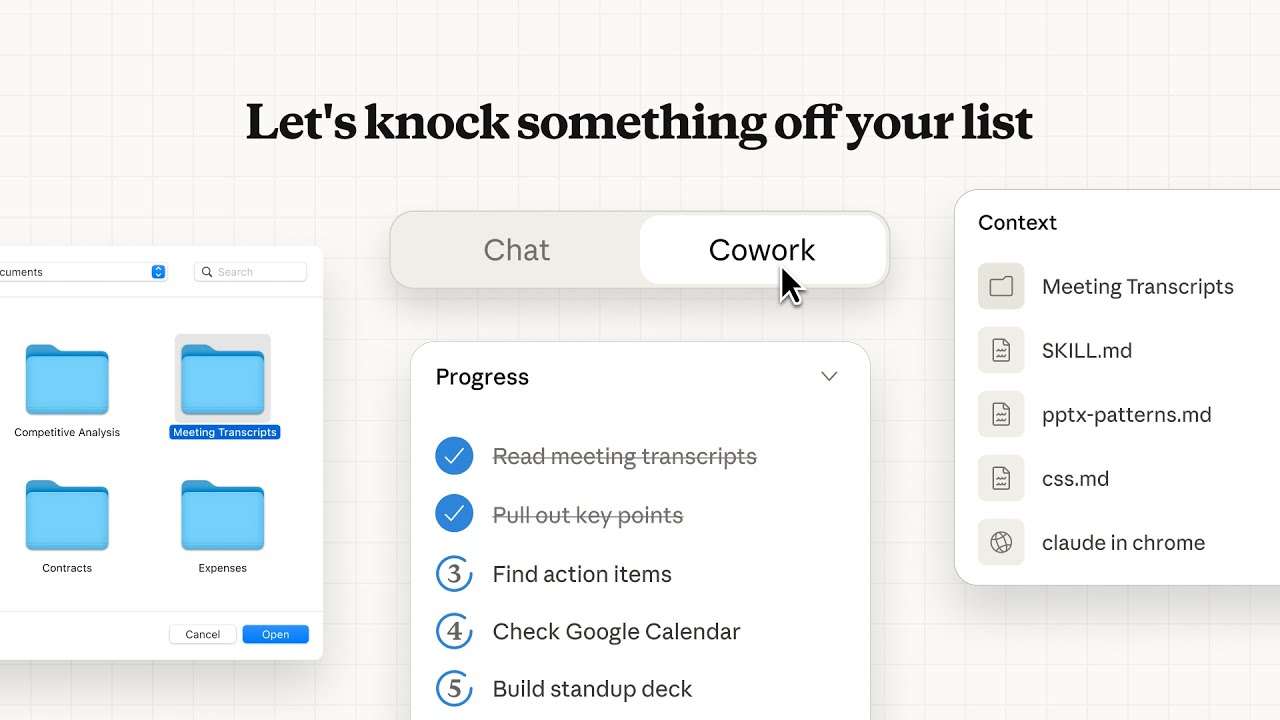
Anthropic has released Cowork, a new feature that runs agentic workflows on local files for non coding tasks currently available in research preview inside the Claude macOS desktop app.
What Cowork Does At The File System Level
Cowork currently runs as a dedicated mode in the Claude desktop app. When you start a Cowork session, you choose a folder on your system. Claude can then read, edit, or create files only inside that folder.
Anthropic gives concrete examples. Claude can reorganize a downloads folder by sorting and renaming files. It can read a directory of screenshots, extract amounts, and build an expense spreadsheet. It can traverse scattered notes in that folder and produce a structured report draft.
The interface keeps the interaction in the standard chat surface. You describe the task in natural language. Claude constructs an internal plan, executes file operations, and streams status messages as it progresses. You can continue to send follow up instructions while the work is running.
Relationship To Claude Code And Claude Agent SDK
Cowork is not a separate model. Anthropic states that Cowork is built on the same foundations as Claude Code and that it uses the Claude Agent SDK as the underlying agent stack.
Claude Code started as a command line oriented environment that allowed developers to run shell commands and mutate project files using natural language, with later web and Slack interfaces on top. Many Max users pushed Claude Code into non coding workflows, using it as a general purpose agent that operates on arbitrary directories and tools. That usage pattern directly informed Cowork.
TechCrunch describes Cowork as a more accessible version of Claude Code, implemented as a sandboxed instance of the same agent stack. Users still designate a specific folder, but there is no need to work in a terminal or configure virtual environments.
Connectors, Skills, And Browser Based Workflows
Cowork can extend beyond local storage. Anthropic allows Cowork to reuse existing Claude connectors, which integrate external services such as Asana, Notion, and PayPal. Cowork also supports an initial set of Skills that are optimized for constructing documents, presentations, and similar artifacts. These Skills package instructions and resources for specific job functions.
When Cowork is paired with Claude in Chrome, the same agent plan can include browser steps. Anthropic and The Verge articles both highlight browser related tasks where Claude can follow links, read pages, and act inside web apps under user supervision.
This combination gives Cowork a three layer tool surface:
- Local file system access restricted to the chosen folder.
- Connectors for structured external systems.
- Browser actions through Claude in Chrome.
From an implementation perspective, this is a standard agent tool configuration on top of the Claude Agent SDK. The difference is that Cowork hides the tool graph and exposes only a conversational task interface.
Agentic Behavior, Planning, And Parallel Tasks
Anthropic stresses that Cowork runs with more agency than a regular Claude conversation. Once you specify a task, Claude builds a plan, executes a series of tool calls and file operations, and keeps you updated about intermediate steps.
You do not need to paste context repeatedly or manually convert outputs. Cowork reuses the folder as a persistent context boundary. It writes intermediate artifacts directly into that directory, then consumes those artifacts in subsequent steps.
Safety Model, Access Control, And Prompt Injection
Because Cowork operates on real files, safety constraints are explicit in the product design. Anthropic states that users choose which folders and connectors Claude can see. Claude cannot read or edit content outside those structures.
Cowork always asks for confirmation before it takes significant actions. Ofcourse, with all the benefits, there are some heads-up: It is recommended to give precise instructions and warns that misinterpretation is possible.
Anthropic also calls out prompt injection as a primary risk. If Claude processes untrusted content on the internet or in local documents, that content can attempt to alter the plan and steer behavior away from user intent. Anthropic says it has deployed defenses, but it describes agent safety, defined as securing real world actions, as an ongoing research problem.
Availability
Cowork is available today as a research preview for Claude Max subscribers using the macOS desktop application. The Max plan is priced between $100 and $200 dollars per month depending on usage. Users on other plans can join a waitlist. Anthropic plans to add cross device sync and Windows support in future iterations.
Key Takeaways
- Local folder scoped agent: Cowork runs inside the Claude macOS app as an agent that can read, edit, and create files only inside user selected folders, giving Claude direct file system access with explicit scoping.
- Same stack as Claude Code, different surface: Cowork is built on the same Claude Agent SDK foundations as Claude Code, but targets non coding workflows through a GUI instead of a terminal based developer interface.
- Tools: files, connectors, browser: Cowork combines three tool layers in one plan, local file operations, Claude connectors for services like Notion or Asana, and browser actions via Claude in Chrome.
- Agentic, multi step execution: Once given a task, Cowork plans and executes multi step workflows, streams progress updates, and can queue multiple tasks in parallel, rather than operating as a single prompt response loop.
- Constrained but destructive capable: Access is limited to chosen folders and configured connectors, and Cowork asks before major actions, but it can still perform destructive operations such as file deletions, so it must be treated like a powerful automation tool, not a harmless chat bot.
Check out the Technical details here. Also, feel free to follow us on Twitter and don’t forget to join our 100k+ ML SubReddit and Subscribe to our Newsletter. Wait! are you on telegram? now you can join us on telegram as well.
Check out our latest release of ai2025.dev, a 2025-focused analytics platform that turns model launches, benchmarks, and ecosystem activity into a structured dataset you can filter, compare, and export.

Maxime Mommessin
Max is an AI analyst at MarkTechPost, based in Silicon Valley, who actively shapes the future of technology. He teaches robotics at Brainvyne, combats spam with ComplyEmail, and leverages AI daily to translate complex tech advancements into clear, understandable insights