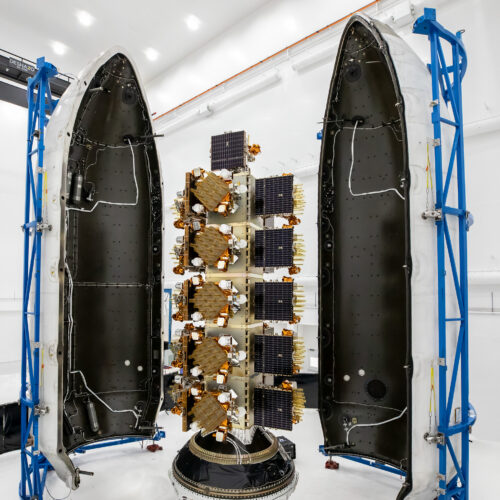
SpaceX has won a lucrative contract to provide the US military with a means of distributing space-based sensing and targeting data, forming the “backbone” of a rearchitected network after separate Pentagon initiatives stalled, officials announced Tuesday.
Space Systems Command, the Space Force’s primary procurement and acquisition center, announced the $2.29 billion firm-fixed-price agreement, confirming long-simmering reports that the Pentagon was likely to tap SpaceX for a new communications network in low-Earth orbit. SpaceX’s selection for the Space Data Network (SDN) Backbone contract “accelerates the delivery of a resilient, high-speed communications network in space,” Space Systems Command said in a statement.
The network will be based on technology originally developed for SpaceX’s Starlink global Internet constellation. SpaceX already builds and launches specially designed satellites, called Starshield, for military applications. The SDN Backbone network in low-Earth orbit (LEO) will presumably use the Starshield platform.
“This award will enhance the network with an expanded optically interconnected mesh of satellites delivering worldwide tactical communications and broadband communication services,” Space Systems Command said.
Col. Ryan Frazier, acting Space Force portfolio acquisition executive for Space-Based Sensing and Targeting, said the network “leverages the best of commercial innovation” and will be a “huge benefit and enabler” for US military forces. The network “acts as a core communications layer for the USSF war-fighting systems, ensuring our sensors and shooters are connected continuously, globally and securely,” Frazier said in a press release.
Changing midstream
This may sound familiar to anyone who has kept up with the evolution of a Pentagon office named the Space Development Agency. Established in 2019, SDA started launching prototypes for a constellation of missile-tracking and data-relay satellites in 2023. The idea was to rapidly procure, develop, and field new generations of tracking and data “transport” satellites every two years. SDA’s strategy was to cast a wide net across the US space industry, using satellites and sensors developed by many companies.