Jet lag and charging added plenty of complications to this regularity road rally.
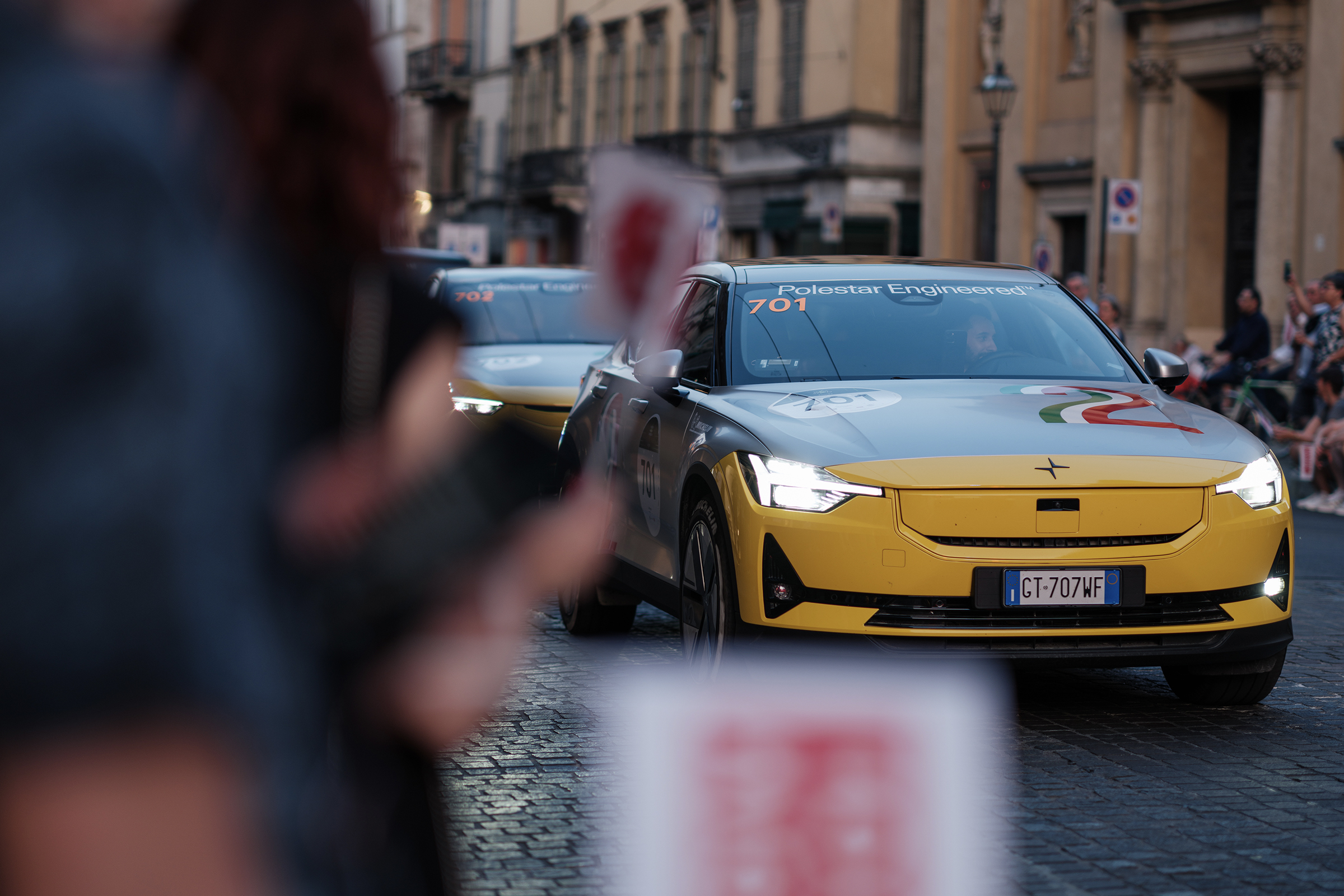
Until 1957, the Mille Miglia—a thousand miles—was a high-speed road race through Italy, conducted on public roads. Now it’s a little less serious, and no one is trying to complete the distance in under 10 hours. Particularly in an EV. Credit: Polestar
Until 1957, the Mille Miglia—a thousand miles—was a high-speed road race through Italy, conducted on public roads. Now it’s a little less serious, and no one is trying to complete the distance in under 10 hours. Particularly in an EV. Credit: Polestar
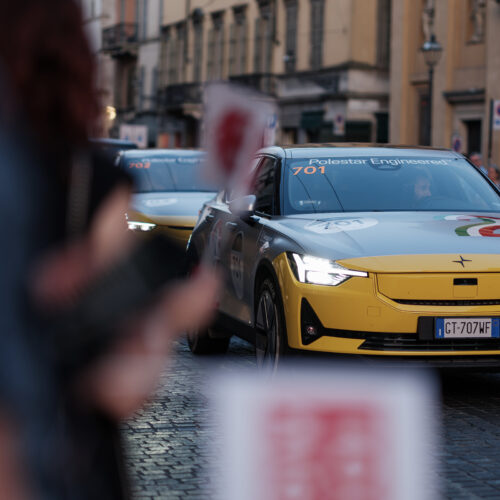
On the first day of this year’s Mille Miglia, a voice rose from the crowds gathered on the shore of Lago di Garda to shout “no sound, no feeling!”at my Polestar 3. Italians love their cars, and they revealed a clear preference for internal combustion engines over the next four days and over 1,200 km of driving. But plenty of other spectators smiled and waved, and some even did a double-take at seeing an electric vehicle amid the sea of modern Ferraris and world-class vintage racers taking on this modern regulation rally.
I flew to Italy to join the Mille Miglia “Green,” which, for the past five years, has sought to raise awareness of sustainability and electric cars amid this famous (some might say infamous) race. And despite mixed reactions from the Italian crowds, our Polestar 3 performed quite well as it traced a historical route from Brescia to Rome and back.
The route snaked a trail through the Italian countryside based on the original speed race’s first 12 outings, but instead of going for overall pace, we spent five days competing against six other EVs for points based on time, distance, and average speed. Our team included a Polestar 2 and 4, and we faced a Mercedes-Benz G 580 with EQ Technology, an Abarth 600e, a Lotus Eletre, and a BYD Denza Z9GT saloon.
I was nervous when I arrived to participate in the drive. I still had to learn how to actually compete in a regulation rally, and my co-driver Chris Rosales and I lacked familiarity with the charging infrastructure of Europe. On our first day leaving Brescia, I took over navigation duties, given my experience with interpreting roadbook Christmas trees while chasing the Dakar Rally in 2023. But day one quickly revealed that navigation wouldn’t factor much into the challenge, as our ragtag convoy of EVs and support cars had a dedicated pace car and police cruiser to lead us through the day.
Don’t go too fast, don’t go too slow
Instead, the points-earning time trials of the Mille Miglia Green threw us for a loop. In the roadbook, red-highlighted short sections ranged from eight seconds to four minutes, while in the real world, little red stop signs dictated the start and end of these timed stints. Without any coaching, and having read an iffy English translation of the rulebook, we struggled to set the proper pace while counting down on an iPhone stopwatch through 24 time trials. Sometimes we went too fast and had to brake to a snail’s pace before the finish, and other times we clearly drove too slowly and had to floor it.
The Polestars stood out a little against the backdrop of vintage race cars. Polestar
By the time we handed in our stamped timecard at the end of the road in Ferrara over seven hours later—with no stops for food, water, coffee, or even a restroom in between—the challenge of charging emerged for the first time. But first, we had a quick 30-minute break for dinner, which was an eight-minute walk from where we were directed to park, and there was a 10-minute line for the single available restroom. We then hopped back in the Polestar 3 for another 1.5-hour drive to Bologna, where we desperately needed to charge the car before trying to get some sleep ahead of an early wakeup the next morning.
We followed two new Italian friends driving the Polestar 2 over to a local “fast” charger but discovered that with both of our cars plugged in, the station maxed out at just a 48 kW charge speed. This meant we wouldn’t top up until around midnight—not exactly great given the next morning’s 3:30 am wakeup call—so Rosales and I drove five minutes to another charge station with multiple 300 kW plugs.
By the time we got there, though, a fleet of Denza, Lotus, and Abarth crews had already arrived—and the Lotuses wouldn’t recognize one of the chargers. Facing the prospect of waiting in a slow line, we drove 15 minutes to another station, operated by a company called Intuity, and used a charger that peaked at 170 kW to add 62 kWh in 32 minutes, bringing us up to 90 percent SOC with 330 km of range showing on the Polestar’s gauge screen.
We’re… last?
I awoke in the dark morning to a text from my co-driver, who cheerfully informed me that we’d finished the first day dead last in the Green ranking. OK, time to lock in—and this was my day to drive. Day two featured a bevy of similar time trials, which we now understood better, as well as an average-speed challenge along a portion of our route to Siena. But even holding steady by a few hundred meters into the 8.61 km at a dictated average speed of 31 km/h, other cars started passing us.
Halfway through, I asked Rosales to figure out how long it would take to cover the distance at that speed, and we realized our speedometer must be a few km/h off. So I again punched the pedal at the last second and managed a perhaps ill-judged overtake. We figured we might have reached the end somewhere near the prescribed average speed.
My heart rate jumped a bit during that maneuver, but for most of the day, we cruised along behind the pace car and police escort, traversing spectacular hillside roads through some of the most gorgeous countryside on the planet. The timed portion of the day ended in Siena’s picturesque Palazzo Publico, where we parked for lunch as around 400 classics competing in the standard Mille Miglia pulled in behind us.
But this day ended with a parade through Rome, so we scarfed down lunch and headed off to charge once again. This time, the Polestar team took pity on our jetlag and let us climb into a support car to nap as our 3 topped up.
Unfortunately, the logistics of juggling three race entries and three support cars proved too overwhelming, and our team ran hours behind schedule, resulting in the entire group missing the parade through the streets of Rome. It was a massive failure from an optics perspective, given the crowds and photo ops, but it was also a bummer for us drivers, since the historic Mille always ran from Brescia to Rome and back at top speed.
Not last
My partner and I awoke at 4 am the next morning to discover we had moved up a place—hooray! Despite our speedometer issues, my decision to sprint ahead at the end of the average-speed section had clearly paid off. OK, we were learning. But on day three’s route northward from Rome, the entire EV group made a wrong turn almost immediately. From the navigator’s seat, I hollered at Rosales not to follow. Alone on the correct route, we discovered the pace car, which waved us ahead to wait for the lost teams.
Luckily, this afforded us a chance to discover the true heart of the Mille Miglia, mixing it up with the modern Ferraris ahead through winding hills as the early morning mist burned off. From hillside town to hillside town, V12 engines echoing off the marble walls of tiny towns, we could imagine the fun of racing in the early days.
When a few owners stopped for coffee and pastries, we did too, and I sipped the best espresso doppio I’ve had in years. Talk about quintessential Italian life! But the reverie proved short-lived. In my overcaffeinated, sleep-deprived state, I soon made a math error that cost us a few seconds in the next average speed trial.
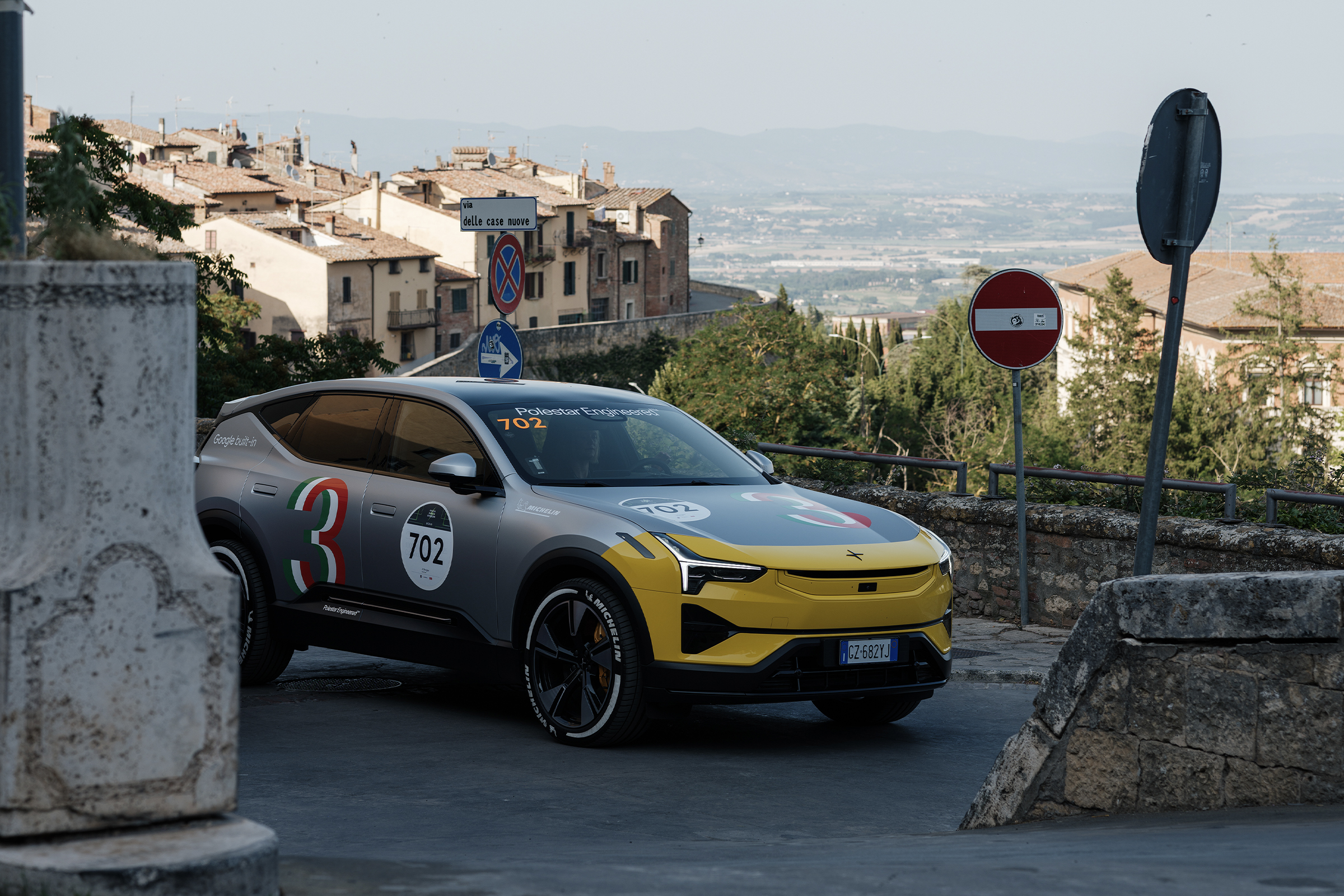
The view was usually stupendous.
Credit: Polestar
The view was usually stupendous. Credit: Polestar
After the first sector, we regrouped with the rest of the Green cars and got caught behind Ferraris driving interminably slowly on a gravel section right during a time trial. (Ahead of us, last year’s Green winner Mirco Magni sacrificed a whole stage to let a gap grow. Later, he explained that the penalty for missing the time by five seconds is the same as for five minutes, something we never located in the English rulebook translation.)
That night, we got a miraculous five hours of sleep, but I still woke up concerned about our rankings. Sure enough, we’d done well in scoring but also earned two “TC” penalties. I slipped behind the wheel of the Polestar, but today we decided to stop for espresso early in the morning, as we’d learned to enjoy ourselves the day before. This time, the vintage cars caught up with us, and I sipped my desperately needed caffeine while watching as a support crew swapped out fouled spark plugs on a Bugatti Type 37.
We then hustled to keep up with a veritable fleet of the open-wheel Bugattis and Alfa Romeos while driving up one of the most incredible mountain roads I’ve ever been on. In the Polestar, we could have easily sprinted away, but we instead sat transfixed by the sight, sound, and smell of tall tires squealing, engines roaring and belching smoke, and drivers and passengers leaning into turns as hard as possible. Really, these century-old cars drove harder than the support crews, eventually getting bound up into clumps on the tight roads west of Cervia.
Rosales and I got chewed out at lunch that day for breaking off from the Green group, but we shrugged it off. With a points win well out of reach, we wanted to enjoy the Mille Miglia more than worry about caravanning through the country at low speeds behind the pace car and police escort.
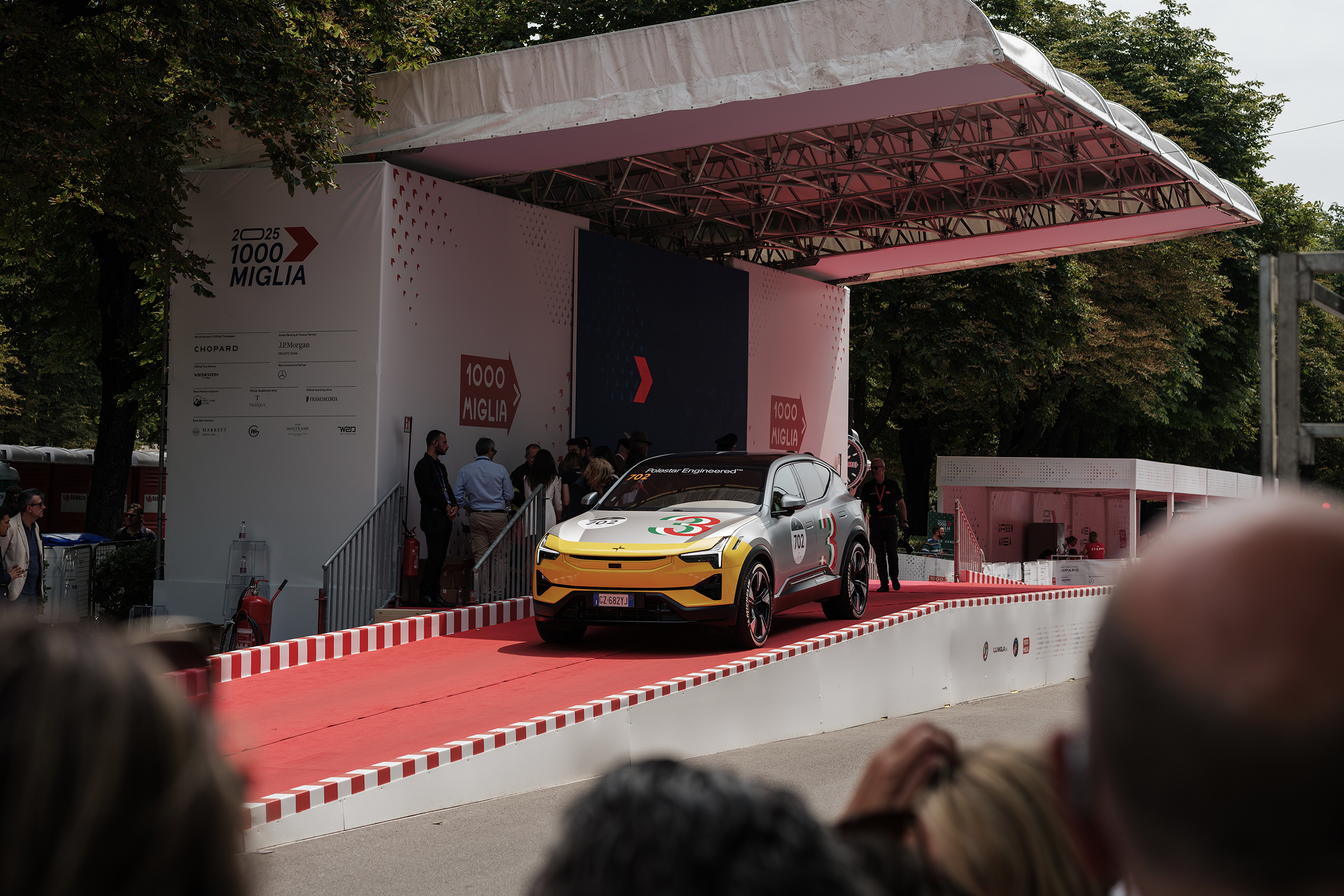
If not victory, then at least the finish line.
Credit: Polestar
If not victory, then at least the finish line. Credit: Polestar
The last day dashed any hope of exploring more vintage fun, though. Instead, we traveled at something nearer to parade pace through small towns on the loop back to Brescia. Out of boredom, I started trying to drift around every roundabout, and we hoped to nail the time trials and maybe jump up the rankings one or two spots. In the end, though, despite doing second or third best in points and penalties after the first day’s mistakes, we wound up beating only the Polestar 2 and G 580 in the Green—not bad, in fairness, for two absolute amateurs using an iPhone stopwatch and Waze speedometer instead of the legit rally computers in every other car.
What did we learn?
Would I do the Mille Miglia again? Only with a rally computer, but also only in a vintage car. The rules stipulate that only classics from 1957 and earlier qualify, which creates the real challenge of keeping the car running in the scorching heat. Still, in the classic race, there are fewer restrictions that the Green put on us. I’d probably choose a Lancia, Alfa, or Fiat, though a Gullwing, Bugatti, or four-cam 356 Carrera would do, too, of course. Plus, the race covered around 1,900 km this year, with transits we used as opportunities to sleep or charge, resulting in our scant 1,202.88-km total distance raced.
But we discovered that an EV can compete in the Mille Miglia Green, and our Polestar 3 consistently outperformed its range estimates while managing just shy of 20 kW per 100 km each day. We noticed only a couple of glitches, including a volume knob that repeatedly stopped working. We also had to do a hard reset after a momentary bricking.
Still, it was hard to escape the general feeling—from both the race organizers and the general public—that we were something of an afterthought, second-class citizens relegated to staying in our place well apart from the main event, parking sometimes 600 meters from the historical cars at stops and being scolded when we tried to join the actual competition cars. But Polestar nonetheless notched another win for Mirco Magni and his co-driver Federico Giavardi in the 2.
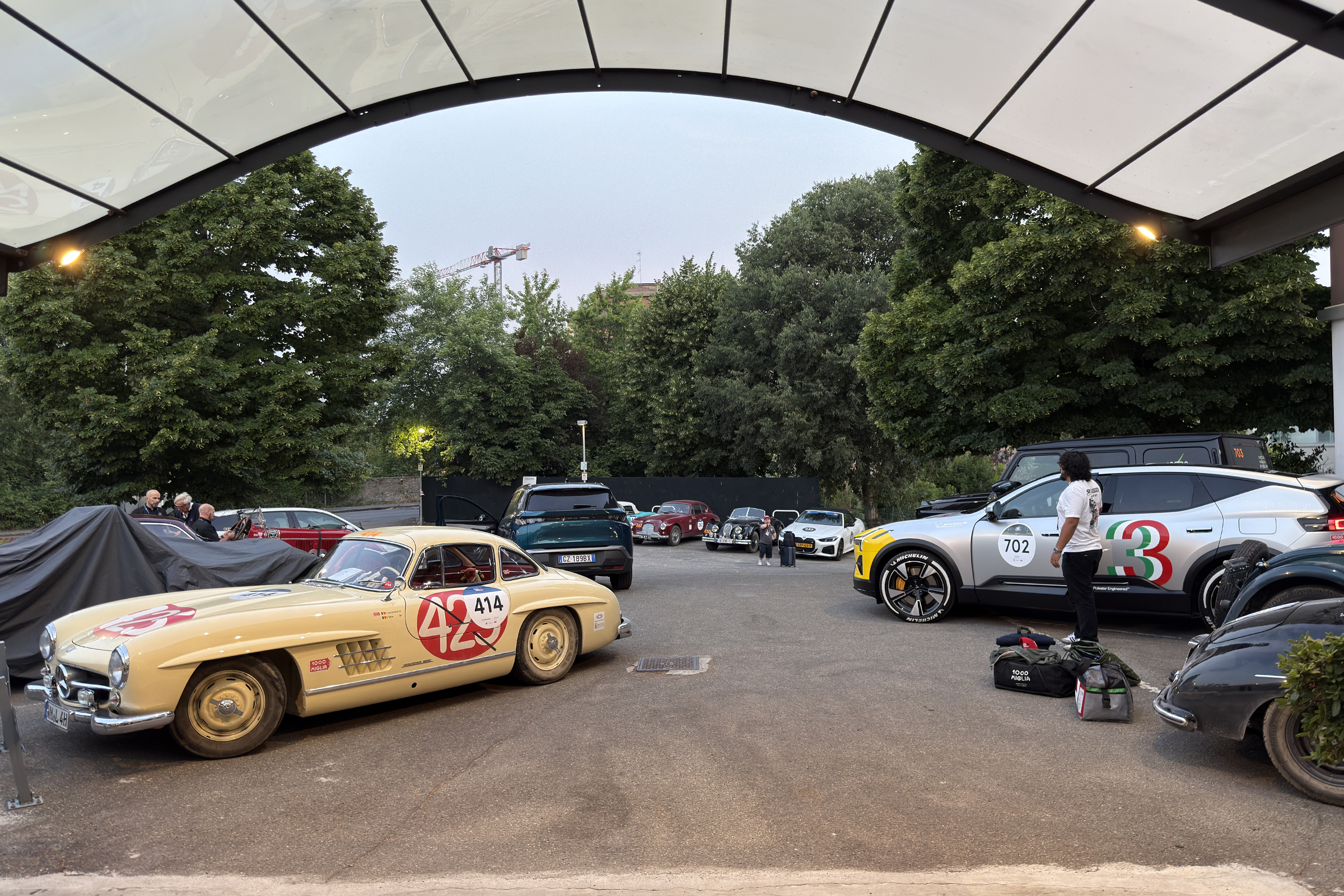
Were I to do it again, I would prefer something like the Mercedes Gullwing on the left over the Polestar 3 on the right.
Credit: Michael Teo Van Runkle
Were I to do it again, I would prefer something like the Mercedes Gullwing on the left over the Polestar 3 on the right. Credit: Michael Teo Van Runkle
On the other hand, the time commitment of charging made the Mille Miglia Green a sleep-deprivation challenge as much as anything. We always started before the classics, so a couple of hours dedicated to adding electrons resulted in an average night’s sleep of just four hours—seriously hard to maintain for five days straight, especially while doing mental math in a moving car, all while battling jetlag.
Perhaps the rules should allow only EV conversions of classic cars, which typically have less range and therefore pose a greater challenge by requiring charging during stages. Or the Green cars could earn points not just in the time trials and average-speed sections but also based on total distance covered and range remaining. This would make navigation and efficiency more important, as opposed to the motorcycle “slow race” style of points and penalty scoring that did not reward us for our superior roadbook skills.
Either would be a different style of regulation rally, but those tweaks would also provide a style of competition more in line with the original spirit of the Mille Miglia speed race, an undeniably enjoyable affair that truly earns the nickname “the most beautiful race in the world.”