All the news that’s fit to lift
“We are fundamentally shifting our approach to securing our munitions supply chain.”
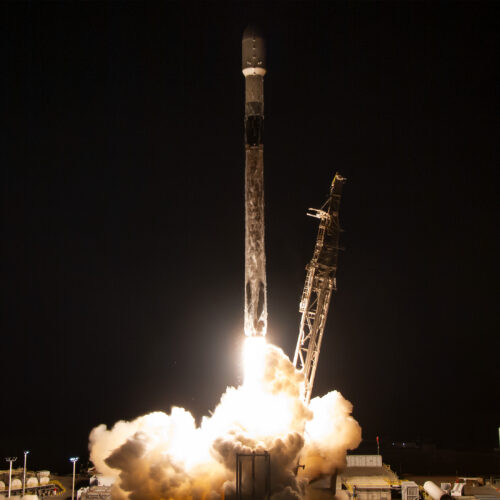
SpaceX launched the Pandora satellite for NASA on Sunday. Credit: SpaceX
Welcome to Edition 8.25 of the Rocket Report! All eyes are on Florida this weekend as NASA rolls out the Space Launch System rocket and Orion spacecraft to its launch site in Florida for the Artemis II mission. NASA has not announced a launch date yet, and this will depend in part on how well a “wet dress rehearsal” goes with fueling the rocket. However, it is likely the rocket has a no-earlier-than launch date of February 8. Our own Stephen Clark will be in Florida for the rollout on Saturday, so be sure and check back here for coverage.
As always, we welcome reader submissions, and if you don’t want to miss an issue, please subscribe using the box below (the form will not appear on AMP-enabled versions of the site). Each report will include information on small-, medium-, and heavy-lift rockets as well as a quick look ahead at the next three launches on the calendar.

MaiaSpace scores a major launch deal. The ArianeGroup subsidiary, created in 2022, has inked a major new launch contract with satellite operator Eutelsat, Le Monde reports. A significant portion of the 440 new satellites ordered by Eutelsat from Airbus to renew or expand its OneWeb constellation will be launched into orbit by the new Maia rocket. MaiaSpace previously signed two contracts: one with Exotrail for the launch of an orbital transfer, and the other for two satellites for the Toutatis mission, a defense system developed by U-Space.
A big win for the French firm … The first test launch of Maia is scheduled for the end of 2026, a year later than initially planned, at the Guiana Space Centre in French Guiana. The first flights carrying OneWeb satellites are therefore likely to launch no earlier than 2027. Powered by liquid oxygen-methane propellant, Maia aims to be able to deliver up to 500 kg to low-Earth orbit when the first stage is recovered, and 1,500 kg when fully expendable.
Firefly announces Alpha upgrade plan. Firefly Aerospace said this week it was planning a “Block II” upgrade to its Alpha rocket that will “focus on enhancing reliability, streamlining producibility, and improving launch operations to further support commercial, civil, and national security mission demand.” Firefly’s upcoming Alpha Flight 7, targeted to launch in the coming weeks, will be the last flown in the current configuration and will serve as a test flight with multiple Block II subsystems in shadow mode.
Too many failures … “Firefly worked closely with customers and incorporated data and lessons learned from our first six Alpha launches and hundreds of hardware tests to make upgrades that increase reliability and manufacturability with consolidated parts, key configuration updates, and stronger structures built with automated machinery,” said Jason Kim, CEO of Firefly Aerospace. Speaking bluntly, reliability upgrades are needed. Of Alpha’s six launches to date, only two have been a complete success. (submitted by TFargo04)
The easiest way to keep up with Eric Berger’s and Stephen Clark’s reporting on all things space is to sign up for our newsletter. We’ll collect their stories and deliver them straight to your inbox.
Another PSLV launch failure. India’s first launch of 2026 ended in failure due to an issue with the third stage of its Polar Satellite Launch Vehicle (PSLV), Spaceflight Now reports. The mission, designated PSLV-C62, was also the second consecutive failure of this four-stage rocket, with both anomalies affecting the third stage. This time, 16 satellites were lost, including those of other nations. ISRO said it initiated a “detailed analysis” to determine the root cause of the anomaly.
Has been India’s workhorse rocket … The four-stage launch vehicle is a mixture of solid- and liquid- fueled stages. Both the first and third stages are solid-fueled, while the second and fourth stages are powered by liquid propulsion. The PSLV Rocket has flown in multiple configurations since it debuted in September 1993 and achieved 58 fully successful launches, with the payloads on those missions reaching their intended orbit.
US military invests in L3Harris rocket motors. The US government will invest $1 billion in L3Harris Technologies’ growing rocket motor business, guaranteeing a steady supply of the much-needed motors used in a wide range of missiles such as Tomahawks and Patriot interceptors, CNBC reports. L3Harris said on Tuesday it is planning an IPO of its growing rocket motor business into a new publicly traded company backed by a $1 billion government convertible security investment. The securities will automatically convert to common equity when the company goes public later in 2026.
Shifting investment strategy … “We are fundamentally shifting our approach to securing our munitions supply chain,” said Michael Duffey, undersecretary of defense for acquisition and sustainment. “By investing directly in suppliers we are building the resilient industrial base needed for the Arsenal of Freedom.” However, the government’s equity position in L3Harris could face blowback from L3Harris’ rivals, given that it creates a potentially significant conflict of interest for the US government. The Pentagon will have an ownership stake in a company that regularly bids on major defense and other government contracts.

First Ariane 64 to launch next month. Arianespace announced Thursday that it plans to launch the first variant of the Ariane 6 rocket with four solid rocket boosters on February 12 from French Guiana. The mission will also be the company’s first launch of Amazon Leo (formerly Project Kuiper) satellites. This is the first of 18 Ariane 6 launches that Arianespace sold to Amazon for the broadband communications megaconstellation.
A growing cadence … The Ariane 6 rocket has launched five times, including its debut flight in July 2024. All of the launches were a success, although the first flight failed to relight the upper stage in order to make a controlled reentry. Arianespace increased the cadence to four launches last year and will seek to try to double that this year.
Falcon 9 launches the Pandora mission. NASA’s Pandora satellite rocketed into orbit early Sunday from Vandenberg Space Force Base, California, Ars reports. It hitched a ride with around 40 other small payloads aboard a SpaceX Falcon 9 rocket, launching into a polar Sun-synchronous orbit before deploying at an altitude of roughly 380 miles (613 kilometers).
A satellite that can carry a tune … Pandora will augment the capabilities of NASA’s James Webb Space Telescope. Over the next few weeks, ground controllers will put Pandora through a series of commissioning and calibration steps before turning its eyes toward deep space. From low-Earth orbit, Pandora will observe exoplanets and their stars simultaneously, allowing astronomers to correct their measurements of the planet’s atmospheric composition and structure based on the ever-changing conditions of the host star itself.
ArianeGroup seeking ideas for Ariane 6 reuse. In this week’s newsletter, we’ve already had a story about MaiaSpace and another item about the Ariane 6 rocket. So why not combine the two and also have a report about an Ariane 6 mashup with the Maia rocket? As it turns out, there’s a relatively new proposal to retrofit the existing Ariane 6 rocket design for partial reuse with Maia rockets as side boosters, Ars reports.
Sir, maia I have some cost savings? … It’s infeasible to recover the Ariane 6’s core stage for many reasons. Chief among them is that the main stage burns for more than seven minutes on an Ariane 6 flight, reaching speeds about twice as fast as SpaceX’s Falcon 9 booster achieves during its two-and-a-half minutes of operation during launch. Swapping out Ariane 6’s solid rocket motors for reusable liquid boosters makes some economic sense for ArianeGroup. The proposal would bring the development and production of the boosters under full control of ArianeGroup and its French subsidiary, cutting Italy’s solid rocket motor developer, Avio, out of the program. All the same, we’ll believe this when we see it.
Meet the EtherealX Razor Crest Mk-1. I learned that there is a rocket company founded in Bengaluru, India, named Ethereal Exploration Guild, or EtherealX. (Did you see what they did there?) I found this out because the company announced (via email) that it had raised an oversubscribed $20.5 million Series A round led by TDK Ventures and BIG Capital. So naturally, I went to the EtherealX website looking for more information.
Let me say, I was not disappointed … As you might expect from a company named EtherealX, its proposed rocket has nine engines, is powered by liquid oxygen and kerosene, and has a maximum capacity of 24.8 metric tons to low-Earth orbit. (Did you see what they did there?) The website does not include much information, but there is this banger of a statement: “The EtherealX Razor Crest Mk-1 will house 9 of the most powerful operational liquid rocket engines in Asia, Europe, Australia, Africa, South America, and Antarctica – Stallion.” And let’s be honest, when you’ve bested Antarctica in engine development, you know you’re cooking. Alas, what I did not see on the website was much evidence of real hardware.

NASA topples historic Saturn and shuttle infrastructure. Two historic NASA test facilities used in the development of the Saturn V and space shuttle launch vehicles have been demolished after towering over the Marshall Space Flight Center in Alabama since the start of the Space Age, Ars reports. The Propulsion and Structural Test Facility, which was erected in 1957—the same year the first artificial satellite entered Earth orbit—and the Dynamic Test Facility, which has stood since 1964, were brought down by a coordinated series of implosions on Saturday, January 10.
Out with the old, in with the new … Located in Marshall’s East Test Area on the US Army’s Redstone Arsenal in Huntsville, the two structures were no longer in use and, according to NASA, had a backlog of $25 million in needed repairs. “This work reflects smart stewardship of taxpayer resources,” Jared Isaacman, NASA administrator, said in a statement. “Clearing outdated infrastructure allows NASA to safely modernize, streamline operations and fully leverage the infrastructure investments signed into law by President Trump to keep Marshall positioned at the forefront of aerospace innovation.”
Space Force swaps Vulcan for Falcon 9. The next Global Positioning System satellite is switching from a United Launch Alliance Vulcan rocket to a SpaceX Falcon 9, a spokesperson for the US Space Force Space Systems Command System Delta 80 said Tuesday, Spaceflight Now reports. SpaceX could launch the GPS III Space Vehicle 09 (SV09) within the next few weeks, as the satellite was entering the final stages of pre-flight preparations.
The trade is logical … SV09 was originally awarded to ULA as part of order-year five of the National Security Space Launch (NSSL) Phase 2 contract, which was announced on October 31, 2023. This isn’t the first time that the Space Force has shuffled timelines and switched launch providers for GPS missions. In May 2025, SpaceX launched the GPS III SV08 spacecraft, which was originally assigned to ULA in June 2023. In exchange, ULA was given the SV11 launch, which would have flown on a Falcon Heavy rocket. The changes have been driven largely by repeated delays in Vulcan readiness.
Next three launches
January 16: Long March 3B | Unknown payload | Xichang Satellite Launch Center, China | 16:55 UTC
January 17: Ceres 2 | Demo flight | Jiuquan Satellite Launch Center, China | 04:05 UTC
January 17: Falcon 9 | NROL-105 | Vandenberg Space Force Base, Calif. | 06:18 UTC


Eric Berger is the senior space editor at Ars Technica, covering everything from astronomy to private space to NASA policy, and author of two books: Liftoff, about the rise of SpaceX; and Reentry, on the development of the Falcon 9 rocket and Dragon. A certified meteorologist, Eric lives in Houston.