“I think there’s plenty of fire lit under them already.”
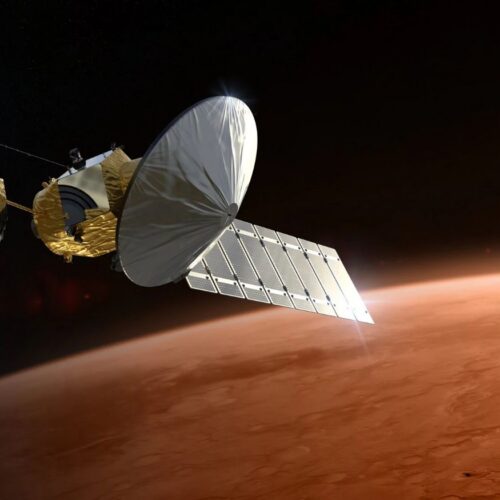
A rendering of Rocket Lab’s design for the Mars Telecommunications Network Credit: Rocket Lab
NASA released a much-anticipated contract solicitation for a Mars-orbiting spacecraft late last week, kicking off what is sure to be a hotly contested and potentially controversial procurement.
At issue is $700 million, already appropriated by Congress, to build a spacecraft, launch it to Mars, and once there to serve as a vehicle to relay communications between the red planet and Earth. But the stakes may be even bigger than this, including the possible resurrection of the recently canceled Mars Sample Return mission.
As part of the new solicitation, NASA says it will conduct the acquisition “as a full and open competition.” But will it? That’s the question that several people involved with this procurement process are asking. And it could turn messy, quickly.
What is not controversial is that NASA needs a new spacecraft capable of relaying communications from Mars to Earth. NASA’s best communications relay today is the Mars Reconnaissance Orbiter, which has now been there for 20 years. It’s a great spacecraft, but it’s getting long in the tooth.
The US Congress, more or less out of the blue, stepped up with $700 million in funding for a new Mars Telecommunications Orbiter in the “One Big Beautiful Bill” passed in 2025. Ars previously wrote about this legislation, which raised some eyebrows, as this is a large appropriation for a relatively straightforward spacecraft.
Competition is narrowed
Proposals to build the spacecraft, the name of which has been changed to Mars Telecommunications Network (MTN), are due by June 15. A contract is expected to be awarded by October 1, less than five months from now.
There was some curious wording in the legislation that funded the Mars orbiter. It specified the spacecraft must be selected from among US companies that “received funding from the Administration in fiscal year 2024 or 2025 for commercial design studies for Mars Sample Return; and proposed a separate, independently launched Mars telecommunication orbiter supporting an end-to-end Mars sample return mission.”
Similar language ended up in NASA’s procurement notice, which states that to be eligible to bid, a company needs to “demonstrate that the Offeror proposed a separately and independently launched Mars telecom orbiter to support an end-to-end Mars Sample Return mission.”
That seems like a curious requirement. Why must the bidder for a relatively straightforward orbiter around Mars have previously proposed an orbiter as part of an “end-to-end” mission to return samples from Mars? Was Congress seeking to be preferential for a particular company?
Some hints about what is happening
The One Big Beautiful Bill was signed into law on July 4, 2025. One month later, as part of its Q2 Investor Update, Rocket Lab included a slide about its plans to support human missions to Mars. In the corner of the slide, the company noted that $700 million had just been appropriated for a Mars orbiter (MTO).
“Rocket Lab was the only commercial provider to propose a MTO as part of an end-to-end Mars Sample Return mission to support human exploration and science missions to Mars,” the slide stated.
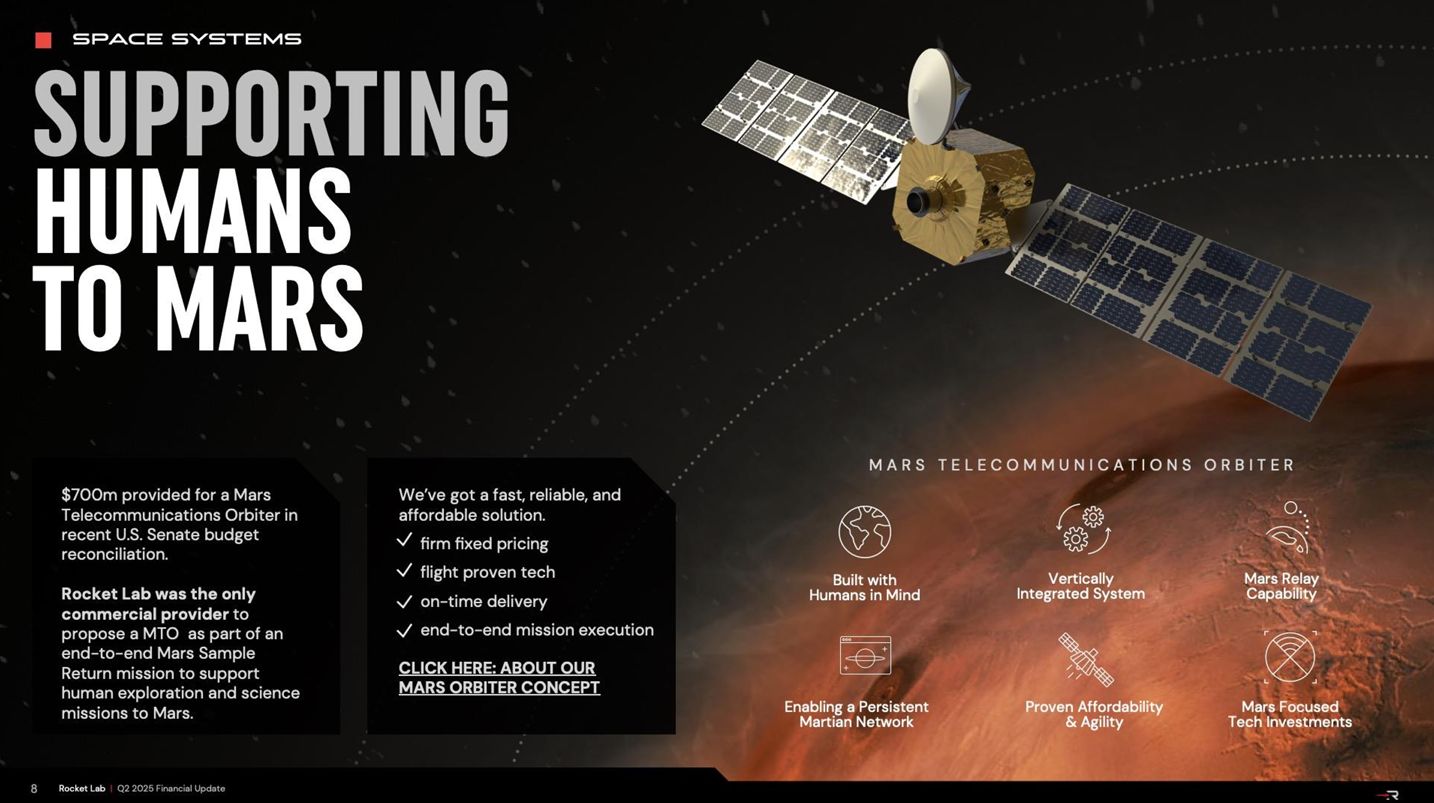
Slide from Rocket Lab Q2 2025 Investor Update.
Credit: Rocket Lab
Slide from Rocket Lab Q2 2025 Investor Update. Credit: Rocket Lab
Rocket Lab is one of several companies eligible to compete based on the requirement that bidders have received funding in 2024 or 2025 for a “commercial design study” for a Mars Sample Return mission. Other eligible bidders include: Blue Origin, L3Harris, Lockheed Martin, Northrop Grumman, SpaceX, Quantum Space, and Whittinghill Aerospace.
At an “Industry Day” event earlier this year, NASA officials indicated that the contract solicitation would be released by May 1. However, it was two weeks late. Weeks matter when NASA is seeking to have this spacecraft built and launched before the end of the next Mars launch window in late 2028.
Ars’ Stephen Clark recently asked Rocket Lab chief executive Peter Beck if he knew why this delay had occurred. He said he did not. Beck was also asked whether NASA was moving quickly enough given the schedule constraints.
“I think there’s plenty of fire lit under them already,” Beck said. “They understand the importance of the mission. So I think we just need to get it out there, and they need to get it awarded, and everybody needs to get to work.”
One source indicated to Ars that this delay was due in part to a letter sent by US Sen. Roger Wicker, R-Miss, earlier in May to NASA. According to this source, Wicker’s letter was interpreted as favorable toward Rocket Lab’s position in the competition.
Despite multiple efforts, Ars has been unable to obtain a copy of this letter. A NASA spokesperson, noting that the agency is now in a “blackout” period due to the contract solicitation’s release, declined to confirm the existence of Wicker’s letter or to release it.
Mars Sample Return
Why would Wicker be interested in a space company like Rocket Lab, which was founded in New Zealand and now has its headquarters in Long Beach, California?
The answer probably lies in the Stennis Space Center, a rocket engine test facility in southern Mississippi. Rocket Lab already tests its Archimedes rocket engine there and plans to test engines for its Mars orbiter there. Additionally, two sources indicated, the company would likely do more testing there if NASA’s Mars Sample Return (MSR) program were resurrected.
Do you remember Mars Sample Return? NASA’s plan to return Martian rocks and soil to Earth came under severe scrutiny three years ago when its projected price tag ballooned to $10 billion. This led to much debate, including NASA ultimately asking for cheaper “commercial” proposals from companies like Rocket Lab.
“We were a relatively loud voice on MSR, because we just saw a program and a capability that could be solved,” Beck said in his recent interview with Ars. “The cost estimates for MSR, and all the rest of it, was just nuts. I think anybody knows that I have a bit of a soft spot for planetary sciences. So with MSR, I just saw a whole bunch of Nobel Prizes sitting on the surface there, and it was just criminal not to bring them home. As part of that, we studied the whole architecture very, very, very closely, and it was clear to us that a Mars Telecommunication Orbiter would be an important part of that.”
Not dead yet
Ultimately, the Trump White House and the US Congress, as part of the budget process, canceled the Mars Sample Return mission in January.
Only, maybe it’s not dead yet.
In March, the US Senate Committee on Commerce, Science, and Transportation unanimously passed a new NASA Authorization Act that called for a reinstatement of Mars Sample Return. According to this legislation, NASA shall “establish within the Science Mission Directorate a new Mars Sample Return program for the purpose of returning scientifically curated samples from Mars to Earth.” This mission should cost no more than $8 billion, according to the bill.
Although this legislation has not passed the full US Congress, we can draw some clues from it. Sen. Ted Cruz, R-Texas, chairs the committee that authored the bill, and he likely supports a revival of Mars Sample Return because it would bring new facilities and prestige to Johnson Space Center in Texas. Rocket Lab, if it were to obtain the contract to build a Mars orbiter, would have a leg up in the contracting process to develop the rest of the sample return mission. Testing for these vehicles, including a Mars Ascent Vehicle, could happen in Mississippi.

Eric Berger is the senior space editor at Ars Technica, covering everything from astronomy to private space to NASA policy, and author of two books: Liftoff, about the rise of SpaceX; and Reentry, on the development of the Falcon 9 rocket and Dragon. A certified meteorologist, Eric lives in Houston.