“It’ll go when the engines light at T-0.”
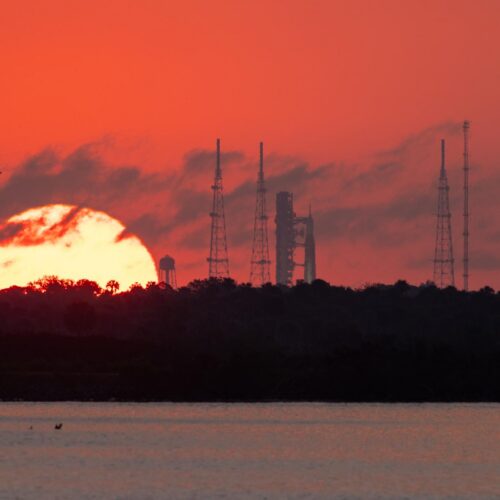
The Sun rises on NASA’s Kennedy Space Center in Florida, where the Artemis II mission is set to launch as soon as Wednesday. Credit: NASA/Ben Smegelsky
KENNEDY SPACE CENTER, Fla.—Launching to the Moon is an all-day undertaking, something the four astronauts waiting to climb aboard NASA’s Artemis II rocket know well.
“It is actually a very long day,” said Victor Glover, the pilot on Artemis II. “We wake up about eight hours before launch, and there’s a pretty tight schedule of things to get out there.”
Glover and his three crewmates have their schedules planned to the minute throughout the nine-day Artemis II mission. If all goes according to plan, their mission will carry them more than a quarter-million miles from Earth, farther from home than anyone has ventured in human history. After looping behind the Moon, the astronauts and their Orion capsule will fall back to Earth at some 25,000 mph (40,000 km/hr), setting another record for the fastest that humans have ever traveled.
Reid Wiseman, the mission commander, will join Glover at the controls inside the Orion spacecraft’s cockpit. Mission specialist Christina Koch and Canadian astronaut Jeremy Hansen round out the crew. All four have critical roles during the mission to test the Orion spaceship, which is flying with humans for the first time after 20 years in development.
The journey could begin as soon as Wednesday at NASA’s Kennedy Space Center in Florida. The mission has a two-hour launch window opening at 6:24 pm EDT (22:24 UTC). You can watch NASA’s live coverage of the countdown and launch in the YouTube stream embedded below.
The full Moon, Artemis II’s destination, will rise over the eastern horizon at the spaceport during the launch window.
Looking at the Moon has taken on a new meaning for the Artemis II astronauts since their selection for the mission three years ago. Artemis II is the first crew mission for NASA’s Artemis program. The long-term goal of Artemis is to build a sustained human presence at the Moon, with a lunar base at the Moon’s south pole, to set the stage for future expeditions to Mars.
“A destination is not just something we’re looking at,” said Koch, 47, a former spacecraft engineer and Antarctic explorer. “It is our strong hope that this mission is the start of an era where everyone, every person on Earth, can look at the Moon and think of it as also a destination.”
NASA flew nine Apollo missions to the Moon, accomplishing six landings, but humans haven’t been back since 1972. Artemis II will change that. Sixty years ago, America was racing the Soviet Union. Today, it’s China that aims to put its own citizens on the Moon by 2030. NASA’s current schedule calls for landing US astronauts on the lunar surface in 2028.
The Artemis II mission has six launch opportunities through Monday, April 6, or else it must wait until the end of the month for the next chance to shoot for the Moon. The periods available for launch hinge on several factors, such as the Moon’s location in its 28-day orbit around the Earth and trajectory constraints to ensure the Orion spacecraft has enough sunlight to charge its batteries. Additionally, NASA wants to ensure the Orion capsule reenters the atmosphere over the Pacific Ocean at precisely the correct angle. The mission’s exact trajectory depends on the day of launch.
Wiseman, the mission commander, knows there’s a chance Artemis II won’t launch Wednesday.
“The way I kind of think about it in my head is this is the first time we’re loading the crew on (the rocket), with fuel, on the pad,” said Wiseman, a 50-year-old former Navy test pilot. “NASA is ready. This vehicle is definitely ready to go. We went through the flight readiness review. We are ready to launch, but we’re also humans trying to load millions of pounds of propellant onto a giant machine and send it to the Moon.
“So it could very well be that we get on April 1, and we’re behind timeline and we’re just not ready as a team, and then we’ll probably take a 24- or 48-hour pause,” Wiseman said. “If we get off on the third, great. If we get on the sixth, great. If we’ve got an issue and we’ve got to come back in May or June or whenever the vehicle and the team are ready, we are ready for that.”
Ars has prepared a list of key things to watch for during Wednesday’s countdown. Here’s the rundown.
Will hydrogen leak again?
Sometime shortly after 7 am EDT (11:00 UTC), NASA is scheduled to begin loading more than 750,000 gallons of super-cold propellants into the 322-foot-tall (98-meter) Space Launch System (SLS) rocket. This is not a straightforward activity.
Preparations for filling the rocket with propellant will begin about 11 hours before launch with thermal conditioning of the core stage tanks to receive their cryogenic contents.
Once the tanks are properly chilled down to cryogenic temperatures, liquid hydrogen should start flowing into the core stage at around 8:30 am EDT, followed 15 minutes later by the start of liquid oxygen loading. The launch team will ramp up flow rates to “fast fill” mode on both tanks sometime around 9:00 am EDT. This will be one of the most critical phases of the countdown, when engineers watch for buildups of gaseous hydrogen around the fueling connector near the bottom of the rocket.
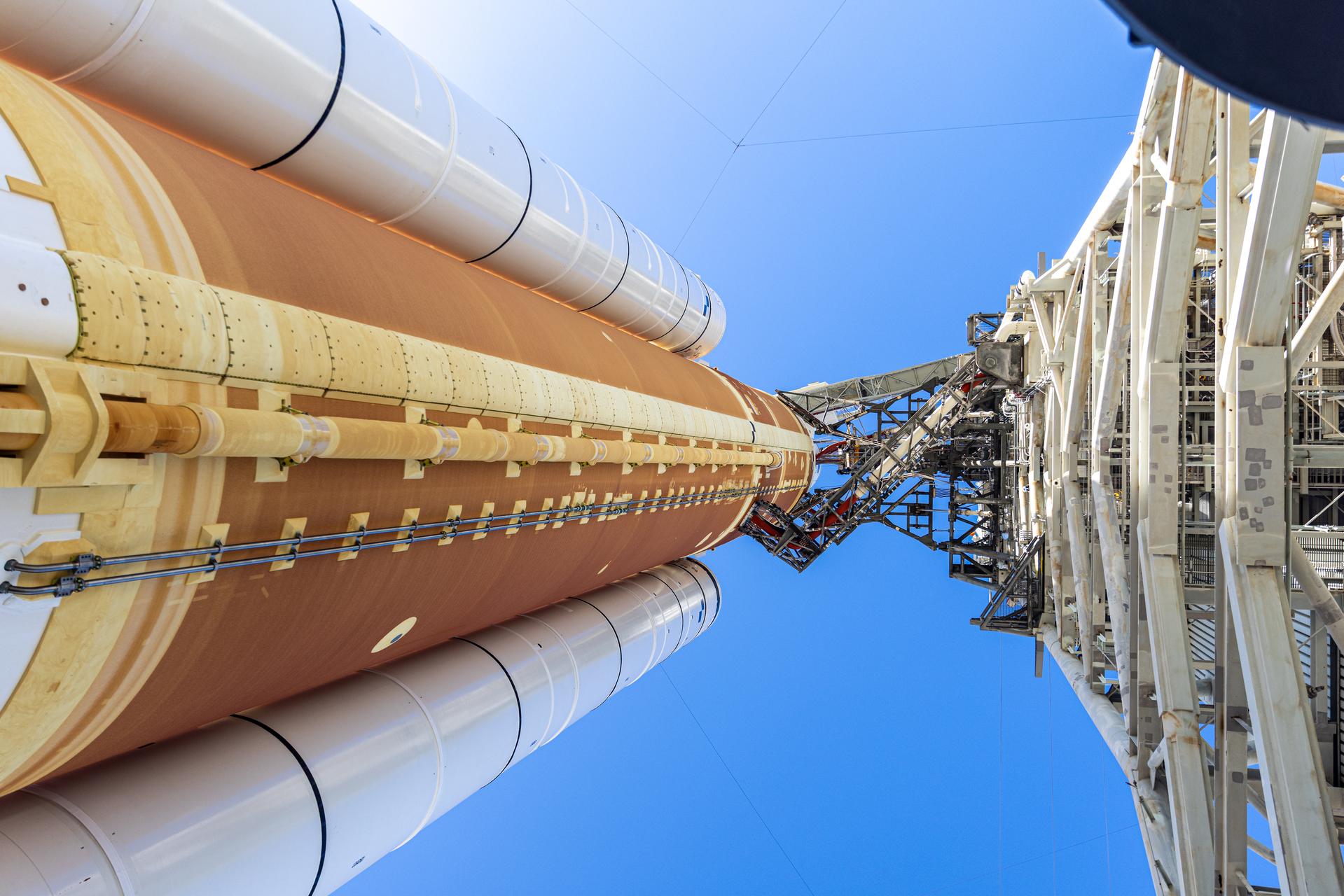
Looking straight up from the base of the SLS rocket’s mobile launch platform.
Credit: NASA/Frank Michaux
Looking straight up from the base of the SLS rocket’s mobile launch platform. Credit: NASA/Frank Michaux
Liquid hydrogen must be kept at temperatures of around minus 423° Fahrenheit (minus 253° Celsius), cold enough to freeze solid any gas it comes into contact with except for helium. Hydrogen is also the lightest element on the periodic table, and it has a propensity for finding leak paths. This is something NASA knows well after struggling with hydrogen leaks in the SLS core stage fueling line four years ago on the unpiloted Artemis I test flight. The leak recurred when the launch team attempted to fuel the rocket for Artemis II for the first time in February.
Aside from its leaky nature, liquid hydrogen stresses any materials it comes in contact with. The fluid’s cryogenic temperature can change the shape and size of seals and gaskets, creating leak paths that escape detection at ambient temperatures.
After finding leaks in February, technicians replaced the hydrogen seals on Artemis II, and the launch team sailed through a successful countdown rehearsal a few weeks later, raising confidence that the seals would hold again on launch day. But NASA officials haven’t completed an investigation into what makes the seals leak. Sensors are in place to immediately detect any buildup of hydrogen during the countdown.
It will take about three hours to fill both tanks on the SLS core stage. Liquid hydrogen and liquid oxygen will begin pumping into the rocket’s upper stage soon after the start of core stage loading. If the countdown remains on track, the rocket should be fully fueled soon after 12 pm EDT. That’s when NASA will dispatch the closeout crew to Launch Complex 39B to prepare for the arrival of the astronauts. Throughout it all, the rocket will slowly be replenished with propellant as the super-cold liquids boil off.
Crew boarding
While the launch team has its focus on activities at the launch, the Artemis II astronauts will awaken around 9:45 am EDT inside NASA crew quarters about 8 miles away. After having breakfast, the crew members will receive a weather briefing and an update on the countdown, then begin putting on their orange pressure suits they will wear for launch.
Shortly before 2 pm EDT, the four astronauts will walk out of the Neil Armstrong Operations and Checkout Building. Their families, NASA officials, and news photographers will gather outside the building to witness their departure for the launch pad. The ride inside a converted Airstream motor coach, called “Astrovan II,” will take about 20 minutes.
Upon reaching the launch pad, the astronauts will ride an elevator to the 274-foot level on the mobile launch tower next to the SLS rocket. There, they will be greeted by the closeout crew, including astronauts Jenni Gibbons and Andre Douglas, who will help strap them into their seats inside the Orion spacecraft. Crew boarding should begin shortly before 2:30 pm EDT if all remains on schedule.
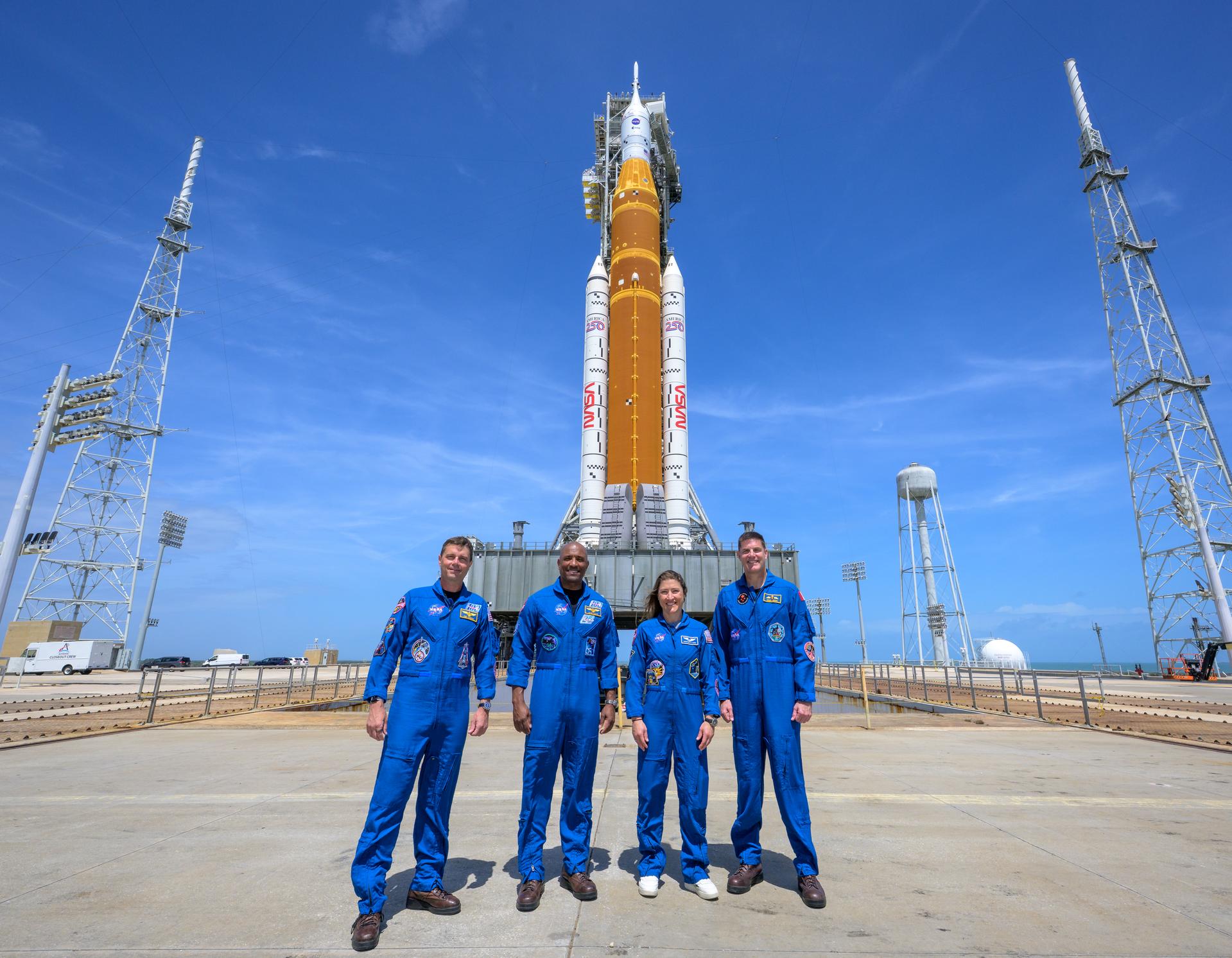
The Artemis II crew, from left to right: Reid Wiseman, Victor Glover, Christina Koch, and Jeremy Hansen.
Credit: NASA/Bill Ingalls
The Artemis II crew, from left to right: Reid Wiseman, Victor Glover, Christina Koch, and Jeremy Hansen. Credit: NASA/Bill Ingalls
“There is not a lot of time for personal ritual, I would say, but before I fly an airplane, I generally say a very short prayer, and then I try to send a note to my family, a note to tell them that I love them,” said Glover, 49, making his second flight to space. “Our families are outside the building when we walk out, and so that is the moment that I’m going to get to tell them I love them. Instead of sending a text message or a phone call, I get to tell them I love them. And I’ll still say my prayer before we all get into the vehicle. That way, I can focus on that timeline and making sure that the launch control team is not waiting on us, the crew.”
Once the crew is inside the spacecraft, the ground team at the pad will close the hatches to the Orion capsule, then swing an outer door closed on the ship’s aeroshell, which is connected to the rocket’s launch abort system. That should happen around three hours prior to liftoff, or at about 3:30 pm EDT. The closeout crew will continue configuring the launch pad for liftoff before they evacuate the complex.
Will the weather hold?
Probably. Forecasters predict an 80 percent chance of favorable weather for launch Wednesday, with a low risk of cumulus clouds and ground winds that could violate NASA’s launch commit criteria.
The concern with cumulus clouds is that if they’re tall enough, they might create a risk that the rocket could trigger lightning as it climbs through them. If the clouds reach above the freezing layer, the launch team will want to ensure the rocket will not fly through them, even if the clouds haven’t spawned an actual thunderstorm.
NASA also monitors wind direction and wind speed to ensure that the Orion spacecraft won’t be blown back over land in the event of an abort on the pad or shortly after liftoff. If onshore winds are too strong, NASA will hold the countdown.
There are other factors under consideration. Weather officers in Florida and at Johnson Space Center in Houston, home of mission control, are watching wind and wave conditions along the flight corridor over the Atlantic Ocean. If the mission suffered a launch failure, the Orion capsule could splash down anywhere along the flight path, from Florida’s east coast to the western coast of Africa. The good news is there is a less than 10 percent chance of any violation of downrange weather criteria on Wednesday.
Final poll and terminal countdown
If everything else has gone according to plan Wednesday, the countdown clock will pause at T-minus 10 minutes to allow time for NASA’s launch team to verify their readiness for launch. Charlie Blackwell-Thompson, NASA’s launch director, will orchestrate the countdown from her post inside NASA’s launch control center at Kennedy, approximately 4 miles from the pad.
She will poll the team for their “go” or “no go” for launch around 17 minutes before liftoff. If launch team is “go,” the four astronauts will close their helmet visors a couple of minutes later, and the countdown clock will resume at T-minus 10 minutes and counting.
The final steps to prepare for launch include activating the Launch Abort System, starting Auxiliary Power Units to power the core stage steering system, and switching control of the countdown to an automated sequencer at T-minus 30 seconds. After that moment, any hold in the countdown will result in a scrub for the day. Here is a snapshot of the key moments in the final minutes:
- T-08:00: Crew Access Arm retract
- T-06:00: Go for core stage tank pressurization; Orion spacecraft to internal power
- T-05:20: Launch Abort System is available
- T-04:30: Flight Termination System armed
- T-04:00: Core stage Auxiliary Power Unit start
- T-02:02: Upper stage to internal power
- T-02:00: Boosters to internal power
- T-01:30: Core stage to internal power
- T-00:50: All propellant tanks topped off for flight
- T-00:30: Automated launch sequencer start
- T-00:12: Hydrogen burn off igniters initiated
- T-00:10: Launch sequencer commands core stage engine start
- T-00:06: RS-25 engine start
- T-00:00: Booster ignition and liftoff
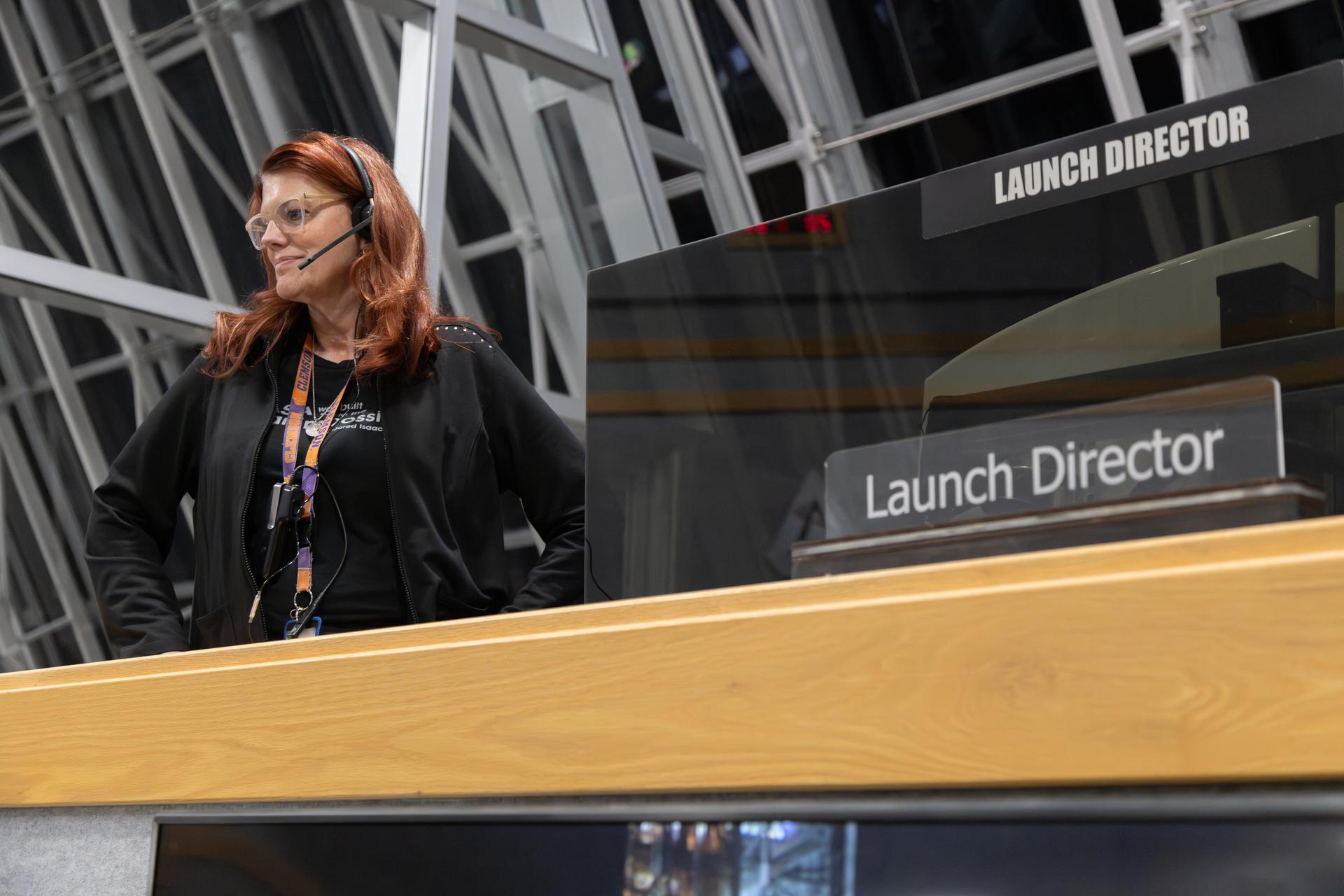
NASA launch director Charlie Blackwell-Thompson.
Credit: NASA/Amber Jean Notvest
NASA launch director Charlie Blackwell-Thompson. Credit: NASA/Amber Jean Notvest
From KSC to the Moon
The cumulative thrust from the rocket’s four RS-25 engines and twin solid rocket boosters, all holdovers from the space shuttle program, will be enough to propel the nearly 6 million-pound vehicle from its moorings at Kennedy Space Center.
A few seconds after liftoff, the rocket will roll onto the proper heading and begin arcing over the Atlantic Ocean. The trajectory will take Artemis II toward the east or northeast. The exact heading will depend on the time of launch. The rocket has a dynamic targeting capability, meaning it can adjust its heading based on when it lifts off. The azimuth changes minute by minute, varying by as much as 9 degrees during Wednesday’s two-hour window.
The rocket will surpass the speed of sound in about a minute, and the twin boosters mounted to each side of the orange core stage will burn through their solid propellants in a little more than two minutes.
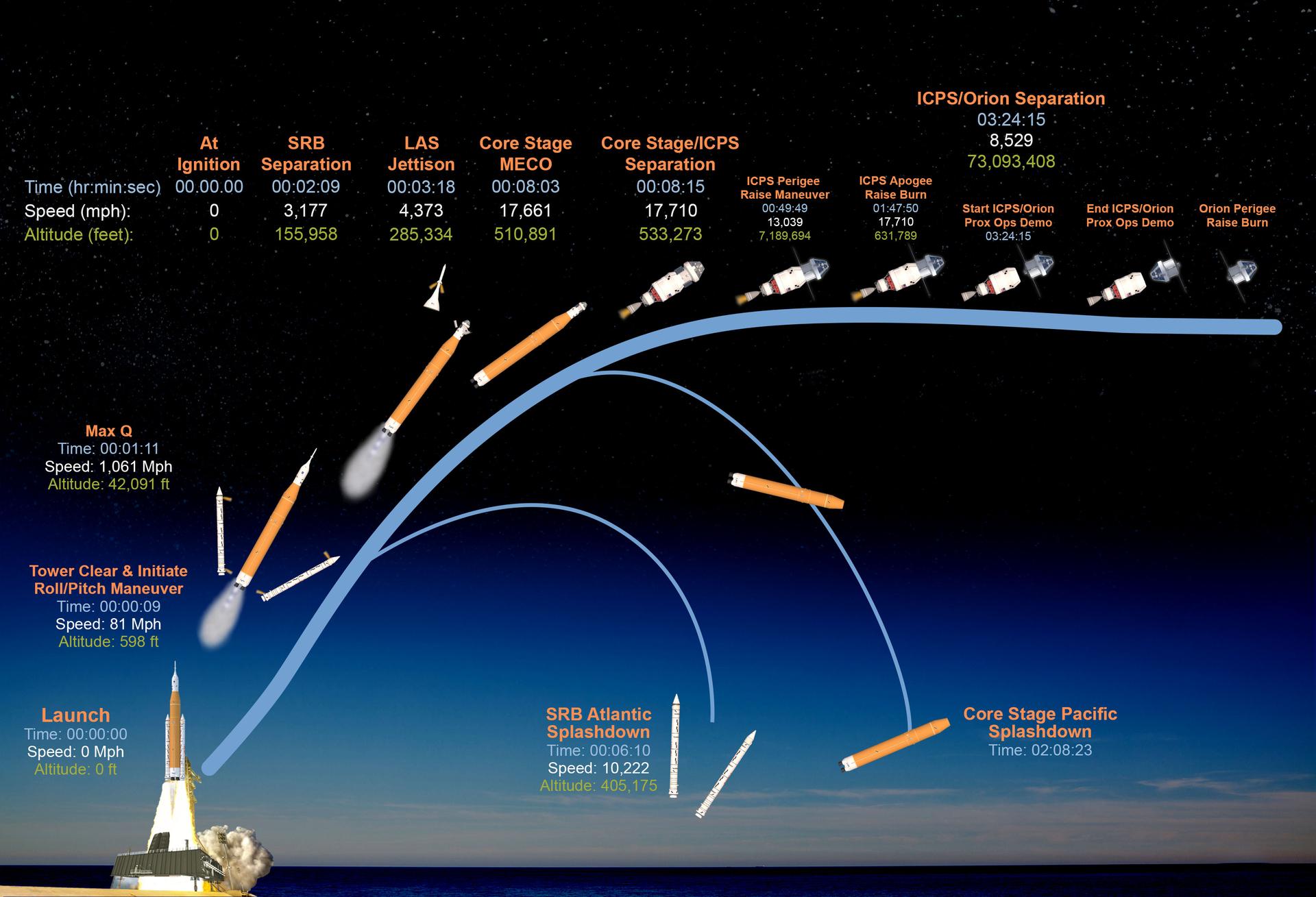
This graphic illustrates the major events during Artemis II’s climb into space.
Credit: NASA
This graphic illustrates the major events during Artemis II’s climb into space. Credit: NASA
The core stage will continue firing for more than eight minutes before jettisoning and giving way to the upper stage, which will fire its RL10 engine two times, first to reach a stable low-altitude orbit and then to climb into a higher elliptical orbit taking Orion and its crew more than 40,000 miles from Earth.
That will set the stage for the Orion capsule to separate from the upper stage about three-and-a-half hours after launch. Pilot Victor Glover and commander Reid Wiseman will take manual control of the spacecraft to maneuver it around the spent upper stage for one of the mission’s first major tests, gathering useful information to plan dockings on future missions between Orion and the landers that will ferry crews to the lunar surface.
The Artemis II astronauts will spend a day in this high-Earth orbit. Then, if Orion checks out, mission controllers will give the “go” to fire the ship’s main engine for a trans-lunar injection, or TLI, burn to kick off the journey to the Moon.
“We want to set expectations realistically,” said Hansen, the first non-US citizen to travel beyond low-Earth orbit. “It’s not [like] being on the International Space Station 250 miles away. The communications system may be really robust, and we may be able to get a lot of information back, but we might not be able to as well.”
If Artemis II lifts off Wednesday, the astronauts will soar beyond the back side of the Moon on Monday and return to Earth on April 10. We can expect live views from the Orion spacecraft and descriptions of what the astronauts see as they soar more than 4,000 miles above the Moon.
“One of the test objectives is to see how our deep space communications system works, how much bandwidth we have for transmitting high-resolution photos and video… Just imagine the Moon in the foreground and the Earth in the background, and you’re all in that shot,” Hansen said. “Yeah, we’re really excited to share that with you.”

Stephen Clark is a space reporter at Ars Technica, covering private space companies and the world’s space agencies. Stephen writes about the nexus of technology, science, policy, and business on and off the planet.