


Phishing emails containing company names see the highest click rates, while domain spoofing appears in nearly 90 percent of top-clicked attacks according to the latest Phishing Simulation Roundup from KnowBe4.
The report shows that personalization significantly increases click rates, with the two most-clicked subject lines containing recipients’ company names. Internal topics dominated engagement, appearing in 100 percent of the top 10 most-clicked subject lines, while HR-related topics were referenced in 46 percent.
Messages posing as IT notifications, training updates and routine HR communications consistently rank among the most effective phishing lures.
Analysis of phishing delivery methods further reinforces these trends. Among the top 20 hyperlinks clicked, around 87 percent referenced internal topics, and 90 percent involved domain spoofing, highlighting how closely attackers imitate legitimate business infrastructure to establish trust and prompt quick action.
“The fact that nearly 90 percent of top-clicked phishing attempts involved domain spoofing shows that attackers are successfully creating convincing illusions of legitimacy,” said Erich Kron, CISO advisor at KnowBe4. “When employees see their company name, their manager’s name, or familiar internal systems referenced in an email, their natural inclination is to trust and act quickly. Organizations must recognize that technology alone isn’t enough — building a security-conscious culture where employees feel empowered to pause and verify is our strongest defense against these increasingly deceptive attacks.”
The report also analyzed real-world phishing threats reported using the KnowBe4 Phish Alert Button. The top 10 most-reported phishing attacks impersonated trusted brands such as Microsoft, ShareFile, Google, Zoom, Adobe, Coinbase and DHL, as well as internal IT and HR departments. Overall, 62 percent of phishing landing pages users interacted with were branded, with Microsoft accounting for 22.9 percent of impersonated brands. Social media platforms collectively represented 14.5 percent.
You can see the full report on the KnowBe4 site and there’s an infographic summary of the findings below.
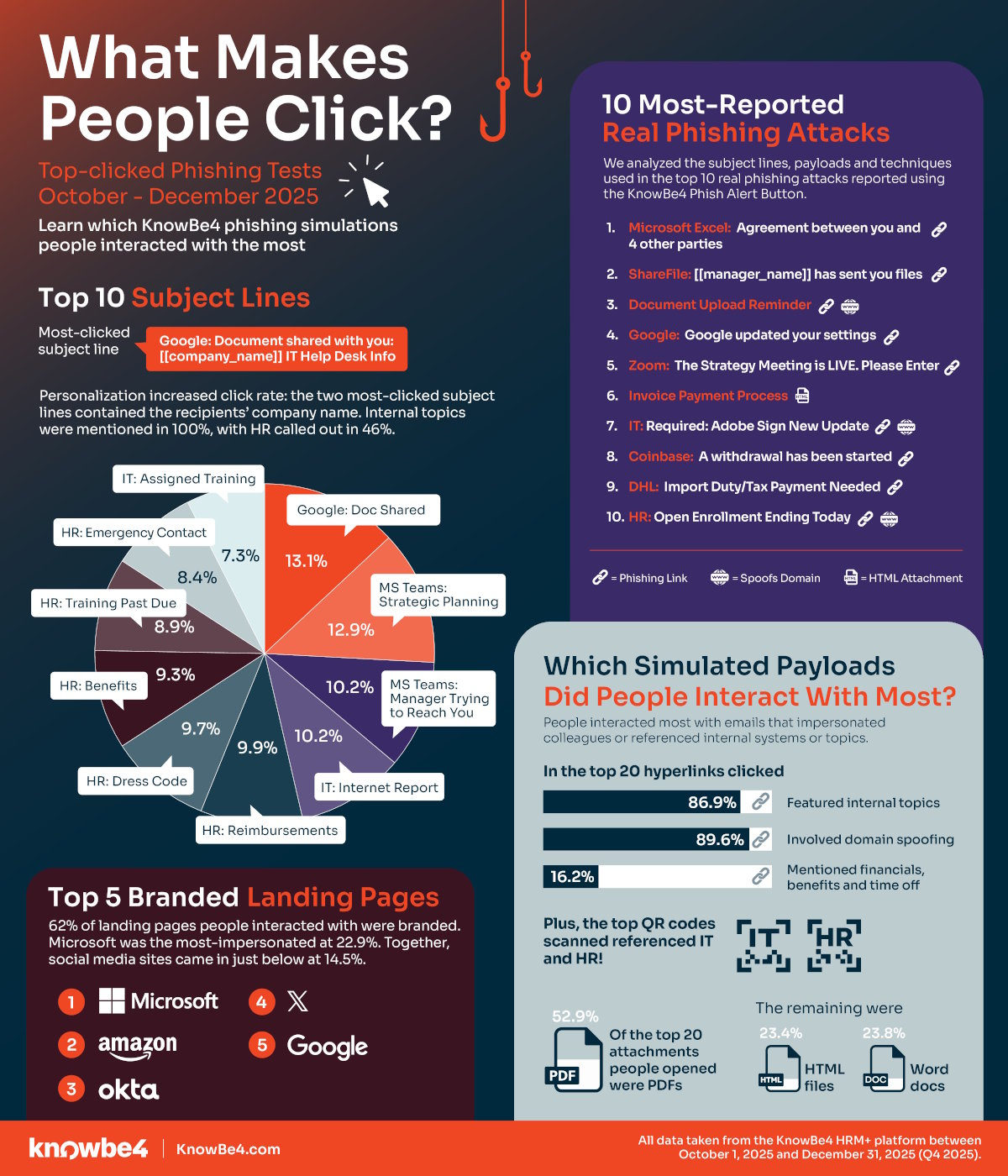
Image credit: djbagaha/depositphotos.com


