It’s difficult to pinpoint the moment in my life where America started to lose the plot.
There’s always hope. Credit: Aurich Lawson | Getty Images
There’s always hope. Credit: Aurich Lawson | Getty Images
The last time America celebrated a big anniversary, I was all of three years old. Even so, I retain a few fuzzy memories from a sunny summer afternoon in small-town Michigan: climbing on a cannon in front of the courthouse, watching a parade, and seeing my dad, a veteran and Centreville city councilman, giving a short talk about democracy.
Only later would I realize the significance of the date: July 4th, 1976, America’s bicentennial.
America was imperfect and inconsistent in its approaches to “freedom,” but the country had done some big, difficult things in recent decades. We had led the charge to roll back the tide of fascism and Holocaust during World War II. We had begun to confront internal demons through the nonviolent activism of the civil rights movement. And, critically for my own life trajectory, we had landed on the Moon.
The ’70s were hardly a simple or heroic time, but I was too young to experience the turbulence of the era. My dad fought in Vietnam but returned before I was born, and I have no recollection of Watergate or waiting in lines for gasoline during the 1970s energy crisis.
Instead, I came of age in the 1980s, watching the Berlin Wall fall and American pop dominate the global charts. When I entered the job market during the 1990s, the economy was booming. Our investments in basic research and universities made this country the preeminent scientific and economic power in the world. By the start of the new millennium, with China only beginning its rise, there stood just a single superpower in the world. Despite our many problems and failures, America remained something one could still celebrate in an imperfect world.
And then—what?
It remains difficult to pinpoint the moment in my life when it felt like my country started to lose the plot. Oh, there were signs, like the September 11 attacks and the botched response that drew us into interminable entanglements in Afghanistan and Iraq without “fixing” either country. The financial collapse in 2008 accelerated wealth inequality. Increasingly online, Americans started populating echo chambers and imbibing conspiracies, and distrust of the media grew. No one could agree on a common set of facts anymore, let alone debate them in good faith. More kids wanted to become social media influencers than astronauts.
Anger, isolation, and paranoia rose. Big things weren’t getting done, couldn’t get done. With the rise of smartphones, life shifted even further toward screens to mediate the world. The forces of ignorance and grift even managed to turn parts of Americans against vaccines, arguably the single most life-saving medical invention in human history.
All of this played out against an increasingly poisonous political environment. When Donald Trump was first elected a decade ago, many Americans were struggling and felt unserved by the existing political class. Trump campaigned on addressing those frustrations, promising disruption instead of the status quo. Americans chose disruption, and they got it. They also got hatred, contempt, bullying, misogyny, narcissism, corruption, lies, and a palpable love for dictators—and what were these but symptoms of advanced political disease?
The numbers show that Americans have been unhappy with the direction of the country—though for different reasons—for twenty years. And in 2026, Americans’ optimism about their own futures has fallen to a record low, lower even than during the pandemic, when people at least still believed tomorrow would be better.
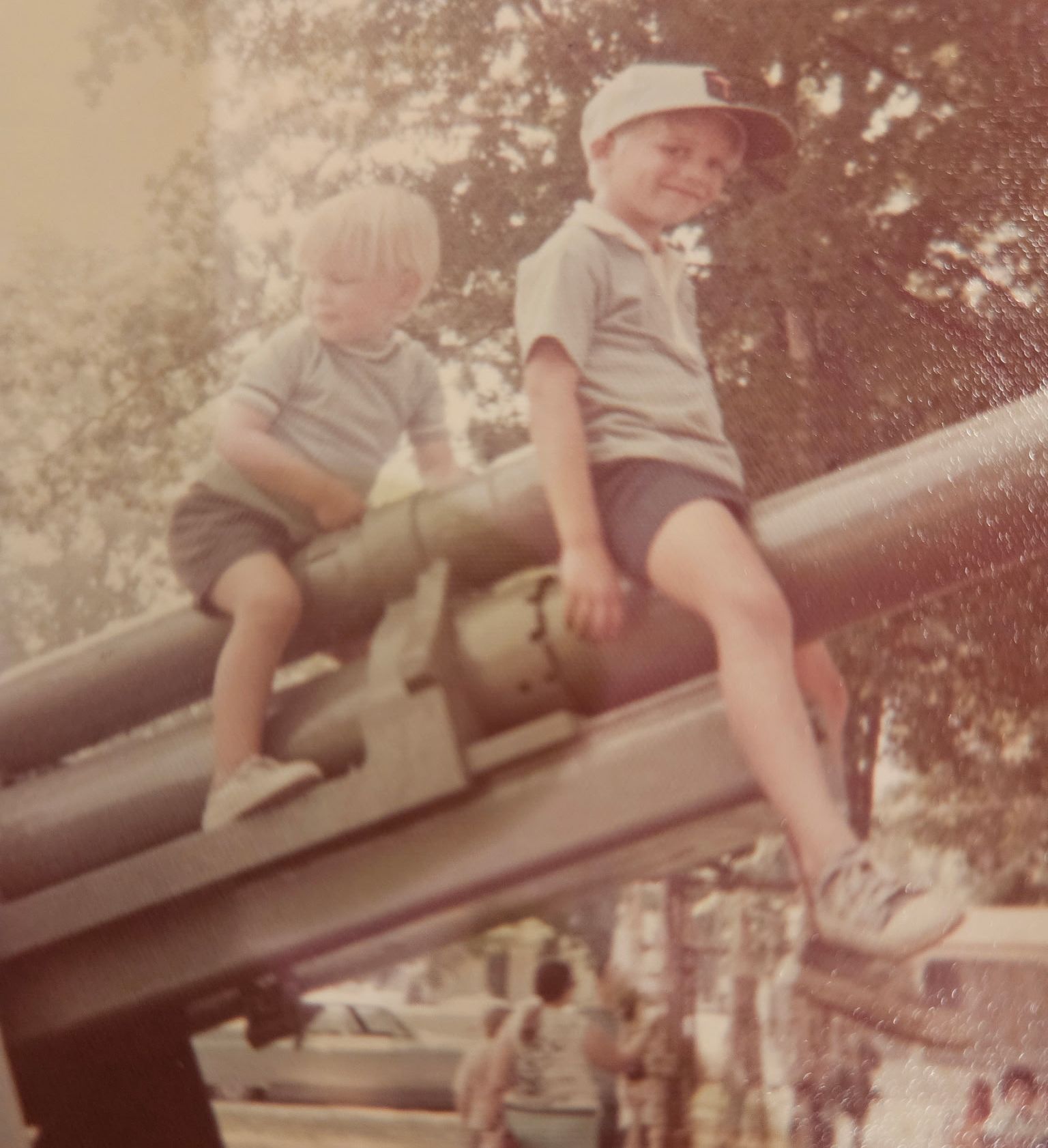
The author, at left, climbs onto a cannon on America’s bicentennial.
Credit: Bruce Berger
The author, at left, climbs onto a cannon on America’s bicentennial. Credit: Bruce Berger
For someone who has watched the last quarter of a century unfold in real time, all this can feel a little hopeless. And as a father of two daughters who recently became young adults, I worry about the world we’re leaving to them.
Because we have real problems. The planet is warming. Generation Z is coming into a workforce with uncertain job prospects and futures darkened by artificial intelligence. Billionaires increasingly run the show—and often not in society’s best interests. Goodness knows when younger people will be able to buy a home, once considered the bedrock of achieving the American dream. And we’ve thrown so many addictive habits at them, from corrosive social media to pervasive online gambling, how can we expect them to thrive?
Finding some hope
It would be easy to wallow in this mess—to doomscroll as the world washes away.
But on this anniversary of the United States of America, I believe we are not without hope. It may feel like America has been careening along the highway of enshittification since the turn of the century, but the thing about driving on highways is that you can always take an off-ramp. The truly remarkable thing about this country is its ingenious ability—through elections, immigration, freedom of speech, and economic mobility—to constantly remake itself.
We need to become makers once again, working against the rage, the despair, the grifting, and the misinformation wherever we find them. And we can. Based simply on what I’ve seen as a journalist over the last quarter century, reasons for hope remain. It can be useful once in while to gather these reasons about us as armor against despair.
About a decade ago, when I left the Houston Chronicle newspaper to write about space full-time for Ars Technica, I also started a website focused on local weather. Our purpose was clear: In an era of sensationalized storm coverage, Space City Weather would provide no-hype information about weather impacting the lives of people in Houston. We stuck to that, and when giving public talks, I often joke, “Boring is our brand.”
But in a world awash in clickbait and shouting, the quiet work we have done with Space City Weather still resonated with people. When storms threaten the community, it turns to us—because it trusts us. For many Americans, there remains a hunger for credible, evidence-backed news and information. Of course, if you’re reading Ars Technica, you share such a hunger already. But you are not alone.
I spend most of my days writing about space, and I’ve met so many good people in this industry working to extend humanity’s reach to the Moon, to Mars, and to worlds beyond. Courageous and ingenious people build satellites to spy deforestation on Earth, to gather sunlight for energy rather than burning fossil fuels, to connect people around the world, and to secure resources from asteroids and other worlds so we need not strip-mine our own planet. Not all of this will succeed, and not all of these actors are heroes, of course. But if you want to find faith that humanity can still build toward a brighter future, you could do worse than spend a little time on the space beat.
More generally, much of my life has been spent writing about science. I revere the people who gather insights about our universe and attempt to tease out new secrets from nature. It has been a dark time for science, with the White House attempting to slash science funding across federal agencies, undermining “woke” research, and setting ridiculous health policies over vaccines. But even here, where the damage is being done gleefully and wantonly, the US Congress has stood up to these funding cuts in a bipartisan manner. For most Americans, knowledge is not yet the enemy.
Progress does continue, even among the retrograde orbit of our political life. In recent decades, we have seen great advances against cancers like childhood leukemia and metastatic melanoma, and the next 10 to 20 years should bring additional progress with cancer vaccines. As our population ages, there will be a greater focus on advancing aging science. We will continue to see wins with genetic diseases. The story is similar in physics, astronomy, chemistry, and the other sciences.
When I first started writing about science in the mid-1990s, consider how difficult it was for scientists to collaborate using the time-tested tools of books, printed journal articles, and telephones. Today, researchers can access almost every bit of knowledge about a specialized topic, instantly; work globally with hundreds of scientists; sequence genomes cheaply; and run models on powerful supercomputers. And science is now global. No single government or religion can halt its progress. When America showed the world during the latter half of the 20th century that basic research begat economic development in a big way, the world took note.
Finally, reality itself has a way of fighting back against lies and propaganda. Yes, it takes far longer than one would like. But in the end, badly built rockets explode. False medical claims don’t cure. Companies with corrupt accounting—early in my career, I covered Enron’s bankruptcy case in New York City—eventually fail. More recently, we have seen commercial satellite imagery and communications provide incontestable truths about Russian activities on the ground in Ukraine, undermining attempts at propaganda. As Shakespeare wrote, “Truth will out.”
Power surge
There are so many reasons to be unhappy about the state of America, the world, and humanity as we come to the nation’s 250th birthday. But America has been resilient. And the beauty of this country is that every person has the power—small in isolation but much greater in the aggregate—to make change. That power is not wholly spent, nor wholly eclipsed, by anti-democratic forces. Because I am unlikely to greet America when it turns 300 years old, the best time for me to exercise that power is today. I hope you’ll join me.
Eric Berger is the senior space editor at Ars Technica, covering everything from astronomy to private space to NASA policy, and author of two books: Liftoff, about the rise of SpaceX; and Reentry, on the development of the Falcon 9 rocket and Dragon. A certified meteorologist, Eric lives in Houston.