Retro design and a naturally aspirated V12 deliver tremendous appeal, but it’ll cost ya.
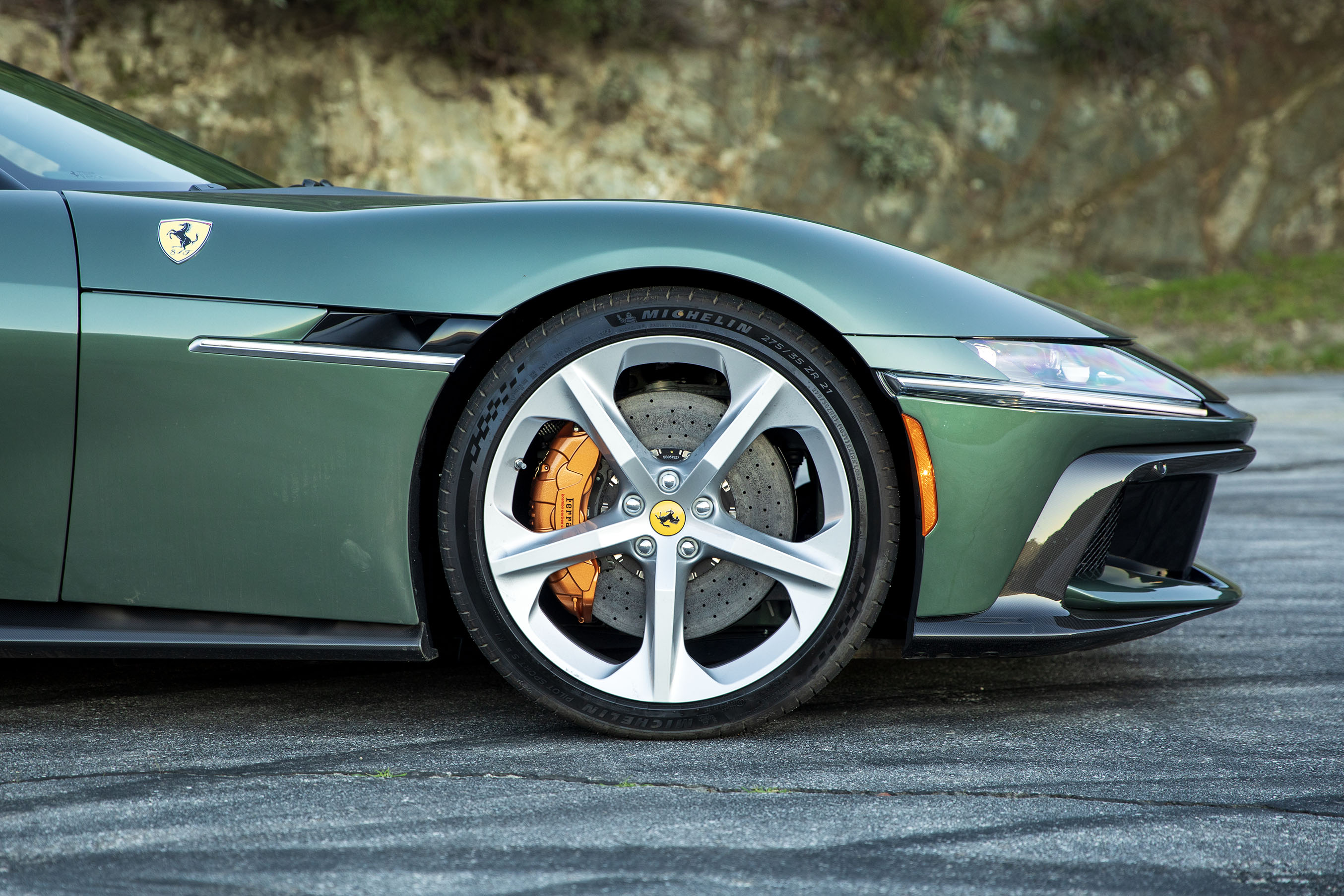
In the old days, they used to say Ferrari would sell you an engine and give you the car for free. The rest of the 12Cilindri is too good for that cliche, but it really is all about the engine. Credit: Bradley Iger
In the old days, they used to say Ferrari would sell you an engine and give you the car for free. The rest of the 12Cilindri is too good for that cliche, but it really is all about the engine. Credit: Bradley Iger
It has been nearly 80 years since Ferrari unleashed its first V12-powered sports car upon the world with the 125 S. In 1947, its debut year, the 125 S secured Ferrari’s first race victory, along with five other wins in the 14 events it competed in that season.
Although it was soon replaced by the 159 S, the success of the 125 S kick-started Ferrari’s storied history of producing some of the most desirable 12-cylinder performance cars known to man. And while the Italian automaker has come to embrace forced induction and electrification in recent years, its legacy of building stunning front-engine, rear-wheel drive machines with spectacular V12s stuffed into their engine bays continues with the 12Cilindri Spider.
Ferrari hasn’t shied away from leveraging cutting-edge technology in the development of its latest models, but the company also understands the value of a good throwback. As the successor to the 812 Superfast, the 12Cilindri boasts clever performance technologies, like a sophisticated active aero system and a four-wheel steering system that can manage each corner independently to enhance response, but it’s ultimately an homage to the heady days of late ’60s luxury grand touring. The exterior styling takes obvious inspiration from the 365 GTB Daytona, while its lack of all-wheel drive, turbocharging, and electric assistance bucks trends that have become nearly inescapable in modern performance cars.
It’s actually an easy car to drive every day, despite the width. Bradley Iger
Buy the engine, get the car for free?
Instead, Ferrari has deliberately prioritized the core principles that have defined its most enduring GT icons: elegant design, a meticulously engineered chassis, and a sensational naturally aspirated V12, the latter represented here by a 6.5 L dry-sump mill that delivers 819 hp (611 kW) and a soaring 9,500-rpm redline.
That horsepower figure might not raise as many eyebrows as it would have just a few years ago, but it’s worth noting that at a time in history when an alarming number of new performance vehicles are now as heavy as full-size pickups, the 12Cilindri Spider tips the scales at a relatively svelte dry weight of 3,571 (1,620 kg) pounds thanks in part to its focus on the fundamentals. Equipped with massage seats and a retractable hardtop that opens and closes in just 14 seconds, the 12Cilindri Spider is primarily aimed at fulfilling drivers’ fantasies of cruising along the French Riviera with the smell of the ocean in the air and the banshee wail of 12 cylinders in their ears. But it also takes on a noticeably more sportscar-like persona than its primary rival, the Aston Martin Vanquish Volante, mainly due to the 12Cilindri’s eight-speed dual-clutch transmission and more earnest performance-tuned chassis.
Sport is the 12Cilindri Spider’s default drive mode, a naming decision that helps set expectations for suspension stiffness, but you can also depress the steering-wheel-mounted Manettino drive mode dial to enable Bumpy Road mode, which softens the adaptive dampers beyond their standard tuning for more compliance on rough pavement. While the gearbox occasionally needs a second to get its act together from a standstill, and the car’s low stance makes the nose lift system an often-used feature, the 12Cilindri Spider is a remarkably civil cruiser when pressed into service for everyday driving tasks.
Crackle red paint covers the intake boxes, and maybe the cylinder heads. Bradley Iger
Still an HMI disaster
The in-car tech does tarnish this driving experience to a tangible degree, though. The liberal use of capacitive surfaces on the steering wheel and the instrument panel to control features like rear-view mirror position and adaptive cruise control, as well as the functions that are accessed via the 15.6-inch digital gauge cluster, frequently led to frustration during my time with the car, and although the high-resolution 10.25-inch central touchscreen looks great and is quick to respond to user inputs, wireless Apple CarPlay crashed on several occasions for no discernible reason and remained inaccessible until after the next key cycle. These may seem like trivial issues, but in a car with a $507,394 MSRP ($661,364 as-tested with destination fee), it’s tough to excuse problems that are so distracting and seemingly easy to rectify.
We had the same problem with the 296 GTB, and it’s time Ferrari retired its capacitive wheel and replaced them all with the version that has physical buttons. Which it will do for existing owners—for a hefty fee.
But, perhaps unsurprisingly, those quibbles always seemed to fade away whenever I found an open stretch of canyon road and set the Manettino to Race mode. Doing so eases up the electronic assists, sets up the transmission and differential for sharper response, and opens up the valves in the active exhaust system. But, in contrast to convention, it leaves the steering weight, suspension stiffness, throttle response, and brake-by-wire system alone in order to maintain predictable dynamic behavior regardless of which drive mode you’re in.
Ferrari’s capacitive touch multifunctioning steering wheel continues to let down the experience of driving a modern Ferrari. Bradley Iger
Although the exhaust is a bit quieter than I’d prefer, even with the roof stowed away, the sound that this V12 makes as you wind it out is the stuff that dreams are made of. It took me a moment to recalibrate to the lofty redline, though—with the gearbox set to manual mode, my mind naturally wanted to pull the column-mounted paddle about 2,000 rpm early. I blame this on my seat time in the Vanquish coupe last year. Aston’s decision to equip the Vanquish’s 5.2 L V12 with a pair of turbochargers enables it to best the 12Cilinidri’s horsepower figure by a few ponies while also providing a significant advantage in peak torque output (738 lb-ft/1,000 Nm versus the Ferrari’s 500 lb-ft/678 Nm), but it also relegates the Vanquish’s redline to a more prosaic 7,000 rpm while naturally muting its tone a bit.
OK, that’s enough torque
And to be frank, I don’t think the 12Cilindri Spider needs another 238 lb-ft (322 Nm), a theory that was backed by the flashing traction control light that fired up any time I got a little too brave with the throttle coming out of a slow corner. Intervention from the Ferrari’s electronic safeguards is so seamless that I rarely noticed it happening at all, though, and I can’t say the same for the Vanquish, which is undoubtedly thrilling to drive but often felt like it was fighting against its own prodigious output in order to keep the nose on the intended path. The 12Cilindri, by contrast, feels easy to trust when the going gets fast, and that sensation is bolstered by tons of mechanical grip, a quick steering rack, and a firm, progressive brake pedal.
But regardless of my thoughts on the matter, the 12Cilindri’s successor will likely be a significantly different beast with a lot more power on tap. Nearly a decade ago, we predicted that the 812 would likely be the last Ferrari to feature a naturally aspirated V12, and while this is a prediction that we’re happy to have been wrong about, this era is undoubtedly drawing to a close. A hybridized V12 will likely offer even more grunt, and enthusiasts rarely scoff at the prospect of more power, but it also opens the door to all-wheel drive, significantly more heft, and ultimately a very different driving experience. Until then, the 12Cilindri Spider serves as an important reminder that sometimes the most compelling aspects of a performance car can’t be quantified on a spec sheet.