Microsoft says it’s finally seeing “encouraging recovery progress” after a huge global outage affected millions of Outlook, Teams and Microsoft 365 users.
The issues started on Thursday November 12, when around 120,000 concurrent reports appeared on Downdetector across the US at 12.30pm ET / 5.30pm GMT. The situation then quickly became global affecting at least 74 countries.
The worst-hit services were Outlook, Microsoft 365 and Copilot, but reports also suggested issues with OneDrive. Microsoft’s cloud service, Azure, also had reports of service issues, which may account for the widespread nature of the outages.
Microsoft ruled out a cyber-security incident, commenting that the problems were caused by “elevated load”. However, the after effects are still being felt worldwide — here’s all the latest news on Microsoft’s biggest outage of 2026…
The story so far
- The Microsoft outage started at around 1pm ET / 6pm GMT on Thursday November 12
- It hit multiple services including Outlook, Teams and Copilot
- Microsoft says it’s now seeing “encouraging recovery progress”
- The tech giant has ruled out a cyberattack as being a cause of the incident
Microsoft rules out cyberattack
We are deeply sorry for the disruption this incident has caused our customers and partners. We know the trust they place in our services and take that responsibility extremely seriously. We are seeing broad recovery and stability across our services. This was a technical issue not related to cyber or AI / agents. The incident was introduced by an issue during an earlier network capacity upgrade that surfaced following a recent network change. We have addressed the underlying issue and continue to restore service to remaining customers and regions. Given the scale of demand, we restored services gradually, validating stability at each stage. While this took longer, it helped ensure a stable restoration. We will provide a full post-incident report once our review is complete.November 13, 2026
Microsoft’s consistent line throughout this global outage is that it hasn’t been caused by a cyberattack.
The latest update from its Service Health dashboard is that “at this time, we have no evidence of malicious activity associated with this incident.”
And a new post on X from the official Microsoft account goes a bit further. “This was a technical issue not related to cyber or AI / agents. The incident was introduced by an issue during an earlier network capacity upgrade that surfaced following a recent network change. We have addressed the underlying issue and continue to restore service to remaining customers and regions,” it says.
While the uncertainty in the early stages of incidents like these always breeds rumors of malicious cyberattacks, the reality is usually more mundane. So while we have recently seen supermarket freezers hit by hackers, this time the classic problems of overloaded servers and configuration challenges were to blame.

Email queues ‘approaching normal levels’
We’re seeing encouraging recovery progress, with service availability and email delivery performance improving across a growing portion of affected infrastructure. We know our customers rely on our services to get important work done every day, and regret the impact these outages had on those who depend on us. We will continue to share more information as we have it, and for now we can confirm that there is no indication this is the result of malicious or cyber activity. Our teams are reviewing what happened and how we can prevent similar issues going forward.November 13, 2026
Microsoft sounds increasingly confident that it’s fixed this huge global outage. The tech giant says it’s “continuing to see improvements in service availability, with email queues significantly reduced and approaching normal levels”.
In the X post above from 10.40am ET / 3.40pm GMT, it adds that it’s seeing “encouraging recovery progress” and that it regrets “the impact these outages had on those who depend on us”. That’s the first real apology we’ve had from Microsoft during the whole incident, which started almost 24 hours ago.
The reports on Downdetector suggest the likes of Outlook and Teams are indeed almost back to normal for most people, with many receiving a wave of delayed emails. But the attention will now turn to the post-mortem for this hugely disruptive incident.
Microsoft reports ‘encouraging’ progress
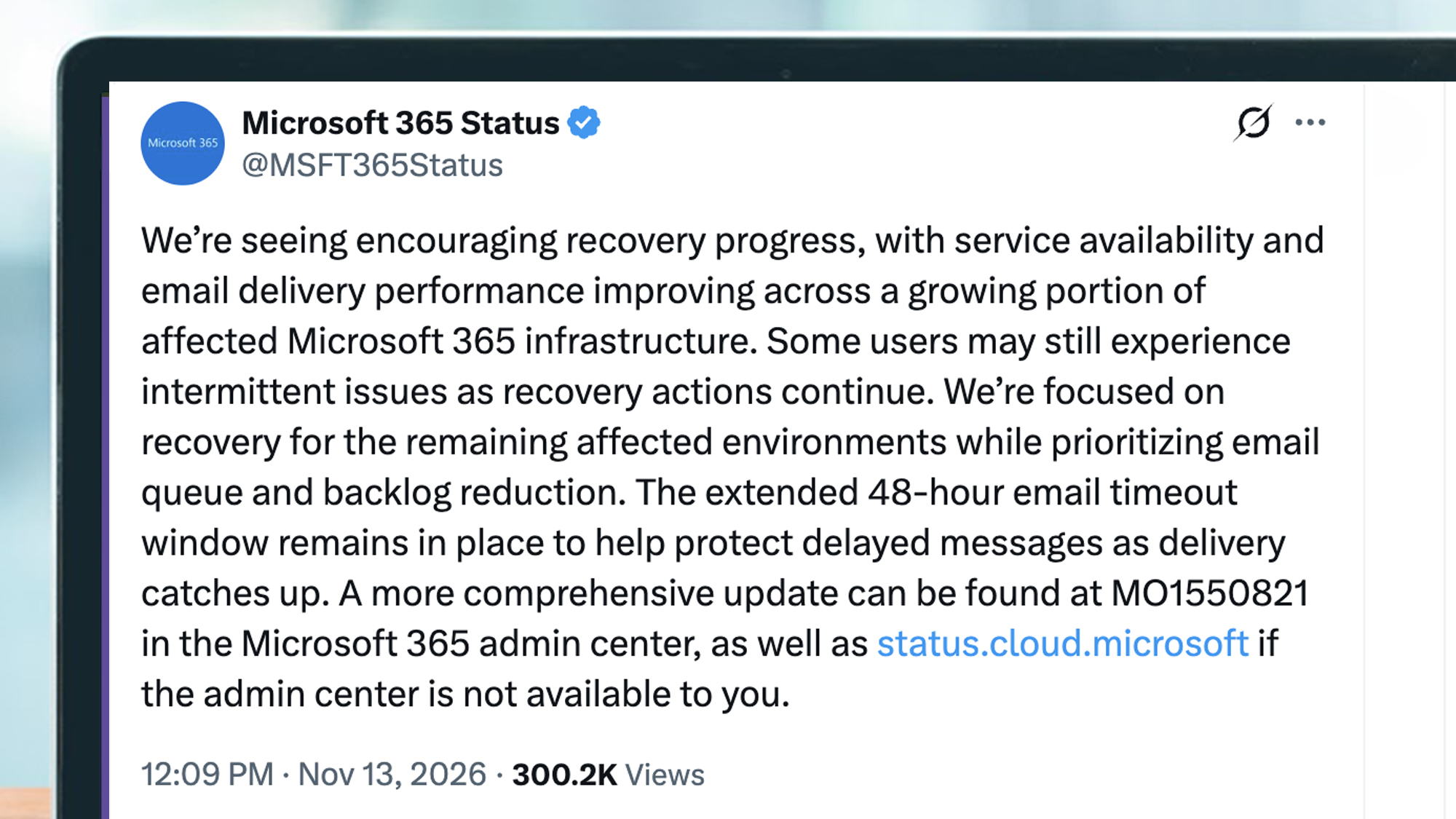
The latest news from Microsoft is that it’s seeing “encouraging recovery progress”, with email and services returning to life — and that’s been reflected by reports on Downdetector, too.
That doesn’t mean there aren’t still thousands of people and companies affected worldwide, with the knock-on effects expected to last for some time. But on its Service Health dashboard, Microsoft says it’s seeing “broader improvements” in North America and “sustained improvements across much of Europe”.
Are you still experiencing problems with any of Microsoft’s services? Let us know in the poll at the top of this page.
Reports are trending downwards
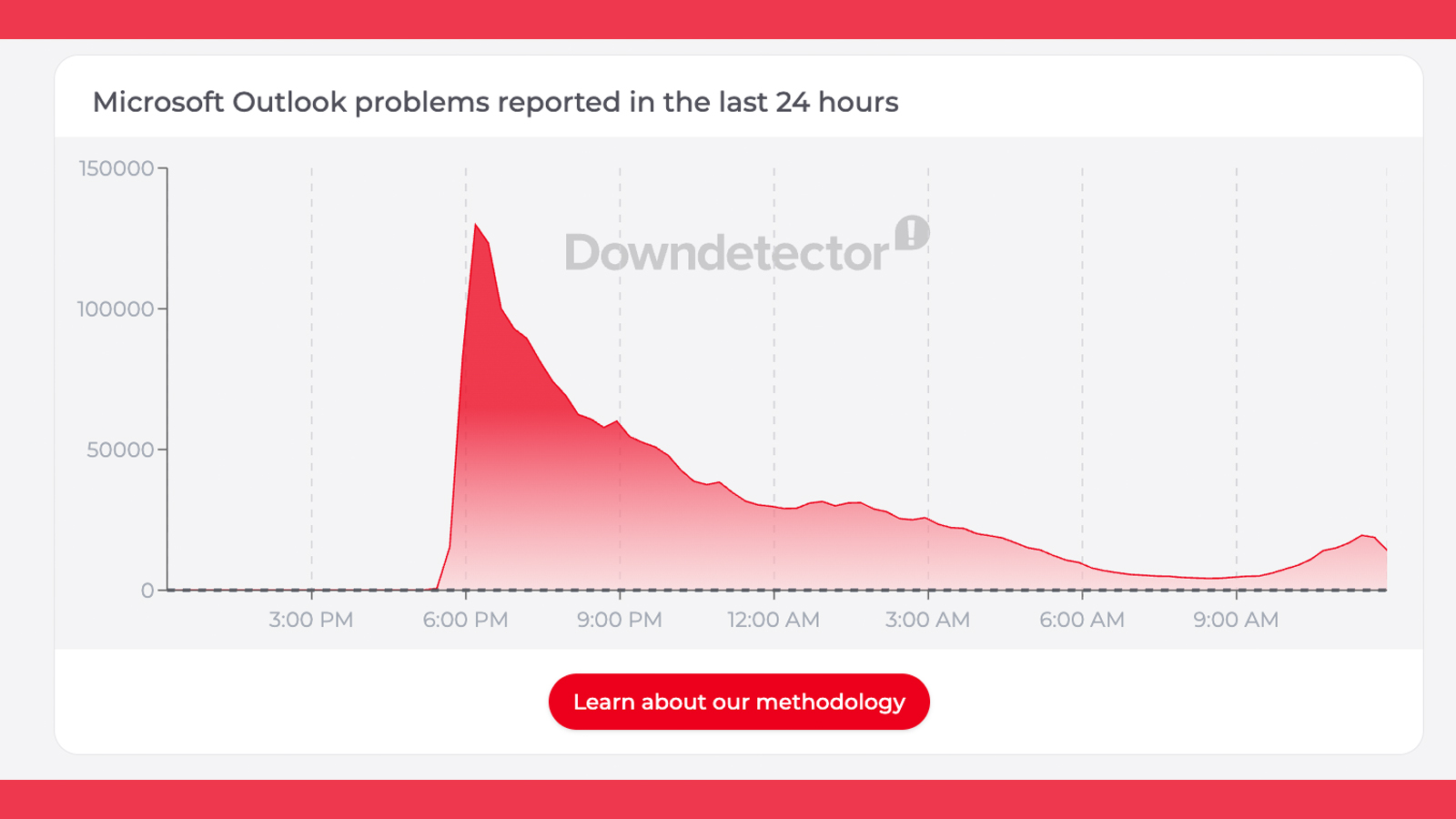
It seems that Microsoft’s “additional progress” towards recovery might be having a real-world impact — as reports on Downdetector are slowly trending downwards, while still remaining high.
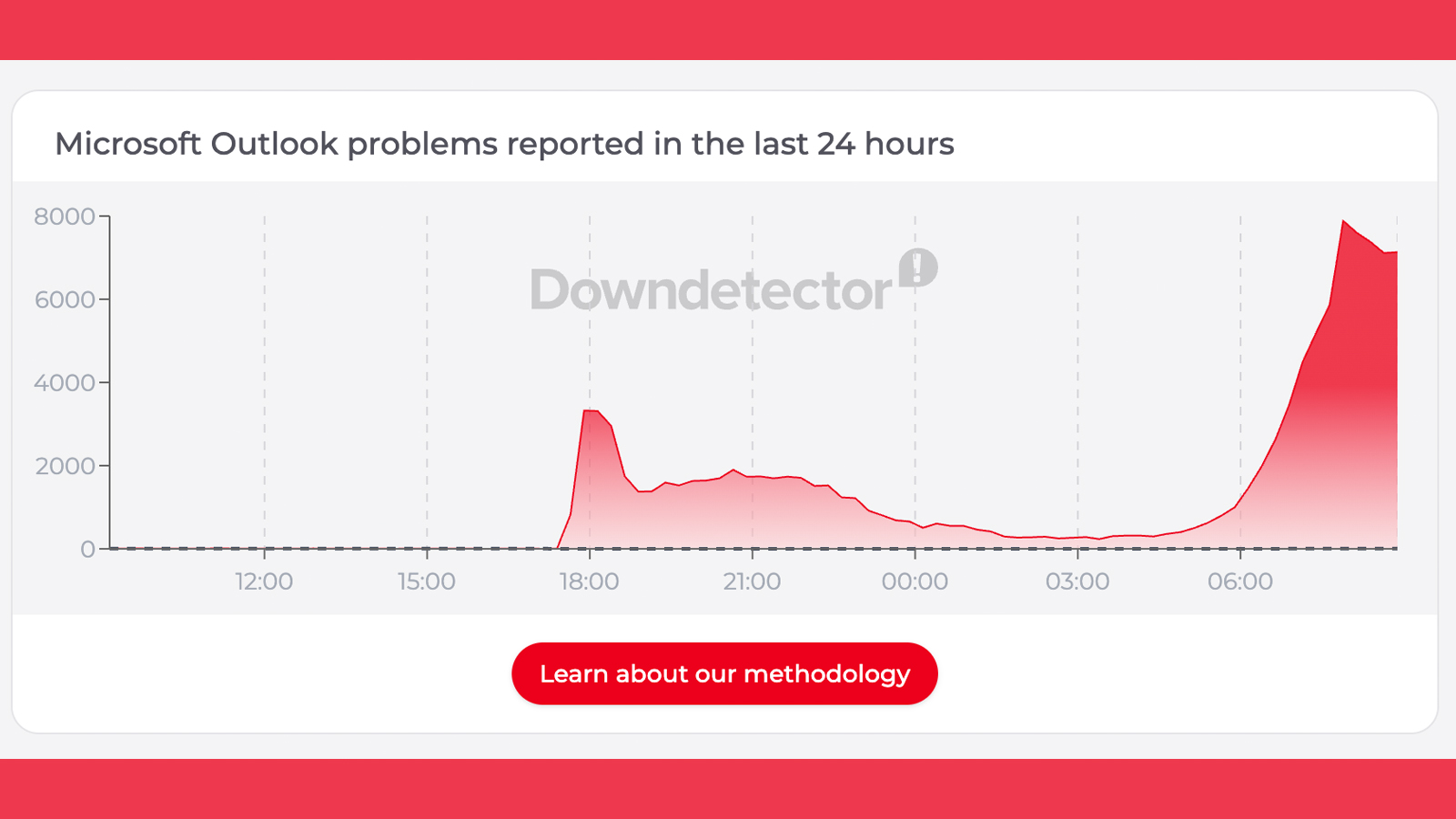
The graph above for US reports about Outlook puts things in perspective. It’s still early morning for many in the US, but after climbing at 4am ET / 9am GMT the reports are already dropping – and there’s a similar pattern in the UK, with reports dropping to just over 4,000 (half the number from three hours ago).
This was never going to be a quick, simple fix — but the signs are promising that things are finally moving in the right direction, 18 hours after all of this started.
Microsoft says it’s made ‘additional progress’
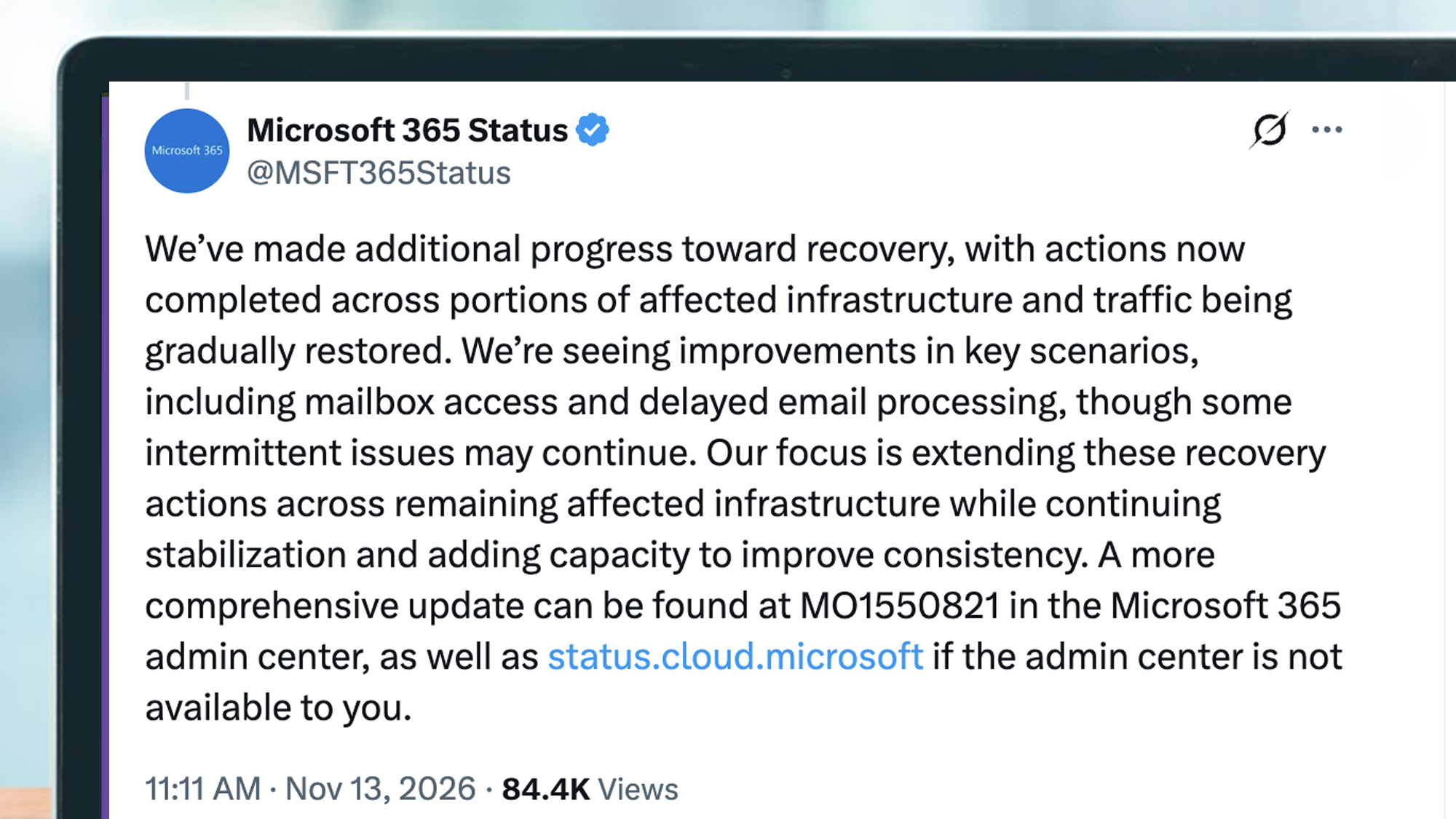
A fresh post from the Microsoft 365 account on X says that the tech giant has made “additional progress toward recovery” and it’s “seeing improvements in key scenarios, including mailbox access and delayed email processing”.
However, it says that “some intermittent issues may continue” and the reports on Downdetector suggest a significant number of people are still experiencing issues. In the US, for example, the reports for Outlook have pushed past 20,000 — short of its 130,000 peak from yesterday, but still moving in the wrong direction.
‘Disaster plans’ are being tested

Experts are weighing in on the lessons from this huge Microsoft outage — and one of the big ones is for companies to have contingency plans for when this happens, despite the challenges.
“Whilst many employees have reacted gleefully at not being able to log into a Friday morning online meeting, this outage affecting email, calendaring and videoconferencing is having a disabling effect on a huge number of organisations, which have ground to a halt without Microsoft’s services,” Matt Saunders, Field CTO at Adaptavist, told us.
“Classic IT disaster planning strategies suggest using a second service for resilience, but in practice, it’s almost impossible for a business to function without tools such as Microsoft” he noted. “It’s not just a problem of synchronising data so you can use the other when one is down; any company of any size will not be able to transparently switch from one to the other, because the offerings are different and no one designs systems to interoperate with both,” he added.
However, making backup plans isn’t easy. “It’s hard, as these tools provide a fuzzily-defined “productivity layer” in most businesses, and the impact the loss of them has can’t necessarily be predicted. People can use the old-fashioned phone for meetings, but that’s challenging when everyone’s numbers are in a system that is also offline,” he concluded.
That’s a challenge that many companies and public services are facing today — and the repercussions are likely to continue for hours, perhaps days, even after Microsoft rolls out a fix.
‘Early signs of stabilisation’
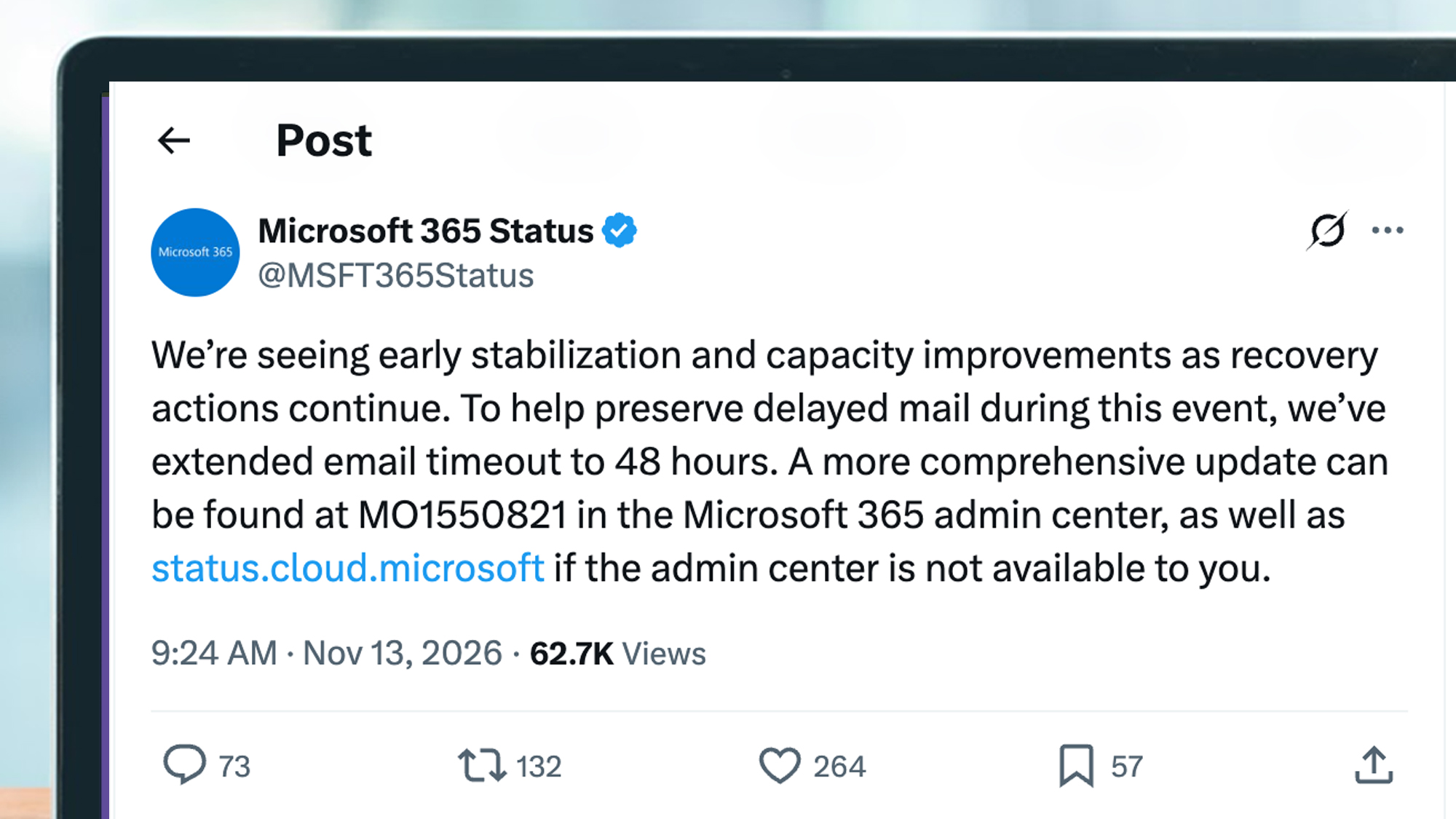
A new Microsoft 365 post on X says it is seeing “early stabilization and capacity improvements as recovery actions continue”. However, its Service Health dashboard adds that “service capacity has not yet returned to normal levels” and “health remains variable as traffic is carefully reintroduced.”.
In other words, we should start to see improvements across Outlook, Microsoft 365 and Teams soon, but progress could still be slow.
For Outlook, Microsoft says it’s also “extending the email timeout window to 48 hours to help protect delayed messages”, which means your emails should still eventually arrive — even if you’re not able to see them yet.
Hope on the horizon?
The latest update from Microsoft’s status dashboard is that it’s “seeing positive results for server stability” after applying a patch — and that it’ll expand this other services after it’s monitored its progress.
There’s been a small dip in Microsoft Outlook reports on Downdetector (above), which suggests it may be having a small effect. However, Microsoft 365 and Teams reports are continuing to rise, so we shouldn’t get too hopeful just yet.
Microsoft continues to deny that this is a cyber-security incident, stating that “as of now, we are not aware of any malicious activity that is causing this incident”. Although “as of now” is doing quite a lot of heavy lifting there — the post-mortem is certainly going to be interesting.
Crucial public services are being hit
System disruption ⚠️ Please be aware that due to a global Microsoft service issue, our access to email and some online form submissions may be affected. (1/2)November 13, 2026
This outage shows how worryingly dependent many vital public services are on Microsoft.
Here in the UK, a government spokesperson has said it’s “”working closely” with Microsoft to assess “any impact on government services” from the issues.
Meanwhile, local councils like Richmond in London and local police forces are warning users that online form submissions might be affected today.
Police services like Hertfordshire and Dorset Police says that if your report is “time-critical but not an emergency” you should call 101 instead, or for emergencies continue to call 999.
Reports continue to surge globally
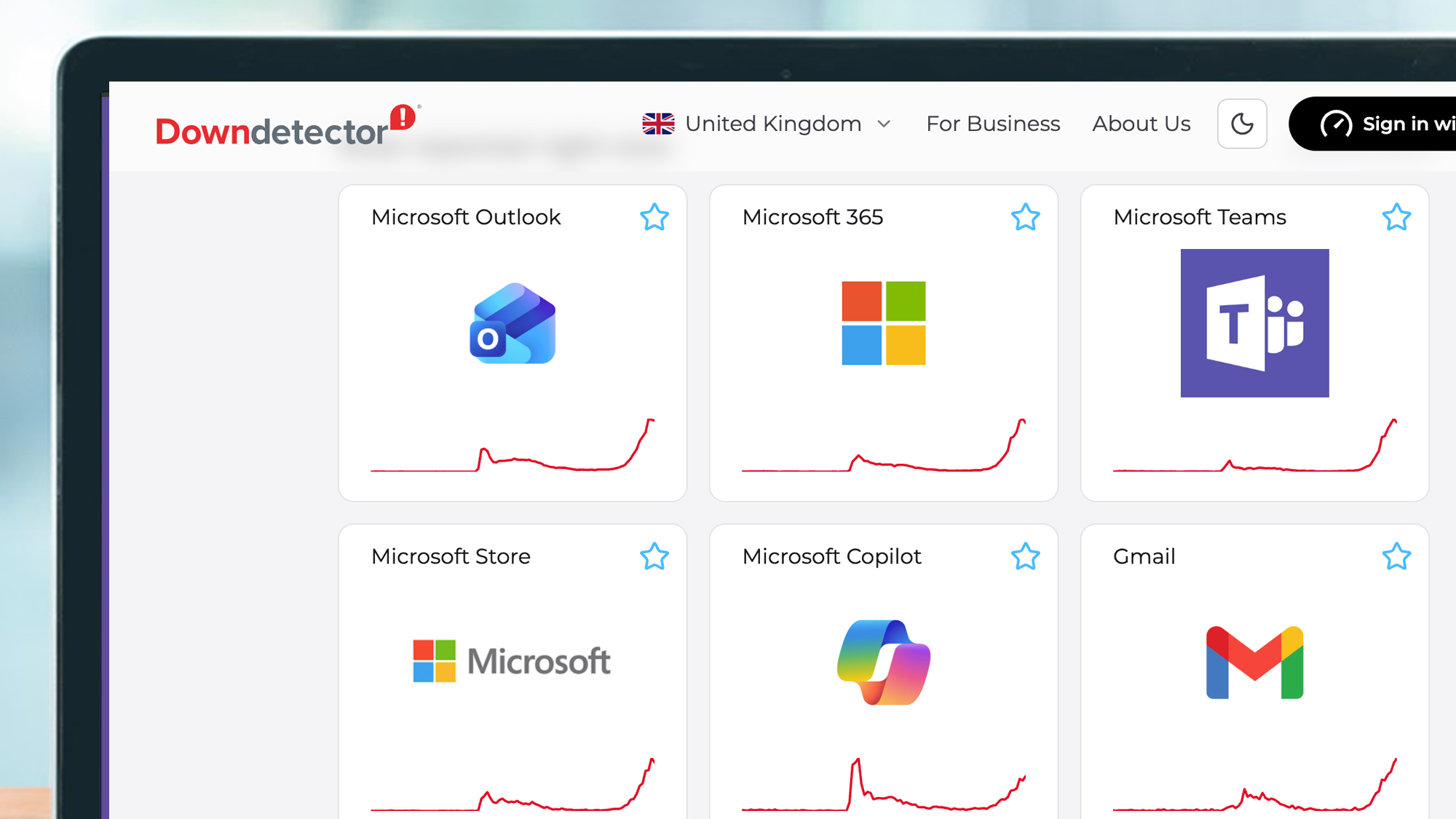
This global Microsoft outage doesn’t appear to be going away, as thousands of people continue to report issues across Outlook, Microsoft 365 and Teams.
Here in the UK, for example, there are currently almost 7,900 reports for Outlook, with most reporting issues with connecting and loading their emails.
According to Microsoft, the problems have been caused by an “elevated load” after many of its servers became “unexpectedly unavailable”. Microsoft’s status page says it’s still “pursuing multiple workstreams” to fix the issues.
The outage continues
Morning, and welcome to day two of this huge Microsoft outage, which continues to affect millions of users worldwide across Outlook, Teams and Copilot.
While Microsoft has said in a post on X at 2.45am ET / 7.45am GMT that it’s seeing “positive results” from a fix, its Service Health dashboard continues to say that “users may be unable to connect to multiple Microsoft 365 services” — and surging reports on Downdetector continue to bear that out.
Beware Outlook scams
As Outlook comes back online, you may also receive texts and emails telling you that you need to reset a password or click a link to restore your account.
Do not fall for it.
These phishing attempts will try to use social engineering to fool you into sharing your Outlook credentials. They might try now because they know you’re anxious to get back into your email. Microsoft won’t ask you to do these things. So be extra cautious as the whole system slowly comes back online.
Slow and steady recovery
Microsoft’s work to restore Outlook services to millions of users across the Amnericas continues and it sounds like they may finally have a handle on things. In a new update from around 6:05PM ET, Microsoft reports returning servers to service (always a good sign) and that “they remain stable so far.”
The other thing Microsoft notes that I think it’ll be good for Microsoft customers to keep in mind as the recovery continues is that access to affected services like email may be gradual. You’re inbox may not fill out in one fell-swoop. You may get chunks of emails or maybe none for a while as the servers are all stuffed with a backlog. We caution patience.
Maybe wait until tomorrow. By then, I bet it’ll be all clear and you’ll be back to emailing, Teaming, accessing files, and being buried by work.
We’re returning a portion of affected servers to the service, and they remain stable so far. We’re also shifting traffic to alternate routes wherever possible and observing limited recovery. In parallel, we’ve streamlined the process of returning the remaining affected servers to service. As capacity is restored, users may experience a gradual recovery as their clients reconnect. More info under EX1550543 and MO1550821 in the Microsoft 365 admin center, as well as https://t.co/pYdahqxDv3 if the admin center is not available to you.November 12, 2026
Let’s take a look at the current status of Microsoft’s 365 and Outlook outage — as of now, it’s still unresolved, and Down Detector is still showing over 40,000 reports of issues. That’s down from a high of over 131,000, but it’s still a mixed bag, with access not back for everyone or even most users.
Here’s what the current, most recent update on the Microsoft 365 Status page shows:
Current status: We’re continuing to pursue all available pathways to restore service, as our actions taken thus far have not provided the anticipated relief. Our investigation has found that a core process on the affected servers is becoming overwhelmed, which causes the servers to stop responding and contributes to the capacity loss.
To validate a potential recovery approach, we’re fully isolating a portion of our service infrastructure, restarting the affected components, and gradually reintroducing traffic to confirm our services remain stable before applying this approach more broadly. We’re also analyzing traffic patterns across our entire service infrastructure and evaluating whether isolating traffic within each region may allow affected regions to recover independently.
Talk about not getting schooled
Is the Microsoft Outlook outage a good enough excuse for your teachers and college professors? I’ve noticed some students, like this one, complaining online that they have assignments to turn in. I guess many of them use Outlook and other Microsoft 365 services like OneDrive.
Wonder if searches for Google Drive and Google Workspace are on the rise.
Post by @bratz.brainz View on Threads
Fixing slowly
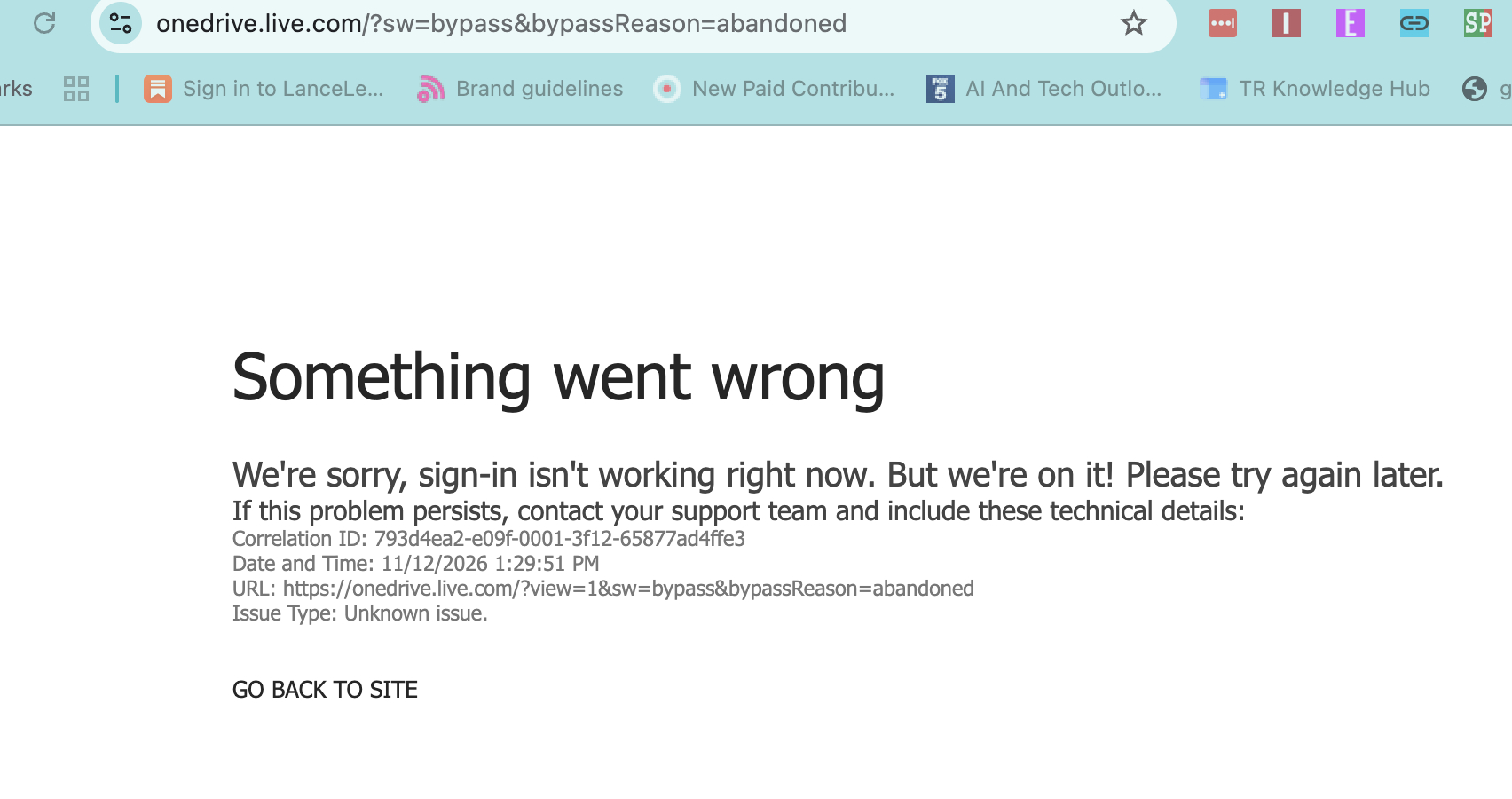
We’re not out of the woods yet. Your current blog author (Lance Ulanoff) just tried to access his OneDrive and… well, you can see the result. Clearly, Microsoft’s fix is rolling out slowly, and it now seems unlikely this will all be resolved before the end of the workday (on the East Coast, at least).
What’s your experience been like? Can you access any of Microsoft’s online and cloud-connected services? Let us know in the comments.
A full report on status
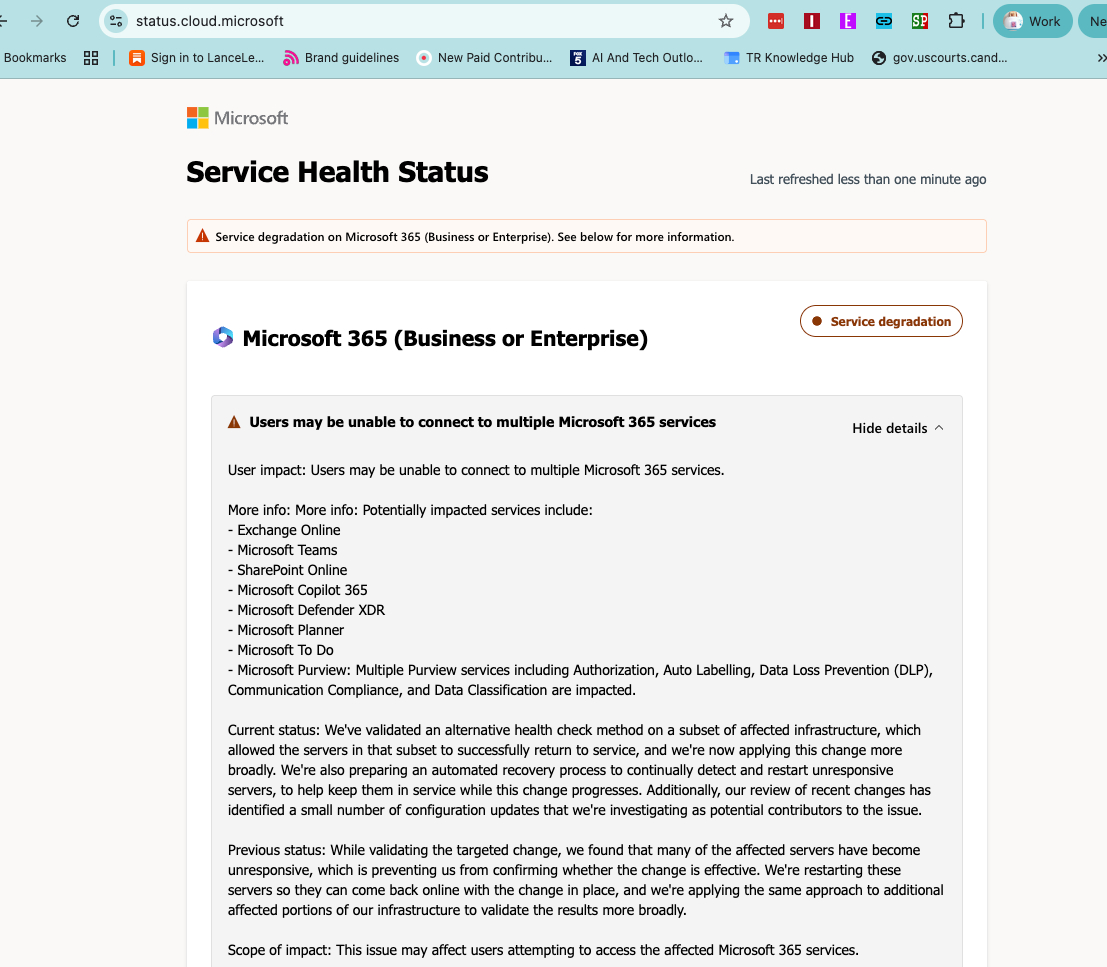
You can tell the situation is improving because we can finally access the Microsoft 365 Service Health Status page, and it has a lot of information about all the services affected by this Outlook (and more) outage.
If you want all the latest details on the service disruption, this might be a good page to bookmark.
We’re almost back, baby
We may be turning a corner. Microsoft at 402PM ET reported on X that it had built and validated a new “alternative health check method” to replace the one that kept shutting services down. The fix is so good that “a subset of affected servers” have now “successfully returned to service.”
Microsoft adds that an automated system is checking on unresponsive servers and restarting them.
Put another way, it looks like, while Microsoft may not have discovered the root cause, it has built and deployed a fix. Your Outlook might be back before you know it.
We’ve validated an alternative service health check method, which allowed a subset of affected servers to successfully return to service. We’re now applying this change more broadly. We’re also preparing automated recovery systems to continually detect and restart unresponsive servers, to maintain service stability while this change progresses. More info under EX1550543 and MO1550821 in the Microsoft 365 admin center, as well as https://t.co/pYdahqxDv3 if the admin center is not available to you.November 12, 2026
A silver lining for one?
You know the one person who might be happy about this outage? Former Nvidia CEO Jensen Huang. This is the one tech story big enough (the outage spans countries) to push aside the wild story of his ouster. Leaves us wondering if Nvidia is a Microsoft services house.
Also, shouldn’t AI be able to figure out what’s going on here?

You have to laugh, right?
When times get tough, humor carries the day. Posts across social media feature people venting their anger, frustration, and concern, but there are the jokers. This Threads post on the ongoing outage was one of our favorites.
Post by @huge_fat_loser View on Threads
Microsoft has provided another update on the 365 Status account on X, writing, “We’ve not identified any recent change correlated with the start of impact; however, our investigation indicates the failed health checks may originate from a specific component that’s responsible for processing server health.”
It continues, “We’ve taken steps to prevent additional servers from being impacted while we work to return the affected servers to service.” So it’s clear there is some more work to do to get this resolved, and it is focused on mitigating further impact on the affected servers. We’re waiting for a solution to resolve the issues. Let us know in the comments if you’re still impacted.
We’ve not identified any recent change correlated with the start of impact; however, our investigation indicates the failed health checks may originate from a specific component that’s responsible for processing server health. We’ve taken steps to prevent additional servers from being impacted while we work to return the affected servers to service. More info under EX1550543 and MO1550821 in the Microsoft 365 admin center, as well as https://t.co/pYdahqxDv3 if the admin center is not available to you.November 12, 2026
Microsoft’s 365 Status page is back online
This is likely a good sign — Microsoft’s own 365 Status Page is back up and loading again, confirming the active issue: “Service degradation on Microsoft 365 (Business or Enterprise).“
The message reads in full:
User impact: Users may be unable to connect to multiple Microsoft 365 services.
More info: Potentially impacted services include:
– Exchange Online
– Microsoft Teams
– SharePoint Online
– Microsoft Copilot 365
– Microsoft Defender XDR
Current status: We’re aggressively pursuing all pathways to reduce impact. As a precaution, we’ve paused all deployments and configuration changes while we review recent changes for any correlation to this event. We’ve determined that the elevated load isn’t driven by an overall increase in traffic, but by a large number of servers being unexpectedly unavailable, which is shifting load onto the remaining infrastructure. We’re investigating what’s causing these servers to become unavailable while we work to safely return them to service.
Scope of impact: This issue may affect users attempting to access the affected Microsoft 365 services.
Next update by: Thursday, November 12, 2026, at 10:00 PM UTC
While Microsoft’s teams are working on a fix, impacted folks are still taking to social networks like X and Threads to comment and even offer a bit of joy in light of not being able to use Outlook or other 365 essentials.
Microsoft Outlook is down in the middle of the workday? That’s unfortunate… https://t.co/HAeoE8zF19November 12, 2026
Microsoft is rolling out a fix or two
Some good news correlating with that slight dip on Down Detector: it appears that Microsoft’s team is on the case and is now testing a fix, well, more specifically, two fixes concurrently. It seems that a main culprit was servers failing automated health checks and, as a result, becoming unavailable to users.
To address that, Microsoft is testing a configuration change and, at the same time, restarting each affected service to let them ‘return to service.’ That’s a good sign all around.
We’re testing a configuration change to address a problem that’s causing servers to fail automated health checks and become unavailable. In parallel, we’ve initiated a restart of all affected servers and are monitoring health as they return to service. More info under EX1550543 and MO1550821 in the Microsoft 365 admin center, as well as https://t.co/pYdahqxDv3 if the admin center is not available to you.November 12, 2026
Let’s take a look at Down Detector
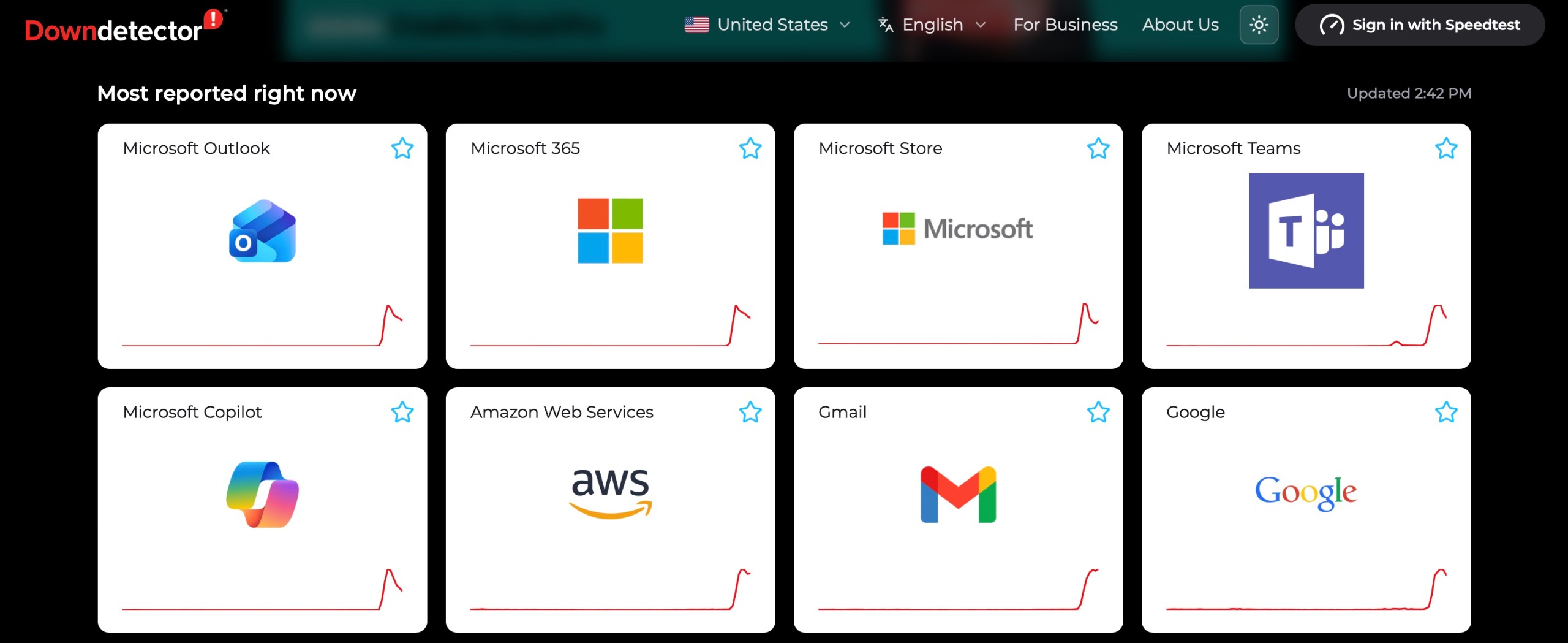
Alright, it’s clear that the main services seeing outages, and in turn being effectively down for users right now, are Outlook as well as Microsoft 365, but Down Detector is currently showing a slight dip towards recovery. Even so, many users are still reporting errors.
In fact, even with the dip, Microsoft Outlook still shows over 77,000 reports. That is down from the high, as of yet, of over 131,000 reports.
Microsoft’s status page still isn’t loading
We’re still waiting for another update from Microsoft 365 Status on X (formerly Twitter), but if you’re hoping to check the company’s direct status page, you’ll hit a roadblock. Why? Well, the actual status page appears to be down as well and will not load.
What is real
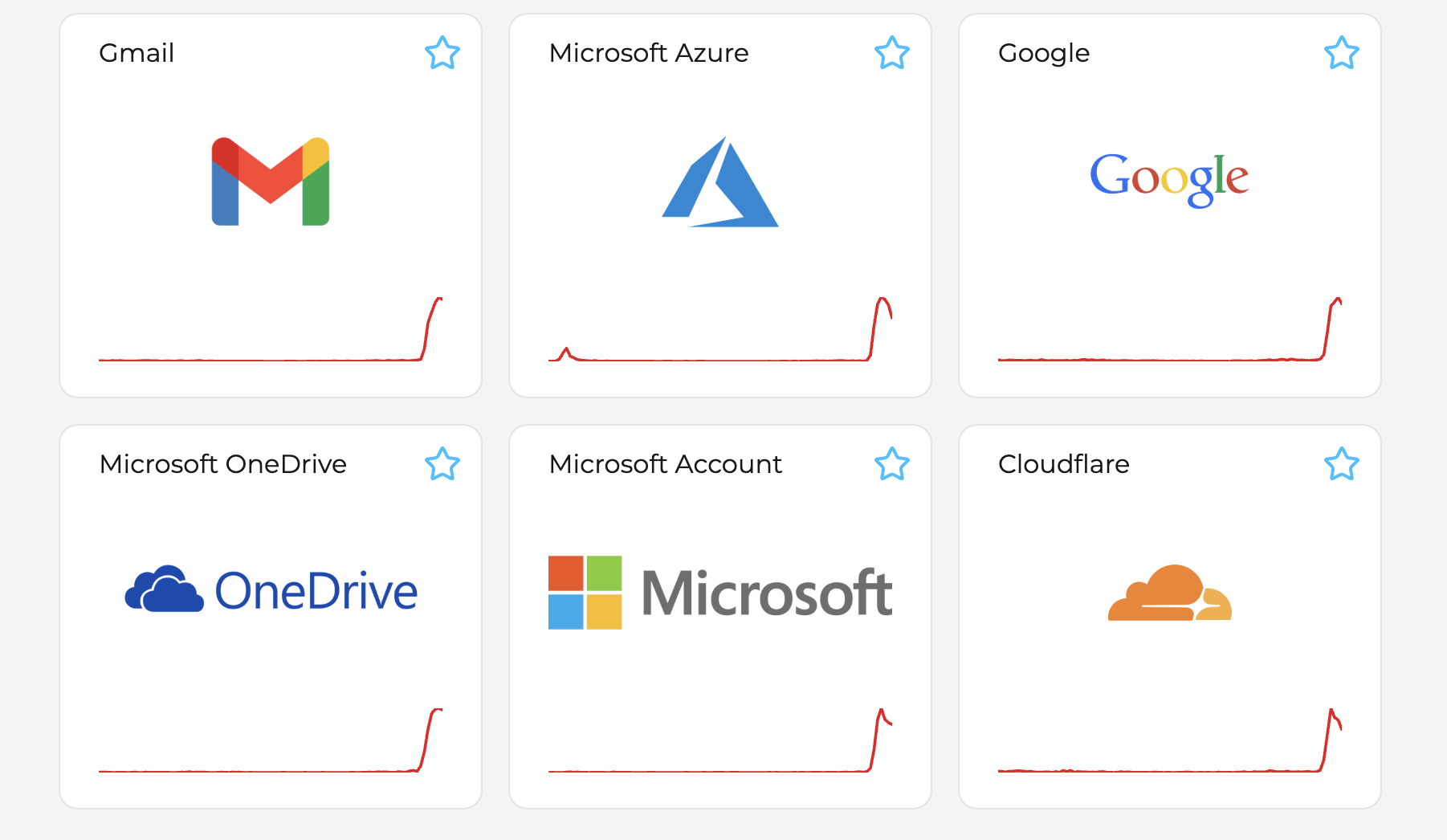
As we noted earlier, big outages like this can have a knock-on effect. That’s likely why cloud provider Cloudflare has popped up here on DownDetector, along with Google and Gmail. To be clear, there’s no indication that these services are experiencing similar outages.
Some perspective
Sure, millions can’t access work and personal emails, but they still have social media where they can complain or at least take their minds off the fact that a huge chunk of Microsoft products are currently not functioning. As this X user notes, at least social media isn’t out.
The MS Outlook outage is annoying and everything, but at least it isn’t Instagram. Imagine having that go down and have to scroll work emails instead.November 12, 2026
We’re still not here
By 2:25 PM ET, DownDetector was showing a small slowdown in outage reports across Microsoft services, but social media is still filled with posts about the ongoing Outlook outage that is across the US and the rest of the Americas.
What, we work?
Millions rely on Microsoft tools like Outlook and OneDrive to get work done. When they’re offline, well, as you can see below, things kind of slow down.
When Outlook stops working…I stop working too https://t.co/LYVTTTA1TJNovember 12, 2026
Microsoft knows
A Microsoft 365 support account has acknowledged the issues across “the Americas” and wrote, “We’re investigating reports of users experiencing issues accessing Exchange Online mailboxes through multiple connection methods in the Americas. More details can be found in the Microsoft 365 admin center under EX1550543.”
So they’re investigating, but there’s no news of a fix, just that they’re working to mitigate it.
We’re investigating reports of users experiencing issues accessing Exchange Online mailboxes through multiple connection methods in the Americas. More details can be found in the Microsoft 365 admin center under EX1550543.November 12, 2026
When one service catches a cold…
A look at DownDetector indicates that it’s not just Outlook and Microsoft services that are struggling. However, these user-based reports can be misleading. Sometimes when people can’t access one service connected to larger services, they assume it’s their local one.
We checked, for instance, AWS’s status page and found no widespread reports of outages.

Not everything is offline
There are some indications that the situation is worsening. While we were able to access OneDrive online 30 minutes ago, the site is no longer responding.
The pain is being felt by individuals and organizations, such as universities, where entire email systems are now inaccessible.

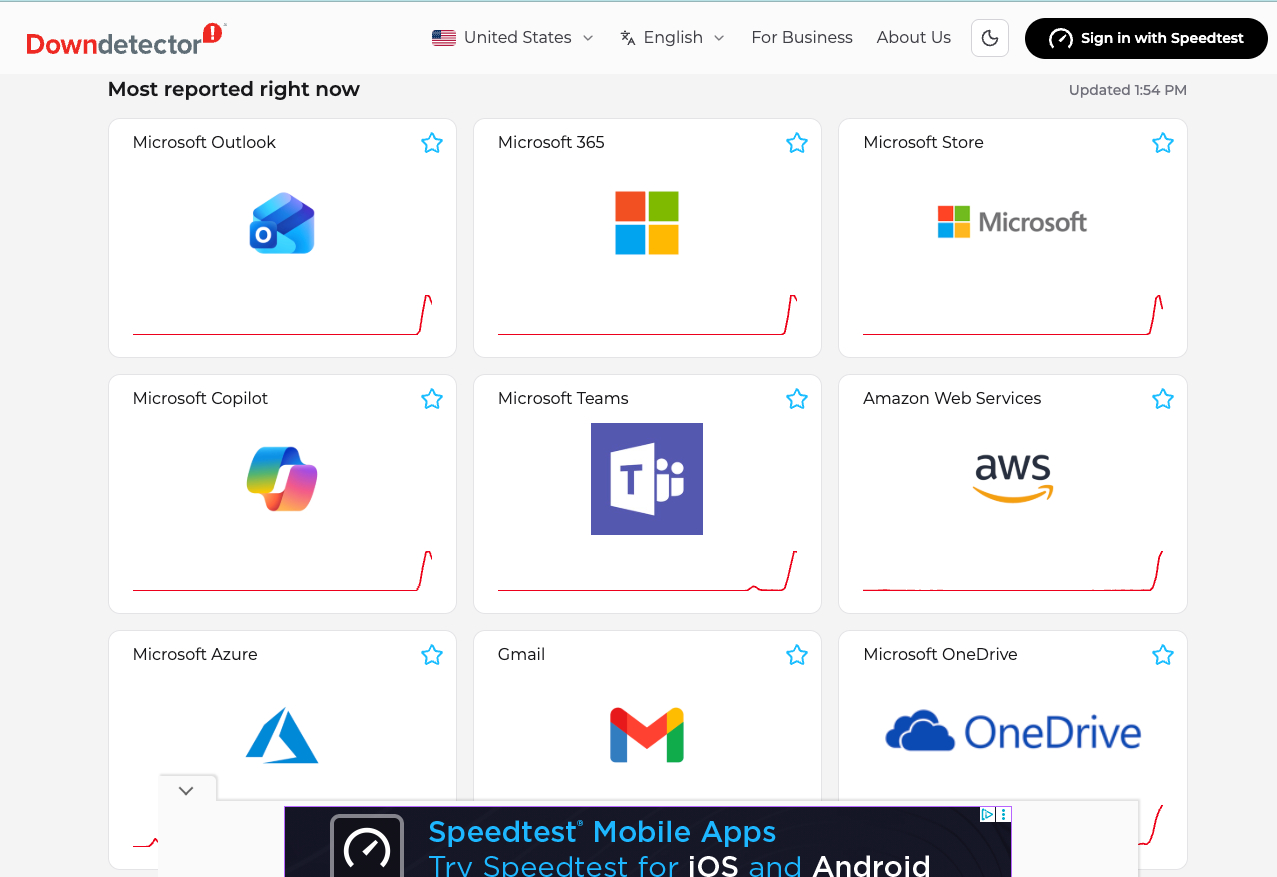
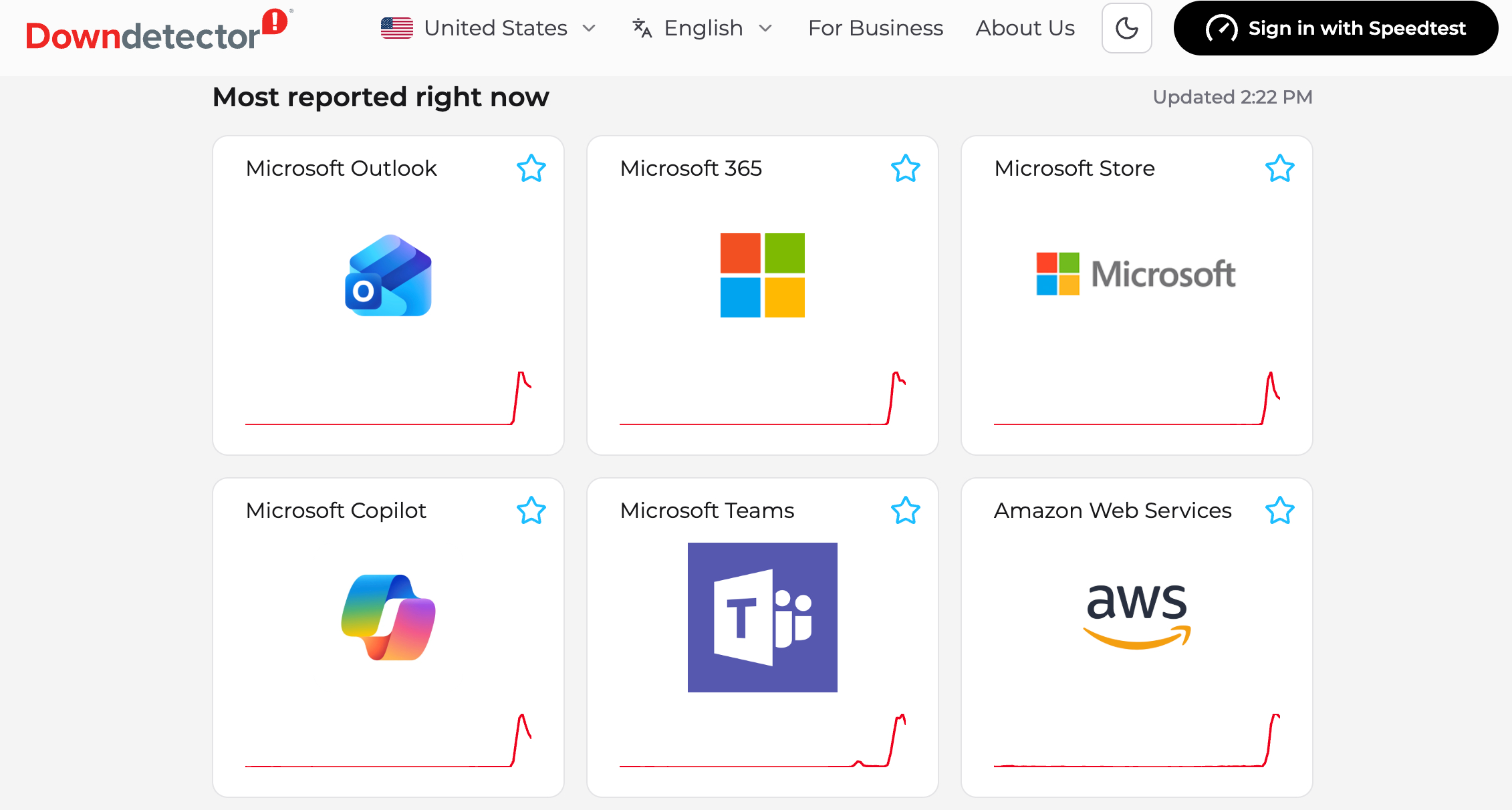
Our first indication that something was awry with Outlook was on Downdetector, which noted a sharp rise in reports of service outages for Outlook. Microsoft 365, Microsoft Store, Microsoft Copilot, Microsoft Teams, OneDrive, and Microsoft Azure.
It’s worth noting that users report these issues to Downdetector. Microsoft has yet to comment or confirm any of this.
We’ve contacted Microsoft for comment and will update this live blog when they reply.