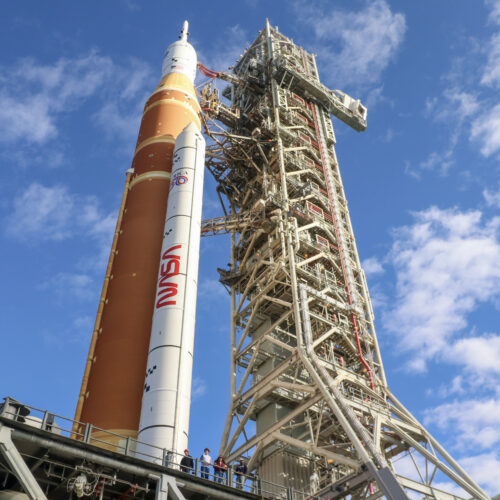
NASA launched the Artemis II mission Wednesday evening from Kennedy Space Center in Florida, sending four astronauts on a 10-day journey that will carry them around the Moon and back to Earth. The 322-foot Space Launch System rocket lifted off at 6:35 p.m. ET, or 22:35 GMT, from Cape Canaveral in front of large crowds gathered near the launch site. The flight is the first crewed mission to the Moon’s vicinity since the Apollo programme ended in 1972 and the first time humans have traveled beyond low-Earth orbit in more than 50 years.
About five minutes after launch, mission commander Reid Wiseman spoke from orbit as the spacecraft headed toward deep space. “We have a beautiful moonrise,” he said. “We’re heading right at it.”
The launch followed a tense countdown in which engineers worked through technical concerns while preparing the rocket for liftoff. Teams monitored the vehicle during fueling because hydrogen leaks had delayed the mission previously, but no major leaks appeared on launch day. Engineers also resolved issues involving battery sensors and the rocket’s flight termination system, which is designed to destroy the rocket if it travels off course.
Artemis II had faced several delays before the successful launch. NASA had earlier scheduled the mission for November 2024 but postponed it to investigate technical issues involving Orion’s heat shield. Later launch opportunities targeted February 6 and March 6, until a hydrogen leak forced NASA to roll the rocket back to its vehicle assembly building for inspection.
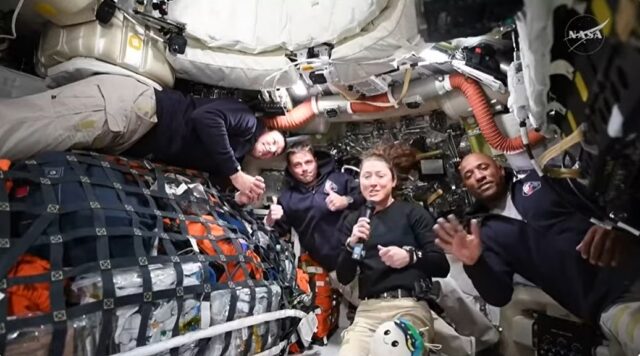
The mission crew consists of NASA astronauts Reid Wiseman, Victor Glover, and Christina Koch, along with Canadian Space Agency astronaut Jeremy Hansen. Wiseman, 50, a former International Space Station commander and U.S. Navy test pilot turned astronaut, serves as mission commander. Glover, 49, the pilot, is a U.S. Navy aviator who flew on SpaceX Crew-1 and became the first Black astronaut assigned to a lunar mission. Koch, 47, a mission specialist, holds the record for the longest single spaceflight by a woman at 328 days and has participated in multiple spacewalks. Hansen, 50, a mission specialist and former Royal Canadian Air Force fighter pilot and physicist, is the first Canadian set to travel to the Moon and is on his first spaceflight.
Before heading to the launch pad, the astronauts followed a long-held NASA tradition by playing cards in the crew quarters until the mission commander lost. NASA describes the ritual this way: “A long-held spaceflight tradition, NASA crews play cards before leaving the crew quarters ahead of launch until the commander, in this instance, NASA astronaut Reid Wiseman, loses. It is hoped that by losing, the commander burns off all his or her bad luck, thereby clearing the mission for only good luck.” Weather conditions were also closely watched because certain cloud formations and lightning risks could have halted the launch, but the flight proceeded under clear conditions.
Once Orion reached orbit, the astronauts began the mission’s first operational phase by conducting system checks in high Earth orbit. During these early hours, the crew evaluated the spacecraft’s life support and propulsion systems to confirm readiness for deep-space travel.
NASA officials said Orion’s environmental control systems performed well during the initial checkout. Howard Hu, NASA’s program manager for the Orion spacecraft, said systems, including carbon dioxide scrubbers, which remove exhaled gas from the cabin atmosphere, and onboard water systems, functioned properly.
One minor problem occurred during an early test of Orion’s toilet system. Engineers attempted to wet the system with water to prime the pump, but introduced too little water, leaving the pump unresponsive. After additional water was added, the system began operating normally.
Pilot Victor Glover then carried out a proximity operations demonstration to test Orion’s maneuvering capability. Using the spacecraft’s 24 reaction control thrusters, he piloted the capsule to within a few dozen feet of the rocket’s upper stage. Glover then performed a sequence of movements including side-to-side motion, vertical translation, pitch, roll, and yaw while describing the maneuvers during the test. He said the spacecraft handled better than expected. Hu said the Orion team had confidence in the spacecraft’s autonomous maneuvering capabilities but that introducing a human pilot adds variables. “Victor did exactly what he needed to do, and the spacecraft responded,” Hu said. Engineers confirmed that all thrusters functioned properly throughout the multi-hour test with no failures.
About one day after launch, Orion carried out the maneuver that placed the spacecraft on its path to the Moon. After the mission management team polled “Go,” the spacecraft fired its main engine for five minutes and 50 seconds beginning at 7:49 p.m. EDT on Thursday. The firing completed the translunar injection burn and pushed Orion out of Earth orbit toward the Moon on a free-return trajectory.
NASA said the Orion main engine produces up to 6,700 pounds of thrust, comparable to the force required to accelerate a car from 0 to 60 miles per hour in about 2.7 seconds. At the time of the burn, the spacecraft weighed about 58,000 pounds and consumed approximately 1,000 pounds of fuel.
The maneuver placed the crew on a path that carries Orion around the Moon before lunar gravity redirects the spacecraft back toward Earth. NASA officials described the burn as the final main engine firing required to send the crew on their outbound journey. During a Thursday evening news conference, Lori Glaze, NASA’s senior official over exploration, said, “Things are going really well right now. I don’t think we could be more pleased.”
The mission timeline spans about 10 days. During the first two days, the crew remains in high Earth orbit, completing spacecraft checks before the translunar injection maneuver. Days three and four involve the translunar transit, when astronauts continue monitoring Orion’s systems as the spacecraft travels toward the Moon.
On day five, Orion enters the Moon’s gravitational sphere of influence, where lunar gravity becomes stronger than Earth’s pull. During this phase, the astronauts test their spacesuits by practicing how quickly they can put them on, pressurize them, and secure themselves in their seats.
The spacecraft is expected to reach the Moon on about April 6, the sixth day of the mission. During the flyby, Orion will approach within about 4,000 to 6,000 miles, or 6,450 to 9,650 kilometers, of the lunar surface. NASA said about 20 percent of the Moon’s far side will be illuminated as the crew passes closest to the surface.
Following the flyby, Orion continues on its free-return trajectory during days seven through nine as the astronauts carry out scientific work in deep space, including medical monitoring through programs such as ARCHER.
On day ten, Orion separates from its service module and reenters Earth’s atmosphere at about 25,000 miles per hour, or 40,230 kilometers per hour. The spacecraft is expected to splash down in the Pacific Ocean on April 10, 2026.
While traveling toward the Moon, astronauts also conduct physical exercise using a flywheel exercise device aboard Orion. During these sessions, teams on the ground monitor the spacecraft’s air revitalization system, which maintains a breathable environment inside the cabin and tracks how astronaut exercise affects spacecraft movement.
The flywheel uses a cable-based mechanism that supports aerobic activities such as rowing along with resistance exercises including squats and deadlifts. The system operates like a yo-yo, providing resistance proportional to the force applied and supporting loads of up to 400 pounds. Orion’s flywheel weighs about 30 pounds and is roughly the size of a carry-on suitcase. NASA said astronauts aboard the International Space Station rely on more than 4,000 pounds of exercise hardware spread across about 850 cubic feet.
During early mission operations, the crew also checked out the AVATAR scientific payload. Engineers investigated a brief loss of two-way communications between Orion and mission control shortly after the spacecraft reached orbit. NASA determined that the interruption resulted from a ground configuration issue involving the Tracking and Data Relay Satellite system and corrected the problem quickly with no impact on mission operations.
After Orion began its journey toward the Moon, NASA’s lunar science team started developing a Lunar Targeting Plan to guide the crew’s observations during a six-hour viewing window on April 6. Astronauts will document surface features including craters, ancient lava flows and cracks and ridges formed as the Moon’s outer layer shifted over time.
The observation plan also includes a solar eclipse expected to last nearly an hour toward the end of the flyby window. During the eclipse, the Sun will move behind the Moon from Orion’s perspective. Astronauts will see a mostly dark Moon and look for flashes caused by meteoroids striking the lunar surface as well as dust rising above the lunar horizon. They will also observe deep-space objects including planets while viewing the Sun’s outer atmosphere, known as the solar corona.
Each astronaut carried personal items aboard the spacecraft. Wiseman brought a small notepad to record his thoughts during the mission. He is raising two teenage daughters alone after losing his wife to cancer in 2020 and previously spoke with them about the risks of the mission during a walk. “Here’s where the will is, here’s where the trust documents are, and if anything happens to me, here’s what’s going to happen to you… That’s part of this life,” he said.
Christina Koch carried handwritten notes from people close to her and described them as a “tactile connection” to loved ones on Earth. Jeremy Hansen brought four moon-shaped pendants engraved with the phrase “Moon and back” for his wife and three children and packed maple syrup and maple cookies. Victor Glover carried a Bible, his wedding rings, family heirlooms and a collection of inspirational quotations compiled by Apollo 9 astronaut Rusty Schweickart.
Astronauts traveling away from Earth also experience views that few people have seen firsthand. Koch previously described the sight of Earth from orbit: “You see the thin blue line of the atmosphere, and then when you’re on the dark side of the Earth, you actually see this very thin green line that shows you where the atmosphere is. What you realise is every single person that you know is sustained and inside of that green line and everything else outside of it is completely inhospitable. You don’t see borders, you don’t see religious lines, you don’t see political boundaries. All you see is Earth and you see that we are way more alike than we are different.”
Image credit: NASA