a 225-year effort… and counting
Such experiments bring “order to the universe, whether or not the number agrees with the expected value.”
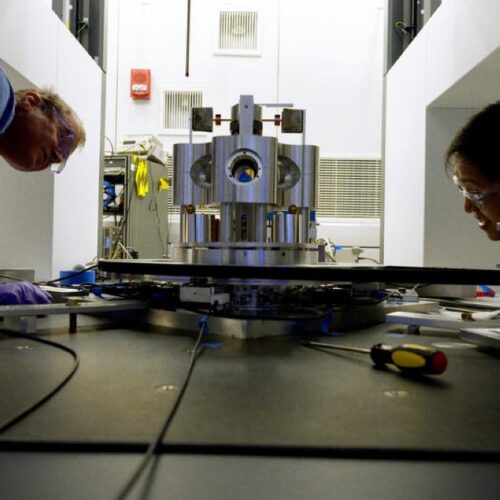
NIST scientists Stephan Schlamminger (left) and Vincent Lee examine the torsion balance they used to measure the gravitational constant (“Big G”), a decade-long undertaking. Credit: R. Eskalis/NIST
The gravitational constant, affectionally known as “Big G,” is one of the most fundamental constants of our universe. Its value describes the strength of the gravitational force acting on two masses separated by a given distance—or if you want to be relativistic about it, the amount a given mass curves space-time. Physicists have a solid ballpark figure for the value of Big G, but they’ve been trying to measure it ever more precisely for more than two centuries, each effort yielding slightly different values. And we do mean slight: The values vary by roughly one part in 10,000.
Still, other fundamental constants are known much more precisely. So Big G is the black sheep of the family and a point of frustration for physicists keen on precision metrology. The problem is that gravity is so weak, by far the weakest of the four fundamental forces, so there is significant background noise from the gravitational field of the Earth (aka “little g”). That weakness is even more pronounced in a laboratory.
In the latest effort to resolve the issue, scientists at the National Institute of Standards and Technology (NIST) spent the last decade replicating one of the most divergent recent experimental results. The group just announced their results in a paper published in the journal Metrologia. It does not resolve the discrepancy, but it gives physicists one more data point in their ongoing quest to nail down a more precise value for Big G.
Isaac Newton introduced the concept of a gravitational constant when he published his law of universal gravitation in the late 17th century, although it didn’t get its Big G notation until the 1890s. Newton thought it might be possible to measure the strength of gravity by swinging a pendulum near a large hill and measuring the deflection, but he never attempted the experiment, reasoning that the effect would be too small to measure. By 1774, the Royal Society had established a committee to determine the density of the Earth as an indirect measurement of Big G, using a variation of Newton’s pendulum concept.
It was Henry Cavendish in 1798 who achieved the first direct laboratory measurement of the gravitational attraction between two bodies using a torsion balance, although his target was the Earth’s density. This consisted of a large dumbbell with two-inch lead spheres on either end of a six-foot wooden rod suspended by a wire at its center so it could rotate. There was also a second dumbbell with two 12-inch lead spheres, each weighing 350 pounds, that would attract the smaller spheres when brought close, causing the suspended rod to twist.
Cavendish painstakingly recorded those oscillations to measure the gravitational force of the larger spheres on the smaller ones, and from that he could infer Earth’s density. His torsion balance has since become something of a workhorse for physicists keen on refining the value for Big G.
Updating the Cavendish experiment
Developing ever-more precise experiments has long been the dominant strategy for resolving the discrepancies. The authors of this latest paper realized that simply adding more measurements to the dataset would not be sufficient, since earlier inconsistent results would still dominate. So they came up with the idea of taking a closer look at one of the largest outliers—specifically a 2007 experiment by physicists at France’s International Bureau of Weights and Measures (BIPM) that employed a much more sophisticated version of Cavendish’s torsion balance apparatus.
The NIST team replicated the original BIPM experiment, building a torsion balance with eight metal cylinders: four on a rotating carousel and four smaller masses inside the carousel, sitting on a suspended disk held by a thin ribbon of copper-beryllium. The torsion balance and ribbon would twist when the outer masses attracted the inner ones, and physicists measured Big G by tracking the cylinder’s rotation and the resulting gravitational torque. They also performed a second set of measurements by applying a voltage to electrodes beside the inner masses. This twisted the wire in the opposite direction to the gravitational torque, and the voltage magnitude provided another estimate of Big G.
The NIST scientists also added an extra twist: They ran two versions of the experiment, one with copper masses and one with sapphire masses, achieving nearly identical values for both. This ruled out the possibility that the specific materials used were affecting the measurements. After all that, they came up with a value of 6.67387×10⁻¹¹ meters3/kilogram/second2. That’s 0.0235 percent lower than the original BIPM result.
Some might question why physicists continue to try to measure the value of G with more precision. One benefit is that it leads to ever-better instruments for measuring small forces, torques, and other subtle effects, advances that benefit science in general. But also, “Every measurement is important, because the truth matters,” said co-author Stephan Schlamminger, a physicist at NIST. “For me, making an accurate measurement is a way of bringing order to the universe, whether or not the number agrees with the expected value.”
Metrology, 2026. DOI: 10.1088/1681-7575/ae570f (About DOIs).

Jennifer is a senior writer at Ars Technica with a particular focus on where science meets culture, covering everything from physics and related interdisciplinary topics to her favorite films and TV series. Jennifer lives in Baltimore with her spouse, physicist Sean M. Carroll, and their two cats, Ariel and Caliban.