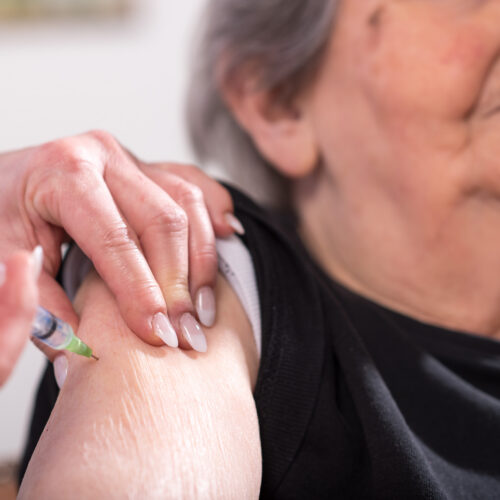
Vaccines may be training a part of our immune system long thought to be untrainable.
More and more routine vaccines are being linked to lower risks of dementia. Shots against seasonal flu, RSV, tetanus, diphtheria, and pertussis (Tdap), pneumococcal infections, hepatitis A and B, and typhoid have all been linked to lower risks. And one of the strongest connections is from vaccination against shingles, with more data supporting the link still coming in. But as the evidence mounts, scientists continue to puzzle over the pleasant surprise—how are vaccines that target specific pathogens inadvertently shielding our minds from deterioration?
A burgeoning hypothesis offers a brow-raising possibility: The shots may be protecting our noggins by training the part of our immune system that had long been considered untrainable. If the idea holds up, it could generate a deeper understanding of fundamental aspects of our immune systems while opening new avenues to treating or preventing dementia. It could also add another dimension to the benefits of vaccines, which already save millions of lives worldwide.
Trained immunity
It’s well understood how vaccines work generally; they’re designed to prime our immune systems against specific pathogens. Vaccines present either defanged pathogens or distinctive fragments of them to specialized immune cells—namely, T cells and antibody-producing B cells—that can then learn to identify those microbial enemies.
So if such a pathogen stages an attack after immunization, those immune cells will be able to recognize the invaders quickly and destroy them. This process, as intended, engages adaptive immune responses, the part of the immune system known to be trainable. It can learn to target specific threats—and remember those threats, aka immunologic memory.
Then there’s the other part of the immune system, the innate immune responses. These precede adaptive responses, acting as first-line, non-specific defenses against germs and injury. Innate defenses include everything from physical barriers—skin, mucous, gastric acid—to immune cells that can indiscriminately gobble invaders, as well as chemical signals that can swiftly ignite generic inflammation.
For decades, the innate immune response was considered relatively static—not one that evolves or hones itself as new threats are encountered. But that changed in 2011 with the coining of the term “trained immunity” to explain changes documented in innate immune responses from past exposures. Trained immunity occurs when cells involved in innate responses are activated and then primed by generic signals from a germ. Those primed cells acquire and maintain changes that allow them to respond to those germ signals faster and with more intensity the next time they’re encountered.
Specifically, the changes observed in trained immunity are epigenetic. These don’t alter the underlying DNA sequence of the cells but are modifications or chemical tags that alter gene activity. In the case of trained immunity, the changes may involve genes coding for pro-inflammatory signals that make those genes more active when the same germ signal is encountered again. Ultimately, this would lead to a stronger inflammatory response. Similar to adaptive responses, these epigenetic changes stick around afterward, creating another type of immunologic memory.
Quirky vaccines
So how does this connect to vaccines? The concept of trained immunity was solidified by data involving a vaccine—but one that’s far from routine in the US: the quirky Bacillus Calmette-Guérin (BCG) vaccine, which was designed to protect against tuberculosis, caused by the bacterium Mycobacterium tuberculosis, but also used to treat bladder cancer (it’s still unclear how the vaccine works against this cancer).
Nevertheless, in 2012, researchers in the Netherlands conducted an experiment to investigate trained immunity in mice engineered to lack adaptive immune responses—they had no T cells or B cells. The researchers vaccinated the weakened animals with BCG, looking for changes in innate responses, the only responses the mice had.
The researchers found that the shot not only bolstered the rodents’ innate protective responses against M. tuberculosis but also boosted responses against an unrelated yeast pathogen, Candida albicans. Further work suggested similar trained immunity occurred in humans.
In the same study, the researchers examined blood samples from healthy human trial participants before and after immunization with BCG. After vaccination, the researchers found that immune cells in their blood produced stronger innate responses (pro-inflammatory signals) to M. tuberculosis than they did before the shot. They also produced stronger responses to C. albicans and the bacterial pathogen Staphylococcus aureus, suggesting non-specific trained immunity. The study was published in PNAS.
Since then, researchers have built a body of evidence to support and understand trained immunity. But in the past few years, the idea has collided with a steady stream of large population studies that have found that vaccines seem to protect against dementia. While most of the big studies that have made headlines have focused on routine vaccines—shingles and the flu, for example, a study in 2023 found that the BCG vaccine is also associated with a significantly lower risk of dementia.
In March, vaccine researchers in Belgium and South Africa, led by Justin Devine, put the findings together, including all the work on BCG, and published a hypothesis: Perhaps trained immunity from vaccines is behind the lower risks of dementia.
Prior to this, a leading hypothesis for the connection was that vaccines reduce the risk of dementia directly by preventing infections that can lead to inflammation in the brain, which, over time, could cause deterioration. This is particularly a strong hypothesis for the shingles vaccine. Shingles is caused by the varicella-zoster virus, which initially causes chickenpox but then lingers in the body, staying mostly dormant in nerve cells. It can reactivate any time there’s a fault in the immune system, which often happens in older age, when immune responses naturally wane.
A shot of a shingles vaccine blocks reactivation, potentially preventing the virus from triggering brain inflammation that could contribute to the development of dementia. Conversely, there’s some evidence that having shingles may increase the risk of dementia.
A possible mechanism
But not every vaccine linked to reduced dementia risk comes with such an explanation for how it may protect the brain. For example, the seasonal flu vaccine seems to reduce dementia, but it’s unclear how. Still, in a large retrospective study published last month, researchers again bolstered the link between the seasonal flu shot and lower risks of dementia, this time finding that high-dose seasonal flu shots given to older patients are yet more protective against dementia than standard doses.
In other words, there seems to be a dose-dependent response—the higher the flu vaccine dose, the lower the dementia risk. The authors don’t speculate on how the seasonal shot could affect cognitive health, but they call for more research into potential mechanisms, including trained immunity.
In the March hypothesis piece, published in the journal Frontiers in Immunology, Devine and colleagues hypothesize that trained immunity from vaccinations could indeed be responsible.
“A central element in this immunological model is that uncontrolled or excessive levels of neuro-inflammation, associated with elevated dementia risk, can be counteracted by epigenetic reprogramming of innate immune cells,” they write.
For instance, it may be that the nonspecific changes to innate responses from vaccines are able to keep both targeted and non-targeted pathogens in check, preventing brain inflammation from flaring up, they say.
For now, the idea is just a hypothesis, and there’s a lot more work needed to validate it. But the stakes are high for pursuing it, the researchers argue. “Elucidating the mechanisms underlying these promising observations may open new avenues to promote healthy aging through vaccination and could be crucial for alleviating the global burden of dementia,” they write.

Beth is Ars Technica’s Senior Health Reporter. Beth has a Ph.D. in microbiology from the University of North Carolina at Chapel Hill and attended the Science Communication program at the University of California, Santa Cruz. She specializes in covering infectious diseases, public health, and microbes.