

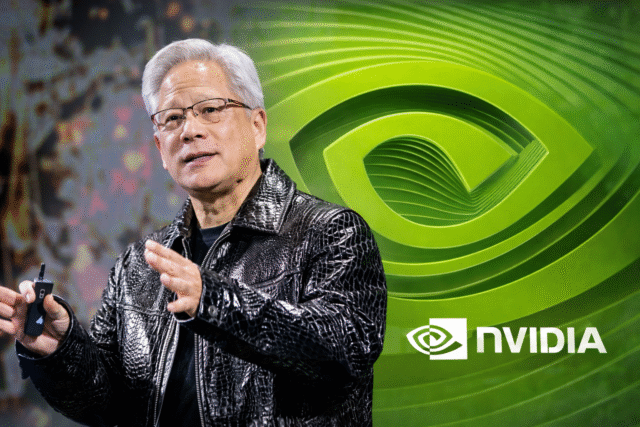
Nvidia reported record financial results on Wednesday, delivering $68.1 billion in revenue for the fourth quarter of fiscal 2026 as demand for artificial intelligence infrastructure continued to accelerate.
The quarterly figure rose 73% from a year earlier and 20% from the third quarter, surpassing the $65.7 billion analysts had forecast and exceeding company guidance by about $3 billion. Net income for the quarter reached approximately $43 billion, with one reported figure at $42.96 billion, more than doubling year over year. GAAP net income increased 35% quarter over quarter and 94% year over year. GAAP diluted earnings per share climbed 35% to $1.76, nearly double compared with fiscal 2025. Non-GAAP income, which excludes gains tied to Nvidia’s investment in Intel stock, totaled $39.6 billion. Shares rose more than 2% in early after-hours trading, with reports of gains reaching 5% before giving back much of the increase.
The company’s data center division generated between $62 billion and $62.3 billion of the quarterly total, up 75% from a year earlier and 22% from the prior quarter. Nvidia divided that data center revenue into $51 billion in compute revenue, largely from GPUs, and $11 billion from networking products such as NVLink.
For the full fiscal year ending January 25, 2026, Nvidia reported revenue of $215.9 billion, up 65% from the previous year. GAAP operating income totaled $130.4 billion and net income reached $120.1 billion. Data center revenue for fiscal 2026 was reported at $197.3 billion in one release and $193.7 billion in another, up from $115.2 billion the year before, representing an annual gain of about 68%. Quarterly revenue increased sequentially throughout the year: $44.1 billion in Q1, $46.7 billion in Q2, $57 billion in Q3, and $68.1 billion in Q4.
These results build on fiscal year 2025, which ended in January 2025, when Nvidia posted $130.5 billion in revenue, more than doubling the $60.9 billion recorded the year prior. Net income for fiscal 2025 was $72.9 billion, and operating income rose to $81.5 billion.
Chief executive Jensen Huang addressed concerns that hyperscale cloud customers may not sustain capital expenditures approaching $700 billion annually. Combined spending from Alphabet, Amazon, Meta, and Microsoft is projected to reach that level this year as competition in AI intensifies. A recent Moody’s report identified $662 billion in future data center lease commitments that have not yet begun and remain off those companies’ balance sheets.
Huang responded directly during the earnings call.
“The demand for tokens in the world has gone completely exponential,” he said. “I think we’re all seeing that, to the point where even our six-year-old GPUs in the cloud are completely consumed and the pricing is going up.”
He linked computing capacity directly to revenue generation in the AI economy.
“In this new world of AI, compute is revenue. Without compute, there’s no way to generate tokens. Without tokens, there’s no way to grow revenues.”
Huang attributed the rise in demand to what he described as the arrival of agentic AI, in which AI agents take decisions in place of humans. In a statement, he said, “Computing demand is growing exponentially — the agentic AI inflection point has arrived. Enterprise adoption of agents is skyrocketing. Our customers are racing to invest in AI compute — the factories powering the AI industrial revolution and their future growth.”
Investors also focused on margins. Previous guidance called for a 74.8% GAAP gross margin. Nvidia reported a GAAP gross margin of 75%, up from 73.4% in Q3, and a non-GAAP gross margin of 75.2%. Huang and chief financial officer Colette Kress have said the objective entering fiscal year 2027 is to hold margins in the mid-70s.
Looking ahead, Nvidia forecast $78 billion in revenue for the current quarter, plus or minus 2%, exceeding the roughly $72 billion analysts expected. Total supply-related commitments increased from $50.3 billion at the end of the third quarter to $95.2 billion at the end of the fourth quarter. Nvidia said it has “strategically secured inventory and capacity to meet demand beyond the next several quarters.”
The company reported no revenue from chip exports to China during the quarter, despite the recent lifting of export restrictions by the U.S. government. It also said it is not assuming any data center compute revenue from China in its outlook. Kress stated that small amounts of H200 products for China-based customers were approved by the U.S. government but have not generated revenue, and she said the company does not know whether imports will be permitted into China. She added that competitors in China, supported by recent IPOs, including Moore Threads’ December IPO, have the potential to disrupt the structure of the global AI industry over the long term.
During the call, Huang addressed Nvidia’s reported $30 billion pending investment in OpenAI. He said the company continues to work toward a partnership agreement and believes it is close, though filings with the U.S. Securities and Exchange Commission said there is “no assurance” an investment will take place. Huang also referenced partnerships with Anthropic, Meta, and Elon Musk’s xAI.
Last quarter, Huang responded to concerns about a possible AI bubble by describing three platform transitions underway: from traditional CPUs to GPU-driven computing; from traditional machine learning to generative AI; and from generative AI to agentic AI. He said the first two transitions were funded through cost reductions and revenue growth, while agentic AI adds a new layer requiring investment.
Kress previously stated that Nvidia has visibility to $500 billion in revenue from its Blackwell and Rubin offerings from the start of calendar year 2025 through the end of calendar year 2026. She also said Nvidia believes total AI infrastructure investment could reach $3 trillion to $4 trillion annually by 2029 or 2030.
Nvidia, founded in 1993 and based in Santa Clara, California, now commands a market capitalization of $4.7 trillion to $4.8 trillion. Despite volatility in AI stocks, its shares are up more than 50% over the past year, though about 2.2% year to date before the latest earnings release.


