
Meta has filed a patent application for an AI that listens to your voice throughout the day, works out how it thinks you are feeling from the way you sound, and keeps a timestamped log of every read.
Each read gets pinned to the moment it happened: the time, your location, what you were doing, even how you were using your phone. Some versions in the filing would listen all day; others would check in only at set times.
None of these ships in a product today, and Meta has not announced one; a filing like this stakes a claim on an idea long before anyone commits to building it.
The application, US 2026/0182881, was filed by Meta Platforms in December 2025 and published on July 2. It names a single inventor, Lachlan Dunn, and traces back to a provisional filing from December 2024. The patent-analysis site Patentlyze flagged the filing first.
Its title pairs two ideas, emotional state analysis and real-time fitness coaching. The claims show the first is the one that matters: of the 20, the three independent ones cover emotional analysis on its own, while workout coaching appears only in the dependent claims that build on them.
What the patent describes
A device records your speech across the day. It could be smart glasses, a phone, a smartwatch, headphones, or a smart home speaker, the patent says.
The device transcribes it, and an AI trained to read mood goes to work on both the words and the way you say them: your tone, your pace, a sigh, a laugh. It tags each stretch of audio with an emotional read, matches that read to the context around it, and over a set period, a day or a month, builds a summary of your patterns.
The system does not just label you stressed. It points back to the words behind each reading, what the patent calls a citation. In one example, an anger reading arrives with the exact harsh words you used.
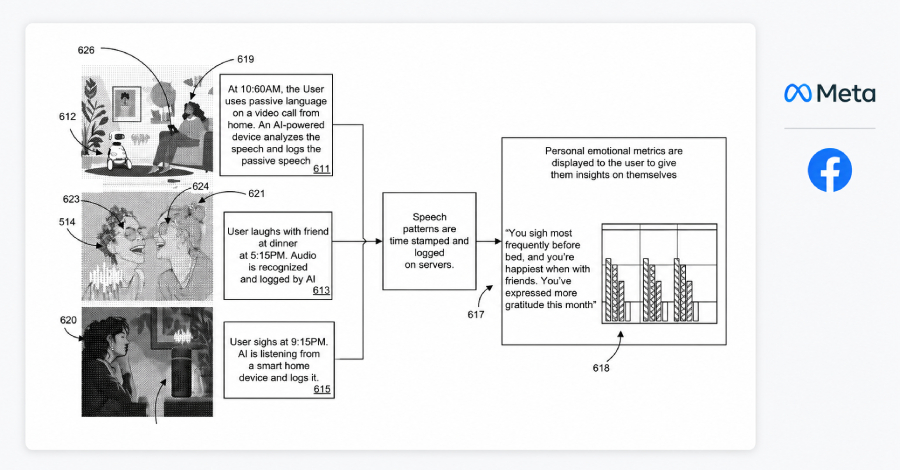
One figure logs a single person across a day: passive language on a morning video call from home, a laugh with a friend at dinner, a sigh at 9:15 PM caught by a smart home speaker.
In that figure, the speech patterns are “time stamped and logged on servers,” and the system hands the user an example readout like this:
“You sigh most frequently before bed, and you’re happiest when with friends. You’ve expressed more gratitude this month.”
The filing reaches well past your voice. It can fold in biometric and eye-tracking signals, using pupil size, blink rate, even eye moisture to flag stress or crying. It can also watch how you use your devices, down to the posts you view or like, your screen time, and how fast you switch between apps. All of it feeds one emotional profile.
The patent’s other half is a workout coach. Smart glasses watch your form in a mirror and talk you through the set, telling you to sink deeper into a squat, then cheering you on for a few more reps.

The coach reads your mood, too. If it senses you are tired or discouraged, it eases off. If it decides you have energy to spare and are slacking, the patent says it may “admonish” you. The patent claims no human coach could match its precision or keep it up all day.
We have been here before
The ambition is not new. Amazon put voice mood-reading into its Halo wearable in 2020. Its Tone feature listened to your pitch and pace and told you how you came across through the day, calm, frustrated, and the like, and it processed those samples on your phone and deleted them, never touching the cloud.
It drew scrutiny anyway: in December 2020, Senator Amy Klobuchar pressed federal health regulators over Halo’s collection of voice-tone and body-scan data, calling it unusually intrusive.
Amazon shut the whole line down in 2023, though it never tied that to privacy. The gap with Meta’s filing is not really storage: the patent keeps the work on-device in some versions and logs to servers in others. It is reach. Tone reads your mood from your voice alone; Meta’s system also reads your eyes and your phone.
Regulators have their own doubts about whether reading emotions this way even works, and they have started drawing lines. Since February 2025, the EU’s AI Act has banned AI that infers people’s emotions in workplaces and schools, except for medical or safety reasons, with fines up to 35 million euros or 7% of a company’s global turnover, whichever is more.
Its drafters flagged the thin science directly: emotional expression varies from person to person, culture to culture, and moment to moment. That ban stops at consumer tools, though. A separate rule arriving in August 2026 will make systems that read emotions from biometric signals disclose that they are doing so.
Whether a voice-first coach counts is arguable; one that also reads pupils and blink rate would fall more squarely inside that biometric line.
The Hacker News has reached out to Meta for comment on whether the application reflects any product plans and how such a system would handle user data, and will update this story with any response.
The workout coach is one use. Underneath it is a running log of everything the system decided you felt, keyed to where you were and what you were doing.
Amazon’s mood-reading listened to your voice alone, and it got pulled in 2023. Meta’s reaches into your eyes and your phone too, and the only thing keeping it out of your life is that no one has built it yet.
Found this article interesting? Follow us on Google News, Twitter and LinkedIn to read more exclusive content we post.