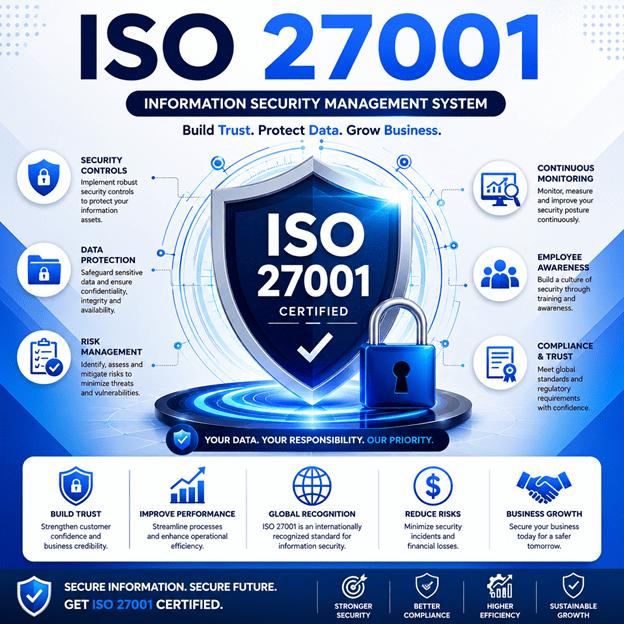

Data is the vital ingredient of modern-day business. Financial transactions, customer records, intellectual property, and internal communication companies of all sizes produce and store huge quantities of sensitive data every day. With cyber-attacks becoming more sophisticated each year, the concern isn’t whether an organization is at risk rather, what happens.
ISO 27001 has emerged as the gold standard for addressing this challenge, but not by constructing walls following the attack but instead by creating a security culture before an attack even occurs.
Also Read: Top 8 Cybersecurity Certifications
What Exactly Is ISO 27001?
ISO 27001 is an internationally acknowledged standard for creating as well as keeping the Information Security Management System (ISMS). The standard was developed in ISO, the International Organization for Standardization (ISO) . It offers a well-defined framework that is based on risk, which helps businesses identify their vulnerabilities and then implement the correct controls, and constantly improve their security.
It’s less about an exercise in checklists and more of an alteration of mindset — from reactive firefighting to proactive risk-management.
The standard is built on four fundamental principles:
- Confidentiality ensures that information is only accessible to the people who are authorized to view it.
- Integrity is a way to protect the information from unauthorised modification or alteration
- Accessibility -ensuring that systems and data are available when they need to
- Together, they make up the basis of any reliable information security program.
Why the Threat Landscape Demands a Structured Approach
The dangers that companies have to face today aren’t just hypothetical. The ransomware attack has shut down many hospitals as well as supply chains. Phishing campaigns have damaged executive accounts. Insider threats, whether accidental or malicious, have exposed millions of customer data. As for penalties imposed by the regulators for improper handling of data are getting more severe every year.
If a company does not wait in the event of an accident to happen before securing its system isn’t addressing risk; it’s risking their reputation and relationships with customers and frequently its own existence. ISO 27001 changes that equation by requiring a systematic well-documented method for finding and fixing vulnerabilities before they turn into crises.
The short answer is any business that manages sensitive information.
This covers SaaS platform and tech providers as well as financial institutions, fintech firms, healthcare organizations as well as government contractors, ecommerce businesses as well as consulting firms and professional service providers. In reality, ISO 27001 is relevant to all businesses that range from startups in the early stages of creating trust with their initial customers to huge companies that manage complex, multi-system environments.
More often, certification is becoming a requirement for commercial use. Enterprise buyers, procurement teams as well as government agencies routinely request proof for ISO 27001 compliance before signing contracts. It’s not only about security- it’s a differentiator in the marketplace.
The Core Benefits of Certification
Security posture that is stronger: The certification process makes organizations more aware of and fix any weaknesses in their security measures and weaknesses that could otherwise be unnoticed until they are discovered.
Reducing business risk: With formal risk assessment procedures in place, companies can make educated and documented decisions on how to put their money into security and at what degree of risk residual is acceptable.
Higher trust in the customer: In a world where data breaches get headlines often, certification sends a message to partners and customers that their information is secure. The trust that is earned by customers and partners directly translates into a commercial benefit.
Compliance with regulatory alignment: ISO 27001’s framework is in complete agreement with GDPR’s requirements, HIPAA, SOC 2 and other important compliance frameworks, making it simpler to prove compliance with several obligations at the same time.
The business continuity: Organizations with mature security plans recover quicker in the event of an incident and less likely experience long-lasting operational interruptions.
How ISO 27001 Implementation Actually Works
The process is a continuous process of improvement, usually known as Plan-Do Check-Act.
1. Determine the scope: Define which processes, systems, and business units are included into the ISMS. The scope of the decision will affect the rest of the.
2. Perform a risk assessment: Draw out the risks and weaknesses that could affect the information resources you have. This is a precise analysis -It’s not a simple tick-box exercise.
3. Set up security controls: As a result of the risk analysis, implement the proper organizational and technical security measures in the place. ISO 27001 provides a comprehensive list of control categories to take advantage of, from cryptography and access management to the physical security of your business and suppliers relations.
4. Document the policies and procedures: Write down the records to prove that your ISMS is working as it should. Documentation is among the most time-consuming aspects of certification. However, it’s also the thing that can make the system auditable and adaptable.
5. Conduct internal audits: Before inviting external auditors to audit, conduct internal reviews to make sure that controls are functioning and determine areas that need improvement.
6. Audits for certification and external audits: A certified certification body examines an ISMS against the standards. It typically includes reviewing your documentation and the on-site (or remote) evaluation.
7. Continue to improve and maintain: Certification isn’t just a finishing point, it’s an ongoing effort. Companies must review their certifications regularly to address new risks and show continuous improvement by conducting periodic surveillance audits.
Common Challenges to Expect
ISO 27001 is achievable, but it takes commitment. The most frequently encountered issues for organizations are:
Volume of documentation: Building and maintaining an extensive library of policies requires considerable effort, particularly at the beginning of.
Multi-functional Buy-in: Information security is not the responsibility of the IT department by itself. Making sure that HR, leadership as well as legal operational departments get in support of the ISMS is usually the most difficult aspect to complete.
Complexity of risk assessment: Accurately assessing risk across a myriad of processes, systems, and third-party dependencies requires meticulous planning and often expert input.
Inspiring the momentum: Many organizations invest massively to get their HTML0 certification only to allow the ISMS in a state of stagnation. The standard requires constant focus, not just a single effort.
The use of compliance automation tools can drastically reduce manual work load, specifically in the areas of documentation gathering, evidence collection, and preparation for audits.
ISO 27001 as a Business Growth Enabler
Security-conscious businesses, institutions, buyers from institutional sources, and other industries that are regulated increasingly consider ISO 27001 certification as a standard expectation, not as a benefit. Certification opens the door to partnerships, contracts, and markets that otherwise require lengthy security assessments or independent audits to gain access.
Beyond the commercial aspect there’s also a strategic angle. As businesses grow their data environment, it becomes more complicated — many employees and systems, as well as third-party integrations and thus greater attacks. A well-designed ISMS grows with the company’s needs, delivering an infrastructure that makes security in check even as complexity grows.
Also Read: Top 15 Essential Open Source Cyber Security Tools
Final Thoughts
Cyber-related threats aren’t becoming less complex, nor are the commercial and regulatory expectations placed on companies who handle information. ISO 27001 offers a proven international standard to meet those standards -not by promising flawless security (nothing could) however, it does so by demonstrating a systematic and documented method of managing risks.
Businesses who put their money into ISO 27001 today are not just securing themselves against today’s threats. They’re laying the foundation for security and trust as well as operational resiliency that the next stage of growth will require.
Frequently Asked Questions
What exactly is ISO 27001?
ISO 27001 is an international standard that outlines the specifications of the implementation of an Information Security Management System (ISMS). It assists organizations in systematically managing their security for sensitive data through the use of risk-based controls and continual improvement.
Is ISO 27001 certification mandatory?
No, certification is voluntary. However, many corporate clients, government entities and industries that are regulated are required to have it or strongly recommend certification as a prerequisite for conducting business.
How long will the process of certification require?
Timelines typically range between 3 and 12 months, based on how large and complex the company and also its beginning point in relation to the existing security measures and documentation.
Do small-scale businesses have the ability to obtain ISO 27001 certification?
Yes. ISO 27001 is a scalable standard that is applicable to companies regardless of size. The application and scope of ISMS can be customized to reflect the size as well as the nature and scope of the company.
What’s its major advantages?
Improved information security, better risk management, better customer trust, differentiated pricing, and alignment with compliance requirements for regulatory requirements like GDPR and HIPAA.