
TechRadar Verdict
The issue with the ZimaBoard 2 is that you can buy two N150-powered mini PCs for this money, and they come with WiFi included. While the flexibility of an external PCIe slot and passive cooling will attract some customers, there are some big limitations to these options.
Pros
- +
Silent
- +
Intel N150 is a good upgrade
- +
PCIe 3.0 x 4 is useful
- +
Dual 2.5GbE
- +
Runs full x86 OS without caveats
Cons
- –
No upgrade paths
- –
Only two USB ports
- –
WiFi is not included
- –
Extra costs for HDMI adapter and ZimaOS+
Why you can trust TechRadar We spend hours testing every product or service we review, so you can be sure you’re buying the best. Find out more about how we test.
ZimaBoard 2: 30-second review
IceWhale built its reputation on a simple idea: affordable, hackable, x86 single-board servers for people who want control over their own data. The original ZimaBoard launched in 2021 on Kickstarter. Using an Intel Apollo Lake processor, it offered a level of expandability that ARM-based boards crowding the market at the time couldn’t match. Four years later, the company is back with the ZimaBoard 2, and the update is substantial in all the ways that matter most.
Alongside that comes faster LPDDR5x memory, an upgraded PCIe Gen 3 x4 slot, dual 2.5GbE networking, and the same passively cooled all-aluminium chassis concept that made the first board so appealing to homelab builders.
Two variants are available at retail: the ZimaBoard 2 832 with 8GB of RAM and 32GB of eMMC, and the ZimaBoard 2 1664 with 16GB of RAM and 64GB of eMMC. Both ship pre-installed with ZimaOS, and both support a wide range of alternative operating systems if you prefer something else.
While it is possible to get N150 PC systems for less than even the cheaper 832 model, these don’t typically offer a PCIe slot, so this hardware might interest those developing a solution based on an X4 slot. But it might also be useful, as it’s passively cooled, to those creating embedded solutions, such as automated signage.
The ZimaBoard 2, like its predecessor, is a unique offering that isn’t expensive for the flexibility it provides. However, there are cheaper ways to get a small N150 system running TrueNAS or Proxmox, and a Raspberry Pi can run some of the apps, like Pi-Hole, that this system might otherwise be useful for.
I’m not sure this hardware is generic enough to be one of our best NAS devices for home and small business users, but there are people who will be attracted to what it has to offer.
ZimaBoard 2: Price and availability
- How much does it cost? From $279
- When is it out? Available now
- Where can you get it? Direct from IceWhale
There are two versions of the Zimaboard 2: a cheaper 832 model with 8GB of RAM and 32GB of eMMC storage, and a slightly more expensive 1664 model with double the memory and storage. Since you can’t upgrade either the memory or the eMMC storage, it would be a good idea to choose wisely before purchasing either.
Direct from IceWhale, the pricing is $279 for the 832 and $349 for the 1664 model, though shipping costs vary by location.
It is possible to get it from an online retailer, such as Amazon, but the 1664 model is $399.90 in the US and £322.99 in the UK.
For those in Europe, the Euro prices are €238.62 and €298.49 respectively. Currently, the online shop allows you to buy from the UK, France, Germany, Italy, the Netherlands, Poland, Sweden, Spain, Saudi Arabia, Japan and South Korea. All these locations can be paid either in the local currency or US dollars, with the curious exception of the UK, where it can only be paid in dollars.
That doesn’t seem expensive, until you put these numbers against what you might pay for a mini PC.
For example, the GMK NucBox G3 Pro costs less, $259 on Amazon.com, which gets you an Intel Core i3-10110U Processor (Beats 4300U/N150), 8GB DDR4, 256GB of M.2 SATA storage, and it includes WiFi and Bluetooth. Storage and memory are upgradable, and there is a second M.2 slot.
That’s from a known brand. But if you just want an N150 mini PC or NAS, then less than $200 is possible via Amazon, and even cheaper systems can be found on AliExpress.
Unless you want a specific feature of the ZimaBoard 2, such as passive cooling or an external PCIe slot, there are cheaper options available.
- Value: 3.5 / 5
ZimaBoard 2: Specs
Swipe to scroll horizontally
|
Model: |
1664 Model |
|
CPU: |
Intel Processor N150 (Twin Lake), quad-core, up to 3.6GHz Turbo |
|
Architecture: |
x86-64, 4 cores / 4 threads |
|
Cache: |
6MB |
|
GPU: |
Intel UHD Graphics (24 EUs) at 1000MHz |
|
TDP: |
6W PBP (configured at 10W) |
|
Memory: |
16GB LPDDR5x at 4800MHz (soldered) |
|
Storage: |
64GB eMMC (OS storage) |
|
SATA Ports |
2 x SATA III (6Gbps) for HDD or SSD |
|
Max SATA Capacity |
Up to 36TB via two drives |
|
PCIe Expansion |
NVMe SSD, 10GbE NIC, GPU, AI accelerator via PCIe Gen 3×4 slot |
|
Ethernet |
2 x 2.5GbE (Intel i226 controllers) |
|
USB |
2 x USB 3.2 Gen 1 (Type-A) |
|
Display |
1 x Mini DisplayPort 1.4 (4K60 output) |
|
Audio |
None onboard |
|
WiFi / Bluetooth |
None onboard (PCIe expansion required) |
|
PCIe Slot |
1 x PCIe 3.0 x4 (side-mounted, external) |
|
Supported Add-ins |
10GbE NIC, NVMe adapter, GPU, AI accelerator, WiFi card |
|
Fan Header |
Optional fan header for PCIe card cooling |
|
Pre-cut PCIe Section |
Accommodates longer PCIe cards |
|
Dimensions |
140 x 83 x 31mm |
|
Chassis |
Full aluminium enclosure doubling as a heatsink |
|
Cooling |
Fully passive (fanless); optional fan via header |
|
Power Supply |
12V DC 60W adapter included |
|
Packaging |
Box can be repurposed as a stand for the board and two 2.5in drives |
|
Bundled OS |
ZimaOS (Linux-based, pre-installed on eMMC) |
|
Alt OS Support |
TrueNAS, Proxmox, Debian, Ubuntu Server, pfSense, OpenWrt, Windows, LibreELEC |
|
App Store |
372 one-click install applications via ZimaOS |
|
Container Support |
Docker built in via ZimaOS |
|
VM Support |
Yes (limited by 4-core CPU; single VM recommended) |
|
Remote Access |
Via Zima Client (Mac, PC, iOS, Android) |
|
Warranty |
2-year warranty |
ZimaBoard 2: Design
- All-metal construction
- Passively cooled
- PCIe 3.0 x4 slot
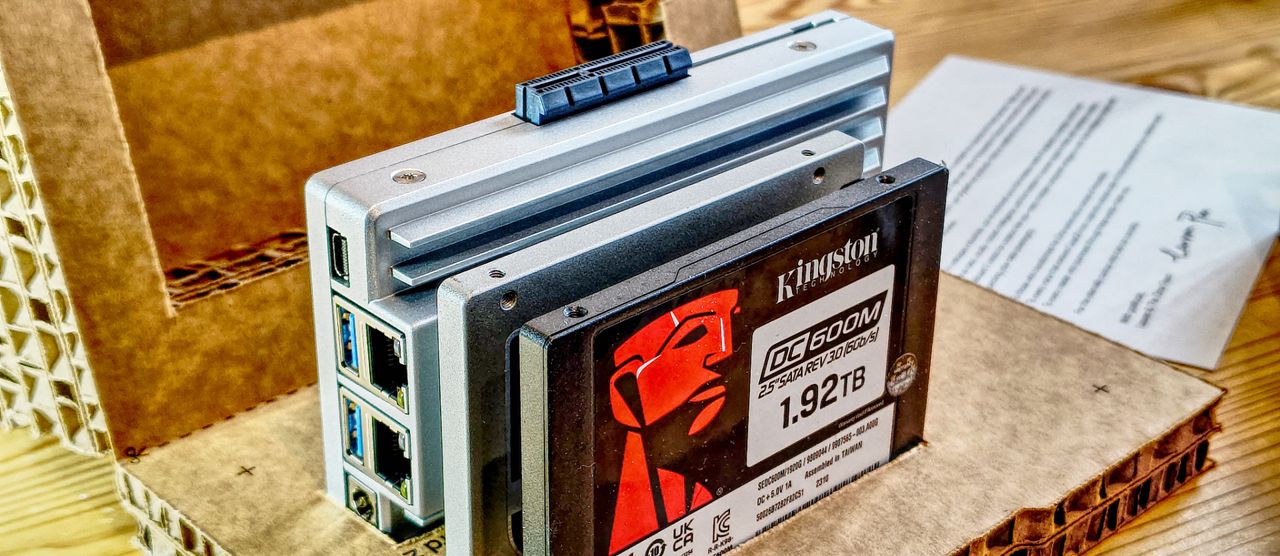
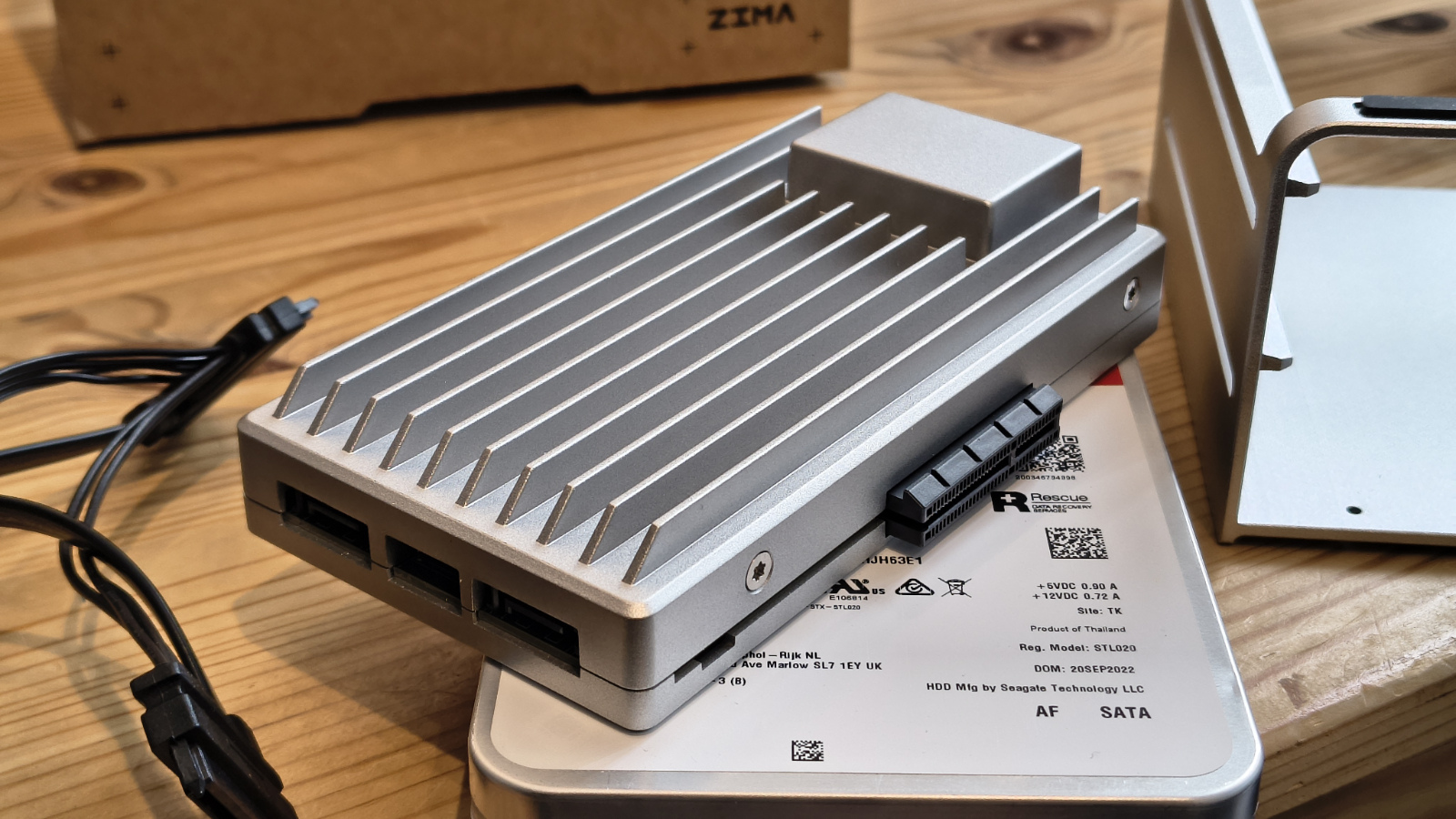
While I’ve seen even smaller, the ZimaBoard 2 is tiny for an Intel X86 platform. At just 140 x 83 x 31 mm, it sits comfortably in the palm of one hand, and the full aluminium chassis that encloses it is doing two jobs at once: protecting the electronics and acting as a radiator for internal heat ace. There is no fan, no vent, and no thermal compound to manage. The board runs silently under all circumstances, which is either its most appealing feature or a cause for concern, depending on what stress you plan to put it under.
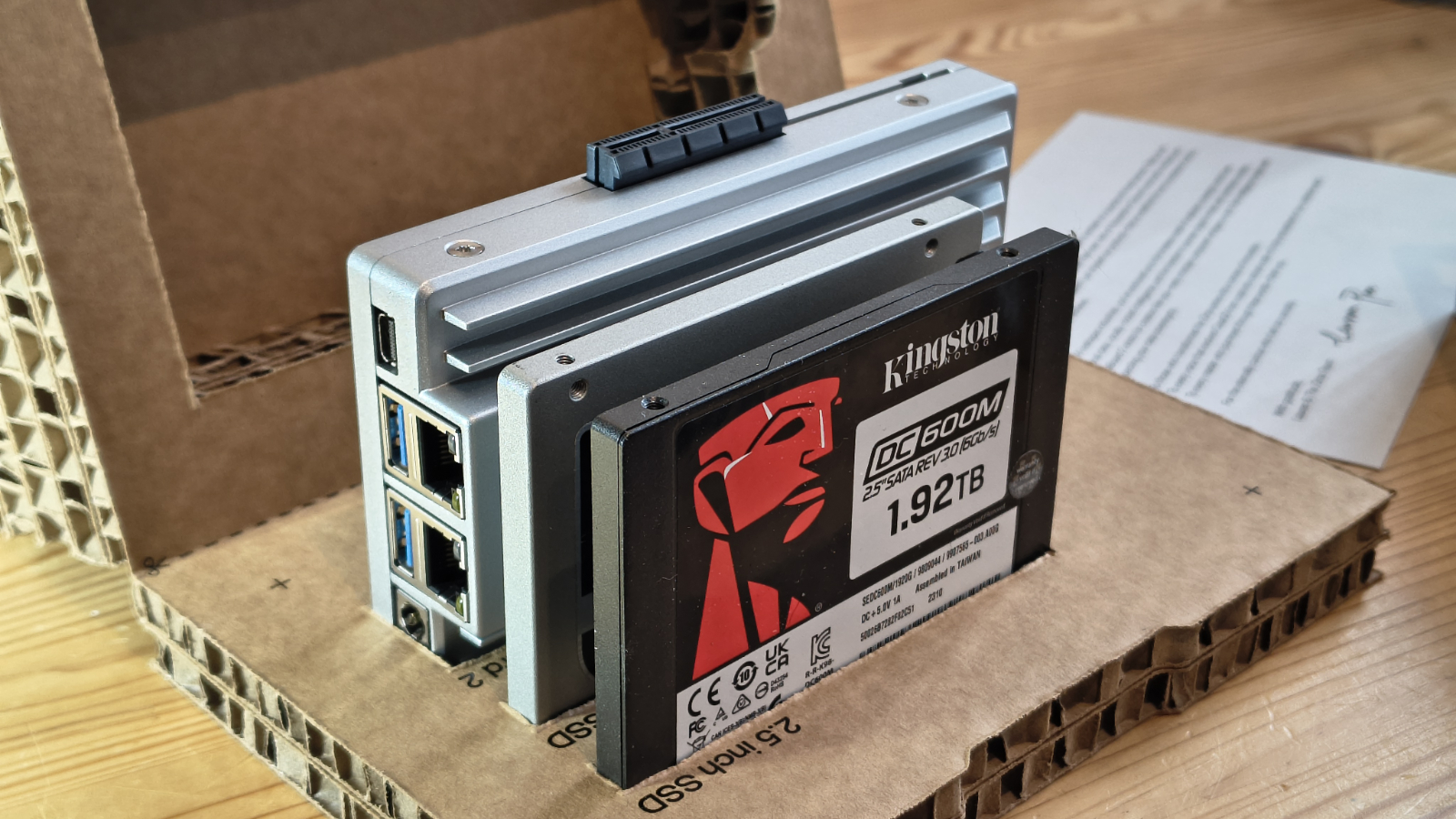
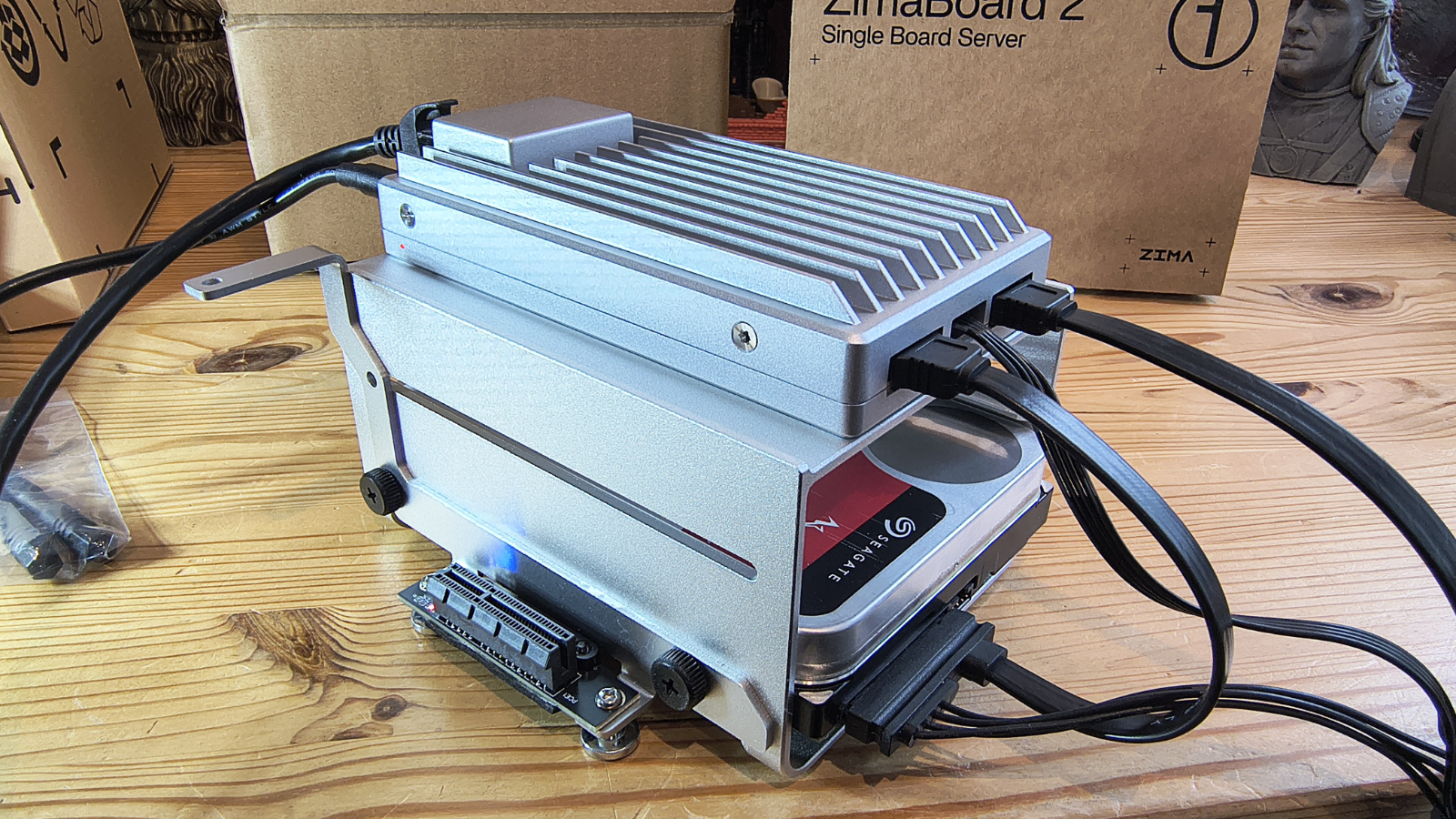
IceWhale has kept the layout practical. Ports are clearly labelled, and the side-mounted PCIe 3.0 x4 slot is pre-cut to accept longer cards. A fan header is present for those who add a PCIe card that runs warm. The packaging has a clever trick: the cardboard box is designed so that cutting the lid converts it into a stand for the board and two 2.5in drives, which is a small but thoughtful touch for a product aimed squarely at budget-conscious builders.
However, in this reviewer’s view, hot electronics and cardboard aren’t perfect bedfellows, and I do recommend spending another $30 on the aluminium rack tray accessory IceWhale offers.
It’s a bit of an exercise to mount the ZimaBoard 2 to that rack, but it makes the drives and any PCIe cards you attach seem much more secure and part of the system.
As a method to reduce the amount of internal heat generated, this system doesn’t have an internal PSU, opting instead for an external 12V wall socket PSU.
That’s fine, since I’d have expected an external supply, but what I’m less thrilled by is the lack of a power button. If you shut this down, unless you’ve configured wake-on-LAN, the only way to restart it is to pull the PSU out and then jam it back into the socket.
The other obvious absence, onboard WiFi, is a deliberate omission rather than an oversight, I believe. IceWhale positions the PCIe slot as the expansion path for wireless, which keeps the base board cost down but means an additional purchase for anyone who cannot run Ethernet. And, to be honest, WiFi seems like a poor use of the only slot, given what else it can be used for.
As I’ll get into in more depth in this review, the PCIe slot is called upon to do plenty of heavy lifting, possibly beyond the point of practicality.
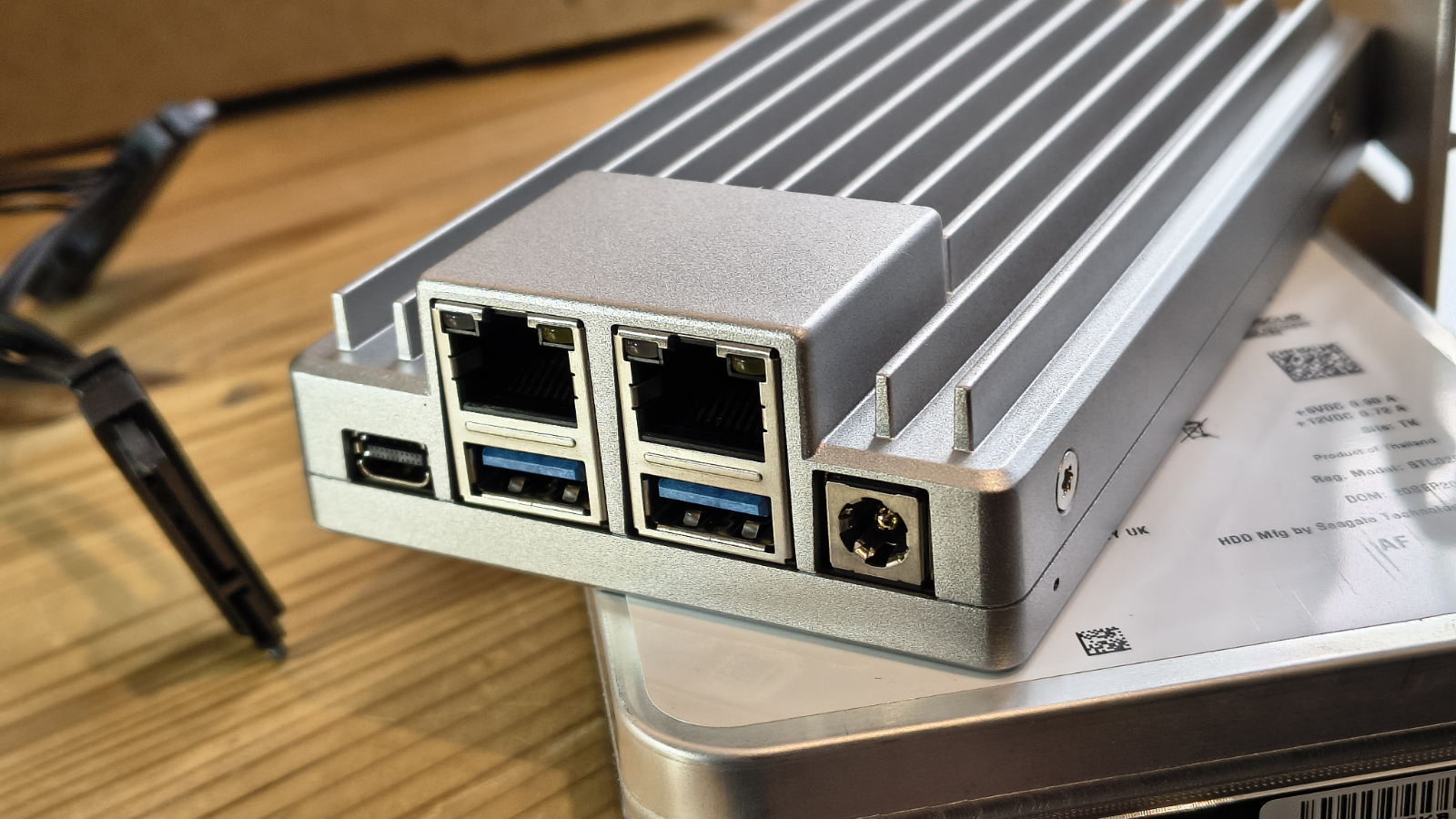
There is so much focus on the PCIe slot because the unit only has two USB ports. If you intend to attach a keyboard, mouse and anything else USB, you will need a hub. There is only Mini DisplayPort video output, so IceWhale sells a cheap adapter that converts it to HDMI. Which begs the question, why didn’t they just use Mini HDMI and include a cable?
What you do get is dual 2.5GbE LAN ports, which could be channel-bonded to send and receive up to 5Gbps over the network. That works out to about 600 MB/s of transfer, which is faster than the internal eMMC, a SATA-connected SSD, or a hard drive. The only way that network bandwidth could be saturated is for an NVMe to be attached using the PCIe slot.
However, the dual LAN configuration could be extremely useful for those wanting a hardware Firewall or to run Pi-Hole for trapping web adverts before they reach network users.
In conclusion, this is an extremely compact, silent-in-operation design that draws relatively little power and can be used interactively or as an embedded solution.
However, to achieve those things has involved some sacrifices to the specification that may or may not be the sort of trade-off that you are happy with.
- Design: 3.5 / 5
ZimaBoard 2: Features
- Intel N150
- Zero internal upgrades
- Storage choices
The Intel N150 is a Twin Lake processor built on a refined version of Intel’s low-power architecture. Four cores running at up to 3.6GHz turbo, with a 6W base power budget and 6MB of cache, represent a clean generational leap over the original ZimaBoard’s Apollo Lake silicon, which was already ageing when that product launched.
IceWhale’s claim of roughly three times the CPU performance is plausible on paper, and the move to LPDDR5x at 4800MHz sharpens the memory bandwidth picture considerably.
Those things said, the N150 is patently not a multi-VM workhorse. Four cores and four threads impose a real ceiling on anything involving multiple concurrent virtual machines, and those who push the board in that direction will find it hits its limits rapidly under combined GUI VM workloads. For single-VM use cases, light virtualisation, Docker containers, Pi-hole, Home Assistant, Plex, Jellyfin, and general NAS duties, the processor is more than adequate.
But the N150 was never a great experience for Windows, and fitting that OS onto the 64GB of eMMC storage could be challenging. Using the M.2 addon board could provide more space for a larger OS and apps, but with only four cores at its disposal, this is a system to be pragmatic about rather than optimistic.
Where this system is compromised, compared to a typical N150 Mini PC, is that it offers no internal upgrades whatsoever. The memory is soldered in place, and the eMMC storage is also fixed. Yes, you can boot from external storage attached via the PCIe slot or USB, but whatever memory and storage are in the ZimaBoard 2 at purchase is all it will ever have.
In my testing, I explored many of the potential configurations this design allows. These included using it with nothing attached, using USB devices, and using PCIe cards. As this hardware was reviewed alongside the ZimaCube 2, I was able to borrow a PCIe to NVMe card intended for the Zima Cube, and put an NVMe drive on that, which worked fine.
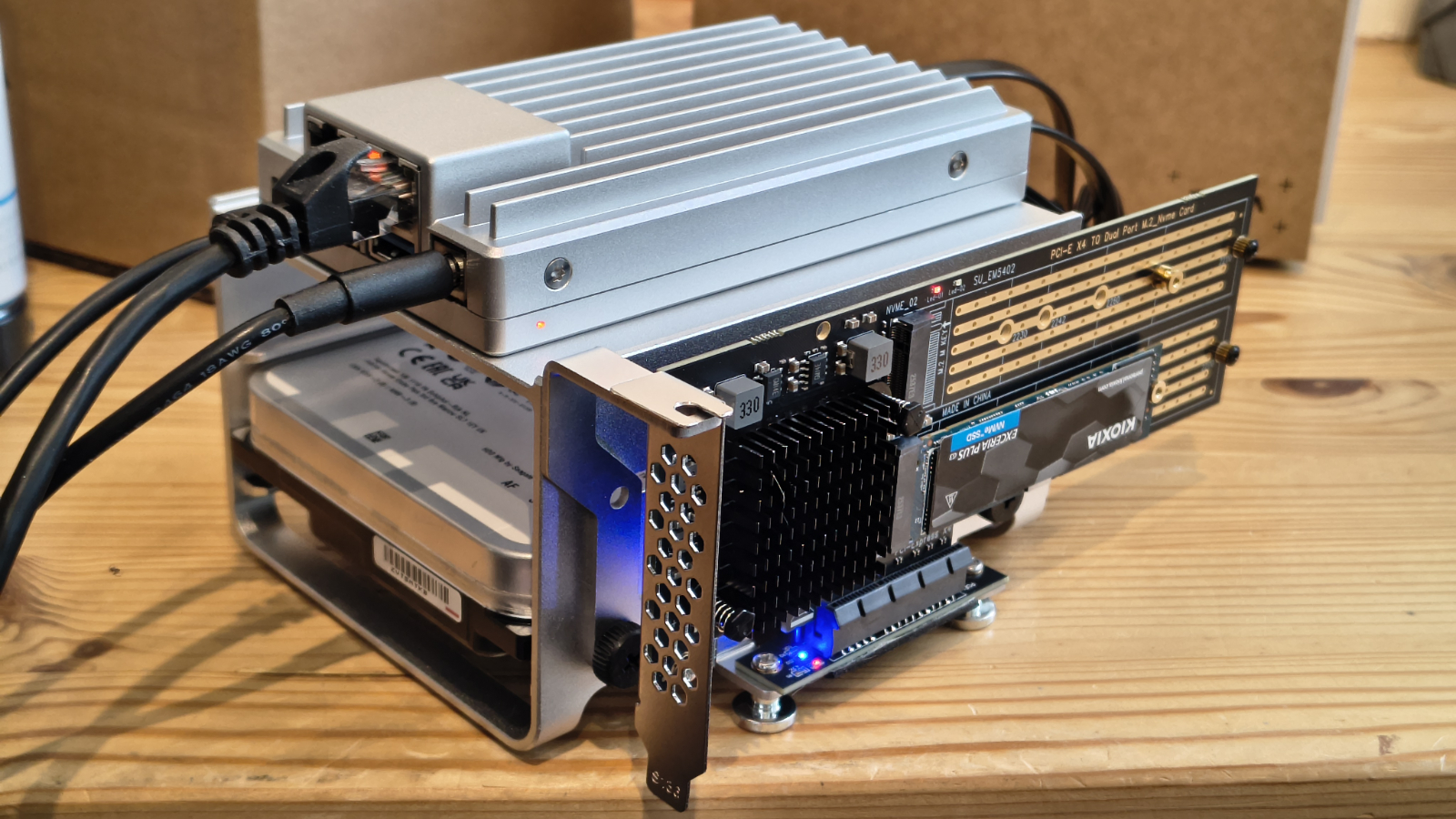
I also attached a 20TB Seagate IronWolf Pro, which also functioned normally, and I was able to format it in ZimaOS. The reason I mentioned this seemingly obvious success is that the IceWhale specifications for this machine say that the maximum amount of SATA storage is 36TB from two drives, which by definition would be 18TB.
While I don’t have the drives to test this assertion, I suspect that it would work with 24TB, 28TB, 30TB, 32TB and even 34TB SATA drives. For those curious, the SATA interface, in conjunction with 64-bit GPT (GUID Partition Table) partitioning, has a maximum theoretical capacity of 9.4 Zettabytes ((9.4 times 10^9) TB). So going from 18TB to 36TB isn’t much of a leap.
More of an issue than just buying bigger hard drives is that, in constant use, these drives will get hot, and even with the aluminium cradle, there is no fan cooling to prevent overheating. It’s somewhat ironic that this is a passively cooled computer, but if you use it in certain arrangements, you would be forced to add active cooling for subcomponents, not the system. As part of the cradle kit, you do get a tiny 25mm fan meant to help cool the electronics on a PCIe card. But this wouldn’t practically cool a hard drive or an NVMe.
Any video card needs to work with only four PCIe lanes, have its own cooling and if it needs power beyond that provided by the PCIe slot, its own power supply.
Unless you are looking for a modest GPU upgrade or to enhance AI, the PCIe slot is probably best used for devices other than video cards.
- Features: 4 / 5
ZimaBoard 2: Software
- ZimaOS Plus
- Paid licensing tier
- TrueNAS approved
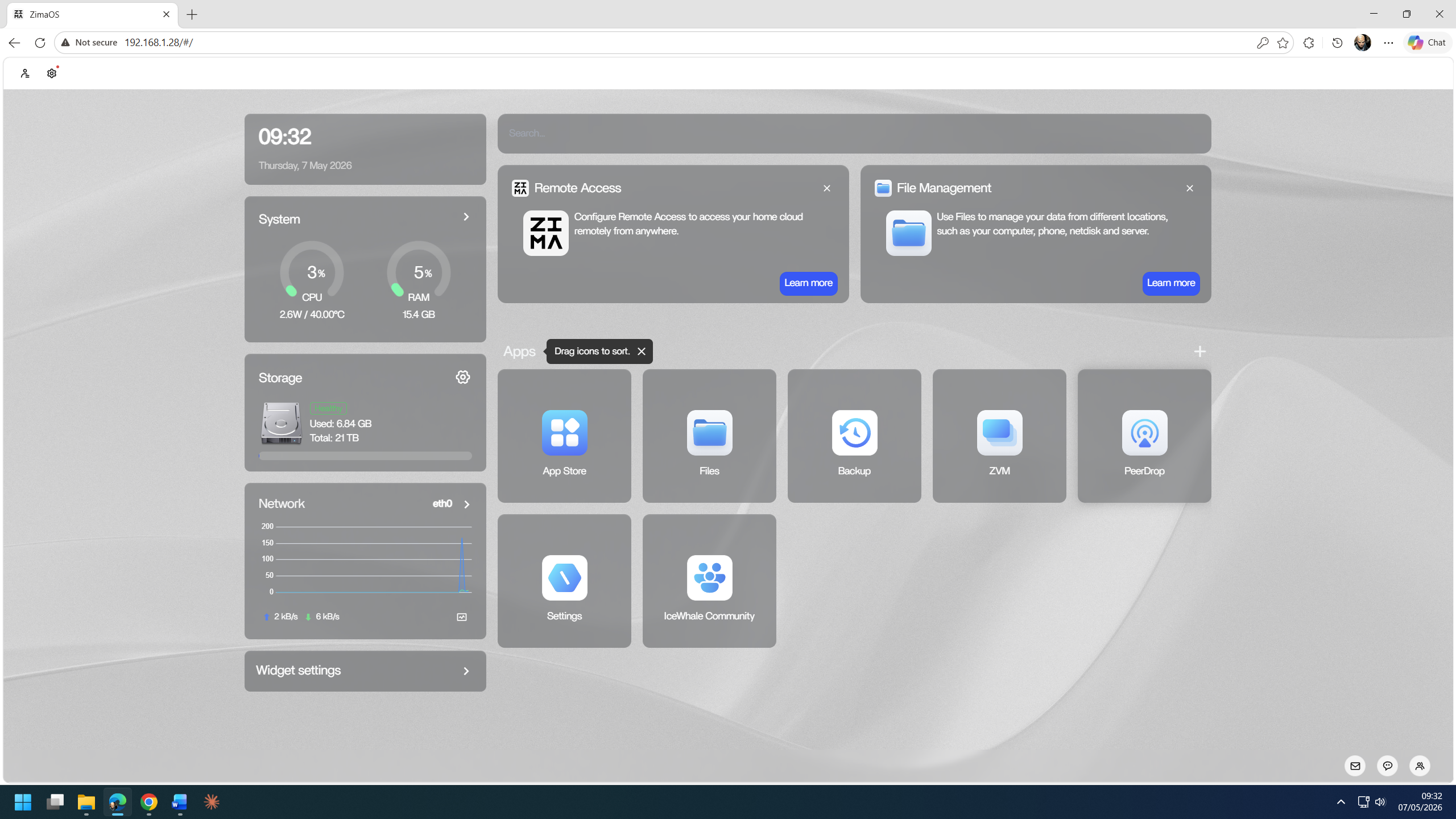
ZimaOS comes pre-installed on the eMMC and boots directly to a web dashboard the moment the board finds a network connection. IceWhale’s approach is to make the first-run NAS experience as close to frictionless as possible, and it largely succeeds.
The dashboard provides access to an app store with over 370 one-click-install applications covering media servers, backup tools, containers, smart home integrations, and more.
There is a minimalist aesthetic that is attractive, and owners are guided through the installation of drives and applications neatly.
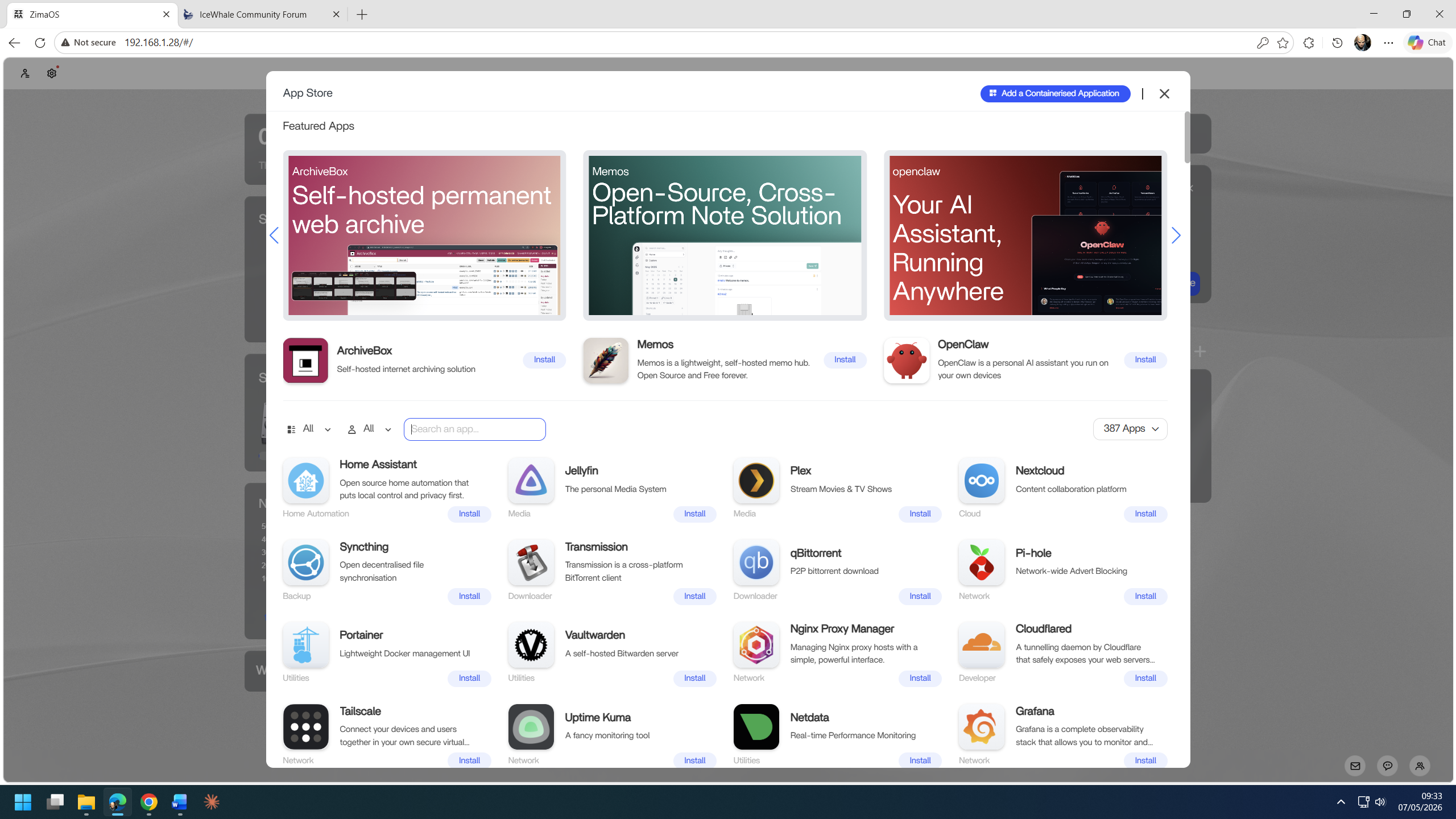
,The Zima Client companion app for Mac, PC, iOS, and Android handles remote access and picks the best available connection path automatically. For users who want to go further, the full x86 platform means TrueNAS, Proxmox, Debian, pfSense, OpenWrt, and even Windows are all valid options with no compatibility caveats. The ZimaOS Plus licence costs $29 as a lifetime purchase and unlocks unlimited disk support and unlimited users beyond the free tier.
I mentioned this previously in my ZimaCube 2 review, and I’d prefer that the $29 fee be bundled with the cost of the hardware rather than owners discovering it when they try to add their second child. Debian is free, so if you are willing to grasp the technicalities of that OS you can exploit this hardware without further investment.
- Software: 4 / 5
ZimaBoard 2: Performance
- Expansion possibilities are limited
- Ambition versus reality
Where I see this platform being most useful is as a Proxmox backup server, or a hardware Firewall. You can’t attach enough storage to make it that useful as a NAS, in my opinion, although technically you could attach two very large hard drives and use them both if you are willing to forgo drive-failure resilience. The alternative is to mirror the drives, cutting the capacity in half.
It should be possible to attach an external RAID array via USB, but frankly if you are investing in equipment like that, then why not just buy a proper four or six bay NAS, like the ZimaCube 2?
Networking tops out at 2.5GbE per port. For most home NAS scenarios, that is sufficient, but anyone wanting higher throughput will need to occupy the PCIe slot with a 10GbE card, which trades away the slot’s other potential uses. Thermal behaviour under the passive chassis is worth watching closely on test, as the aluminium body does all the work, and a PCIe card installation will add heat to an already closed thermal loop.
Adding things to this system is a bit like the whack-a-mole game. Because you upgrade the networking to support 10GbE, but the storage isn’t quick enough to saturate that. So you use the M.2 card and have NVMe drives that can offer the performance, but you are back to a 2.5GbE LAN. A single Gen3 x4 slot isn’t enough to enhance the storage and network, and there aren’t enough USB ports to use them as a workaround.
For most people, they’ll eventually conclude they need a platform with more PCIe lanes than the 9 that the N150 sports, because once the four are used in the slot, and the other five are allocated to the LAN ports and the USB, there is nothing left.
The next tier of Intel hardware has 20 lanes that mix Gen 4, providing the equivalent of 40 lanes of Gen3, or more than four times as much bandwidth. This is why IceWhale used that in the ZimaCube 2, a system that costs more than double what the ZimaBoard 2 costs.
To summarise my thinking on the performance of the ZimaBoard 2, any system that runs with passive cooling isn’t going to be massively powerful. There is an old quote attributed to Dr Samuel Johnson, the first author of a dictionary, “Sir, a woman’s preaching is like a dog’s walking on his hinder legs. It is not done well; but you are surprised to find it done at all.”
If we can ignore the Doctor’s misogyny and see the parallels with this hardware, that it can run a VM or Docker containers is amazing, but don’t expect miracles when it does.
Realistically, one VM is all I’d use, and I’d limit it to a few Docker containers. Because, as efficient Linux platforms can be, what is under the hood of the ZimaBoard 2 isn’t going to break any performance records any time soon.
This is the trade-off for the size of the ZimaBoard 2 and its passive cooling operation.
I limited my performance testing of the ZimaBoard 2 to copying large files to and from the NAS, using a 20GB video file as the blunt instrument of my assault. I’d initially intended to use SSH and an on-client CLI to do more extensive testing, but due to some issues, in the end, I merely copied files across the network and locally on the NAS.
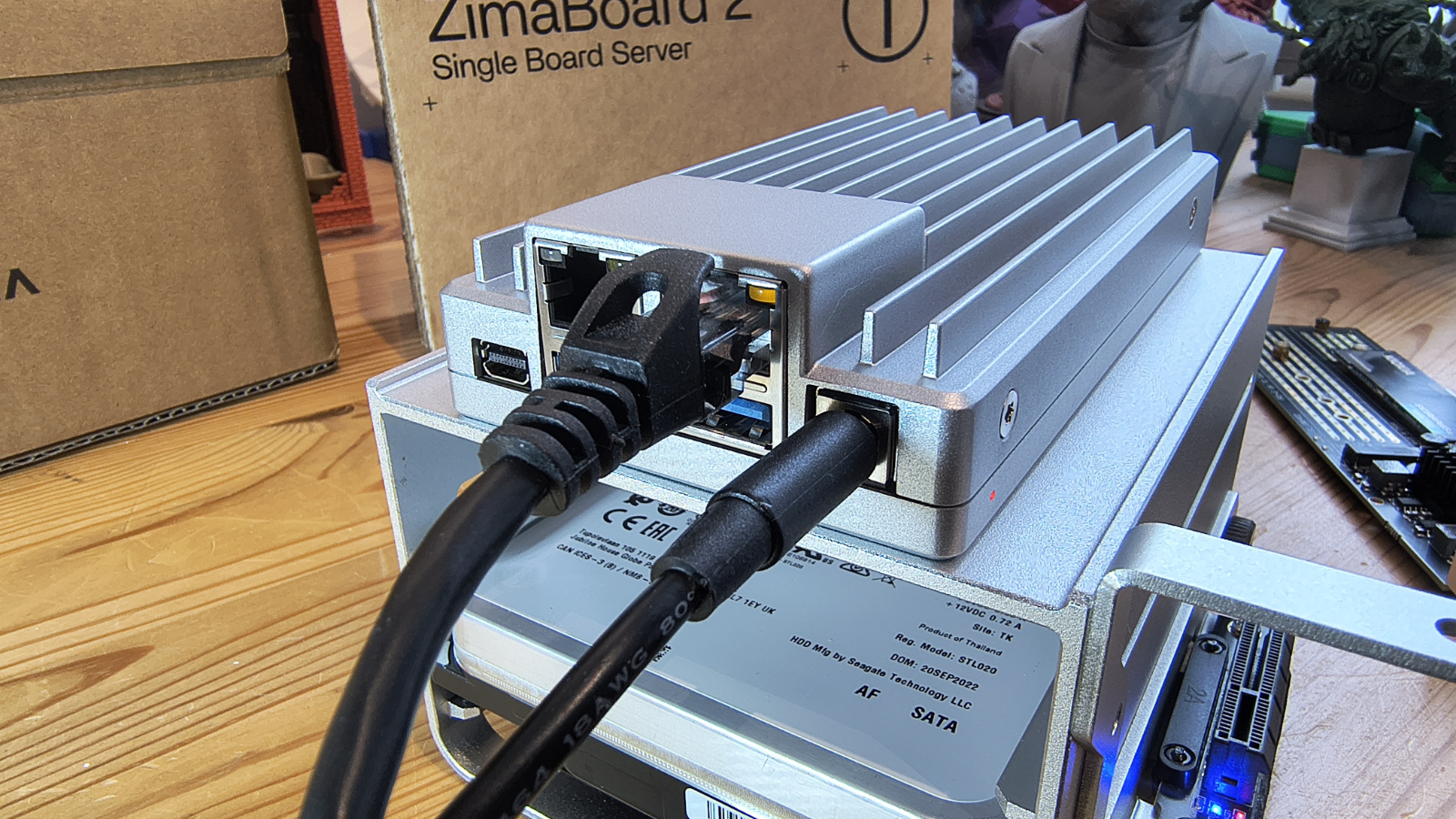
The ZimaOS client on the PC connects storage to specific virtual drives, and so I was able to test the eMMC inbuilt storage, the 20TB Seagate IronWolf Pro and the 1TB Kioxia Exceria Plus G3 that I’d connected via the PCIe slot.
All transfers used a single 2.5GbE LAN connection, and they all managed 280MB/s when the transfers were initiated. However, it became apparent that when writing a file, most of the data was heading into the 16GB of RAM to be written to the storage device later. This was most apparent on the eMMC, since it was so slow that the system ran out of memory for cache at about 17GB, where it dropped dramatically to around 60MB/s.
Equally, the hard drive blipped in the middle of its write, caught between what the system had memory cached and its own internal cache. The best experience, unsurprisingly, was on the NVMe drive that could write the whole 20GB file at 280MB/s without missing a beat. I estimate that the NVMe drive is capable of between 2000 and 3000Mb/s on a PCIe Gen 3×4 slot, but you can’t attach a 10GbE to deliver some of that over the network, since you only have one slot.
I could have found another NVMe drive and tried moving files between them, although this would have cut the performance in half, since one would be reading and the other writing.
A few users in the ZimaOS community have noted that if you use the GUI file manager that, transfers appear to be capped at 600MB/s, but CLI operations aren’t. I can’t confirm this, and it may have been subsequently patched.
As with many NAS, the ZimaBoard 2 can find itself hamstrung trying to express internal performance to outside services. And, those are limitations owners will need to accept.
- Performance: 3.5/5
ZimaBoard 2: Final verdict
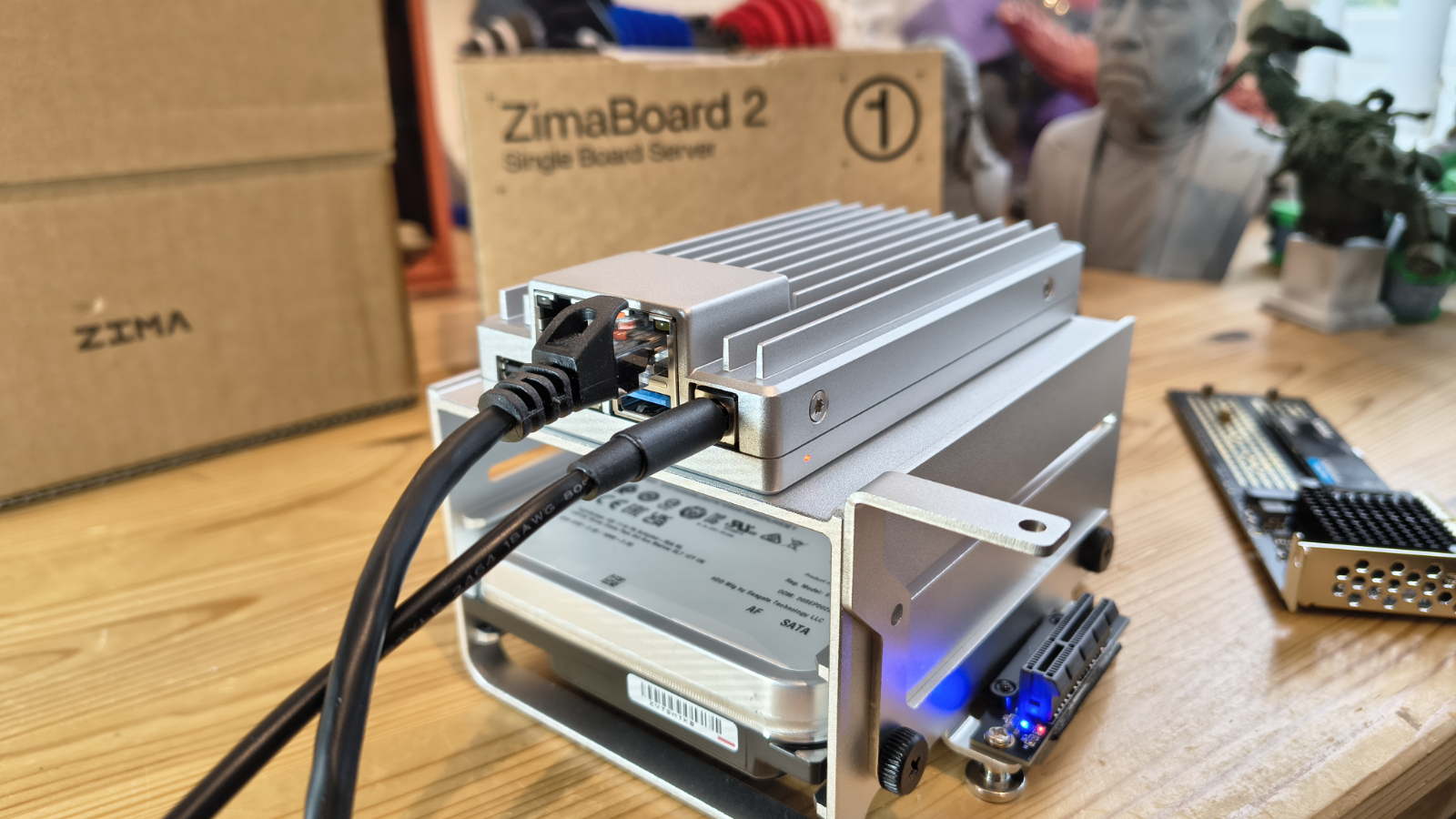
The ZimaBoard 2 is a serious upgrade on the original in every area that counted against it: faster processor, faster memory, faster networking, and a better PCIe slot.
At $279 for the base model, it sits in a competitive price bracket, but the combination of x86 compatibility, dual 2.5GbE, passive cooling, and a genuine PCIe expansion path is difficult to replicate at this size and price point. The soldered memory and external drive arrangement are compromises worth knowing about before buying, and the four-core processor imposes real limits on multi-VM ambitions.
For homelab builders, NAS enthusiasts, router experimenters, and anyone who wants a genuinely hackable low-power server that can run almost any OS without argument, however, the ZimaBoard 2 makes a compelling case for itself.
Should you buy a ZimaBoard 2?
Swipe to scroll horizontally
|
Value |
Lots of features, solidly built but not cheap |
3.5 / 5 |
|
Design |
Ultra compact and passively cooled |
3.5 / 5 |
|
Features |
Limited USB, but it has a PCIe 3.0 4x slot |
4 / 5 |
|
Software |
Workable NAS OS, or use TrueNAS |
4 / 5 |
|
Performance |
Difficult to saturate the LAN using SATA and one PCIe slot |
3.5 / 5 |
|
Overall |
Highly flexible, but silence comes with a cost |
4 / 5 |
Buy it if…

Mark is an expert on 3D printers, drones and phones. He also covers storage, including SSDs, NAS drives and portable hard drives. He started writing in 1986 and has contributed to MicroMart, PC Format, 3D World, among others.
” data-join-the-conversation-text=”Join the Conversation”>
You must confirm your public display name before commenting
Please logout and then login again, you will then be prompted to enter your display name.
Related Posts

ChatGPT’s new customization options are exactly what I’ve been waiting for to make my chats more personal
(Image credit: Shutterstock) New custom instructions added to ChatGPT Responses become more personal to you More new features expected in […]

Missed your chance to buy a MacBook this Prime Day? Fear not, the best deals weren’t even at Amazon
(Image credit: Future/Jacob Krol) Amazon‘s massive Amazon Prime Day had some great MacBook deals this year, but not all is […]

Google Messages is finally rolling out its snooze function for chats – here’s how it works
(Image credit: Shutterstock / sdx15) Google Messages is finally rolling out its long-awaited snooze feature for chats, Android Police has […]