
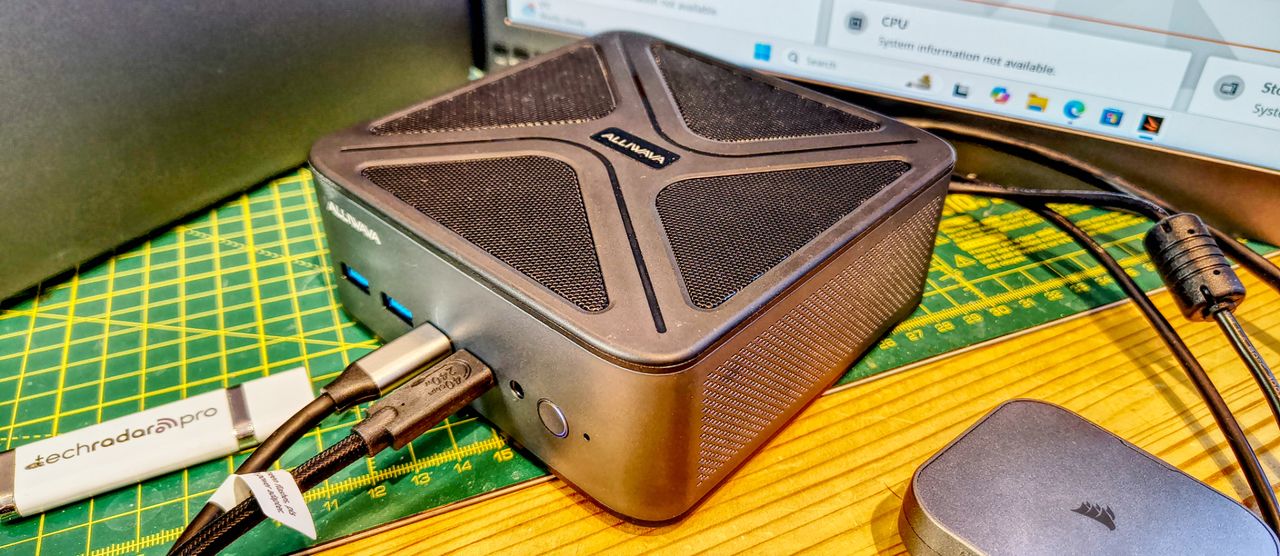
TechRadar Verdict
A better mini PC than the U58, the GH8 delivers decent performance and expansion in a small VESA-mountable enclosure. However, it only has one USB-C port, and none of the USB ports are correctly labelled. Alliwava need to work on the fine details of these products.
Pros
- +
Affordable
- +
Easy internal access
- +
Second M.2 slot
- +
Dual 2.5GbE LAN ports
Cons
- –
Many ports aren’t labelled
- –
Only one USB4 port
- –
1TB NVMe is Gen3 in a Gen 4 slot
Why you can trust TechRadar We spend hours testing every product or service we review, so you can be sure you’re buying the best. Find out more about how we test.
Alliwava GH8: 30-second review
The previous Alliwava machine I covered, the U58, was based on solid but slightly older Ryzen Zen 3 silicon, but the GH8 covered here uses more recent AMD technology.
In the GH8, it has two 16GB DDR5-5600 memory sticks, for a total of 32GB, but it can be upgraded to 128GB with larger modules. The default storage is 1TB NVMe, but this can be upgraded to a 4TB module, and a second slot enables this machine to have 8TB, or potentially more, internally mounted.
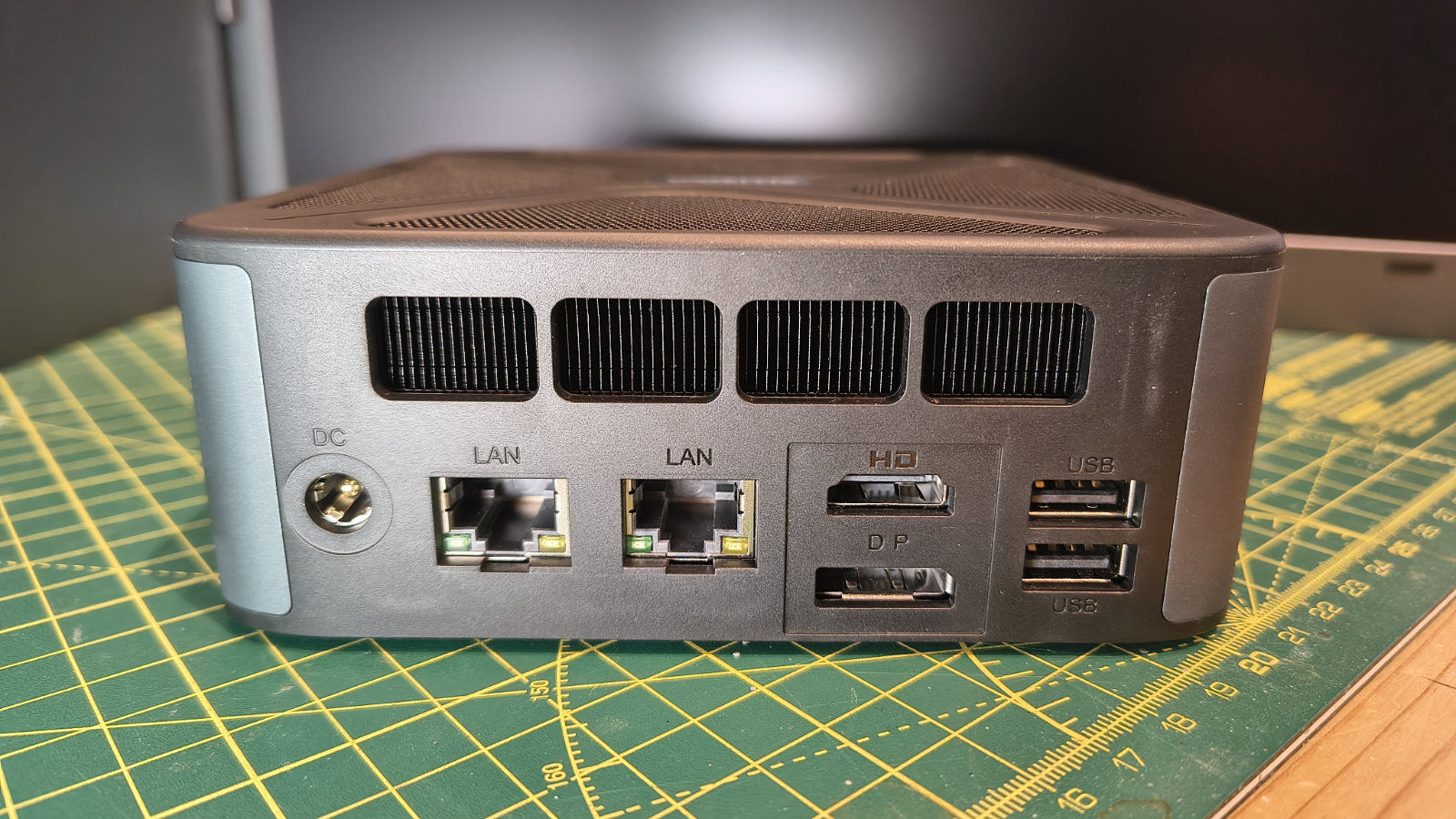
The port selection is reasonably flexible with USB4, USB 3.2 and USB 2.0 ports, along with dual video outputs (HDMI and DisplayPort), and dual 2.5GbE LAN ports. These ports make this machine decidedly more adaptable than the U58, and the platform is significantly more powerful.
The only connectivity caveat is that it doesn’t support Oculink for external GPUs. AMD has since made even more powerful platforms with the Hawk Point refresh and the new Strix Point, Krackan Point, Strix Halo and Fire Range, all with Zen 5 or Zen 5c architectures.
But machines based on these technologies are significantly more expensive, making them exclusively for creative and power users.
The platform used in the GH8 provides a nice balance between the cheaper options, like the 58U, and the expensive Zen 5 product lines. Those who need more power or use USB4 will appreciate the enhanced experience over cheaper NUCs, and the pricing is competitive.
The GH8 probably lacks some of the breakout technologies that would justify its inclusion in our best mini PC round-up, but it’s an attractive option for those who want a NUC that can easily be repurposed for a wide range of uses.
Alliwava GH8: Price and availability
- How much does it cost? From $900/£680/€770
- When is it out? Available now
- Where can you get it? Direct from Alliwava and via online retailers
Note: The prices quoted here are part of a promotion Alliwava currently has, and the website doesn’t say when this sale will end or whether prices will revert to pre-Christmas levels.
At the time of writing, there are only two SKUs of the GH8, one with 32GB of RAM and 1TB of storage, and another with 64GB of RAM and 1TB of storage. Both are available direct from the Alliwava website.
However, at the time of writing, the 64GB model isn’t available, which makes the pricing of this product remarkably straightforward.
The standard price is $898.33 in the USA, £679 in the UK and €766.84 in the EU. Based on the current exchange rates between the US Dollar, UK pound and the Euro, the UK is the most expensive by about £14, but the EU is only a Euro more than its American counterpart.
The AMD Ryzen 9 8945HS processor used in this system has been popular with other mini PC builders, and I’ve personally reviewed the Geekom A8.
Geekom now sell the A8 with the same specification as the GH8, and that is $859 via Amazon in the USA. In the UK, the same machine via Amazon is £899.
While I’ve not tested it, the similarly specced Minisforum UM890 Pro sells for $899.90 in the US and £739 in the UK via Amazon.
Better value is the GMKtec K11, which can be gotten for $739.99 in the USA, and £629.96 in the UK, again from Amazon.
These prices make the GH8 look like something of a bargain, with the possible exception of the GMKtec K11 in the UK.
However, some of these alternatives have a marginally better spec, with the K11 having dual USB4 ports and Oculink, as does the Miniforum UM890 Pro. Where the Geekom A8 offers USB4 Elite Connectivity as an alternative to Oculink.
Unless you specifically want these technologies, the GH8’s pricing seems competitive, though for European customers, the GMKtec K11 offers better value in some respects.
- Value: 4 / 5
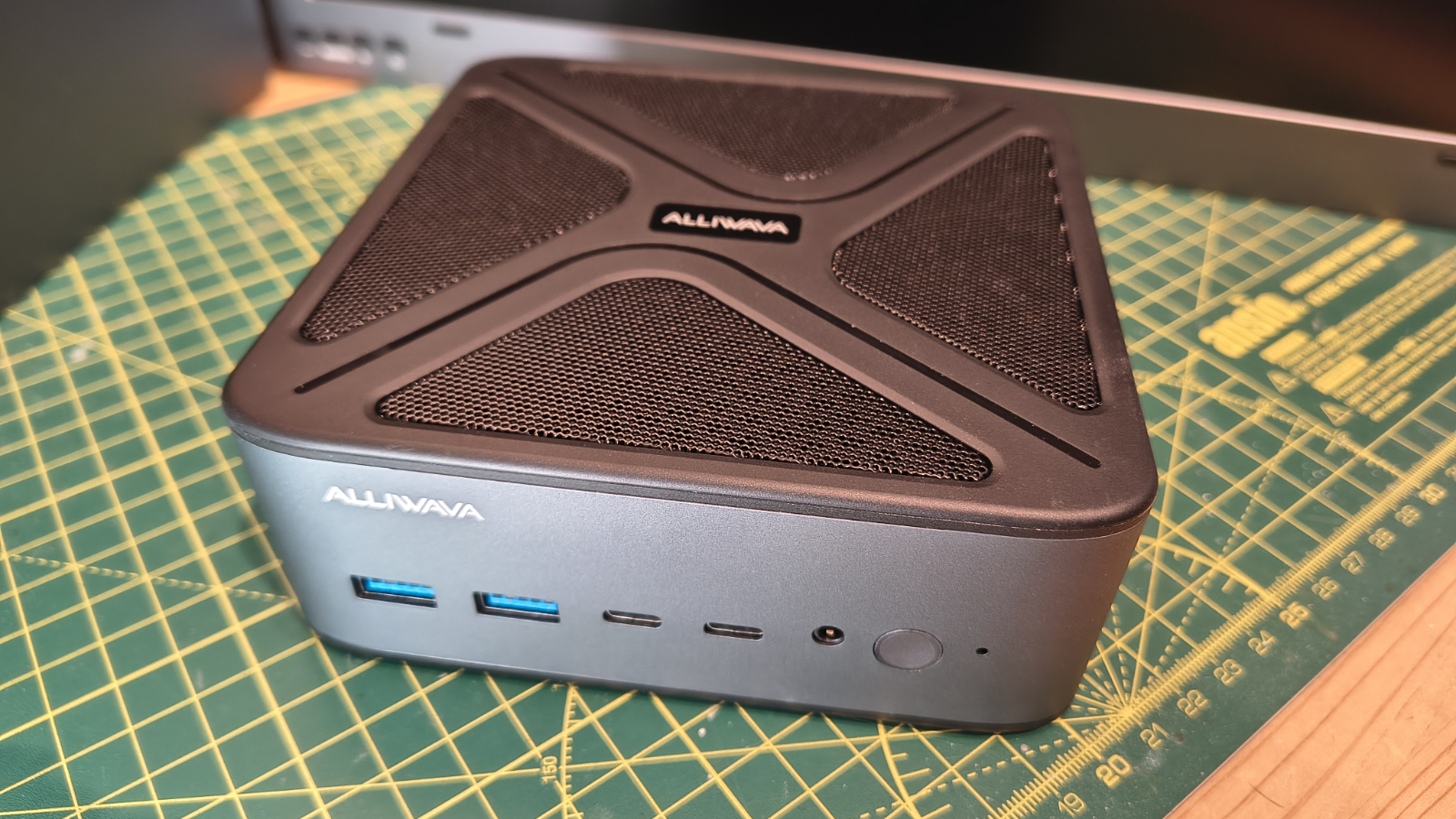
Alliwava GH8: Specs
Swipe to scroll horizontally
|
Item |
Spec |
|---|---|
|
CPU: |
AMD Ryzen 9 8945HS Processors( 8C/16T, up to 5.2GHz) |
|
GPU: |
AMD Radeon 780M, up to 2.8 GHz |
|
RAM: |
32GB DDR5-5600 (16GB x 2) expandable to 128GB |
|
Storage: |
1TB M.2 2280 PCIe Gen 4 |
|
Expansion: |
1x M.2 NVMe |
|
Ports: |
1x USB4 Type-C, 2x USB 3.2 Gen 2 Type-A, 2x USB 2.0, 1x HDMI 2.1, 1x DisplayPort 1.4, 1x 3.5mm Audio |
|
Networking: |
2x 2,5GbE, WiFi 6E, Bluetooth 5.2 |
|
OS: |
Windows 11 Pro (pre-installed) |
|
Base Power: |
35-54W |
|
PSU: |
19V 6.32A 120W |
|
Dimensions: |
130 x 127.5 x 52 mm |
Alliwava GH8: Design
- Basic build quality
- VESA mountable
- Easy internal access
The build quality of the GH8 seemed more than familiar, as it follows the same well-worn construction path as the U58 from the same brand. The plastic case is given a metal banding that encircles the plastic frame, with a plastic floor and lid attached to that.
It looks fine, but if this got knocked off the edge of the desk, it might not survive the impact with a solid concrete floor.
Like the U58, it has threaded inserts on the base that enable it to be VESA mounted, and I noted this time that the mounting hardware has holes for both 100 VESA and 80 VESA, which should cover the majority of monitors with VESA holes.
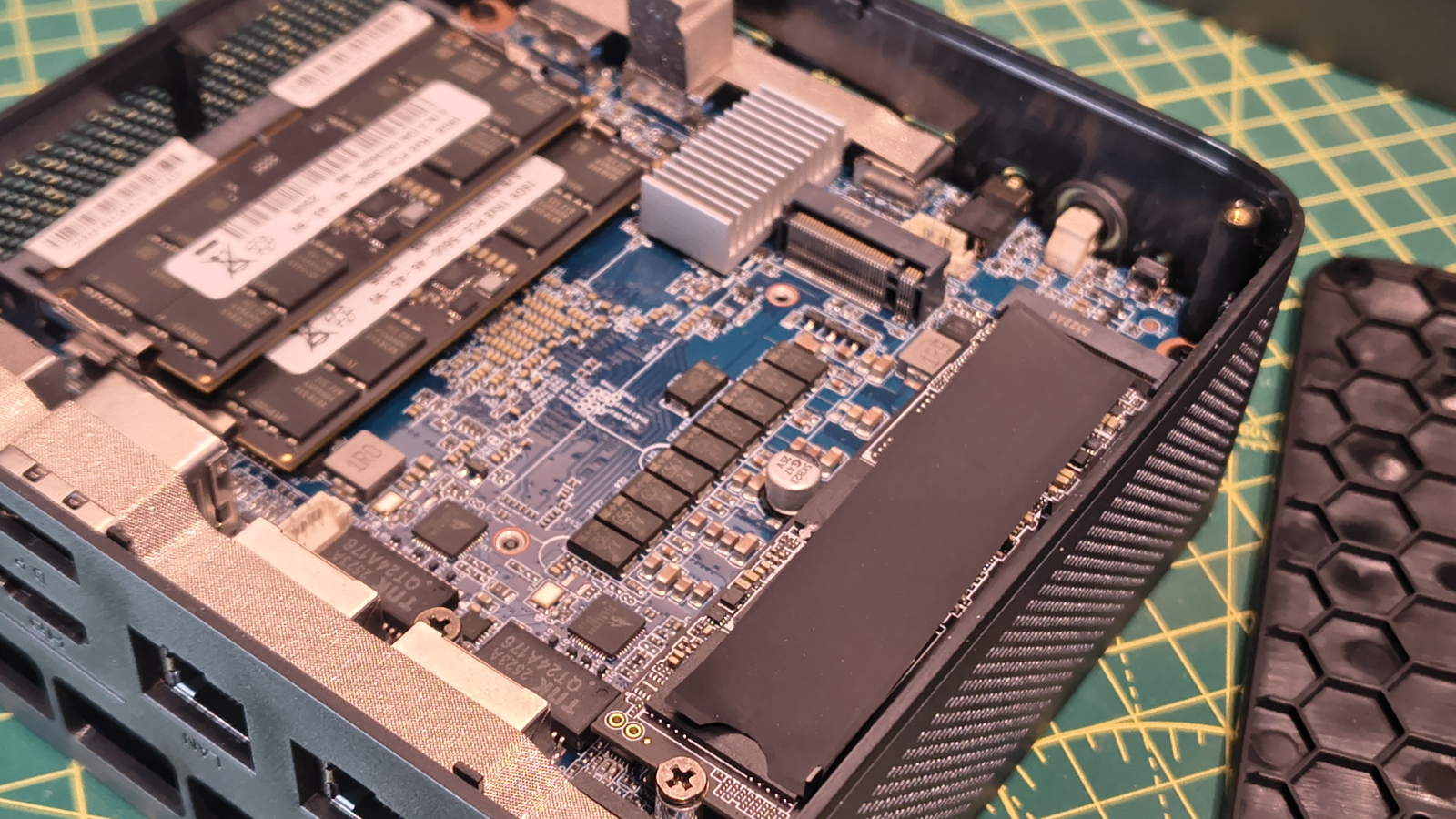
Access is identical to the U58, with four screws holding a plastic floor to the chassis, and once this is removed, you can get to the memory and storage easily.
According to the Alliwava promotional material, the GH8 can take up to 128GB of DDR5, although, realistically, 64GB modules aren’t widely available. But you can get 48GB modules, enabling the two slots to be used to offer 96GB of memory.
This SKU came with a single 1TB Gen 3 M.2 NVMe module in place, but there is room for a second 2280 stick, something the notably U58 lacked.
I’m sure these two M.2 slots are PCIe Gen 4, and therefore, much faster modules can be mounted, and also larger capacities. Having two M.2 slots makes cloning an existing system remarkably easy and fast.
There isn’t anything special about the design and construction of the GH8, but at least it avoids some of the pitfalls of the U58, even if it doesn’t address all of them.
- Design: 4 / 5

Alliwava GH8: Hardware
- AMD Ryzen 9 8945HS
- Only one USB4 port
- Gen 3 SSD in a Gen 4 slot
Where Intel processors gain cores and threads across Core 5, 7, and 9, AMD takes an entirely different approach. All the Hawk Point chips (8040 series) that are Ryzen 7 or 9 have the same number of cores and threads. Only those classed as Ryzen 5 get fewer cores, and the adjustment between the Ryzen 7 and 9 processors is entirely down to the base, turbo and GPU clocks.
At the top of the Hawk Point (8040) series, the Ryzen 9 8945HS delivers a 4GHz base clock with a boost up to 5.2GHz and a 2.8GHz GPU clock.
However, it’s the AI capability of this chip is only 39 TOPS, of which 16 TOPS comes from the integrated AMD Ryzen AI NPU chip. This isn’t any better than all the Hawk Point processors that support AI, including the Ryzen 5 models.
What’s nice about this silicon is that it offers twenty PCIe 4.0 lanes, providing plenty of bandwidth for peripherals, and the memory channels support both DDR-5600 memory, but also LPDDR5x-7500. This equipment uses the first of these, which has less bandwidth but has the advantage that the memory is socketed, not surface-mounted.
Without the need for additional chips, the AMD Ryzen 9 8945HS has two ports of USB4, USB 3.2 Gen 2 and and four ports of USB 2.0.
What’s odd is that according to the Alliwava specs, the GH8 only has one USB4 port, and two USB 2.0 ports. The two USB 2.0 ports are enough, but how did it manage to misplace a USB4 port that required only wiring? On paper, it looked like Alliwave downgraded a USB4 port to become a USB 3.2 port, which is a remarkably poor exchange.
Armed with a Corsair EX400U USB4 SSD, I set out to determine the truth.
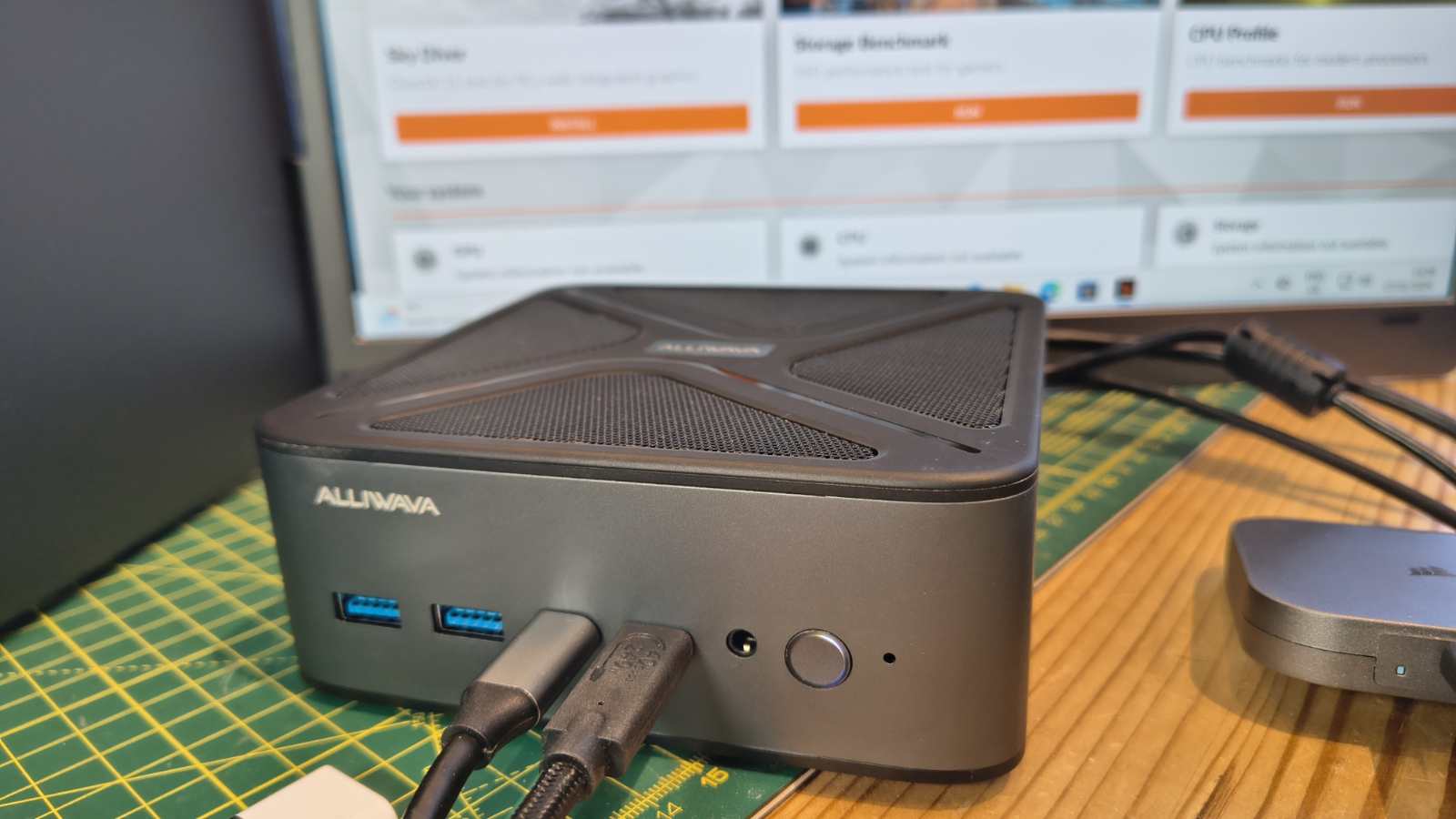
Before I get into the results of those tests, the U58 annoyed me with its lack of proper port labels, and unsurprisingly, the GH8 is even worse. There are two USB Type-C ports on the front of this machine, and neither has any label or icon.
And, while these ports look identical, as they have no labels or icons whatsoever, I can tell you that the one on the left, looking at the front, is USB4, but the one on the right is only USB 3.2 Gen 2. Why this was done, I’ve no idea, but given that the processor has two ports by default, it seems incomprehensible.
What’s also mildly amusing is that, presumably due to cost-cutting, Alliwava provided this computer with only a PCI Gen 3 M.2 drive. And, when using USB4, the externally connected Corsair EX400U outperformed the internal drive at both reading and writing.
Therefore, if it booted from the EX400U, it would be faster.
I’d classify this choice as one that makes less of the GH8 for no good reason, although it might be to do with power. Whatever the logic, like the U58, this Alliwava mini PC has a few technically poor choices like this one, though fewer than the U58 had.
A major advantage of this system over the U58 is that it has the Radeon 780M GPU, which is a much better performer than the Vega 8 that came before it. Running graphics benchmarks, it’s at least twice the speed of the Vega 8, but only marginally quicker than the prior 680M.
This doesn’t make the GH8 a gaming system or ideal for CAD, but it’s markedly better than many integrated graphics, even if it’s been overtaken by the Radeon 8060S on the Max AI processors.
Here, using the USB Type-C DisplayPort Alternate mode, it is possible to drive four monitors from this system. Two on the USB-C ports and one each from the HDMI and DisplayPort outputs.
With the exception of the USB-C mess and Alliwava’s aversion to labelling ports, the hardware in this mini PC is decent and should provide a good user experience.
- Features: 3 / 5
Alliwava GH8: Performance
Swipe to scroll horizontally
|
Mini PC |
Header Cell – Column 1 |
Alliwava GH8 |
Alliwava U58 |
|---|---|---|---|
|
CPU |
Row 0 – Cell 1 |
AMD Ryzen 9 8945HS |
AMD Ryzen 7 5825U |
|
Cores/Threads |
Row 1 – Cell 1 |
8C 16T |
8C 16T |
|
RAM |
Row 2 – Cell 1 |
32GB DDR5 (2x16GB) |
32GB DDR4 (2x16GB) |
|
Storage |
Row 3 – Cell 1 |
1TB NVMe SSD |
512GB NVMe SSD |
|
Graphics |
Row 4 – Cell 1 |
Radeon 780M |
Radeon Vega 8 |
|
3DMark |
WildLife |
16748 |
8218 |
| Row 6 – Cell 0 |
FireStrike |
6655 |
3764 |
| Row 7 – Cell 0 |
TimeSpy |
2789 |
1402 |
| Row 8 – Cell 0 |
Steel Nom Lt. |
2249 |
1307 |
|
CineBench24 |
Single |
97 |
85 |
| Row 10 – Cell 0 |
Multi |
851 |
473 |
| Row 11 – Cell 0 |
Ratio |
8.78 |
5.59 |
|
GeekBench 6 |
Single |
2563 |
1978 |
| Row 13 – Cell 0 |
Multi |
11875 |
7941 |
| Row 14 – Cell 0 |
OpenCL |
21704 |
16925 |
| Row 15 – Cell 0 |
Vulkan |
27657 |
15457 |
|
CrystalDisk |
Read MB/s |
3572 |
3650 |
| Row 17 – Cell 0 |
Write MB/s |
2037 |
2717 |
|
PCMark 10 |
Office |
6815 |
6445 |
|
WEI |
Row 19 – Cell 1 |
8.2 |
8.1 |
Before I get into the benchmarking weeds, I want to mention that the AMD Ryzen 9 8945HS platform has a range of performance based on its power rating that, on some systems, can be configured via the BIOS.
The GH8 is one of those systems, and by default, it is set to 45W. It can be set lower, which might be a good option if you are using it in an embedded scenario where ventilation is an issue, but for my tests, I bumped it up to the maximum value of 54W.
This didn’t have any major impact on fan noise, I noted, but it did produce some small improvements in a few of the benchmarks. The results displayed here are for 54W running, although the BIOS also allows for overclocking, which I didn’t attempt on this system.
The unmodified 45W setting produces almost the same numbers with a variation of less than 5% overall.
For this comparison, I thought I’d use the recently reviewed Alliwava U58, an older Ryzen chip that uses DDR4, not DDR5. When looking at the differences, it’s worth noting that the GH8 is more than double the price for the same capacity of memory and storage.
If the results of each machine were adjusted for cost, then the U58 would probably represent better value, but it can’t deliver the processor or GPU performance of the GH8, or even close.
The only place it edged ahead was in the CrystalMark test of the NVMe drive. A bigger issue here is that on the GH8, the makers used a Gen 3 drive in a Gen 4 slot. To prove that it was a Gen 4 slot, I installed a second M.2 drive in the second slot, a Kioxia Exceria Plus 1TB drive that is Gen 4 rated.
It achieved over 5,000 MB/s in that slot, which is its maximum sequential read speed, proving that the poor performance of the boot drive was down to its specification, not the slot.
What’s slightly sobering is that from the perspective of the Windows Experience Index, there is little difference between these systems, but that’s probably more about the limitations of that Microsoft tool than about the real performance separation. But the PCMark test infers something similar, even if the difference is greater.
What I’d conclude is that if you have the applications and jobs that would be impacted by the enhanced performance of the GH8, then you would certainly want that machine. But equally, if you merely run the occasional Office app and surf the web, you might not notice the difference.
Looking back at my benchmarking results over the past few years, the GH8 delivers good scores, but I have seen them bettered by machines that use the AMD Ryzen 7 8745HS, like the Chuwi AuBox, and the Maxtang FP750, which uses the AMD Ryzen 7 8845HS. And even the GMKtec K6, built on the AMD Ryzen 7 7840HS.
Therefore, the GH8 is good, but it’s hardly special.
- Performance: 4 / 5
Alliwava GH8: Final verdict
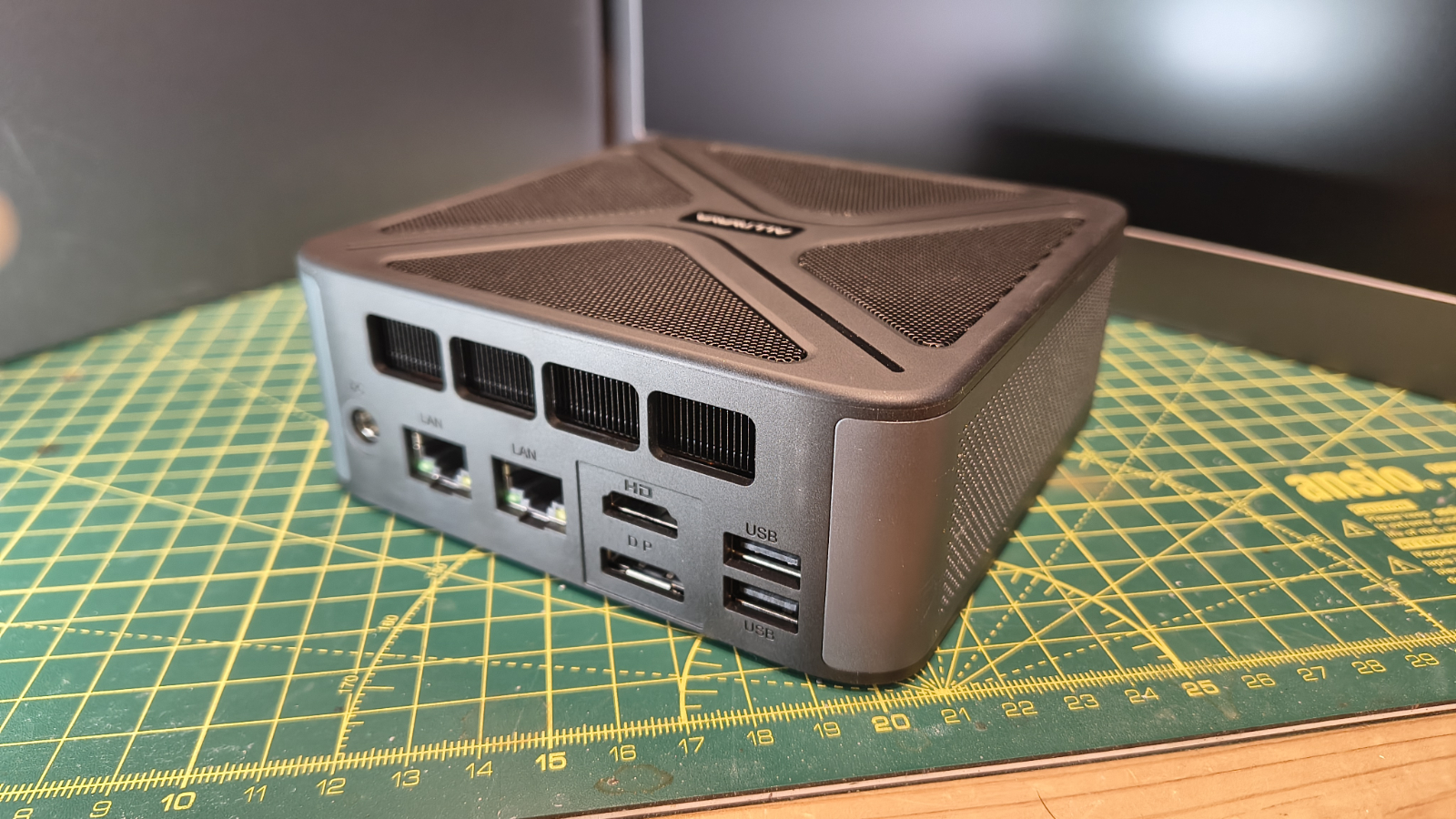
I liked this NUC more than the U58, but it does have a few concerning hallmark features of Alliwava hardware. Like the ability to take inherent features and not implement them, and a Les à faire attitude to correctly marking ports.
The GH8 has fewer feature mistakes, but the lack of proper port marking is prominent, and it’s done across two ports that look physically identical but have entirely different specs.
Looking at other machines built on the same AMD Ryzen 9 8945HS platform, most have two USB 4.0 ports and enough PCIe lanes for an Oculink port, which is missing here.
What’s good about it is the extra M.2 slot, even if they supplied the machine with NVMe Gen 3 and not Gen 4, and both M.2 slots are Gen 4. Therefore, if you wish to get the most from this hardware, it might be worth budgeting for a Gen 4 drive and cloning the system to that faster drive.
The minor problem with that suggestion is that it takes away one of the key reasons you might buy it, the low price. That’s annoying, because the cost difference between a Gen 3 drive and a Gen 4 might be only a couple of dollars to a system builder buying in volume, but it ends up costing another $100 on top of the machine to get the extra performance.
That point aside, this is a highly affordable NUC with decent performance out of the box, more than capable of handling any Office applications or more demanding apps.
Should I buy a Alliwava GH8?
Swipe to scroll horizontally
|
Value |
At the cheaper end of the Ryzen 9 market |
4/5 |
|
Design |
Dual LAN, dual M.2 and USB4 |
4/5 |
|
Features |
Decent processor and GPU, but only one USB4 port |
4/5 |
|
Performance |
A decent performer that is highly flexible |
4/5 |
|
Overalls |
A good Ryzen 9 NUC, but not a great one |
4/5 |
Buy it if…
” data-widget-type=”deal” data-render-type=”editorial”>
GMKtec NucBox K11 mini PC
This mini PC uses the same platform as the GH8, but it adds some useful features, such as Oculink.
In testing, it performed better than the GH8, but some of that difference is down to it using a Gen 4 SSD, and not a Gen 3. It costs a little more than the G8H, but you get a slightly better spec NUC for the money.
Check out our GMKtec NucBox K11 review

Mark is an expert on 3D printers, drones and phones. He also covers storage, including SSDs, NAS drives and portable hard drives. He started writing in 1986 and has contributed to MicroMart, PC Format, 3D World, among others.
“>
You must confirm your public display name before commenting
Please logout and then login again, you will then be prompted to enter your display name.
Related Posts

Quordle hints and answers for Tuesday, April 1 (game #1163)
(Image credit: Getty Images) Looking for a different day? A new Quordle puzzle appears at midnight each day for your […]
After a month with Cricut Maker 4 I’ve pushed my crafting past its limit, and past the limit of the machine
TechRadar Verdict Cricut Maker 4 is a worthy upgrade to Cricut’s astonishing cutting machines. It’s faster and more precise than […]

Convenience over privacy? Nearly one in three Brits sharing confidential information with AI chatbots
(Image credit: Shutterstock) 30% of Britons are providing AI chatbots with confidential personal information Research from NymVPN shows company and […]