Is that the smell of success?
Tracking smells in turbulent air takes a keen sense of direction and sharp memory.
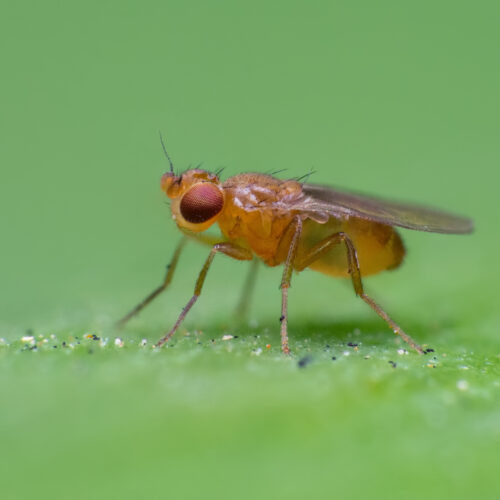
A fruit fly hunting a piece of rotting fruit or a mate navigates by smell, following plumes of odor. Out in the wild, turbulent air swirls these plumes into a chaotic, broken landscape—dense chemical filaments laced through long stretches of clean air. A fly trying to find the source gets the smell in stutters, from constantly shifting directions, with no guarantee that a next whiff is coming at all.
Scientist had little idea of how fruit flies manage this chaotic signal with a brain the size of a pinhead. For a long time, biologists stood by the “surge and cast” model, which posited that insects solved this with hardwired reflexes. The idea was that, when a fly registers the plume with olfactory neurons in its antennae, it simply flies upwind until it’s gone and then flies side to side attempting to catch it again. But now a team led by Vanessa Ruta, a neuroscientist at the Rockefeller University, has shown that fruit flies do something far more advanced.
A treadmill for flies
The trouble with the traditional surge and cast model is that it struggles to explain how an insect tracks a meandering plume across long distances. Chemical cues floating in the air in the natural environment are often sparse and unreliable. But those same features make the mechanism behind olfactory navigation notoriously difficult to test. “Odors are invisible,” Ruta says, “and often they’re carried along by turbulent airflow.” We’ve got no way of knowing what the animal is smelling from one moment to the next.
So, Ruta’s team designed an experiment to learn that. Scientists tethered a fly (Drosophila) in place over a small ball floating on a cushion of air in complete darkness. “It’s a little fly-sized treadmill,” Ruta explains. As the fly walked on the surface of the ball, its turns steered a nozzle that blew a steady stream of air at its antennae, so the insect always felt wind coming from a fixed direction, as if it were walking across an open field. Then the researchers piped apple cider vinegar into that airstream, switching it on and off depending on the fly’s position on this virtual field.
This way, the researchers could precisely control the intensity and direction of the odor the fly was registering. “We could actually generate any kind of arbitrary chemical landscape,” Ruta says. The team could simulate a lifelike olfactory experience with turbulent plumes, straight-edged corridors, and gradients of smell running backwards. “It’s actually not a very complicated virtual reality system, but it is actually extremely powerful,” Ruta adds.
For once, the experimenters knew the identity and quantity of every molecule the fly was receiving. The first thing they tested was the surge and cast model. And it did not hold up well.
Edge tracking
In the experiment with a straight corridor of vinegar about 50 millimeters wide, flowing with the wind, the flies did not do the obvious thing and march up the middle. Instead, they hugged one edge, riding it through a repeating two-step process. The moment a fly crossed into the odor, it would whip around and move back out, loop through the clean air outside, then make a beeline back to the boundary. The team called it edge tracking.
The flies also spent far more time loitering outside the plume than inside it, even though nearly all their forward progress toward the source happened during those brief dips into the scent. “Flies will track meters along the edge of a plume and never cross over,” Ruta says.
The first explanation the researchers came up with was that the flies were climbing a rising gradient of odor toward the source. But they didn’t do that either. When the team reversed the gradient, so the vinegar grew fainter as the fly advanced, the flies tracked the edge just as well.
The team also worked with flies genetically engineered so light could switch their olfactory neurons on directly, in both antennae at once. When scientists swapped real odor for a beam of 660-nanometer red light, the insects tracked the edge of this light plume flawlessly.
The real surprise, though, came when the team took a close look at what the flies were doing when there was no smell at all to guide them.
Olfactory memories
When the researchers made a plume vanish while a fly was outside it, the insect kept heading back to where the edge should have been. Rather than searching at random, they were heading to where they knew the odorant should be. “It looked as if they had a stored memory that was still steering them in that direction,” Ruta says.
So, the team started looking for these stored olfactory memories. The first candidate was a brain structure called the central complex, which is like a navigation hub in the insect brain.
Using fluorescent imaging to watch neurons fire in real time, Ruta and her colleagues pinpointed neurons that acted as the fly’s compass. Throughout edge tracking, that compass stayed locked to the wind, indifferent to whether the fly was in odor or out. When the team silenced these neurons, the flies got lost entirely, wandering upwind with no idea how to get back.
The neuronal compass, though, was just one piece of the puzzle. To find the smell that got lost in the wind, the fly must have a goal—a memory of what to search for. The team went searching for that memory.
The team located olfactory memories in another group of neurons found in something called the fan-shaped body, already known to encode where a fly wants to go. Like in a compass, the activity of these neurons acts like a pointer, but in this case, the one that marks the fly’s intended destination. Out in the clean air, this pointer swung away from the compass to aim at the plume’s edge, several seconds before the fly physically turned to head back. Just as with the compass neurons, silencing the neurons encoding the odor’s edge position made it impossible for the flies to find it. “When they get out, they have no immediate sensory information to guide them back to the plume. That’s when the memory becomes important,” Ruta says.
To confirm whether the flies memorize where the plume’s edge is, the team tested whether the insects could update these memories.
Updating the map
To understand what might be going on in the flies’ brains, the team built a computer model in which a simulated fly flips between a leaving mode and a returning mode, updating a stored plume’s edge position every time it crosses the boundary. It turned out the most important piece of data was the entry angle, the direction from which the fly last hit the plume. Without the angle, the simulated flies could no longer edge track.
Then the researchers went back to real flies to test how fast they could revise their olfactory memories. They had flies track a plume tilted 45 degrees, then abruptly flipped it to the opposite 45-degree angle. At first the insects were lost, searching in the old direction. But a single training session—a puff of vinegar delivered whenever a fly happened to walk the correct new angle—was enough to fix the issue. The flies instantly rewrote their internal goal and began tracking the new segment.
“We could write in new entry angles,” Ruta says. To her that was some of the strongest evidence that a memory, not a reflex, was responsible for fruit flies’ olfactory navigation.
But it doesn’t necessarily mean the old surge and cast idea is done for.
Built-in redundancy
When the team ran the flies through a simulated natural plume in their computer model, the entry-angle memory worked best near the source, where the plume held together as a coherent ribbon. Farther downwind, where it shattered into chaotic filaments arriving from every direction, the memory quickly grew unreliable and got overridden. The team speculates that’s likely where the flies fall back on simpler reflexes. “Animals are adapting their strategy,” Ruta says.
She suggests they probably lean on memory when the world is predictable and abandon it when it isn’t. One of the first things the team wants to examine now is whether the memories are relevant for tracking very turbulent plumes in living flies or are in fact replaced by other mechanisms when things calm down, as their model suggested.
“There’s an increasing appreciation of Drosophila and the power of this fly to provide insights into core computations translating fleeting sensory signals into stored spatial goals,” Ruta argues. Because the fruit fly has one of the simplest and most extensively studied brains, such insights, she thinks, should be relevant for how this process works in the rest of the animal kingdom. “It’s a fundamental feature that all animals are able to carry out, including ones with more sophisticated, complex brains like our own,” she adds.
Nature, 2026. DOI: 10.1038/s41586-026-10827-7

Jacek Krywko is a freelance science and technology writer who covers space exploration, artificial intelligence research, computer science, and all sorts of engineering wizardry.