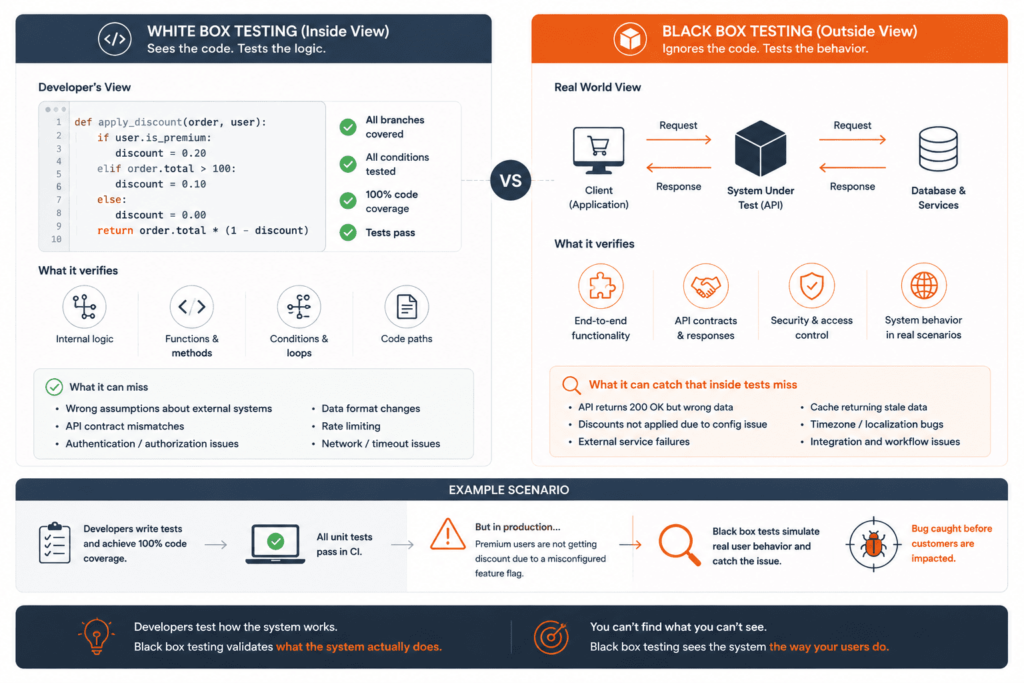
Picture this. A developer spends three days building a feature. They run their tests – all passing. They click through the UI, check the happy paths, verify the edge cases they had in mind while writing. Everything works. They ship it.
Two days later, a user files a support ticket. The bug is embarrassingly simple. The developer looks at it and thinks: how did I miss that?
The answer is almost always the same. They missed it because they knew too much.
When you build something, you carry a map of it in your head. You know which paths exist, which inputs are valid, which sequences make sense. That map is what lets you write the feature quickly. It is also what makes you a terrible tester of your own work. You do not test the roads that are not on your map, because from inside your own mental model, those roads do not exist.
This is not a skills problem. Senior developers with decades of experience have the same blind spot. The code they write is always tested by someone who understands it – which means it is always tested by someone who has already pre-filtered which scenarios are worth trying.
Black box testing removes that filter. The tester brings no map. They know what the software is supposed to do and nothing else. Every path is equally worth trying because no path has been pre-dismissed as unlikely or impossible.
Also Read: What DevOps Teams Get Wrong About Test Automation Tools
Why Developers Cannot Fully Test Their Own Code
When a developer writes a function, they build a mental model of how that function should be used. Valid inputs. Expected sequences. Appropriate contexts. This mental model is what makes them effective at writing the code. It is also what makes them less effective at finding the ways the code can fail.
When the same developer writes tests for that function, they draw on the same mental model. The test cases they write are the scenarios their mental model tells them matter. The edge cases they test are the ones they thought about while writing. The inputs they try are the ones that make sense given how the function was designed.
What they consistently do not test are the scenarios that fall outside their mental model. The input combinations they did not think of because they seemed unreasonable. The sequences of actions that make no sense from an implementation perspective but that real users attempt regularly. The boundary conditions that were never part of the design thinking but that the software encounters in production.
This is not a failure of skill or diligence. It is a structural limitation of testing something you understand deeply.
What Black Box Testing Actually Looks Like
Full knowledge of a system narrows what you think to test. That narrowing is exactly what black box testing undoes.
In practice, black box testing looks less like a structured test plan and more like determined curiosity. What happens if you paste emoji into the search field? What happens if you submit the form twice in two seconds? What happens if you navigate backward after completing the first step of a multi-step process? What happens if your session expires exactly while a payment is processing?
None of those questions occur naturally to the developer who built the feature, because none of them align with how the feature was designed to be used. The developer built a search field for text. They built a form for single submissions. They built a checkout for linear forward progression. Their mental model of correct usage excludes the paths a real user will inevitably find.
A black box tester approaching the same system does not have that exclusion. The search field accepts input – all kinds; let us see what happens. The form submits – what if I do it again immediately? The checkout has steps – what if I skip one, or go back, or close the tab and reopen it?
The tester does not need to understand how the database handles duplicates to discover that submitting twice produces an error nobody designed a message for. They do not need to understand the session management code to find that an expired session mid-transaction leaves the user on a page that has no way forward. They just need to try things nobody expected anyone to try – which is exactly what users do, constantly, without realizing it.
Also Read: How Regression Testing Helps Teams Move Fast Without Breaking What Already Works
The Categories of Bugs Black Box Testing Finds
The bugs that black box testing consistently surfaces fall into recognizable categories that are underrepresented in developer-written test suites.
- Boundary condition failures are the first. Software that handles a field accepting values from one to one hundred might work perfectly for every value from two to ninety-nine and fail at exactly one, one hundred, zero, and one hundred one. A developer testing their own boundary handling will test the boundaries they explicitly coded. A black box tester trying values just inside and just outside every boundary they can find will discover the ones the developer did not code correctly.
- Interaction sequence failures are the second. Software that handles individual actions correctly can fail when those actions happen in specific sequences. Creating a record and then immediately deleting it. Logging in and then attempting an action that requires a different permission level. Adding items to a cart and then changing the currency before checkout. These sequences make logical sense to users and make no sense to developers thinking about how each feature works in isolation.
- Integration point failures are the third. When software communicates with external services, databases, or other components, the contract between them can break down in ways that neither party’s internal tests catch. The external service changes its response format. The database returns an unexpected null. The third-party API rate limits the request. Black box testing that exercises these integration points from the outside catches behavioral failures that unit tests, which mock away the external dependencies, were never designed to surface.
- Input validation failures are the fourth. Every field that accepts user input is a potential source of unexpected behavior when the input falls outside what the developer anticipated. Special characters. Extremely long strings. Empty submissions. Multiple spaces. Non-ASCII characters. Formatted strings like dates and phone numbers submitted in unexpected formats.
A developer tests the input validation they wrote. A black box tester tries every variation of unexpected input they can think of, finding the ones the validation logic did not account for.
How Black Box Testing Fits Into a Development Process
Black box testing is not a replacement for the tests developers write. It would be a mistake to treat it that way.
Developer tests are genuinely good at what they do. A unit test that runs in milliseconds and catches a regression the moment a function changes is exactly the right tool for that job. Integration tests that verify service contracts are catching a real and specific category of failure. These tests have value and the teams that write them rigorously ship better software than the ones that do not.
What developer tests cannot do is step outside the developer’s understanding of the system. They are written by someone who knows how the code works, which means they test the code against the same mental model that produced it. That is appropriate for regression testing. It is insufficient for finding the failures that live outside the mental model entirely.
Black box testing handles that second category. It does not compete with the first. A team running both is testing the software as built and as used – two genuinely different things that require different approaches to test well.
The practical implementation does not require a separate QA team or elaborate testing infrastructure. Any engineer, product manager, or stakeholder who can interact with the software without knowledge of its implementation can perform black box testing. The most effective black box testers approach the software with genuine curiosity about where it might fail rather than with the developer’s implicit assumption that it probably works correctly.
Also Read: How AI Test Generation Is Changing CI/CD Pipelines in 2026
What Changes When Black Box Testing Becomes Routine
Teams that make black box testing a routine part of their development process rather than an afterthought before major releases describe a specific change in the kinds of bugs that reach production.
The bugs that black box testing catches, when they eventually reach production without it, are almost always the ones that generate the most confusing incident reports. They are the bugs that trace back to inputs nobody thought to test, sequences nobody anticipated, or interaction patterns that made perfect sense to the user who encountered them and made no sense to the developer who investigated the failure.
When black box testing catches these bugs before release, the incident reports they would have generated never get written. The support tickets never arrive. The emergency hotfixes never ship at inconvenient times. The apologies to affected users never need to be sent.
Final Thoughts
The developer who writes the code will always be limited by their knowledge of how it works. Black box testing adds the perspective of someone who is not. That perspective is not a nice-to-have in software development. It is the perspective that catches the bugs the developer structurally cannot see, which turns out to be the category of bugs that matters most to the users who eventually encounter them.