Begun, the upgrade war has
2026’s Formula 1 championship now looks far from a foregone thing.
Lewis Hamilton goes by in a blur. Credit: Mark Thompson/Getty Images
After an unanticipated five-week break in the season, Formula One resumed action this past weekend in Miami. Held at a temporary circuit around Hard Rock Stadium, the event is emblematic of the Liberty era of F1: a turbocharged marketing extravaganza crammed full of hospitality suites with ticket prices as high as $95,000. It might be miles from the sea—the original plans to race across a bridge over Biscayne Bay did not survive contact with locals—but the sport is doing its best to make this a modern Monaco, playing up the host city’s glamorous reputation and pastel color palette.
As we learned a couple of weeks ago, there have been tweaks to the amount of energy that the cars’ new hybrid power units can regenerate and deploy via the electric motor that contributes almost half of the car’s power output. The first three races of this season were frenetic, but they alarmed many longtime fans, as the cars are now too energy-limited to be driven flat-out during qualifying; that energy limitation also led to cars swapping positions multiple times, derisively dubbed “yo-yo” racing by critics.
The new limits on harvesting energy from the V6 to charge the battery on the move should reduce the potential for huge speed differentials like the one that caused Oliver Bearman’s crash in Japan, and energy management was (thankfully) not much of a topic this weekend. Miami’s layout definitely helps there, with plenty of braking zones to help regenerate much of the now-allowed 7 MJ each lap.
Correlation is causation
In a more conventional season, you might not bring any upgrades to Miami. It’s one of F1’s six sprint weekends, with just a single hour’s practice session on Friday morning; the other two are replaced by a shortened qualifying session on Friday afternoon, then a (roughly) half-hour sprint race on Saturday morning, before normal qualifying later that day and the proper race on Sunday. Mindful that it had imposed new rules for this round, the sport’s organizers increased practice time to 90 minutes on Friday.
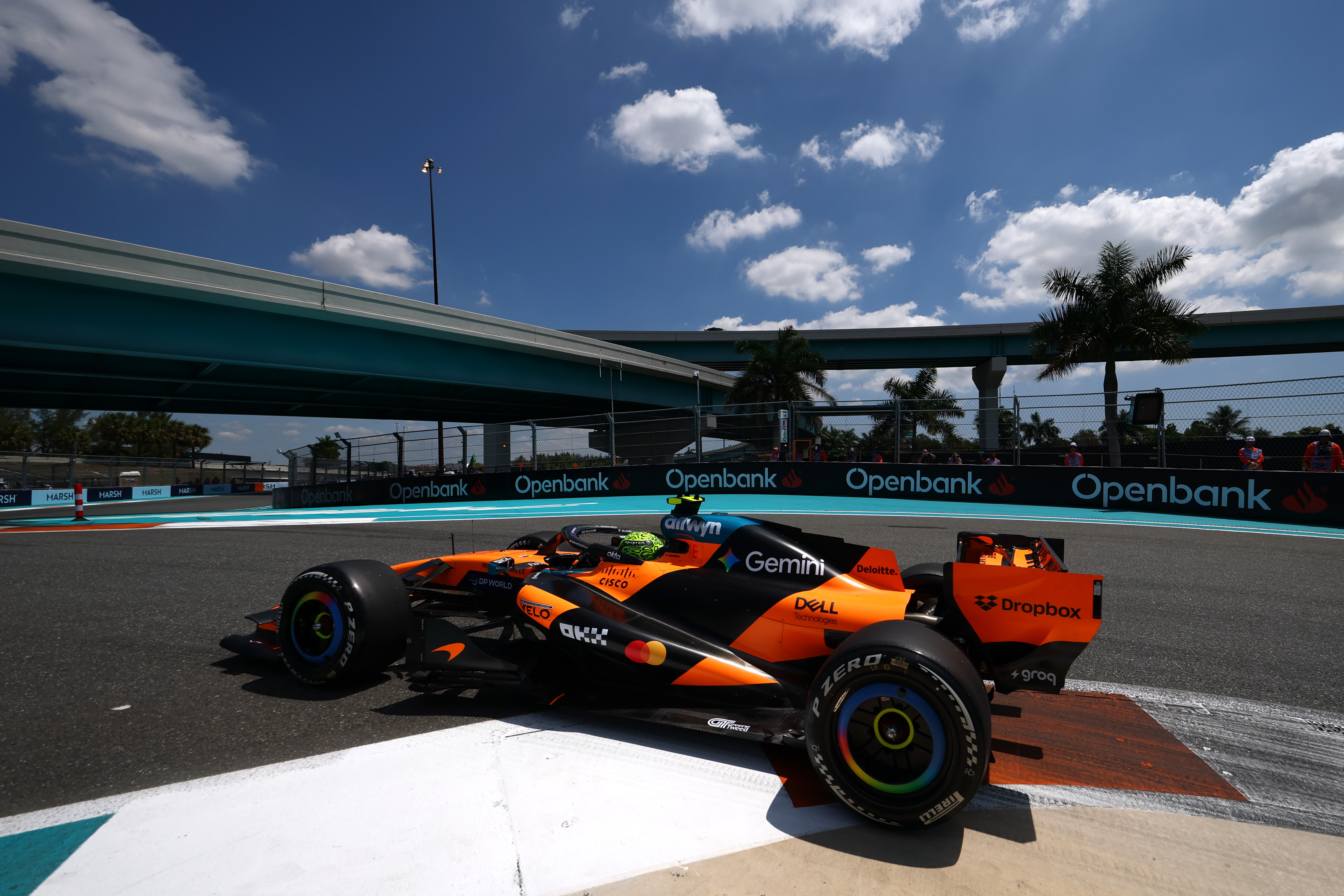
McLaren wasn’t the fastest car at the start of the season, but it might be now.
Credit: Clive Mason/Getty Images
McLaren wasn’t the fastest car at the start of the season, but it might be now. Credit: Clive Mason/Getty Images
Every team, except the troubled Aston Martin, brought an upgrade package to Florida. Coming out of the blocks strong as Mercedes did this year is all well and good, but the 2009 season showed us what happens when a team with a huge advantage at the start fails to develop its car: Everyone else catches up.
Well, that’s assuming those upgrade packages work. A new wing or wishbone or whatever design might look like an improvement when you simulate it in computational fluid dynamics (CFD) or a wind tunnel, but if those aren’t well-correlated with the full-size car on track, that work was for naught. Many’s a time a team has brought what it hoped was a step forward only to find out it’s now even less competitive—just ask the closest tifosi.
Over the past few years, McLaren has nailed that correlation problem, causing all of its upgrade packages to add performance. What’s more, that ability has now spanned across three different sets of technical regulations. It caught up to the front of the pack in 2021 after years in the wilderness, then was the only team to overhaul Red Bull in the ground-effect era. Now it looks set to do that again.
Ferrari and Red Bull have both also taken a step forward. The Mercedes might have looked awfully dominant in Australia, China, and Japan, but as of now, the season looks like a four-way fight.
The flag drops
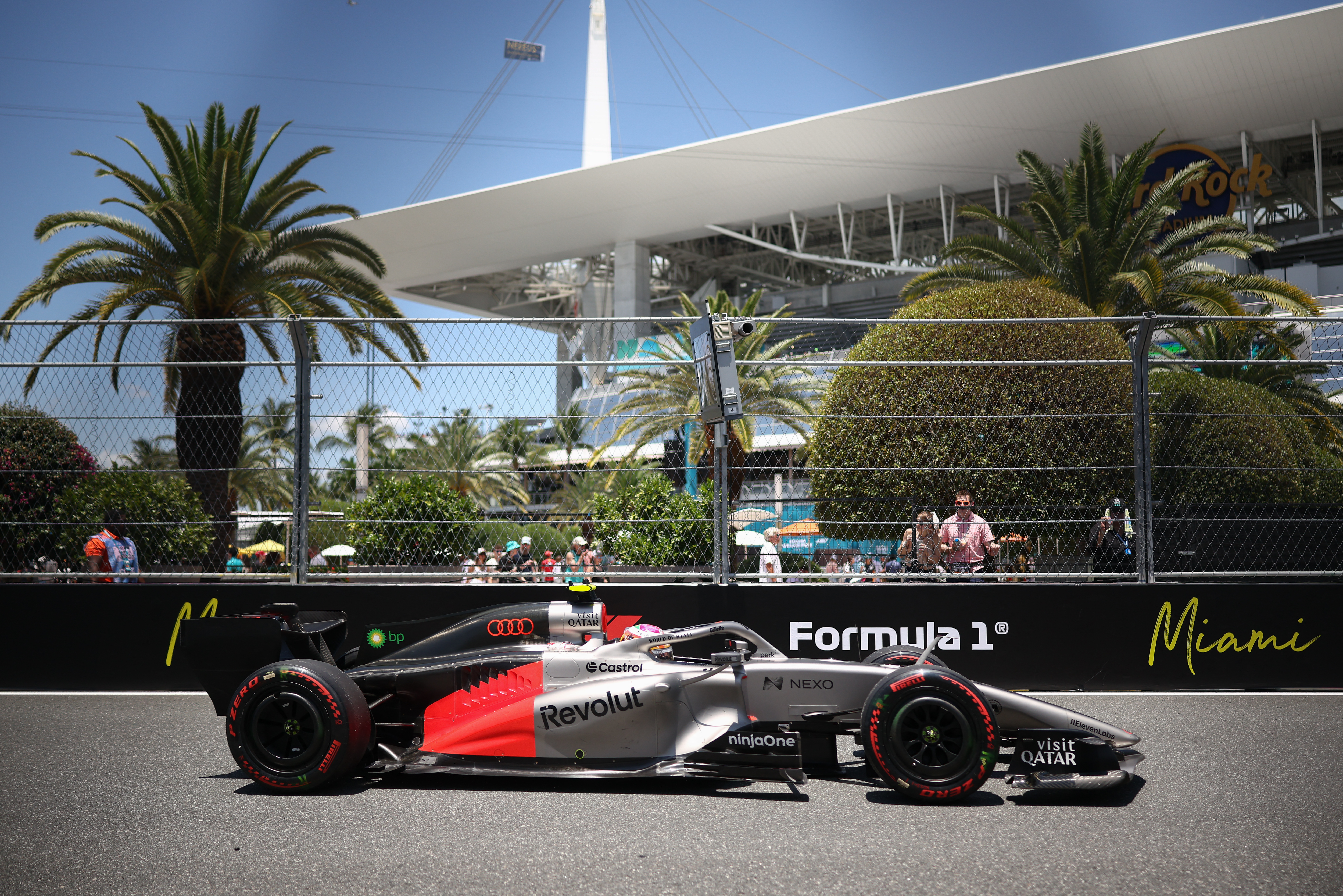
The vast stadium looms over the track.
Credit: CHARLY TRIBALLEAU / AFP via Getty Images
The vast stadium looms over the track. Credit: CHARLY TRIBALLEAU / AFP via Getty Images
The changes to energy harvesting in qualifying looked successful, at least in Miami. Cars weren’t losing speed precipitously three-quarters of the way down the straight, and I doubt anyone could tell they were a second and a bit slower than last year’s machines in qualifying trim.
Lando Norris took pole in sprint qualifying, a couple of tenths of a second faster than McLaren teammate Oscar Piastri. Between 19-year-old Kimi Antonelli and teammate George Russell, Antonelli was able to make his Mercedes do things that his more experienced teammate could not. Charles Leclerc was similarly more at home in his Ferrari than Lewis Hamilton was around the Hard Rock Stadium, but the gap between teammates was nothing like that separating Max Verstappen’s Red Bull from that of Isack Hadjar.
Verstappen, the four-time champion, has been vocal about his dislike of the new cars and the new racing style, and he has increasingly signaled that he could walk away from F1 to pursue other racing interests. This weekend, the Red Bull upgrade package seems more to his liking, and the gap to Hadjar was more than a second in practice.
Both Mercedes made atrocious getaways at the start of the sprint, and the two McLarens drove off to an uneventful 1–2 finish that seemed reminiscent of 2025. Leclerc demonstrated the Ferrari’s superior performance off the line and held third until the end.
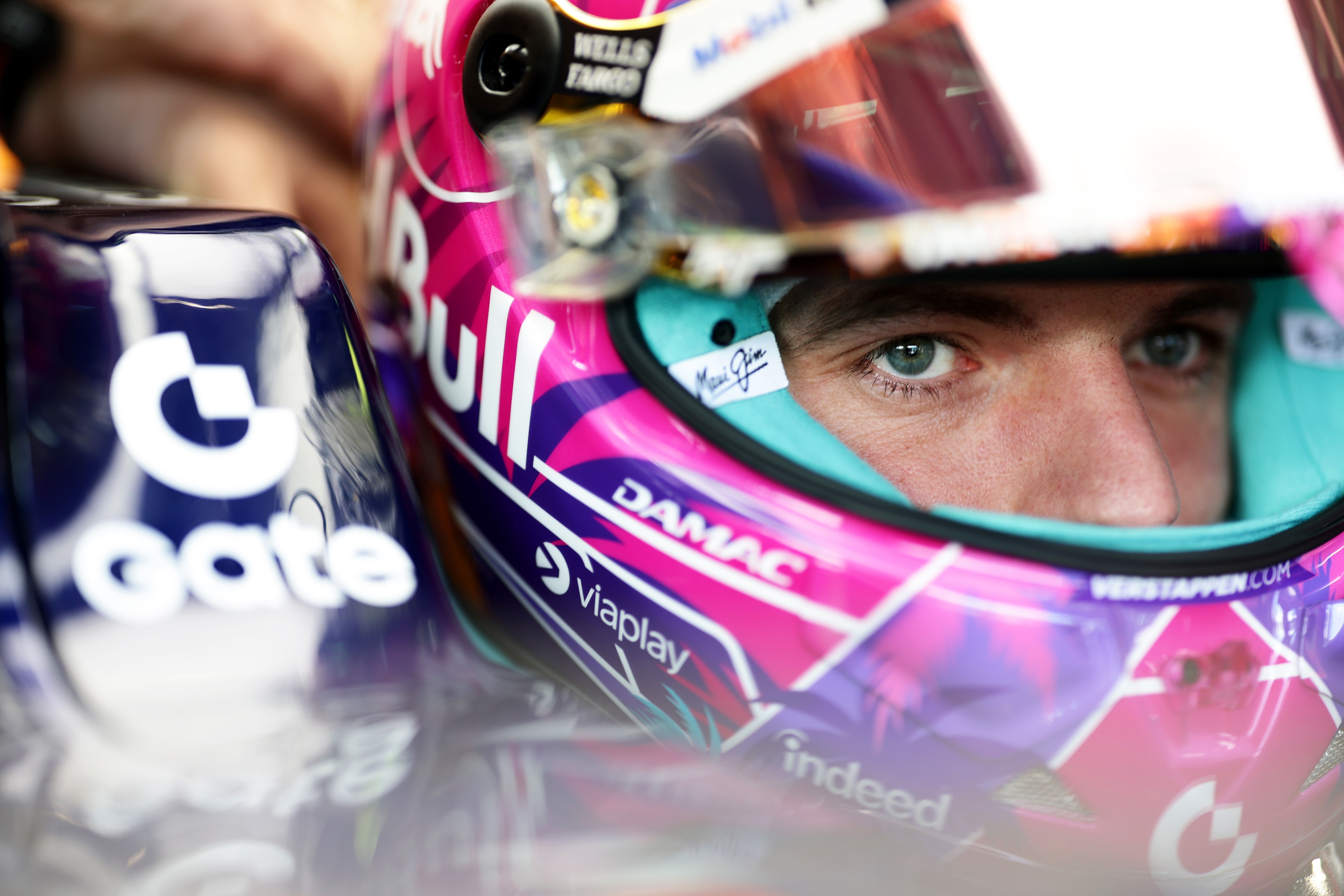
Verstappen got Miami-fied with his helmet.
Credit: Mark Thompson/Getty Images
Verstappen got Miami-fied with his helmet. Credit: Mark Thompson/Getty Images
Fears of a wet race on Sunday did not materialize, although the potential for weather chaos saw the race start moved forward by three hours. Antonelli had secured the pole on Saturday afternoon, his third in a row. Lining up next to him? Verstappen’s Red Bull. Leclerc was third, then Norris, Russell, Hamilton, and Piastri filled out rows three and four.
When Ferrari designed its 2026 power unit, it went for a small turbocharger in large part because it knew engines with larger turbos, and therefore more lag, would struggle with standing starts. Leclerc made mighty use of that and was in first place by turn three. Verstappen tried to stay alongside him but spun at turn three; Verstappen’s resulting pirouette left him facing the right way and still in the race, which is one of his party tricks.
Antonelli got a much better start than the sprint but was the man on the outside as he, Leclerc, and Verstappen went into the first corner, and he ran wide and resumed third. The two McLarens were next, then Russell and Hamilton’s Ferrari, which was damaged in a tussle with Franco Colapinto’s Alpine. The midfield team has also made clear progress and may well trouble the top four a lot more this year.
Lap six was eventful. Hadjar misjudged the apex at turn 13 and destroyed his front left suspension. At about the same time, the other Alpine of Pierre Gasly diced with the Racing Bulls of Liam Lawson before they made contact, rolling Gasly and depositing him partially on the tire barrier at turn 17. Norris got past Antonelli before the safety car came out, then a lap later took the lead from Leclerc. Antonelli also passed the Ferrari quickly, and by lap 22, Leclerc’s race was looking pretty mediocre, stuck behind Russell after both had made relatively early pit stops for the mandatory tire change.
Verstappen was on a different trajectory. After falling to ninth with his spin, he stopped for hard tires and was maneuvering his way back up the running order. As the leaders stopped, they rejoined on track just behind his Red Bull, Antonelli beating Norris to be the one in the middle. As Piastri made his stop, he relinquished the lead to Verstappen, but the Dutch driver was on tires that were 21 laps older than Antonelli’s new rubber, and by halfway around the lap, the Mercedes was through into first with Norris’ McLaren following.
The Antonelli hype is real
Norris harried Antonelli for the rest of the 57-lap race, but the reigning world champion could not force the Mercedes sophomore into a fault. Behind them, Piastri was able to overtake Russell, although he was almost half a minute behind the winner. After a spirited defense, Verstappen’s much older tires meant he surrendered third to Leclerc with 12 laps to go. Piastri was next, then Russell too, clipping the Red Bull’s rear tire with his Mercedes’ front wing.
Piastri wasn’t done; he caught Leclerc with a lap to go, then passed him on the final lap for third place. It went downhill from there for the Ferrari man, who spun, then biffed the wall and broke his suspension, then earned a penalty that dropped him from sixth to eighth place for leaving the track and gaining a lasting advantage.
Between Leclerc’s travails and Hamilton’s somewhat-damaged, mostly anonymous race, it was a weekend without much glory for Ferrari. Audi didn’t have the best time either; Nico Hulkenberg’s car caught fire on the way to the sprint grid, and Gabriel Bortoleto was disqualified from the sprint after finishing 11th for a technical infringement.
Williams went home with smiles, though. It has had a very poor start to 2026, with a car that’s overweight and exhibiting some difficult handling characteristics that saw it mired at the back of the pack if not quite as slow as Cadillac or Aston Martin. But in Miami, the two Williams cars looked far more at home, especially in the race where they both finished in the points. Even Cadillac and Aston Martin will probably be content with their performances on Sunday; both teams got both cars to the flag, and Perez managed to split the two Astons.
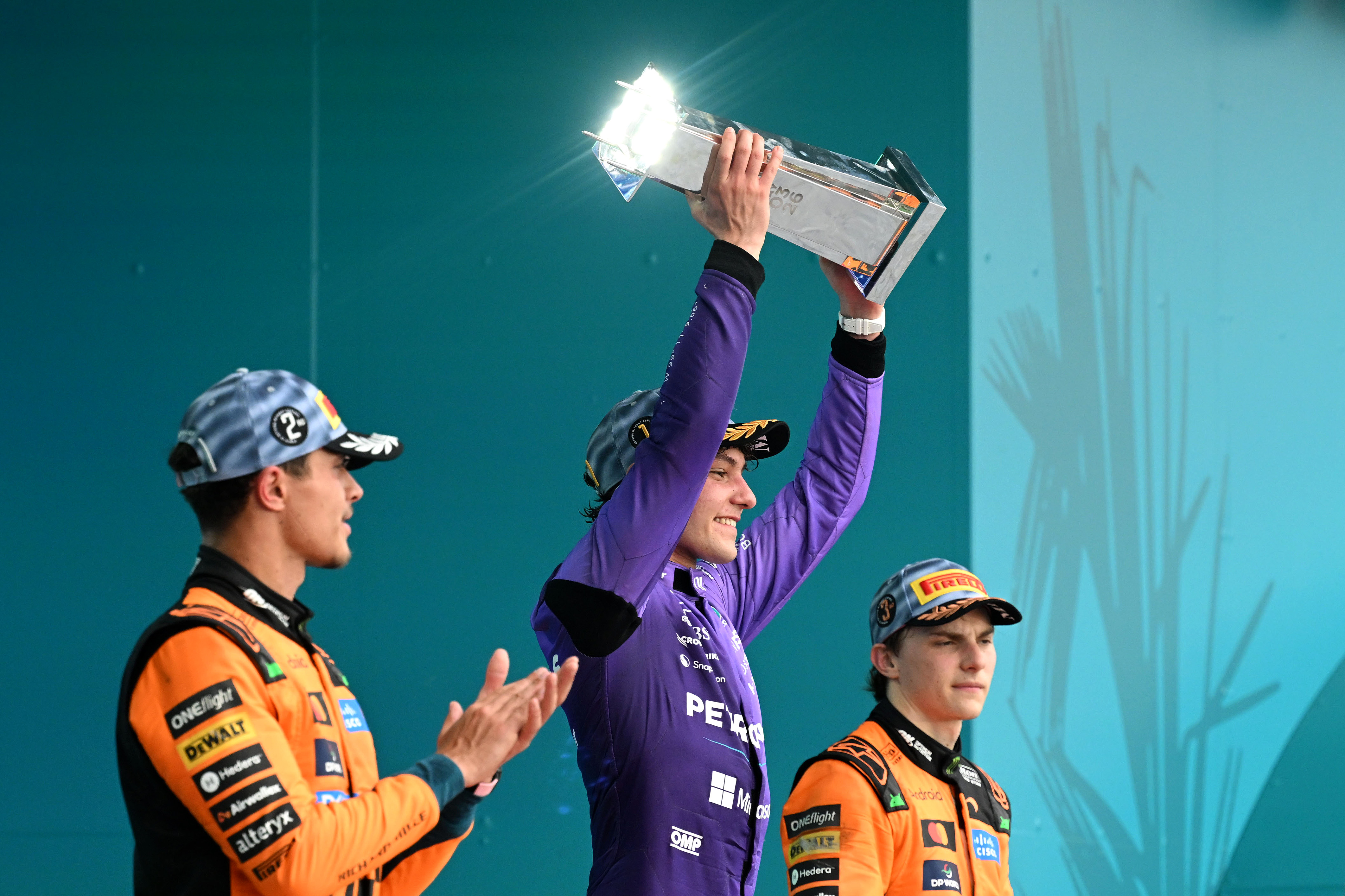
Kimi Antonelli (middle) is too young to spray champagne if he wins a race in America. Lando Norris (left) and Oscar Piastri (right) did not have to abstain.
Credit: Mark Sutton – Formula 1/Formula 1 via Getty Images
Kimi Antonelli (middle) is too young to spray champagne if he wins a race in America. Lando Norris (left) and Oscar Piastri (right) did not have to abstain. Credit: Mark Sutton – Formula 1/Formula 1 via Getty Images
Antonelli has now converted three consecutive pole positions into three consecutive race wins, the first driver to do so in 76 years of F1’s history. And none of those three wins has been a simple lights-to-flag victory, given how sluggish his car is when the five red lights go out. He leaves Florida with a 20-point margin in the championship over Russell in second, albeit with 18 races left to go.
Jonathan is the Automotive Editor at Ars Technica. He has a BSc and PhD in Pharmacology. In 2014 he decided to indulge his lifelong passion for the car by leaving the National Human Genome Research Institute and launching Ars Technica’s automotive coverage. He lives in Washington, DC.