The small bit of air in the bottle sees oxygen and other chemicals move in and out.
Most people perceive a cork in a bottle of wine as a simple plug meant to keep the liquid in and the outside world out. In the recent study published in Science Advances, a team of French scientists demonstrated the cork is way more than that. By regulating the oxygen transfer into and out of the wine bottle, it works almost as another ingredient.
“Twenty years ago, our group focused on the oxidation and aging of wine and all its parameters,” Thomas Karbowiak said. “Oxygen diffusion through cork stoppers is one of these parameters.” Karbowiak is a chemist at the University of Burgundy, France, and the senior author of the study.
The mini-bottle experiment
Oxidation is one of the key drivers of wine aging. A slow, limited ingress of oxygen helps wine mature, smoothing out harsh tannins and bringing out an aromatic complexity. But when too much oxygen gets into the bottle too quickly, it can make the wine stale, brownish in color, and unpleasant to drink. That’s because it will also react with alcohol and phenols in the same process that makes a cut apple turn brown.
The problem with trying to study this is that, in a standard 750 ml wine bottle, the volume of liquid and the thickness of the glass make it difficult to accurately isolate, monitor, and measure real-time oxygen kinetics without introducing external air or disrupting the internal environment. “The real bottle of wine is a complex system. We wanted something simpler and easier to understand,” said Julie Chanut, a researcher at the University of Burgundy and lead author of the study.
To bypass this issue, the team designed a custom experimental rig they called the miniature bottle system. “The idea was to see what mechanisms are at work in this system,” Chanut said.
The setup consisted of small glass vials designed to mimic the standard cylindrical geometry of a commercial wine bottleneck. Each vial was sealed using scaled-down cork stoppers ranging in length from 6 to 42 millimeters; the interior could be precisely loaded with either gas or a specific volume of model wine. The reduction in the total volume of both the liquid and gas phases artificially amplified any oxygen concentration changes that occurred. The system acted as a chemical magnifying glass that enabled the scientists to precisely measure extremely subtle physical and chemical mechanisms like outgassing through the cork or the reactions at the interface between the cork and the wine.
Armed with their miniature bottle setup, the team loaded half of the vials with wine, left the other half empty, sealed them with the selection of different length corks, filled them with sensors, and left them for 18 months to age. It turned out the oxygen dynamics in the vials was way more complex than a simple, steady leak through the cork.
Four phases of breathing
During the experiment, the researchers learned there are four stages of oxygen transfer through the cork, which starts the moment a cork is rammed into a bottleneck. The first phase lasted for the initial 15 days after the vials were corked. “It was an equilibration between the liquid phase of the model wine and the gas phase,” Chanut said. There are differences in the gas content between wine that had been aged in sealed containers and the small bit of air that gets trapped and pressurized by the insertion of the cork. In the experiment, the oxygen dissolved in the liquid phase in the vials escaped back to the gas phase.
The second phase that followed, though, was where things got a little more surprising. Chanut’s team observed that, during the first six months, the majority of oxygen that was getting into the wine wasn’t coming from the outside environment. The oxygen, it turned out, was coming from the cork itself, diffusing out of the microscopic spaces in the cork’s cellular structure. The cork was basically outgassing into the bottle.
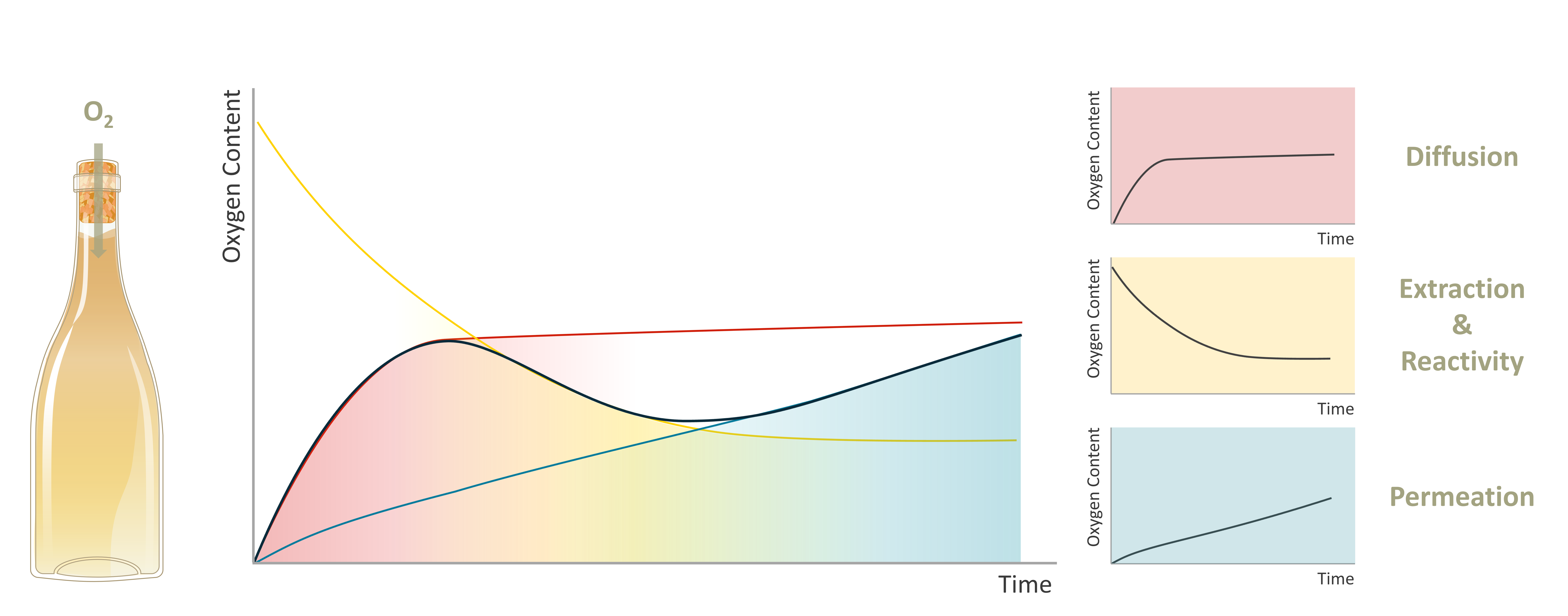
Three factors contribute to the overall oxygen levels, which change over time.
Three factors contribute to the overall oxygen levels, which change over time. Credit: 10.1126/sciadv.aed3023

John is Ars Technica’s science editor. He has a Bachelor of Arts in Biochemistry from Columbia University, and a Ph.D. in Molecular and Cell Biology from the University of California, Berkeley. When physically separated from his keyboard, he tends to seek out a bicycle, or a scenic location for communing with his hiking boots.