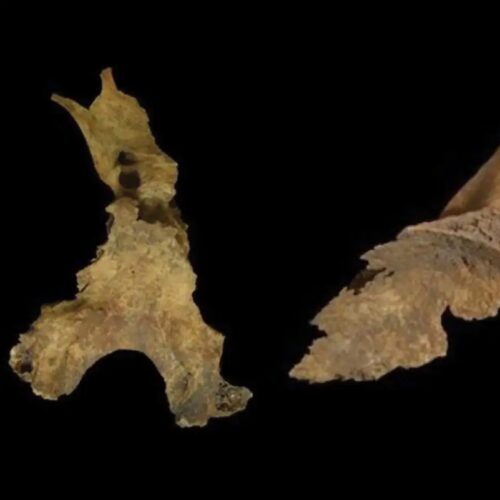
Postmortem manipulation in an Iron Age female Briton
Credit: Rebecca Ellis-Haken
Postmortem manipulation in an Iron Age female Briton Credit: Rebecca Ellis-Haken
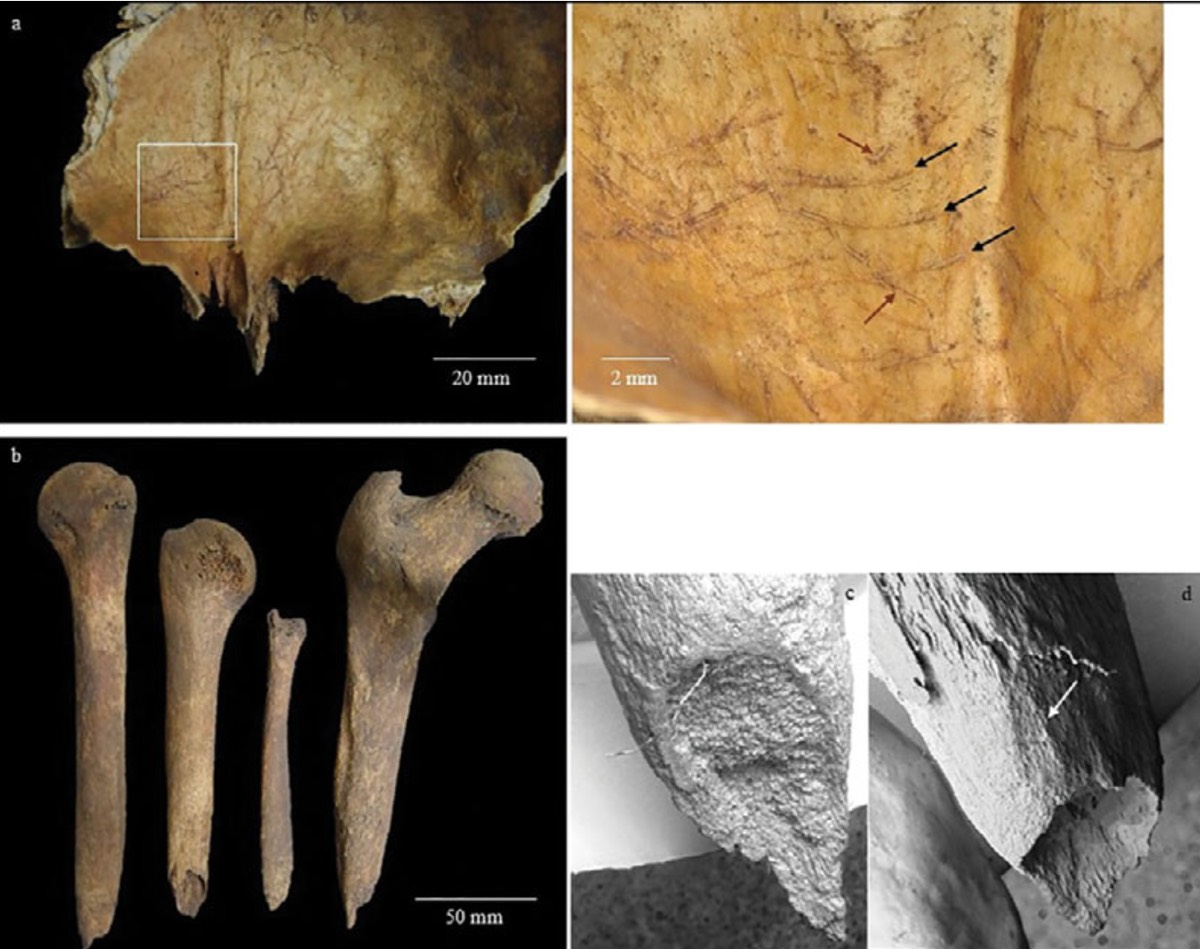
Furthermore, four of the woman’s long bones (both humeri, the left ulna, and the left femur) showed marks that had previously been identified as tooth marks, suggesting rodents had gnawed at the bones. The authors disagreed with that earlier assessment, concluding that the bone marks were more consistent with whittling using a sharp implement. Three of the four bones had been whittled to a sharp edge, while the fourth seemed to have been worn down through use as a tool after being whittled into a sharpened point. Yet all four bones were ultimately placed in the correct anatomical position once they were laid in the grave.
Other archaeologists remain unconvinced that the woman’s brain had been removed or that the long bones had been deliberately whittled down into tools. “The marks certainly suggest some manipulation of the cranium, but whether we can link them to the brain removal, I don’t know,” Richard Madgwick of Cardiff University, who was not involved in the research, told New Scientist. Madgwick thinks the long bones may have already been broken and were simply repurposed as tools and finds it “remarkable” that the used bones were then placed back in the ground in anatomical order.
Second cousins?
As for the young person’s remains, the ancient DNA analysis showed he was male. The authors concluded he was between 14.5 and 15.5 years old when he died, and the bones showed signs of growth disruption and vitamin C deficiency.
Both individuals were genetically typical of Scottish Iron Age populations. The isotope analysis suggested they had both spent the early part of their lives in a coastal environment—most likely the east coast of Sutherland—moving to the Loch Borralie area after childhood. They were close biological relatives, possibly maternal second cousins. The cairn’s layers indicate they were not buried at the same time, however, and their bodies did not receive the same postmortem treatment.
“The genetic and isotopic evidence highlights long-term interconnectedness between maritime communities around the north coast and Northern Isle of Scotland, where individuals and small groups periodically moved across wide areas, facilitating the maintenance and spread of cultural ideas and practices,” the authors concluded. And the treatment of the woman’s bones “demonstrates that, although sparse in terms of their archaeological survival, the Iron Age dead held a strong and compelling presence in the world of the living.”
Antiquity, 2026. DOI: 10.15184/aqy.2026.10353 (About DOIs).