
TechRadar Verdict
Devolo’s app could be more straightforward for first-time users, but the BE6500 mesh system remains good value for money. Its 6.0GHz option provides strong performance for newer computers and mobile devices, whilst also offering a 5.0GHz option for older devices.
Reasons to buy
- +
Competitive price
- +
Two options for dual-band Wi-Fi
- +
Fast, reliable Wi-Fi for larger homes
Reasons to avoid
- –
Ease of use could be improved
- –
Many features require the use of a web browser
- –
No tri-band support
Why you can trust TechRadar We spend hours testing every product or service we review, so you can be sure you’re buying the best. Find out more about how we test.
Devolo WiFi 7 Mesh BE6500: one-minute review
Devolo is best known for its range of PowerLine adaptors and range extenders but, as the name suggests, its new WiFi 7 Mesh BE6500 steps up to provide a full mesh Wi-Fi system for homes that need to extend their Wi-Fi coverage beyond the range of a single conventional router.
Wi-Fi 7 has been around for a few years now, but high-end tri-band routers that support the 2.4GHz, 5.0GHz and 6.0GHz frequency bands are still quite expensive.
So, like a number of Wi-Fi 7 routers and mesh systems that we’ve seen recently, the BE6500 keeps its price down by offering just dual-band Wi-Fi instead. However, it takes a slightly different approach from many of its dual-band rivals by giving you a choice about which frequency bands you can use.
Latest Videos FromTechRadar
You can opt to use the 2.4GHz and 5.0GHz bands together to ensure compatibility with older devices that only support Wi-Fi 5 or 6. Alternatively, you can switch to using 2.4GHz and the faster 6.0GHz band for newer computers and mobile devices that support Wi-Fi 6E or Wi-Fi 7.
That’s a good option for future-proofing your home network, as it will let you use the BE6500 with older computers and mobile devices while still providing an upgrade path for newer devices you may buy in the future.
Devolo Wi-Fi 7 Mesh BE6500: Price & release date
- Released in May 2026
- Available in EU and UK
- Three-pack costs £369.99/€399.90
Devolo products are widely available within the UK and Europe, but the company doesn’t currently operate in the US.
The Wi-Fi 7 Mesh BE6500 is available as a two-pack containing two BE6500 routers for £249.99/€269.90. Devolo doesn’t quote the precise area covered by that two-pack option, merely saying that it is suitable for ‘small-to-medium’ homes.
However, I tested the three-pack option for ‘larger’ homes, which costs £369.99/€399.90. If required, you can further extend your mesh network by buying additional BE6500 routers, costing £129.99/€149.90 each. Those prices are very competitive when compared to rivals in a similar price range, such as Amazon’s Eero 7 and the Netgear Orbi 373, which only support dual-band Wi-Fi 7 on the 2.4GHz and 5.0GHz bands.
- Value score: 4/5
Devolo Wi-Fi 7 Mesh BE6500: Specs
Swipe to scroll horizontally
|
Wi-Fi Support |
Wi-Fi 7 (2.4GHz, 5.0GHz, 6.0GHz) |
|
Wi-Fi Speed |
Upto 6.5Gbps (using 6.0GHz) |
|
Ports |
1x 2.5Gbit WAN/LAN, 3x 1Gbit LAN |
|
Processor |
Qualcomm quad-core @ 1.5GHz |
|
Dimensions |
175 x 118 x 72mm |
Devolo Wi-Fi 7 Mesh BE6500: Design
- Compact design
- Four Ethernet ports per router
- Setup is a bit fussy
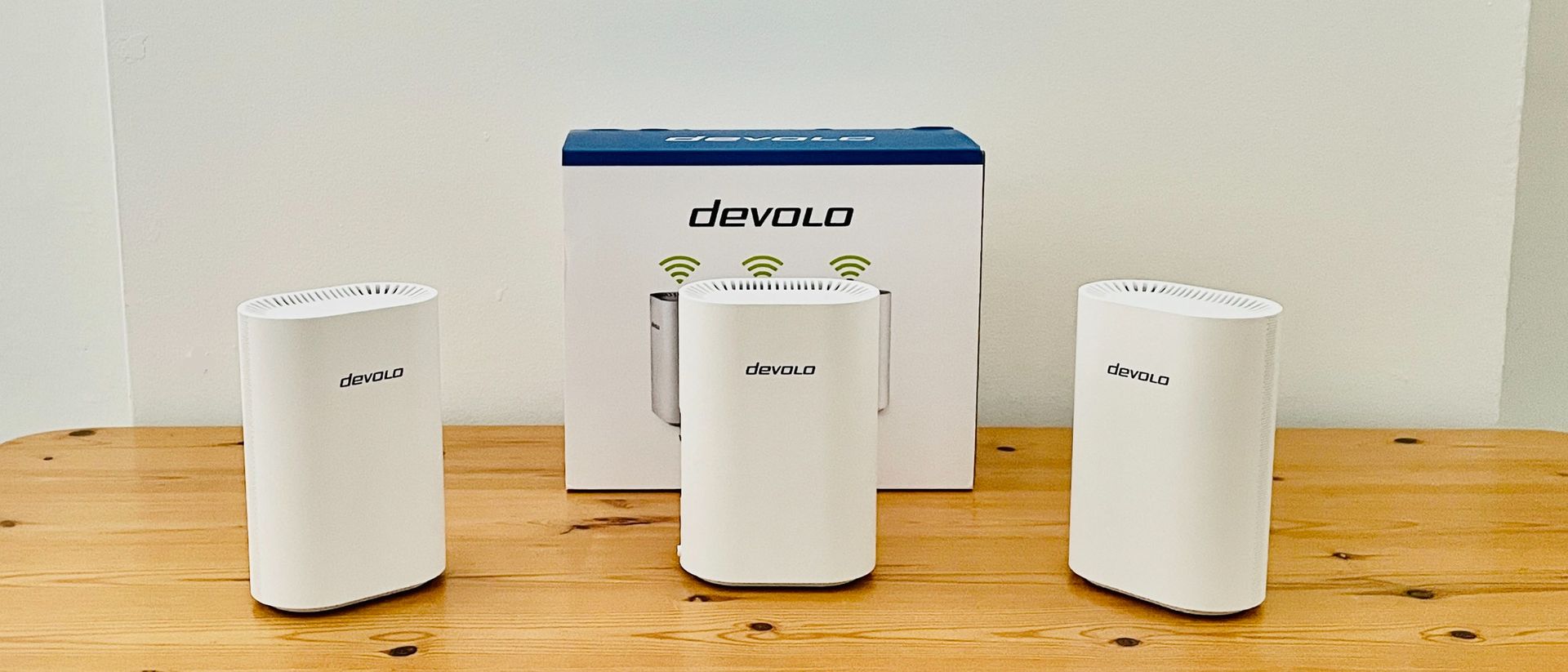
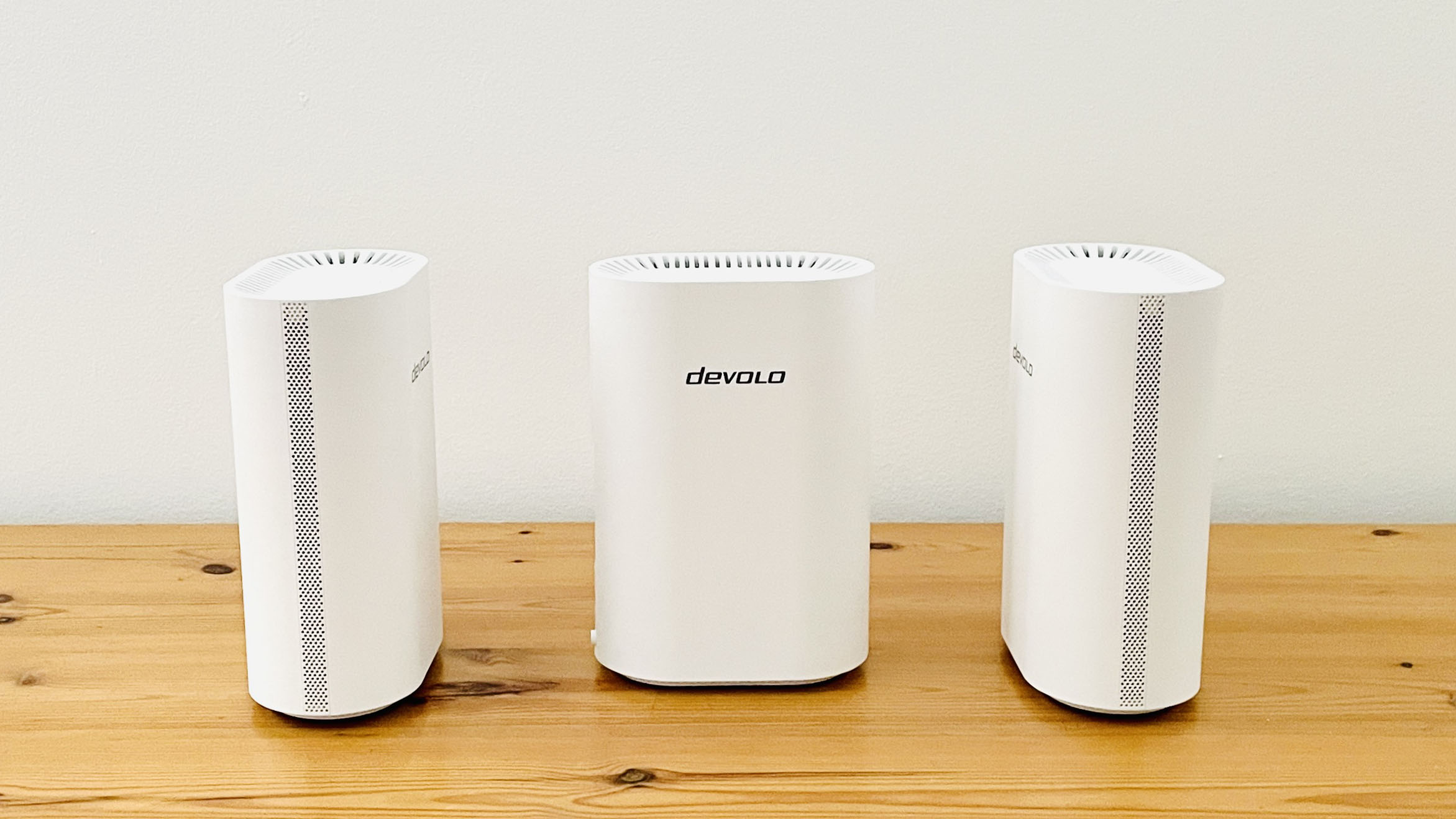
The BE6500 routers are neatly designed, with each plain white unit standing 175mm high, 118mm wide and 72mm deep, so they will fit comfortably onto any convenient table or shelf.
The routers look identical, with four Ethernet ports located on the side, including a 2.5Gbps port for high-speed broadband connections and three 1Gb ports to provide a local (LAN) connection for devices, such as a games console or PC, that may work better with a lag-free wired connection.
However, one of the routers is labelled as the ‘Controller’, and this router will need to be connected to your existing broadband router or modem in order to use its internet connection.
Setting up the Controller router is fairly straightforward, as Devolo’s Home Network app for iOS/Android allows you to simply scan a QR code to connect to the Controller. However, adding the other two routers – referred to as ‘Extensions’ – requires a little more effort.
The app tells you to plug both of the Extension routers into a mains power supply close to the Controller, but it can only connect one Extension to your network at a time. This means that you have to go through the process of connecting the first Extension to your network, and then unplug it so that you can move it to another location, and then repeat the same process for the second Extension.
We’ve seen other mesh Wi-Fi systems that can automatically connect multiple routers in order to create your new network for you, so Devolo could do more to simplify the initial set-up process.
- Design score: 4/5
Devolo Wi-Fi 7 Mesh BE6500: Features
- App is a bit confusing
- Some features are enabled via a browser
The setup process was also unclear how to choose the frequency bands that are used for your new network.
The app doesn’t ask which frequencies you would like to use, but after randomly tapping buttons within the app for a while I did find a mention of the fact that the network was using the 2.4GHz and 5.0GHz bands.
However, there was no option within the app to switch to the 6.0GHz band instead, so I had to connect a laptop to the Devolo network using the default 2.4GHz and 5.0GHz bands, and then use a web browser to view more detailed network settings.
And, again, after some more random button tapping, I did find an option that allowed me to switch to using the 2.4GHz and 6.0GHz bands instead. The browser interface also includes other features, such as a QoS option – Quality Of Service – that allows you to prioritise tasks such as gaming or streaming video.
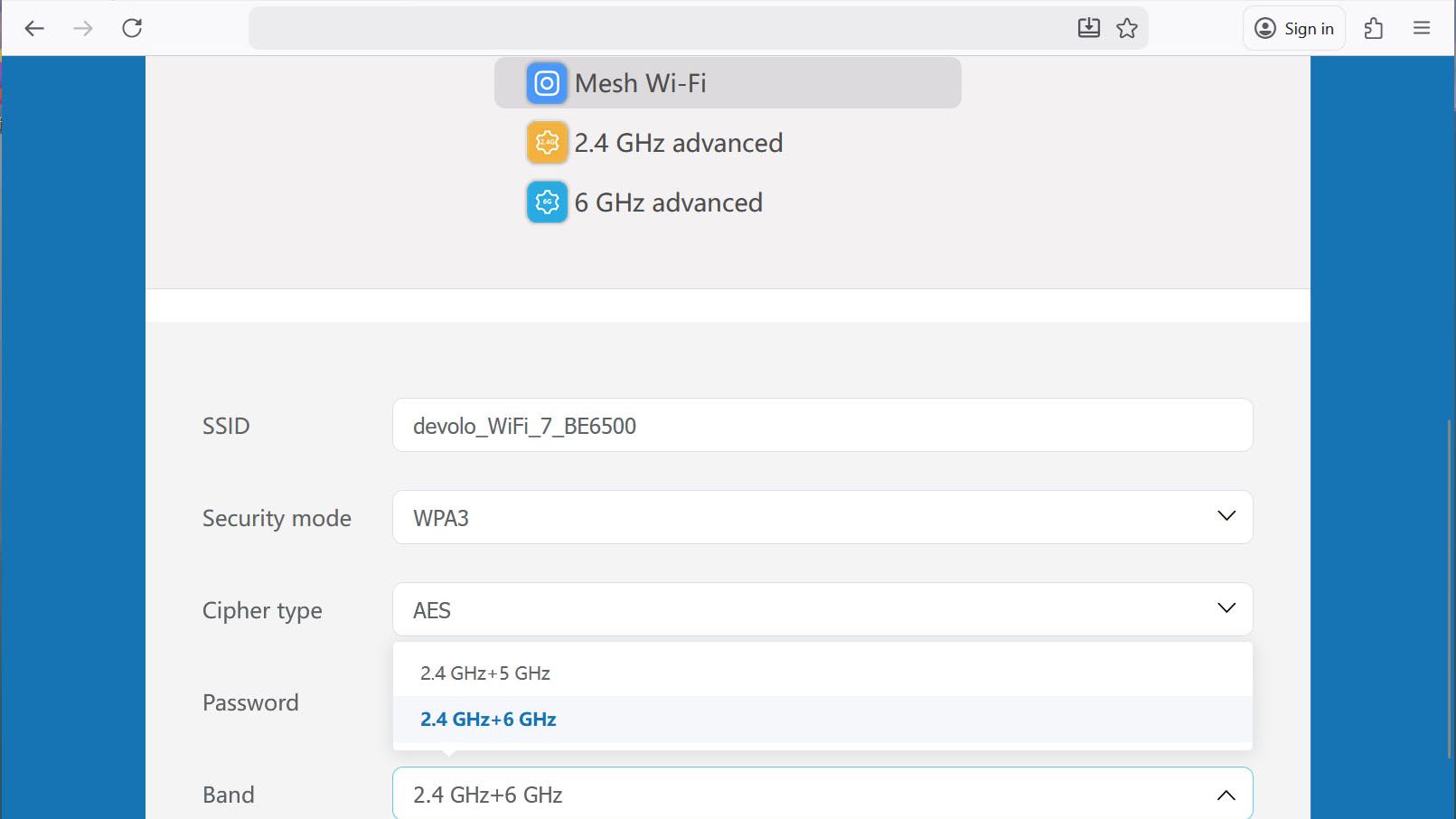
That’s not a very user-friendly approach though, and may well be confusing for people who aren’t used to configuring their network via a web browser interface, so Devolo needs to make its app more straightforward for new users.
- Features score: 4/5
Devolo Wi-Fi 7 Mesh BE6500: Performance
Devolo Wi-Fi 7 Mesh BE6500: Benchmarks
Ookla Speed Test – 2.4GHz+5.0GHz (download/upload)
Within 5ft, no obstructions: 150Mbps/150Mbps
Within 30ft, three partition walls: 150Mbps/150Mbps
Ookla Speed Test – 2.4GHz+6.0GHz (download/upload)
Within 5ft, no obstructions: 150Mbps/150Mbps
Within 30ft, three partition walls: 150Mbps/150Mbps
20GB Steam Download – 2.4GHz+5.0GHz
Within 5ft, no obstructions: 150Mbps
Within 30ft, three partition walls: 150Mbps
20GB Steam Download – 2.4GHz+6.0GHz
Within 5ft, no obstructions: 150Mbps
Within 30ft, three partition walls: 150Mbps
The BE6500 could certainly be more user-friendly, but I can’t fault its performance, and the three-pack system that I tested worked a treat for tackling the Wi-Fi deadspot that I have in an office towards the back of my building.
Devices in the same room as my normal broadband router can generally achieve the full 150Mbps available with my office broadband service both for Steam downloads and the Ookla Speed Test.
My aging router struggles to reach that back office though, so I have to rely on PowerLine adaptors to provide a more reliable wired network connection.
I placed one of the BE6500 Extension routers in that office, with the second placed roughly halfway between the back office and the main Controller router. Steam downloads did slow down a little initially, when using the 2.4GHz and 5.0GHz bands, dipping to 130Mbps as I walked along the corridor with my laptop, but quickly recovered to hit 150Mbps once more.
That pattern was repeated with the Ookla Speed Test as well. Performance was even better when I switched to using the 2.4GHz and 6.0GHz bands, with the BE6500 trio maintaining a smooth 150Mbps throughout my tests.
Some people might prefer a true tri-band router or mesh system that allows you to use the 2.4GHz, 5.0GHz and 6.0GHz bands simultaneously. That will be more expensive though, and if you need an affordable Wi-Fi upgrade that can cover a larger home with reliable Wi-Fi, then the BE6500 is good value for money.
- Performance score: 4/5
Should I buy the Devolo Wi-Fi 7 Mesh BE6500?
Swipe to scroll horizontally
|
Attribute |
Notes |
Score |
|---|---|---|
|
Features |
Dual-band Wi-Fi 7, with support for 2.4GHz + 5.0GHz, or 2.4GHz + 6.0GHz |
4/5 |
|
Performance |
A mid-range option, but fast enough for most domestic broadband services |
4/5 |
|
Design |
Compact and neatly designed, with four Ethernet ports |
4/5 |
|
Value |
A reliable performer at a competitive price |
4/5 |
Buy it if…
” data-widget-type=”deal”>
Netgear Orbi 373
The Orbi 373 only supports dual-band Wi-Fi 7 using the 2.4GHz and 5.0GHz bands, but it performs well, and the Orbi app is very straightforward and easy to use.
” data-widget-type=”deal”>
Amazon Eero 7
The Eero 7 is a modest dual-band performer with a modest set of features, but it’s competitively priced and easy to use, with the backing of the Amazon name behind it.
- Read TechRadar’s reviews guarantee
- First reviewed: September 2026
” data-join-the-conversation-text=”Join the Conversation”>
You must confirm your public display name before commenting
Please logout and then login again, you will then be prompted to enter your display name.
Related Posts

It looks like Microsoft is forcing its controversial Windows 11 24H2 update on people and (plot twist!) it might be for the best
Windows 11 24H2 is rolling out automatically to eligible PCs on 22H2 or 23H2 Persistent bugs like Asus compatibility and […]
‘Prices are probably going to be so bad, no one will be able to afford the things anyway’: worrying rumor aired on the cost of Microsoft’s next-gen Surface devices
(Image credit: Future / John Loeffler) Rumor has it the next-gen Surface devices have been delayed by a month A […]
NYT Strands hints and answers for Friday, May 2 (game #425)
(Image credit: New York Times) Looking for a different day? A new NYT Strands puzzle appears at midnight each day […]