
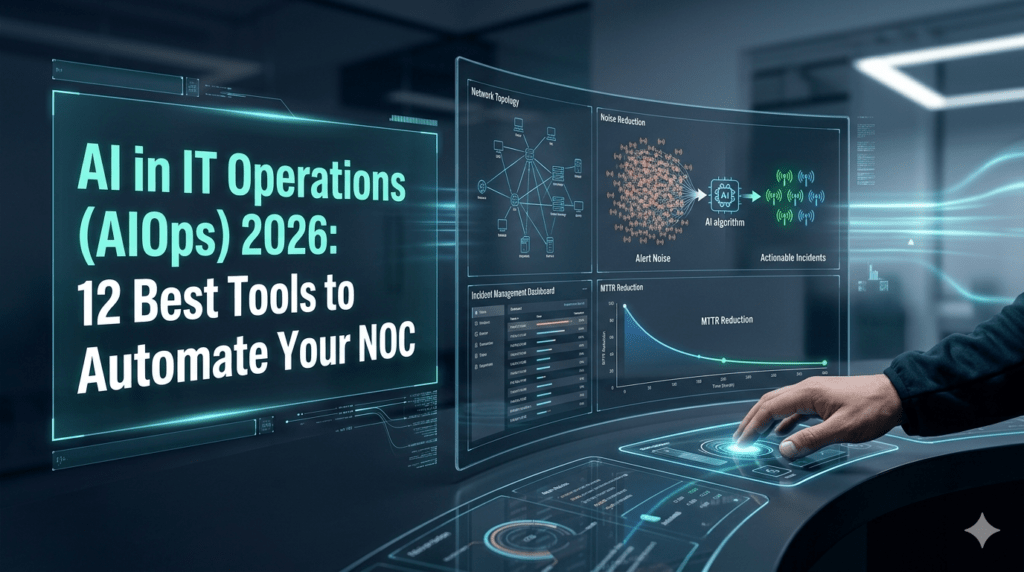
Your NOC team drowns in noise. The average enterprise operations team now receives 500 to 1,200 alerts per day, and despite years of investment in monitoring tools, engineering toil has actually increased by 30% compared to 2024. More dashboards didn’t solve the problem, and more tools made it worse. Each platform generates its own alert stream, often duplicating signals that other tools have already raised, with zero shared context across them.
AIOps (AI in IT Operations) exists to break that cycle. Organizations that deploy AIOps platforms correctly report alert volume reductions of 90–95%, often dropping from thousands of daily alerts down to fewer than 100 actionable items, alongside MTTR (Mean Time to Resolution) improvements of 40–58%. BT Group cut mean time to remediation from 2 hours to 85 seconds through automated alert correlation and runbook-driven self-resolution. PayPal reduced incident triage time by 60% by mapping incident clusters across Kubernetes pods in real time. LinkedIn cut MTTR by 70% through AI-led auto-remediation workflows.
The challenge for buyers is not whether AIOps delivers value; the data settles that question. The challenge is navigating a market that spans fundamentally different architectural approaches: full-stack observability platforms with embedded AI engines, pure-play correlation specialists that sit above your existing tools, and automation-first vendors built around incident response. Choose the wrong architecture, and you invest heavily in a platform that changes nothing operationally.
This guide breaks down 12 leading AIOps platforms, what each one actually does, where it excels, where it falls short, and what it costs — so your team selects the right architecture the first time.
Also Read: Top 10 Agentic AI Platforms for Enterprise in 2026: Buyer’s Guide
What Is AIOps, and Why Does 2026 Demand It?
AIOps or AI for IT Operations, a term Gartner coined in 2017, applies machine learning and big data analytics to ingest logs, metrics, traces, and events from across your infrastructure, then automatically correlates related signals, detects anomalies, identifies root causes, and increasingly triggers remediation without waiting for a human to act.
Market sizing estimates vary significantly depending on methodology and scope. Mordor Intelligence places the AIOps platform market at $18.95 billion in 2026, growing to $37.79 billion by 2031. Research and Markets estimates $14.44 billion in 2026 and projects $41.6 billion by 2030. Global Growth Insights, using a broader market definition that includes adjacent AI operations tooling, estimates the figure at up to $47.29 billion in 2026. Whichever number you trust, the growth trajectory is steep and consistent across every analyst firm tracking the category.
What buyers need to understand before evaluating vendors is the fundamental architectural fork in this market: do you consolidate your monitoring estate onto a single AIOps-enabled platform, or overlay a correlation layer across your existing tools without displacing them? These are genuinely different decisions that lead to entirely different shortlists. Most enterprises today run between 5 and 15 separate monitoring tools simultaneously, which is exactly why this decision matters before you sign anything.
5 Buying Criteria for an Enterprise AIOps Platform
The following buying criteria will help you choose a better AIOps platform that suits your organizational requirements.
- Tool-agnostic integration breadth — Can it ingest from your existing monitoring stack without requiring you to rip tools out, or does it demand wholesale migration?
- Noise reduction methodology — Does it rely on adaptive thresholding, ML clustering, and deduplication, and can the vendor show a measurable compression rate from real deployments?
- Root cause automation depth — Does the platform stop at correlation, or does it identify causal chains and automatically trigger remediation workflows?
- Deployment model fit — Does it offer self-hosted options for organizations with data sovereignty requirements, or is it SaaS-only?
- Pricing transparency — Is pricing consumption-based and predictable, or does it require a sales call and an opaque enterprise contract?
Also Read: What a Reliable Software Deployment Process Actually Looks Like in 2026
The following are the 12 best AIOps platforms in 2026 that effectively deliver on the promise of autonomous, intelligent operations for your NOC.
#1. BigPanda
Best for: Enterprises with fragmented, multi-vendor monitoring estates

BigPanda is not a monitoring tool; it functions as an AIOps Event Hub that sits above your existing observability stack (Splunk, Datadog, Prometheus, Nagios) and ingests their alerts rather than replacing them. Its ML-based correlation engine groups related alerts into unified incidents and uses AI to enrich technical alerts with business context. For example, flagging that a server failure affects the checkout service responsible for 40% of weekend transaction volume.
- Pros: Tool-agnostic by design; reduces alert noise by 95%+ through intelligent correlation and deduplication; GenAI-powered business context enrichment on every alert.
- Cons: Relies entirely on external tools for primary data collection; lacks native deep telemetry collection.
- Pricing: Custom enterprise quote.
#2. Dynatrace Davis AI
Best for: Large, complex environments needing full-stack observability

Dynatrace’s Davis AI engine has performed AI-powered root cause analysis since before “AIOps” became an industry term. The platform’s defining differentiator is deterministic AI: instead of statistical guesswork, Davis AI applies causal analysis across the full application topology, continuously mapped through Dynatrace’s Smartscape feature.
- Pros: Deterministic causal AI eliminates probabilistic guesswork; continuous automated topology mapping; strong native application security monitoring.
- Cons: Highly complex initial configuration process; premium pricing limits adoption for smaller teams.
- Pricing: Full-stack monitoring starts at $58/host/month (8 GB included).
#3. Splunk IT Service Intelligence (ITSI)
Best for: Organizations already running Splunk for logs and security

Splunk ITSI delivers AIOps through ML-based adaptive thresholding, automatically adjusting alert baselines based on seasonal patterns and historical behavior rather than static rules. The platform monitors service health across multi-cloud environments and predicts incidents before they affect operations, using visual dashboards to track KPIs against SLA commitments.
- Pros: Predicts service degradation before customer impact; eliminates manual threshold tuning entirely; proven deployment patterns at Fortune 500 scale.
- Cons: Requires specialized Search Processing Language (SPL) skills and coding knowledge to master; resource-heavy architecture demands significant ongoing maintenance.
- Pricing: Custom enterprise quote tied to Splunk data ingestion volume.
#4. ServiceNow ITOM
Best for: IT operations already embedded in ITSM workflows on the Now Platform

ServiceNow earned the #1 ranking in Gartner’s 2025 Critical Capabilities report for Building and Managing AI Agents, reflecting an architecture that ties event correlation directly into incident, change, and problem management rather than treating AIOps as a standalone analytics layer. The platform’s strength is cohesion: alerts, incidents, and remediation workflows live in a single system of record.
- Pros: Unified ITSM and AIOps in one platform; strong fit for organizations needing incident, change, and problem management with AI-driven operations; analyst-validated governance architecture.
- Cons: Maximum value depends on already running on the Now Platform; implementation timelines run 8–16 weeks for full deployment.
- Pricing: Enterprise contract; custom quote required.
#5. IBM Cloud Pak for AIOps
Best for: Hybrid cloud and regulated industries requiring compliance depth

IBM Cloud Pak for AIOps automates IT operations by applying AI to analyze, diagnose, and resolve incidents across hybrid cloud environments. The platform stands out for industries facing strict audit and compliance requirements — banking, healthcare, insurance, where governance depth often outweighs raw feature count in the buying decision.
- Pros: Purpose-built for regulated industries with strict compliance mandates; deep hybrid-cloud diagnostic capability; vendor-neutral orchestration approach that avoids platform lock-in.
- Cons: Requires meaningful technical investment to deploy at scale; not a point-and-click solution for teams without dedicated AI engineering capacity.
- Pricing: Enterprise contract; custom quote required.
#6. Moogsoft
Best for: High-volume alert environments in telco, finance, and large enterprise

Moogsoft pioneered machine-learning-based alert noise reduction and incident correlation, and its “Situation Room” concept, grouping related alerts into actionable clusters, remains a differentiator for NOC teams overwhelmed by tool proliferation. Moogsoft holds 41 patents and continues deployment in large telco and financial services environments with extremely high alert volumes.
- Pros: Documented results include a 33% MTTR reduction with 85% event data consolidation at HCL Technologies; adaptive thresholding and alert deduplication built specifically for microservice-scale noise.
- Cons: Now embedded within the broader Broadcom portfolio, raising integration roadmap questions for some buyers; enterprise pricing available only on request.
- Pricing: Didn’t find anything about pricing on Moogsoft’s website..
#7. PagerDuty AIOps
Best for: Teams prioritizing incident response speed over full observability

PagerDuty is a digital operations management and incident response platform with AI-powered event intelligence layered on top of its core response workflows. Rather than competing as a full observability platform, PagerDuty focuses on filtering alerts, detecting patterns, and accelerating the human-in-the-loop response process across 700+ integrated tools.
- Pros: Massive integration ecosystem spanning monitoring, observability, and collaboration platforms; mature on-call and escalation workflows; fast time-to-value for response automation.
- Cons: Primarily focused on incident response rather than full-stack observability; advanced AIOps capabilities require higher-tier plans.
- Pricing: Tiered, starting with a basic incident response plan; advanced AIOps features available only on higher tiers.
#8. Datadog
Best for: Cloud-native teams already standardized on Datadog

Datadog has built AIOps directly into its unified observability platform rather than bolting it on. Watchdog AI automatically surfaces anomalies across infrastructure, applications, and logs, while Bits AI Datadog’s generative AI assistant provides conversational troubleshooting during live incidents. The platform integrates log analytics, infrastructure monitoring, and APM into a single solution.
- Pros: Massive ecosystem with 600+ integrations; exceptional out-of-the-box dashboards; AIOps capability is native, not a third-party add-on.
- Cons: Pricing scales aggressively with custom metrics as usage grows; the platform struggles with entirely unstructured PDF runbook content.
- Pricing: Included with the Enterprise plan; Watchdog and correlation features are available on Pro plans.
#9. New Relic AIOps
Best for: Organizations consolidating telemetry onto a single full-stack platform

New Relic AIOps prevents revenue-impacting incidents through AI-powered detection, automated investigation, and proactive remediation within one unified platform. The platform’s Incident Management capability consolidates telemetry across an organization’s entire software ecosystem, and its real-time APM streaming delivers data every five seconds, critical during high-traffic peak events like Black Friday.
- Pros: Real-time five-second APM streaming for immediate response during traffic spikes; unified data platform reduces tool sprawl; strong full-stack root cause identification.
- Cons: Architecture favors full consolidation over an agnostic overlay approach, a weaker fit for organizations that want to keep their existing tools in place.
- Pricing: Usage-based consumption pricing with custom enterprise tiers.
#10. HPE OpsRamp
Best for: Managed service providers and complex multi-vendor hybrid IT

HPE OpsRamp, now part of HPE, is a hybrid IT management and AIOps platform purpose-built for MSPs and enterprise IT teams managing complex, multi-vendor environments. It covers infrastructure discovery, monitoring, event management, and AIOps-driven correlation within a single platform, with strong support for both on-premises and cloud workloads.
- Pros: Strong fit for genuinely complex multi-vendor environments; solid coverage across on-prem and cloud simultaneously; backed by HPE’s enterprise scale and support infrastructure.
- Cons: Less brand recognition among DevOps-native teams compared to Datadog or New Relic; integration depth varies by module.
- Pricing: Custom enterprise quote.
11. LogicMonitor
Best for: Teams wanting conversational, agentic AIOps

LogicMonitor is a unified observability platform built around agentic AIOps capabilities. Its cross-domain observability unifies structured and unstructured data, supplementing it with metadata for contextual, real-time visibility. A generative AI layer leverages Retrieval Augmented Generation (RAG) to translate complex system data into a natural, conversational interface for real-time troubleshooting and root cause analysis.
- Pros: End-to-end incident lifecycle automation from detection through remediation; strong hybrid infrastructure monitoring; conversational RAG interface lowers the skill barrier for interpreting complex telemetry.
- Cons: Notable learning curve for advanced customization; log management capabilities are less deep than dedicated log analytics tools.
- Pricing: Custom quote per device/resource count.
#12. Cisco AgenticOps
Best for: Network-centric NOCs, telecom, and large service-provider environments
Cisco AgenticOps takes an AI-first approach to network operations, blending telemetry, assurance, automation, and collaboration into a single operating model. Its core advantage is context: because the platform already understands devices, network topology, and performance dependencies, its workflow automation becomes more accurate than a generic AI layer applied on top of generic infrastructure data.
- Pros: Network-aware automation rather than a generic AI correlation layer; particularly strong for large enterprises and service-provider environments already running Cisco networking and assurance tools; topology-informed decision-making built into the core architecture.
- Cons: Strongest value concentrates in Cisco-heavy network estates; broader agentic capabilities are newer to market and still maturing relative to established correlation specialists.
- Pricing: Enterprise contract; custom quote required.
Quick Comparison: 12 AIOps Tools at a Glance
The table below provides a quick summary of the starting prices, architectural features, and best use cases.
| Tool | Best For | Architecture | Noise Reduction | Starting Price |
| BigPanda | Fragmented monitoring estates | Overlay | 95%+ | $100K+/year |
| Dynatrace | Large full-stack environments | Full-stack | High (causal AI) | $69/host/month |
| Splunk ITSI | Existing Splunk shops | Full-stack (Splunk-native) | Adaptive thresholding | Custom quote |
| ServiceNow AIOps | ITSM-embedded operations | Full-stack (Now Platform) | Workflow-integrated | Custom quote |
| IBM Watson AIOps | Regulated, hybrid cloud | Full-stack | Diagnostic-led | Custom quote |
| Moogsoft | High-volume alert environments | Overlay | Up to 50%+ (case studies) | $899/month |
| PagerDuty AIOps | Incident response-first teams | Overlay (response-focused) | Pattern detection | Free tier / tiered |
| Datadog | Cloud-native, existing Datadog users | Full-stack | Built-in (Watchdog AI) | Included in Enterprise |
| New Relic AIOps | Full telemetry consolidation | Full-stack | Root-cause focused | Usage-based |
| HPE OpsRamp | MSPs, multi-vendor hybrid IT | Overlay + full-stack hybrid | Correlation-based | Custom quote |
| LogicMonitor | Conversational, agentic AIOps | Full-stack | Cross-domain | Custom quote |
| Cisco AgenticOps | Network-centric NOCs, telecom | Full-stack (network-native) | Topology-informed | Custom quote |
How to Choose: Overlay vs. Consolidate, and Budget Reality
Decide your architecture first: overlay or consolidate? If your organization runs a fragmented estate of 5–15 monitoring tools and is not ready to displace any of them, BigPanda, Moogsoft, and OpsRamp deliver an aggregation layer that correlates everything without forcing migration. If your organization is ready to standardize on a single platform, Dynatrace, Datadog, and New Relic deliver full-stack observability with AIOps built natively into the core product.
Respect your existing platform gravity. Organizations already running Splunk for security and log analytics gain the most immediate value from ITSI. Teams with operations embedded in ServiceNow workflows should extend that investment rather than bolt on a separate AIOps tool. Network-heavy estates running Cisco infrastructure get the strongest contextual automation from AgenticOps. This mirrors a principle that holds across every category of enterprise AI tooling: selecting against your existing stack creates integration debt that erodes ROI before the platform ever delivers value.
Weigh regulated compliance against cloud-native speed. For healthcare, financial services, and government, IBM Watson AIOps and ServiceNow lead on governance and audit depth. For cloud-native, DevOps-first teams that prioritize deployment speed, Datadog, New Relic, and LogicMonitor deliver faster time-to-value with less compliance overhead.
Also Read: Free Browser-Based Developer Utilities That Belong in Every DevOps Toolkit
Check your budget reality before you shortlist. Enterprise-only contracts — BigPanda, Dynatrace, IBM — typically start at $100,000 or more annually and suit large, mature operations teams. Accessible entry points exist, too: Moogsoft’s Pro tier starts at $899/month, PagerDuty offers a free tier for smaller teams, and Datadog’s AIOps capabilities are included once you’re on an Enterprise plan rather than priced as a separate line item.
The Bottom Line
The ROI case for AIOps is no longer in question. BT Group’s 85-second MTTR, PayPal’s 60% reduction in triage time, and LinkedIn’s 70% MTTR improvement settle the “does this work” debate definitively. What remains is execution discipline: choosing the architecture that fits your environment, not the platform with the loudest marketing.
Before enabling full autonomous remediation, run a shadow-mode pilot for a minimum of two weeks, log every recommended automated action without executing it, then validate accuracy against your real environment. Industry data shows nearly one in three teams still fail at full autonomous rollout, with failures concentrated in misconfigured runbooks and insufficient training data rather than technology limitations. Pilot deliberately, validate against your own telemetry, and scale only what your data proves works.
The NOC teams winning in 2026 are not the ones with the most tools. They are the ones running the fewest alerts that actually matter.
Want to stay ahead of enterprise IT operations trends? Subscribe to Techwrix for weekly coverage of the tools, platforms, and strategies that matter to IT decision-makers.