“I realized that if something went wrong up there, things might go very badly down here.”
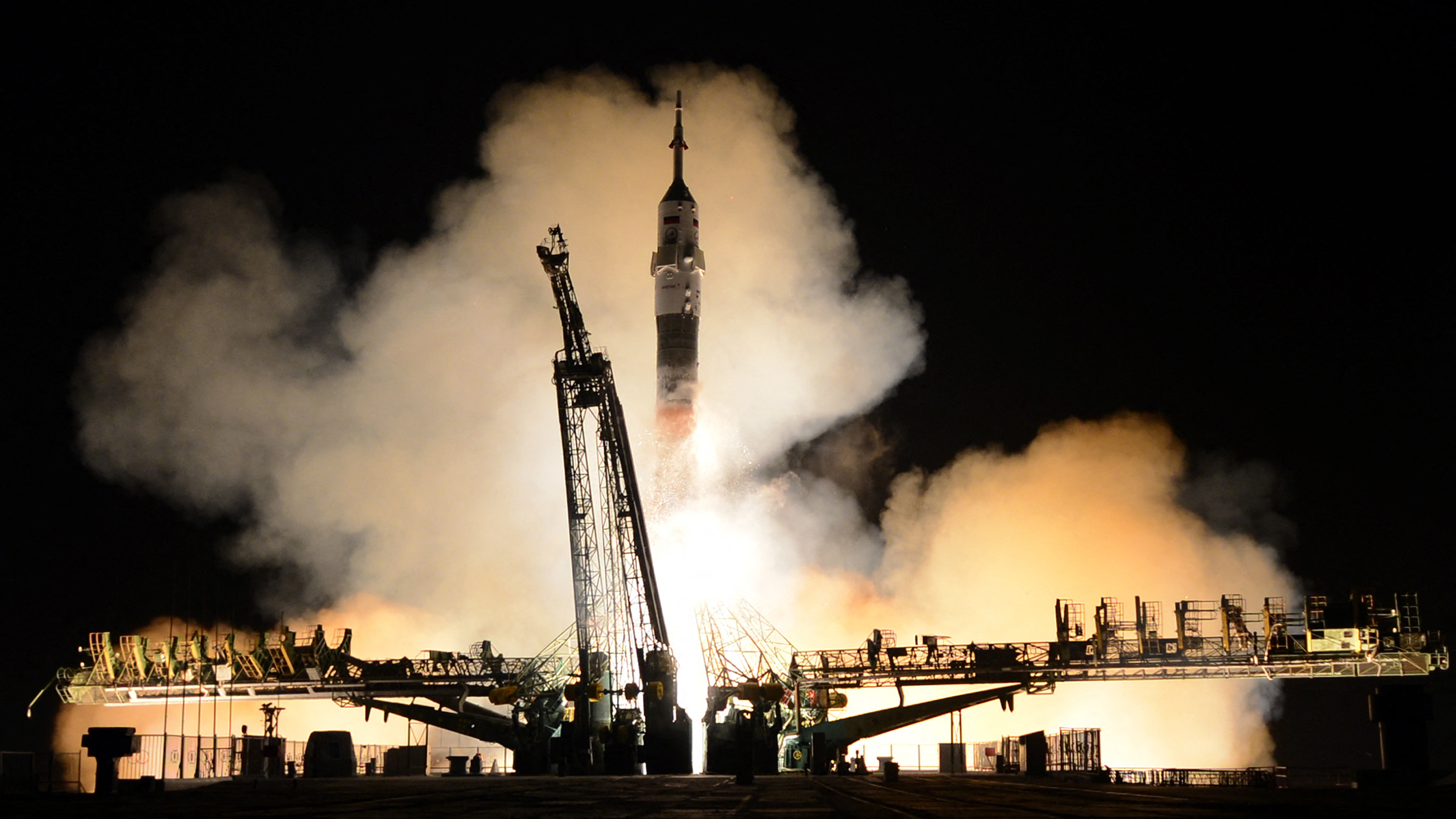
Russian Soyuz-FG rocket with the Soyuz TMA-12M spacecraft launches in March 2014. Credit: VASILY MAXIMOV/AFP via Getty Images
Russian Soyuz-FG rocket with the Soyuz TMA-12M spacecraft launches in March 2014. Credit: VASILY MAXIMOV/AFP via Getty Images
Robert Goddard, a Massachusetts-born physicist, launched the world’s first liquid-fueled rocket on this date 100 years ago.
It was not an overly impressive flight. The rocket, fueled by gasoline and liquid oxygen, rose just 41 feet into the air, and the flight lasted 2.5 seconds before it struck ice and snow.
Nevertheless, this rocket, named “Nell,” represented a historic achievement that would help launch the modern age of spaceflight. Three decades later, the first objects would begin to ride liquid-fueled rockets into space, followed shortly by humans. A little more than 40 years would pass before humans walked on the Moon.
To mark this historic moment, a few Ars staffers are sharing some of their most memorable launches. Please add yours in the comments below.
Space Shuttle Endeavour
In February 2010, I was lucky enough to attend the penultimate night launch of the shuttle program, STS-130. This mission was a major ISS assembly flight, carrying both Node 3 and Cupola to the ISS. This one had nothing to do with me—instead, I was there as a plus-one for my wife, who had worked on Node 3 at Boeing and who had been invited to witness the hardware she’d worked on finally fly.
The day before the launch was a whirlwind of private tours through various KSC locations—we got to see one of the Crawler-Transporters up close, and then we had a photo-op right next to pad 39-A, where Endeavour was staged and ready. We got to see the VAB, the Orbiter Processing Facility, and the Space Station Processing Facility. There was also a big team lunch with some of the ESA partners my wife had worked with (including a group of Italian engineers from Alenia who, being ever Italian, had brought along a lot of wine).
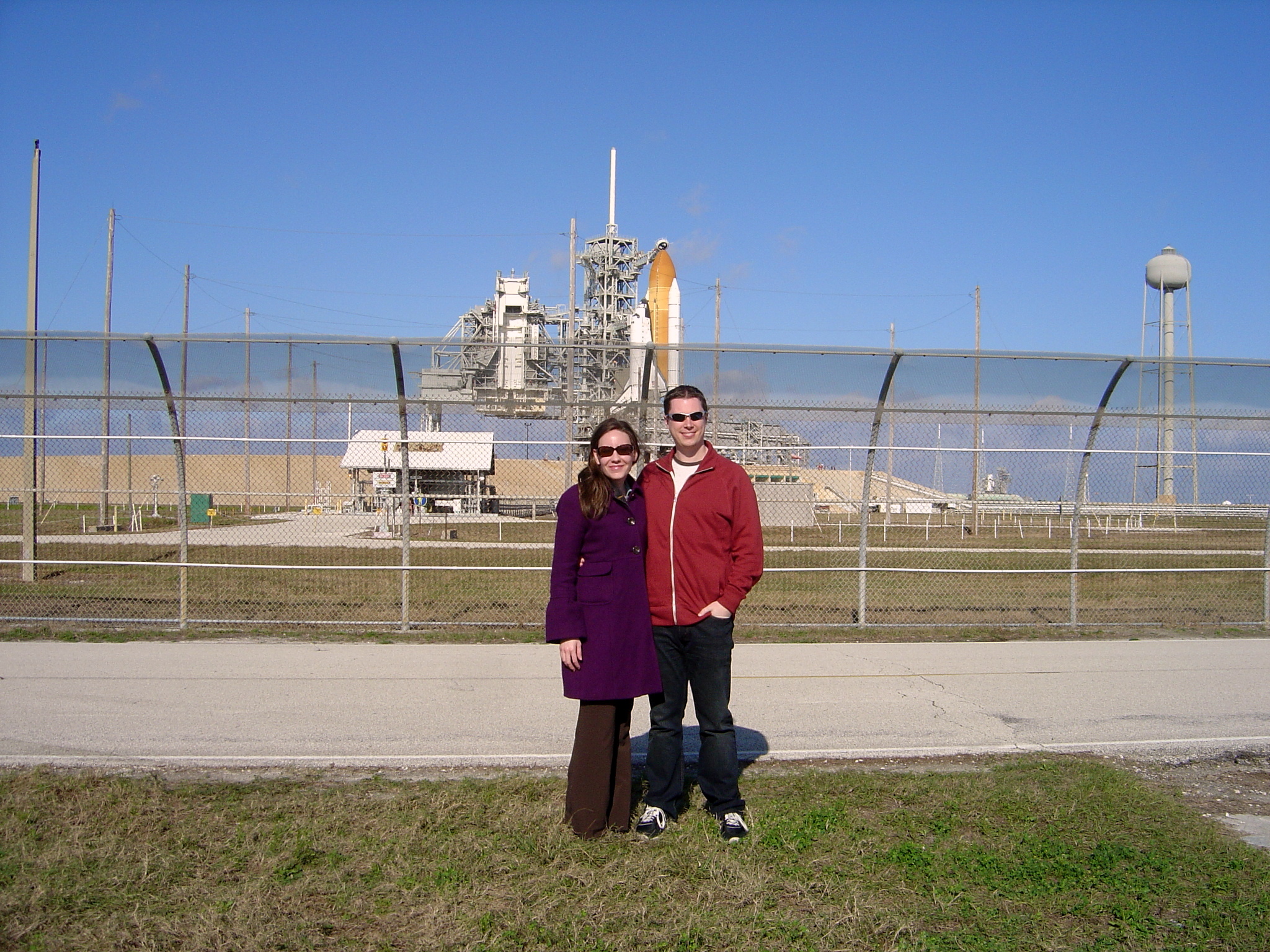
Laura and Lee Hutchinson, standing near LC-39A on February 6, 2010, with Endeavour staged in the background.
Credit: Lee Hutchinson
Laura and Lee Hutchinson, standing near LC-39A on February 6, 2010, with Endeavour staged in the background. Credit: Lee Hutchinson
The launch was originally scheduled for 04:39 Eastern the next morning, February 7, which meant no sleep. After a brief post-tour evening rest, we were all herded onto buses from the hotel at about midnight and then transported with the other program guests to the Banana Creek launch viewing area, about four miles from LC-39A. The Banana Creek viewing area is attached to the Saturn V visitor’s center, so we spent the hours before launch perusing the exhibits and enjoying KSC’s fantastic collection of historic human spaceflight artifacts.
Unfortunately, the morning’s launch attempt ended in a weather-related scrub, followed by an exhausted two-hour bus ride through bumper-to-bumper traffic on highway A1A back to the hotel, with the promise that we’d try things again the next evening. After some sleep, we were all herded back on the buses again around the following midnight and trucked back to Banana Creek.
This time, things went according to plan. At 04:18 Eastern time on February 8, Endeavour lifted silently into the sky on a retina-searing plume of incandescent light from the SRBs. It took several awe-filled seconds for the sound of the launch to come rolling across the water to reach us, but when it did, it was all-encompassing. I could feel the ground under my feet tremble as my clothes vibrated against my skin—something I’d previously only experienced watching top fuel dragsters.
Endeavor clawed its way upward, rolling and accelerating, and as it broke through the low cloud layer, the sun-bright light from the SRBs diffused through and turned the predawn darkness to noon. The thing I remember most is the CRACKLE-CRACKLE-CRACKLE of the solids burning. I’d always thought the crackling was just microphone clipping, but in person, it sounded exactly like it sounded on TV—just at a volume and frequency that literally shakes your pants.
The light faded as the shuttle climbed into the clouds, and when we caught sight of it again, it was a distant star, brighter than Venus and winking slightly as it drifted. The PAO announcer called SRB separation, but we couldn’t see anything notable. After that, a crush of folks all rushed to be first back on the buses for the multi-hour ride back to the hotel. My wife and I drifted with the crowd, holding hands, lost in thought.
It was an amazing experience. I’ve never seen anything like it, and I don’t think I ever will again.
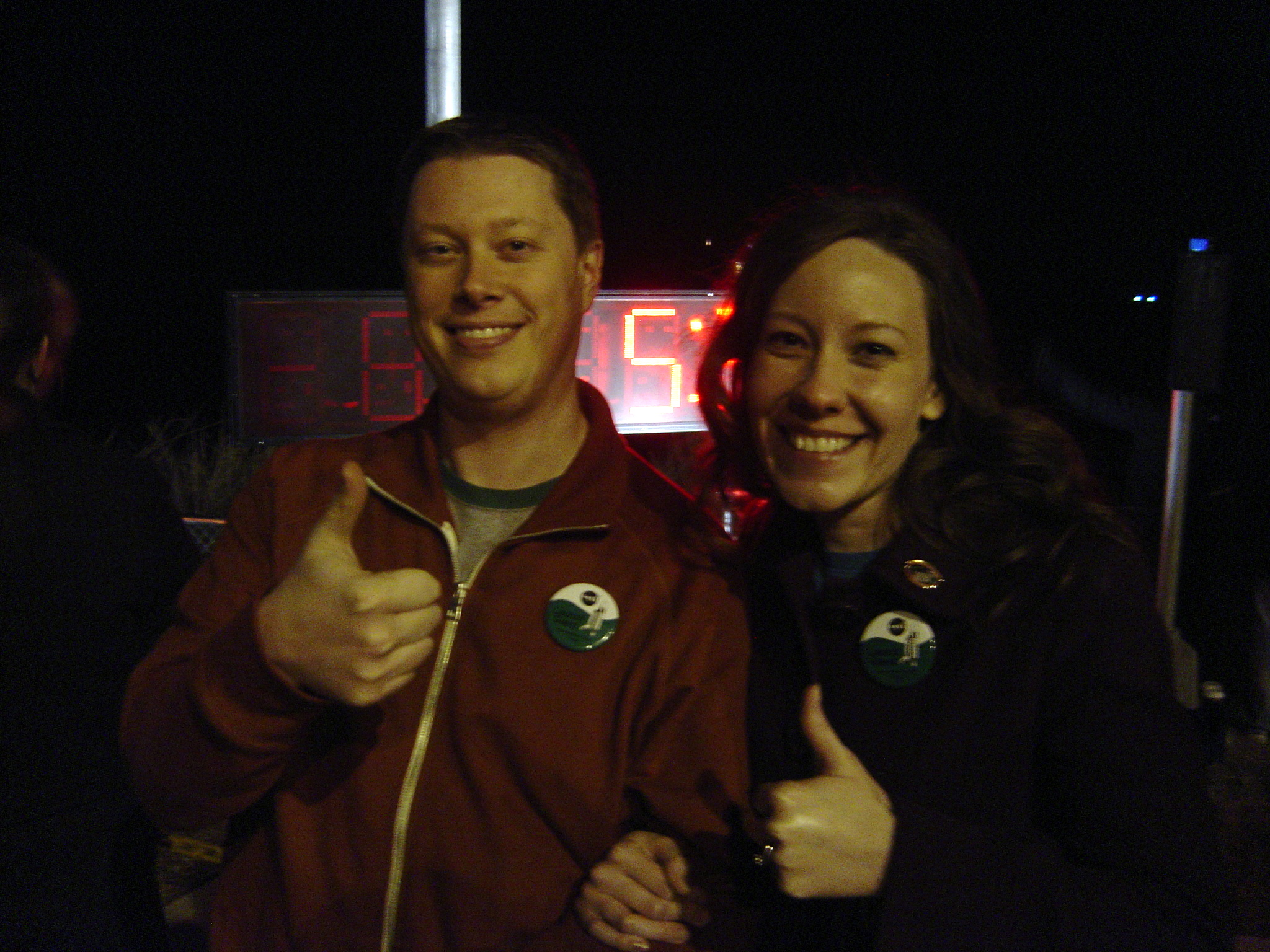
Two happy space nerds, moments after Endeavour‘s successful SRB separation and just before fighting our way back to the bus.
Credit: Lee Hutchinson
Two happy space nerds, moments after Endeavour‘s successful SRB separation and just before fighting our way back to the bus. Credit: Lee Hutchinson
— Lee Hutchison
Delta 1
I’ve now been to a couple of milestone launches: the first US launch by Rocket Lab and the last flight of the Antares. But when I think about launches, I instantly go to one I saw nearly 50 years ago now, with a booster and payload I can’t even identify. (Note from Space Editor Eric Berger: This almost certainly was a Delta 1 rocket, launching the Himawari 1 meteorological satellite for Japan).
The only reason I can remember the year is because of what else happened during that same family vacation in Florida: New York City’s 1977 blackout (brought on by a heat wave that made us appreciate summer temperatures in Florida). That and the release of Star Wars. One of the many items on the vacation agenda was a visit to the Kennedy Space Center during the awkward years between the end of Saturn launches and the start of the Shuttle era. That didn’t mean nothing was going on—the Voyagers would launch later that year—but it meant there was nothing dramatic to time our visit for.
Still, my father learned of a pre-daylight launch, and the whole family dutifully loaded up the car at about five in the morning and headed from wherever we were staying to the Cape. Even so, we didn’t make it on time. At some point, my father spotted the rocket, pulled over to the side of the road, and woke us kids up, and we hustled out of the car. There, already rapidly ascending, was a rocket that lit the pre-dawn sky, giving everything a bluish tint.
All these years later, my memories are pretty limited. I don’t remember it moving out of view, whether I made any mental comparisons of the relatively small, thin booster to the Saturn launches I had seen on TV, or what we did for the next few hours while we were undoubtedly waiting for anything to open for the day. But the single, static image of that rocket has stuck with me ever since.
— John Timmer
Soyuz-FG
Big rockets make the biggest boom during launch—and often the most spectacular sights. I’ve had the privilege of seeing all the biggest ones outside of China—the Delta IV Heavy, Falcon Heavy, Starship, and Space Launch System. But my favorite launch of all time was one of the smallest I’ve seen, a Soyuz FG rocket in 2014.
At the time, I was in the midst of a months-long project to report on the state of NASA (called Adrift, if that gives you any sense of its tone). As part of the project, a photographer from the Houston Chronicle and I traveled first to Russia to see Star City and other space facilities in Moscow before flying down to Kazakhstan to observe the run-up to a crewed Soyuz launch.
As part of the trip, we went with several NASA leaders, along with the family of the space agency astronaut, Butch Wilmore, launching into space. It was an epic trip that included observing a protest march in Moscow over the treatment of Ukraine (this was 2014, and things felt super tense even then) with riot police stationed all along the way. We then walked right up to the Soyuz rocket on the pad.
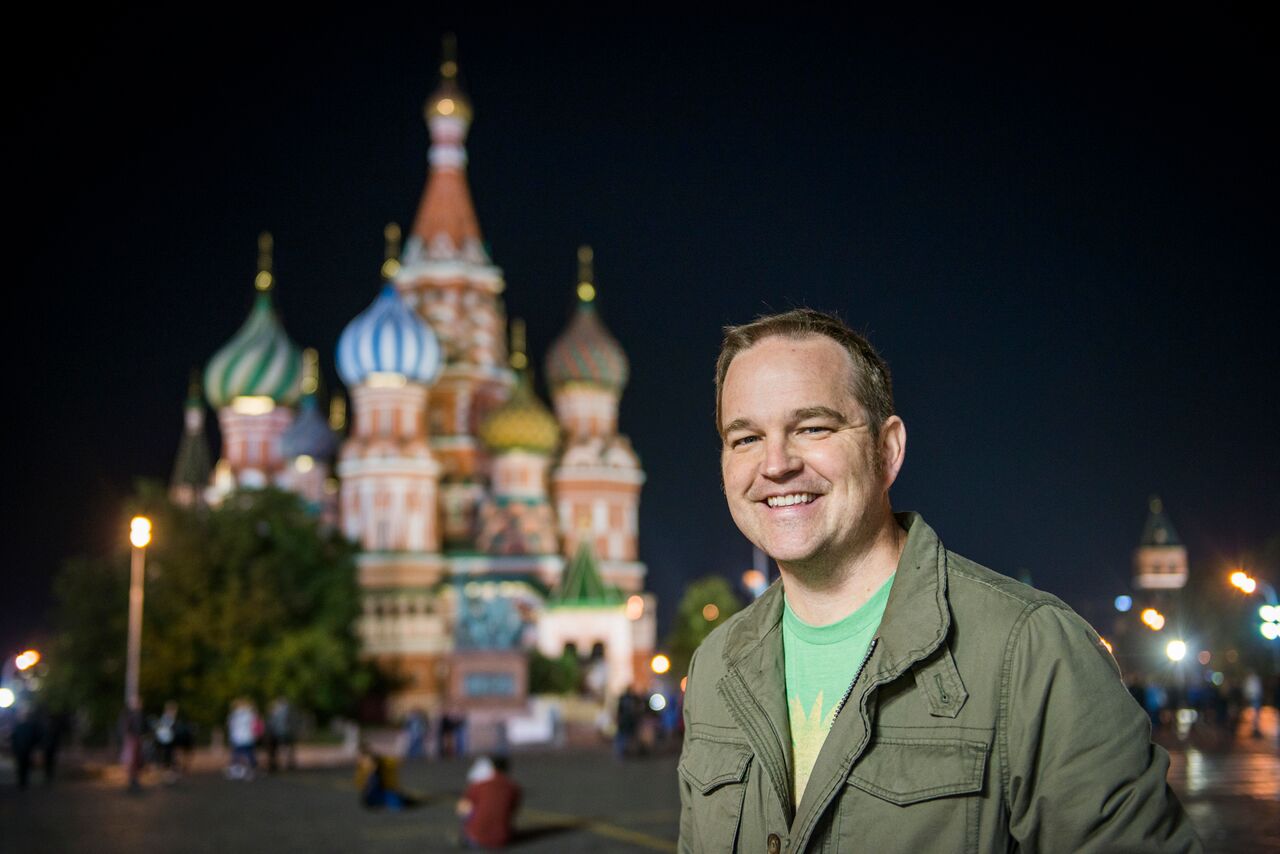
The author in Red Square in September 2014.
Credit: Smiley Pool
The author in Red Square in September 2014. Credit: Smiley Pool
The highlight was the late-night launch of the same Soyuz booster from an observation point less than 1.5 km from the pad. After riding a bus across some of the rattiest roads I’ve ever experienced, we climbed up onto a small covered stand. It all felt historic. This was the pad from which Sputnik first went to space, and then Yuri Gagarin a few years later. Soviet premiers had stood here before, probably shivering in the cold just like I was.
The Soyuz-FG is not a large rocket. It’s about 50 meters tall with a diameter of less than 4 meters. Its lift capacity is a modest 7 metric tons or so to low-Earth orbit. But the proximity to the launch site makes up for all this. As the rocket’s engines ignited, the Soyuz booster appeared to ascend almost directly overhead. There was a period of five or 10 seconds when, very viscerally, I realized that if something went wrong up there, things might go very badly down here.
A few minutes after the ascent, the then-director of NASA’s International Space Station program, Mike Suffredini, walked by on the way back to the buses. He quipped something to the effect of, “Scary enough for you?” Yes it was, Suff. Yes it was. Just one more reason to admire the brave men and women who climb on top of rockets and ride them into space.
— Eric Berger
Space Shuttle Atlantis
I have been fortunate to view a few rocket launches during my half-century on the planet, although early on, they were mostly the “build it at home, launch it at the park” ones from Estes. I now live in Washington, DC, and depending on where you live, the occasional rocket launch from Wallops Island in Virginia is visible from the city as a yellow dot that moves across the sky. Craning out a bedroom window, it’s neat but not very spectacular.
No such contortions were needed to witness NASA’s last shuttle launch as I stood next to the giant countdown clock a mere three miles from the launchpad. A lifetime of seeing footage of Apollo rockets launching left a false impression; there was nothing slow about the way Atlantis left the launchpad. With relatively low cloud cover that day, the shuttle was gone from sight quickly, but the sound, which took some time to reach us in the first place, carried on regardless.
Since then, a couple of other rocketry encounters have stuck with me. In the summer of 2020, with the pandemic raging, I took a very fast, very orange SUV out to Chincoteague Island in Virginia to watch another mission launch from Wallops, this time a National Reconnaissance Office mission aboard a Minotaur rocket. With few clouds in the sky, I was able to follow the Minotaur and its smoke trail for much longer than the shuttle, and once it was out of sight, I had the pleasure of that hybrid Porsche Cayenne to carry me home.
The most recent was a SpaceX launch that happened to coincide with the 2023 “12 Hours of Sebring” in Florida. Sebring is famous for attracting a crowd that likes to party, and by the time the Falcon rocket was ready to take to the skies, it was well into the evening, and many of the spectators were having a good time. That included the man with a 6-foot-tall staff made of beer cans duct-taped one atop the other; the staff started off as a single can, growing with each one he imbibed. But even he could find time to appreciate the sight of a missile heading into space above us while dozens of race cars roared past just a few feet away. That’s something you just don’t see every day.
— Jonathan Gitlin
Space Shuttle Discovery
I’ve had the privilege of seeing hundreds of rocket launches in my time as a space reporter. You might think it would be difficult to pick a favorite. One obvious choice is the first space shuttle launch I attended at Cape Canaveral, Florida, when I was still in grade school. This one, of course, holds a special place in my memory. Seeing SpaceX catch the booster stage of its giant stainless steel Starship rocket was also a wonder like none other I’ve seen.
Today, though, I want to write about the most spectacular launch I’ve witnessed. The date was April 5, 2010, when the shuttle Discovery made its way to the heavens from Kennedy Space Center.
The shuttle lifted off shortly before sunrise on Easter Monday, taking aim at the International Space Station with a crew of seven. I was a little more than 3 miles away as Discovery thundered into the early morning twilight. For all its faults, the space shuttle was a special machine, and it holds a special place in my heart. There was something enchanting about watching a winged spaceship rocket into orbit, hanging off the side of a butterscotch-colored fuel tank, with slender solid rocket boosters on each side. Who made that design choice?
Still, it was a sight to behold. The two boosters generated an extraordinarily bright exhaust plume, almost giving it the appearance of molten metal, which it kind of was. They’re loud, too. Really loud. Their crackling roar hits different than a liquid-fueled rocket, even one as large as Starship.
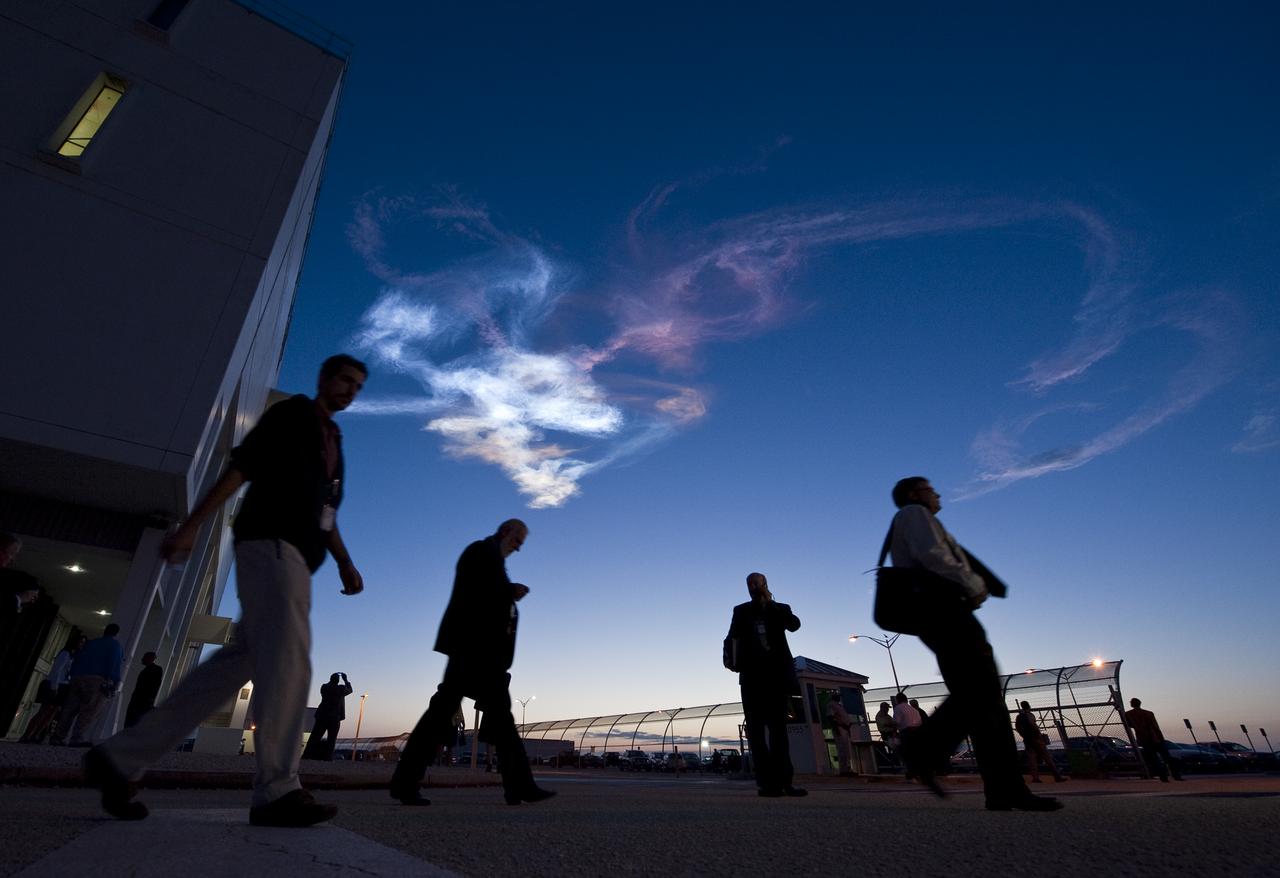
Contrails are seen as workers leave the Launch Control Center after the launch of the space shuttle Discovery and the start of the STS-131 mission at NASA Kennedy Space Center in Cape Canaveral, Florida, on Monday, April 5, 2010.
Credit: NASA/Bill Ingalls
Contrails are seen as workers leave the Launch Control Center after the launch of the space shuttle Discovery and the start of the STS-131 mission at NASA Kennedy Space Center in Cape Canaveral, Florida, on Monday, April 5, 2010. Credit: NASA/Bill Ingalls
On this particular launch, the shuttle Discovery climbed into a high-altitude sunrise a couple of minutes after departing Florida’s Space Coast. Just as the shuttle jettisoned its twin boosters, the nearly transparent exhaust from Discovery’s three main engines caught the first sunlight of the day.
The engines, which are still flying on NASA’s SLS rocket, generate water vapor from the combustion of liquid hydrogen with liquid oxygen. This water vapor instantly freezes in the cold temperatures, but the plume is usually invisible, whether it’s daytime or nighttime. The “jellyfish” effect was in full display on this spring morning. It was the only time, at least in my memory, that a space shuttle launch produced what looked like a jellyfish in the sky. Combining this spectacle with the raw power of the space shuttle, particularly those precarious but dazzling solid rocket boosters, made the launch of the STS-131 mission one I won’t soon forget.
— Stephen Clark

Eric Berger is the senior space editor at Ars Technica, covering everything from astronomy to private space to NASA policy, and author of two books: Liftoff, about the rise of SpaceX; and Reentry, on the development of the Falcon 9 rocket and Dragon. A certified meteorologist, Eric lives in Houston.