
A long flight home from feeding grounds messes with birds’ internal clocks.
Flying across several time zones often causes jet lag, a feeling when the body insists it’s the middle of the night while the clock says it’s lunchtime. Now it turns out this nuisance is not exclusive to humans.
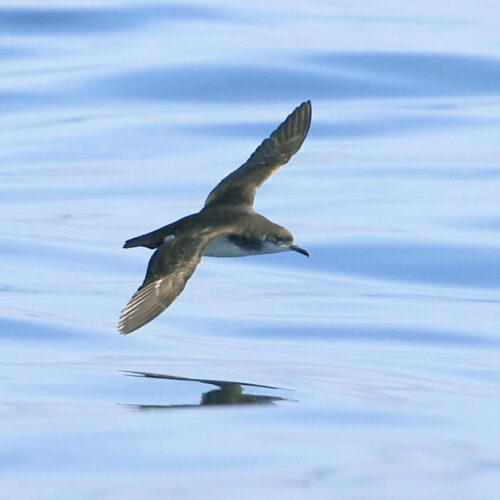
A new Science study on Manx shearwaters, seabirds that can fly hundreds of kilometers a day over the North Atlantic, shows they jet-lag themselves during their excursions. And because these birds navigate by the Sun, that jet lag leaves a measurable mark—it skews their compass.
Clockwork compass
Patrick Lewin is a behavioral and sensory ecologist at the University of Oxford and lead author of the study. “Manx shearwaters are medium-sized birds, about the same size as a pigeon,” Lewin said. “They are white underneath and black on top, but they have very long wings, and they are closely related to albatross.” Manx shearwaters nest in burrows on coastal islands around the North Atlantic. Most breed around the UK and Ireland, with about half of their population living in Wales.
From there, they head out to feed anywhere from a few dozen to more than 1,000 kilometers into the Atlantic. To get back, shearwaters are thought to work out where they are located using a map sense, possibly based on smells, and then use the Sun as a compass to set their direction.
The trouble with navigating by the Sun, though, is that it moves across the sky. “You can imagine an animal or a human that wants to travel south all day. At sunrise, when the Sun’s in the east, it needs to be traveling 90 degrees clockwise of the Sun, but by midday it needs to be traveling straight towards the Sun, and by sunset it needs to be traveling 90 degrees anticlockwise of the Sun,” Lewin said. Effective navigation by the Sun requires a clock that tells you what time of day it is. Birds, like nearly all animals, have such a clock built in. But the clock in Manx shearwaters is not perfect.
The birds recalibrate their internal clock at every dusk and dawn. This means that for every degree of longitude a bird covers between sunrise and sunset, its clock falls four minutes out of sync with local time. In consequence, a Manx shearwater misjudges where the Sun should be and veers off course clockwise when it flies east, or anticlockwise when it flies west.
Scientists had already shown something similar in other birds by catching penguins and quickly moving them across lines of longitude, but before Lewin’s study no one had clearly demonstrated it in wild animals moving on their own, mostly because the effect is small, and so requires a lot of data to become apparent. But Lewin’s team happened to have just the right database.
20 years of tracks
Tim Guilford, Lewin’s supervisor at Oxford, and Chris Perrins, a long-time Oxford shearwater researcher, started fitting shearwaters with GPS tags in 2004, when the devices first became small enough for a bird this size. Two decades later, the team had tracks from 3,688 foraging trips made by 1,045 birds from colonies along the UK’s western coasts. Those trips last from one day up to two weeks.
From this dataset, Lewin and his colleagues separated homeward flights, which the scientists say was rather simple. Foraging shearwaters make short, wiggly flights between dives. “When they are deciding to go back to their colony, they kind of switch into this mode where they are flying as fast as they can in pretty much a straight line continuously without stopping for really long periods,” Lewin said.
For each homing flight, the researchers worked out where the bird last saw the sunrise, at which point its clock should have matched local time. Then, at every GPS fix, they calculated how far east or west it had traveled since, and how much that would bend its Sun compass. Since they knew each bird was headed exactly to its burrow, they could compare those predictions with how the birds actually deviated from their course.
The time shifts were tiny. “About an hour is pretty much the maximum that we observed. Most of these are probably 15-minute, 10-minute time differences,” Lewin says. “For us, that would be pretty imperceptible, but it does still have an effect on their compass orientation that we can detect.”
Across 335 homing flights made out of sight of land, the birds veered just as the Sun compass predictions said they would. Because the study was not a controlled experiment, though, Lewin argues we need to be careful about causality. Still, the team calculated the biases that crosswinds, the Coriolis effect, or a magnetic compass might introduce, and none of those fit the data well. “Our observed biases match by far the best to the Sun compass biases that we would expect,” Lewin said.
Correcting course
The navigational errors apparently caused by jet lag reached up to around 15 degrees, which for birds was way less costly than one might expect. A bird with a map sense can check its position, notice it’s drifting, and correct. The team calculated that for a shearwater flying 1,000 kilometers east in a day, about the maximum the scientists observed, the average error would be roughly seven degrees. If the bird keeps checking where it is, that adds only five kilometers to the trip.
The researchers also found that when shearwaters followed coastlines, they still drifted slightly closer to or farther from the shore depending on their expected compass error. Work done in Oxford two decades ago showed that homing pigeons with shifted clocks do the same, even while following a familiar road. This led researchers to hypothesize that birds may run two parallel navigation systems, one based on the compass and one on familiar landmarks, with the balance between them never tipping entirely to one side.
An alternative explanation, Lewin suggests, might be that they don’t know exactly where on the coast they are and use the Sun to pick which way to follow it. “We don’t quite know. And I think it’s an interesting question, especially as people try and design bio-inspired autonomous navigation systems,” Lewin says.
Jet lag cure
Lewin’s study could not answer whether Manx shearwaters suffer from other jet lag symptoms like poor sleep or hunger at odd hours. “We’ve not been able to investigate that yet,” Lewin said. The next step for his team would be finding out whether the time shifts affect when birds forage, how much food they bring home, and their breeding success. Another question is whether more animals routinely experience jet lag. Lewin thinks it’s quite likely.
The same jet lag effect, Lewin said, could hit any organism with an internal clock that moves far enough east or west in a single day. That mostly means fliers, or animals living near the poles, where lines of longitude are packed closer together. The long-term goal is to find out whether animals that constantly suffer from jet lag evolved some ways to cope with it.
“In humans, if you do it a lot, in the long term it has really negative health impacts,” Lewin said. “So maybe we could take some inspiration from these animals that are constantly experiencing jet lag and see if there are ways that we can mitigate jet lag affecting humans.”
Science, 2026. DOI: 10.1126/science.adz2542

John is Ars Technica’s science editor. He has a Bachelor of Arts in Biochemistry from Columbia University, and a Ph.D. in Molecular and Cell Biology from the University of California, Berkeley. When physically separated from his keyboard, he tends to seek out a bicycle, or a scenic location for communing with his hiking boots.