NASA’s PRIMA mission will use spare parts from Webb to do major science at a lower cost.
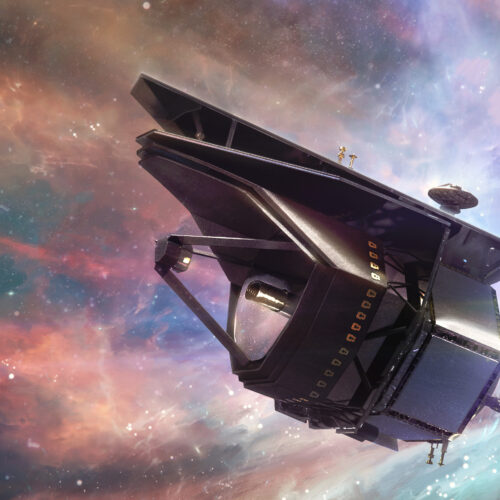
Artist’s illustration of the PRIMA telescope. Credit: NASA
The first in a new class of space telescopes is on track to reach the launch pad in the early 2030s, NASA announced this week.
The PRIMA mission will be the first of NASA’s Probe Explorers, a new line of observatories intended to do more science for less money. The agency’s space telescopes typically fall into lower-cost “Explorer-class” missions, with cost caps in the range of a few hundred million dollars, or flagship observatories like the recently launched Nancy Grace Roman Space Telescope, which came with a price tag of some $4.3 billion.
With the Probe Explorers, NASA officials seek to find a better balance between the smaller Explorer missions and multibillion-dollar flagships. NASA has studied potential Probe Explorer mission concepts for several years after an independent panel of scientists recommended the new mission category. But it wasn’t clear until recently whether NASA’s science budget, which is under pressure from the Trump administration, would be sufficient to actually start developing one.
NASA announced Wednesday it will move forward with PRIMA, short for the Probe far-Infrared Mission for Astrophysics. PRIMA was the sole finalist for the first Probe Explorer mission after NASA disqualified a competing mission, an X-ray observatory known as AXIS, earlier this year. NASA said a concept study for AXIS indicated it would not meet the agency’s schedule and budget constraints.
The scientist leading the AXIS concept study blamed disruptions and mismanagement at NASA’s Goddard Space Flight Center in Greenbelt, Maryland, the NASA location charged with leading the AXIS mission if it moved forward into development. PRIMA will be led by NASA’s Jet Propulsion Laboratory in Pasadena, California, which has also found itself in an institutional crisis, with few missions in development and a series of layoffs.
Flagship missions can take decades to design, build, and test before they make it to the launch pad. The Roman Space Telescope was the exception. It took 10 years from NASA’s approval to proceed into development until Roman’s launch last month on the way to an observation post a million miles from Earth.
Leftovers from Webb
PRIMA, which has a cost cap of $1.2 billion excluding launch costs, will not be as big and complex as Roman, so it’s natural to assume a shorter development cycle. NASA wants to launch PRIMA seven years from now, in 2033. The telescope will observe the Universe in faint, far-infrared light in a range of wavelengths between 24 and 235 micrometers, requiring its primary optics to be cooled to 4.5 Kelvin, or minus 451° Fahrenheit.
This would usually require a brand-new build of a sophisticated cryocooler. PRIMA will instead use a spare leftover from the development of the James Webb Space Telescope, modified to use helium-3 instead of helium-4 as the cooling fluid. The focal planes of PRIMA’s kinetic inductance detectors will be chilled even lower to 100 milliKelvin, putting the mission’s optics in contention for the coldest ever sent into space.
Its far-infrared sensitivity will give PRIMA visibility into the origins of planets and their atmospheres, the coevolution of galaxies and black holes, and changes in the properties of dust and metals over cosmic time, according to the scientists heading the mission. PRIMA, with a 5.9-foot-diameter (1.8-meter) primary mirror, will set up shop in an orbit around the Sun-Earth L2 Lagrange point a million miles from Earth.
The mission will peer deeper into the infrared bands than any of NASA’s past or current infrared observatories, such as Spitzer and Webb, and will build on discoveries made by Europe’s Herschel space telescope, which gave astronomers new insights into the formation of cosmic filaments and the role of water in the formation of stars and planets.
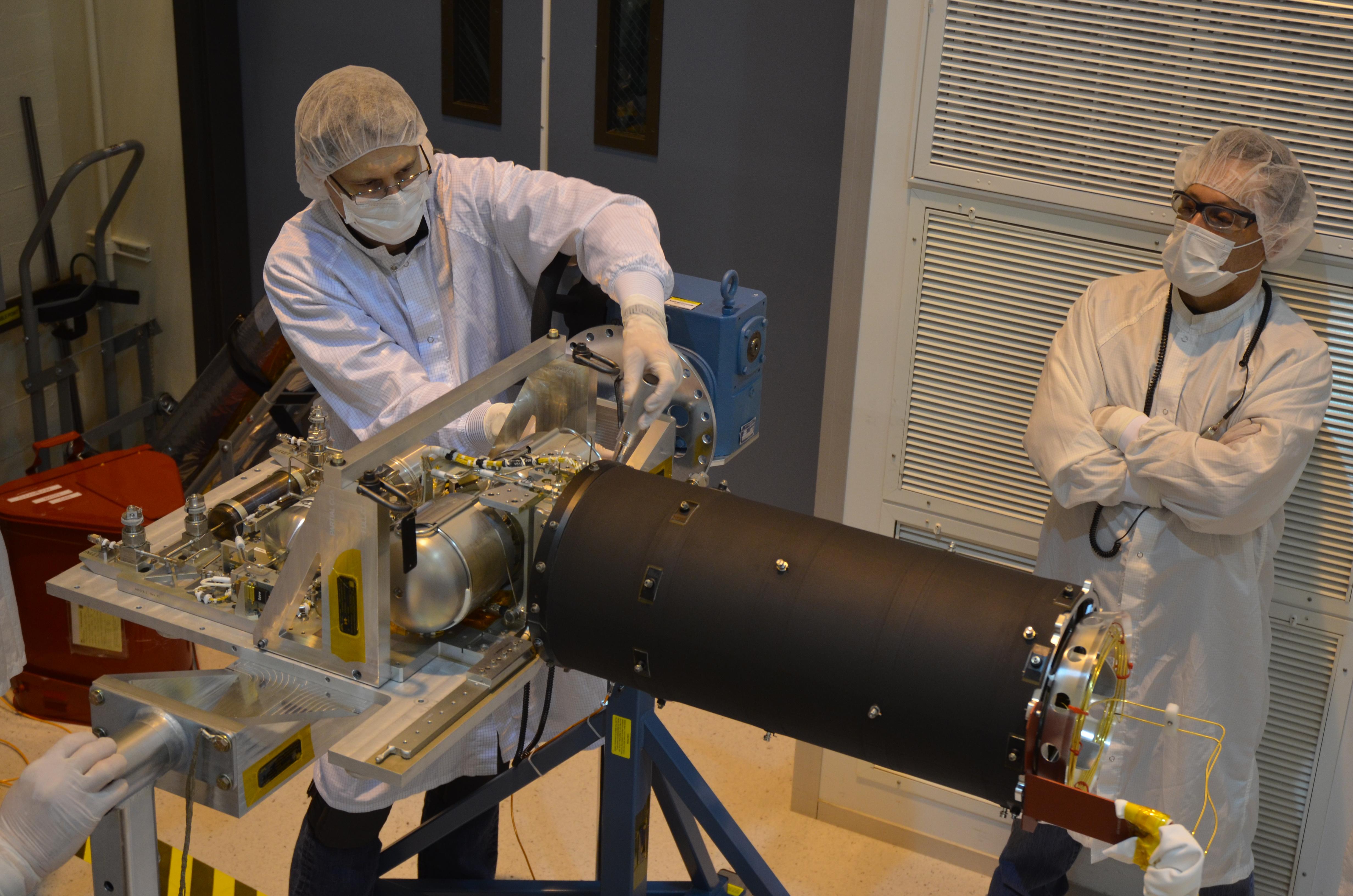
PRIMA uses a modified spare cryocooler from the James Webb Space Telescope. The cryocooler for Webb’s Mid-Infrared Instrument is seen here.
Credit: NASA/JPL-Caltech
PRIMA uses a modified spare cryocooler from the James Webb Space Telescope. The cryocooler for Webb’s Mid-Infrared Instrument is seen here. Credit: NASA/JPL-Caltech
“The PRIMA mission is humanity’s next window into the deep Universe,” said Nicky Fox, associate administrator for NASA’s Science Mission Directorate, in a statement. “It will unveil the obscure across cosmic time to better understand the formation of planets, stars, black holes, and even how water on Earth came to be.”
NASA’s announcement this week gave the green light to move into Phase B of development, working toward a preliminary design review before a confirmation review at NASA Headquarters a few years from now that will mark final approval to proceed into integration of flight hardware. The complete observatory is expected to weigh less than 3.4 metric tons (7,500 pounds) at launch.
“A single mission alone can’t probe all the Universe’s mysteries. But by extending the survey capabilities of our fleet into far-infrared wavelengths with PRIMA, we’re enabling an incredibly comprehensive look at the cosmos,” said Shawn Domagal-Goldman, director of NASA’s Astrophysics Division. “With our Webb and Roman space telescopes, we set a cadence of launching premier-class missions in both halves of the decade. We’re going to keep that up and kick off the next decade with PRIMA, as part of a pipeline that will consistently have missions of this caliber ready to go.”
Flagships are still hard
Meanwhile, NASA continues preliminary architecture studies and technology development for its next big flagship space telescope, the Habitable Worlds Observatory, planned for launch in the 2040s. It is expected to be at least as large as the James Webb Space Telescope, with the potential for an even bigger primary mirror if NASA can take advantage of new super-heavy-lift launch vehicles, such as SpaceX’s Starship. HWO will observe the cosmos in multiple wavelengths, ranging from ultraviolet to visible and near-infrared.
Early cost estimates for the Habitable Worlds Observatory come in at around $11 billion, on par with Webb, which far exceeded its original cost projection.
“This is a sufficiently ambitious observatory where it’s going to require an all-of-nation [approach],” Domagal-Goldman said Tuesday in a meeting of the National Academies’ Committee on Astronomy and Astrophysics. “Frankly, we’re going to need our partners internationally to be a big part of this as well. But we need the best and brightest from throughout the country, whether they’re at Goddard, another NASA center, an industry partner, a new space commercial partner, or a university, to be a part of what we’re doing.”
Domagal-Goldman said this week that NASA aims to use its experience in developing and launching the Roman telescope on budget to help bring future flagships like HWO under tighter cost controls.
“We have proven with the launch of Nancy Grace Roman, ahead of schedule and on budget, that it is not a law of nature that these projects will go over schedule and over budget,” he said. “That doesn’t mean they’re easy, and it doesn’t mean we can be cavalier that they will always be on schedule and on budget because that’s also been disproven.”
The lessons NASA has learned about implementing flagship projects include the importance of defining the mission’s architecture and requirements and ensuring its underlying technologies are well understood before engineers start building flight hardware, according to Domagal-Goldman.
“To put it succinctly, you need to understand the challenge, have a mission where the challenge is incredibly well understood, and then once you understand it, then you put your pedal to the metal and take that observatory to the launch pad as quickly as you can,” he said.

Stephen Clark is a space reporter at Ars Technica, covering private space companies and the world’s space agencies. Stephen writes about the nexus of technology, science, policy, and business on and off the planet.