The hottest news in space
“Fundamentally, we want to learn about the origins of this planet and how it came to be like it is.”
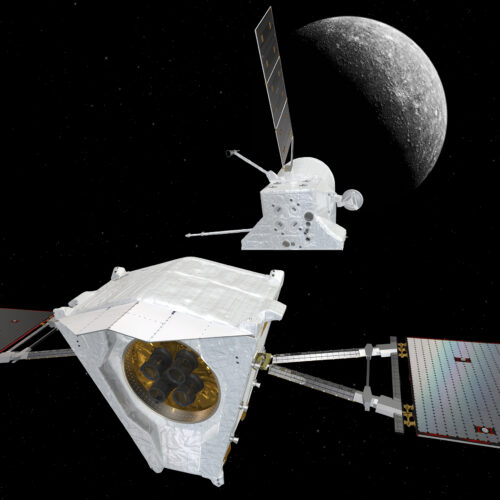
Artist’s illustration of BepiColombo’s propulsion module (bottom) separating from the spacecraft’s two science orbiters. Credit: ESA/ATG medialab and NASA/JPL
The BepiColombo mission cleared a major milestone this week in the final stretch of an eight-year interplanetary voyage to Mercury, the hard-to-reach, scorching hot iron world at the Solar System’s innermost frontier.
The robotic science mission, with a price tag of nearly $2 billion, is led by the European Space Agency with contributions from Japan and the United States. Since its launch in 2018, BepiColombo has spiraled closer to the Sun using a combination of plasma propulsion and a series of flybys of Earth, Venus, and Mercury. The maneuvers changed the spacecraft’s velocity and steered it toward a final encounter with Mercury later this year.
Next time it reaches Mercury, BepiColombo will be traveling at just the right speed for the planet’s gravity to capture the spacecraft into orbit. Scientists working on interplanetary missions are accustomed to long waits for scientific payoffs. It took nearly 10 years for NASA’s New Horizons spacecraft to travel from Earth to Pluto. It turns out traveling to fleet-footed Mercury and then entering orbit requires more energy, or delta-v, than sending a probe to fly by Pluto.
That’s why BepiColombo’s trajectory required an unprecedented nine planetary flybys, or gravity assists, to set up for the chance to enter orbit around Mercury later this year. BepiColombo also launched with the most powerful electric propulsion system ever put into deep space, with four gridded ion thrusters to reshape its orbit around the Sun in between flybys.
BepiColombo is now a few months from reaching the end of its journey, and it no longer needs the plasma engines. On Thursday, BepiColombo jettisoned the section of the spacecraft containing the ion the thrusters. This part of the spacecraft, called the Mercury Transfer Module, was responsible for generating power and providing propulsion for BepiColombo throughout the eight-year cruise.
But the propulsion module was no longer required, and BepiColombo needed to get rid of it before slipping into orbit in November. BepiColombo is unusual in that it is actually a stack of three spacecraft: the Mercury Transfer Module and the Mercury Planetary Orbiter, built by Europe, and the Mercury Magnetospheric Orbiter from Japan, nicknamed Mio.
The separation of the propulsion module Thursday leaves the European and Japanese orbiters still traveling together. The two spacecraft will release from one another in December, soon after they arrive in their initial orbit around Mercury. The orbiters each have their own instruments for scientific observations at Mercury, while the transfer module is dead mass.
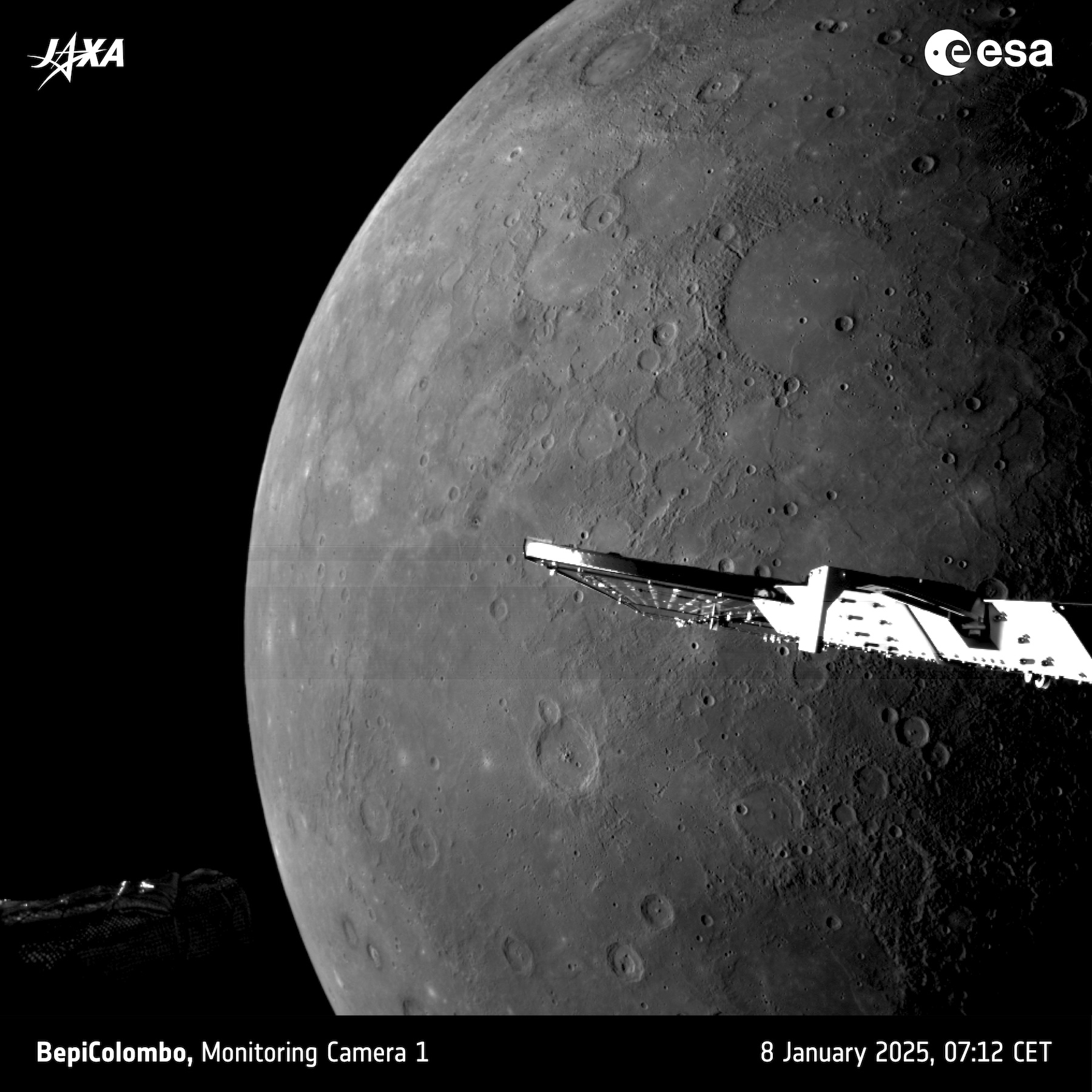
A monitoring camera onboard the Mercury Transfer Module captured this view of Mercury’s cratered surface during a flyby on January 8, 2025.
Credit: ESA/BepiColombo/MTM
A monitoring camera onboard the Mercury Transfer Module captured this view of Mercury’s cratered surface during a flyby on January 8, 2025. Credit: ESA/BepiColombo/MTM
A punishing environment
Nothing like the controlled disassembly of BepiColombo has ever been attempted in such a harsh environment as the region of space near Mercury. Separation of the Mercury Transfer Module occurred 39 million miles (63 million kilometers) from the Sun, less than half the distance of Earth, with extreme temperatures and intense solar radiation.
Ignacio Tanco, head of inner Solar System mission operations at ESA, told reporters the challenge is “equivalent to launching a new spacecraft” with “considerable risk” of something going wrong. Letting go of the transfer module required the rest of the spacecraft take over power generation, propulsion and pointing, and thermal control, a significant concern flying so close to the Sun.
“This is something that we will only see after separation if it has worked, and we will be using several new sensors and mechanisms as part of the attitude control system,” Tanco said.
Several of the mission’s science instruments, including its best cameras, were obscured by the propulsion module during the transit to Mercury. “It will be only upon release of the transfer module that these instruments will see first light,” Tanco said.
Early indications are everything went according to plan Thursday. The spacecraft executed preprogrammed commands to disconnect the transfer module and four springs pushed the two sections apart. Telemetry downlinked from BepiColombo showed the Mercury Planetary Orbiter’s solar arrays were generating power.
“They were not seeing the Sun during the cruise phase,” said Elsa Montagnon, BepiColombo’s spacecraft operations managers at ESA. “We have confirmation that the power margins on the spacecraft are positive, that the solar arrays are recharging the batteries that were discharged during the separation. This is all excellent news.”
The path to Mercury hasn’t always been easy. BepiColombo’s ion thrusters lost partial power in 2024, and engineers extended the mission’s cruise by a year to account for the loss of thrust. BepiColombo has covered more than 6 billion miles (10 billion kilometers) since departing Earth, and is now on track to maneuver into orbit around Mercury on November 21.
“It’s a very ambitious mission,” said Santa Martinez, ESA’s mission manager for BepiColombo. “Mercury is a challenging destination. It’s very difficult to reach. It’s very difficult to operate at because of the extreme environment so close to the Sun. But what makes this mission really unique is that for the first time in space exploration, we are bringing two spacecraft to the vicinity of the planet, and we are going to put them in orbit around this mysterious body. This is going to bring to humanity and to the scientific community unprecedented views of the Mercury planet, and it’s going to open a new chapter in our understanding of the Solar System.”
BepiColombo is named for Italian mathematician and engineer Giuseppe “Bepi” Colombo, a pioneer in orbital mechanics who helped NASA design a trajectory using planetary flybys to allow the Mariner 10 mission to encounter Mercury three times in the 1970s. NASA’s MESSENGER spacecraft became the first probe to enter orbit around Mercury in 2011, completing the first global map of the airless world before ending its mission in 2015.
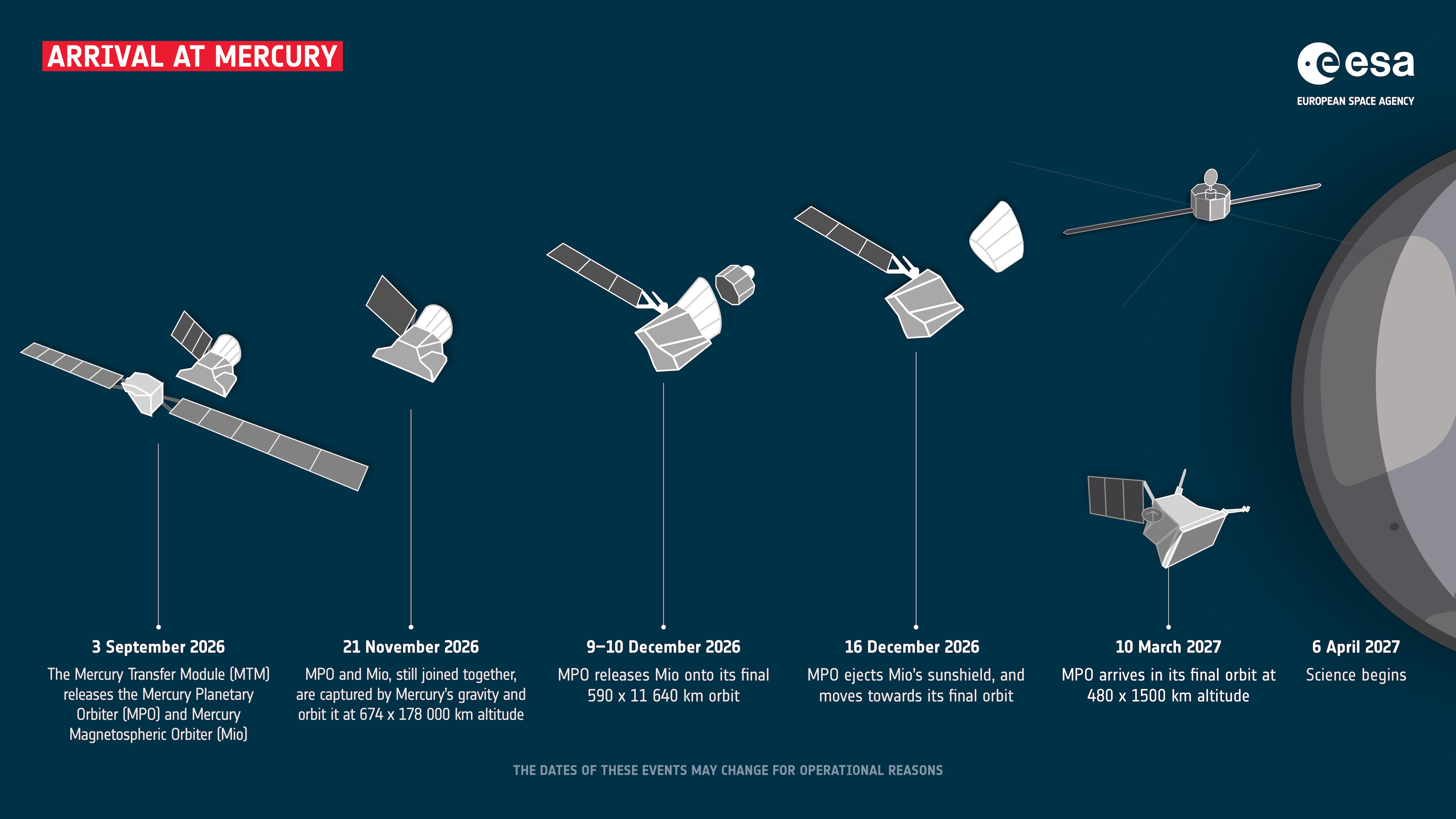
This infographic illustrates the key steps in the arrival of the BepiColombo mission at Mercury.
Credit: European Space Agency
This infographic illustrates the key steps in the arrival of the BepiColombo mission at Mercury. Credit: European Space Agency
Now it’s BepiColombo’s turn.
“There’s a huge amount still left to be learned,” said Geraint Jones, ESA’s project scientist for BepiColombo. “We need to map the whole planet in high resolution and answer some of the many questions that arose from MESSENGER’s first detailed exploration of the system.”
At first glance, Mercury looks a lot like the Moon, with a cratered, almost monotone landscape of gray bombarded by radiation and a near-constant stream of micrometeoroids. The dark floors of craters at Mercury’s poles may harbor water ice, like the bottoms of some craters on the Moon. “We want to look at it in new colors beyond what we can see with our own eyes to learn about what it’s made of,” Jones said.
The European-built orbiter will fly closer to Mercury, with cameras and instruments to study the planet’s surface. Japan’s smaller orbiter will fly in a higher orbit, with sensors tuned to detect magnetic fields, plasma, and dust. Routine science observations will begin next April, assuming the rest of the arrival sequence goes according to plan.
“Having two spacecraft there is groundbreaking,” Jones said. “It makes an enormous difference in understanding the effects that the solar wind has on planets like Mercury, so, fundamentally, we want to learn about the origins of this planet and how it came to be like it is.”

Stephen Clark is a space reporter at Ars Technica, covering private space companies and the world’s space agencies. Stephen writes about the nexus of technology, science, policy, and business on and off the planet.