Enormous eruptions altered Earth’s climate and societies all over the globe.
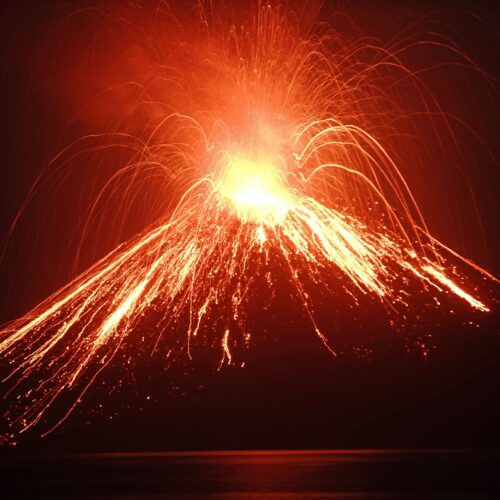
The Indonesian volcano known as Anak Krakatau, or Child of Krakatau, emerged in the 1920s from the underwater ruins of the larger Krakatau volcano that erupted devastatingly in 1883. Here, the volcano erupts in 2018. Credit: FERDI AWED/AFP via Getty Images
The first telegram arrived in Singapore on a Monday, sent from the city of Batavia in the Dutch East Indies (now Jakarta, Indonesia). “Terrific detonations from Krakatau (volcanic island),” it reported. Soon afterward: “Stones falling. Village near Anjer washed away.” The wires continued clattering out news of bridges destroyed, boats smashed, lighthouses “disappeared.” By noon on Tuesday, the scope of the natural disaster was clear: “Where once Mount Krakatau stood the sea now plays.”
Within days, the source of the destruction was known worldwide. On the morning of August 27, 1883, a volcanic eruption had obliterated two islands in the strait between Java and Sumatra, and most of a third. More than 36,000 people perished, the majority in devastating tsunamis that raced outward from the colossal explosion.
Thanks to Victorian-era telecommunications, it was the first time in history that people around the globe could begin to document, in near real time, the immediate and long-term effects of a catastrophic volcanic eruption. What they learned over the next few years laid the foundations for the modern science of volcanology. And it was an especially eye-opening lesson in how the biggest eruptions can influence climate, agriculture, and even the course of human history.
Global effects
In the months after Krakatau, drifting volcanic particles high in the atmosphere circled the globe, causing violently colored sunsets that contemporary artists captured in paintings, likely including the psychedelic background of Edvard Munch’s The Scream.
But the key climate-driving component of the volcano’s emissions was sulfur from the molten rock that fed Krakatau. Once sulfur erupts into the atmosphere, it can form particles called aerosols that reflect sunlight and cool Earth. In the months and years after the eruption, average summer temperatures fell 0.6° Celsius (1.1° Fahrenheit) in the non-tropical regions of the Northern Hemisphere.
Fast-forward more than a century, and researchers now understand that climate changes, especially rapid ones, have transformed societies by affecting agriculture, public health, and living conditions. With what they’ve learned from Krakatau and other eruptions, volcanologists today are identifying past catastrophic blasts that may have contributed to historic events like droughts, famines, epidemics and societal unrest.
“In so many different ways societies were affected … a failure in harvest or flooding or a cold summer or a really cold winter,” says Katrin Kleemann, an environmental historian at the German Maritime Museum in Bremerhaven.
While they can’t prove an eruption caused the demise of a regime, volcanologists have uncovered some intriguing links, including some that could inform our understanding of how today’s society might react to a rapidly changing climate.
536 and all that
The first challenge in making volcano-society connections is to find physical fingerprints of past eruptions. In the year 536, scribes in Europe, the Middle East, and Asia wrote about bizarre weather, including a haze that shrouded the sun for 18 months. Temperatures plummeted, harvests failed, and within a few years, the first documented global plague began.
These early medieval chronicles strongly suggest a major volcanic eruption—but the hard evidence lies deep in polar ice. Scientists can infer that big eruptions happened at certain times in the past by looking for sulfur and ash deposits in ice cores from Greenland and Antarctica. These cores, drilled into ice sheets, preserve an annual record of whatever was circulating in Earth’s atmosphere as it settled onto the surface each year. Researchers can read these frozen layers back in time like turning the pages of a book.
It turns out that polar ice cores do contain large amounts of sulfur dating to 536, a distinct signal of a major eruption. But which volcano went off at the time remains a mystery. There is no known written record from anyone living close to the eruption—Iceland, where it may have occurred, was not yet populated.
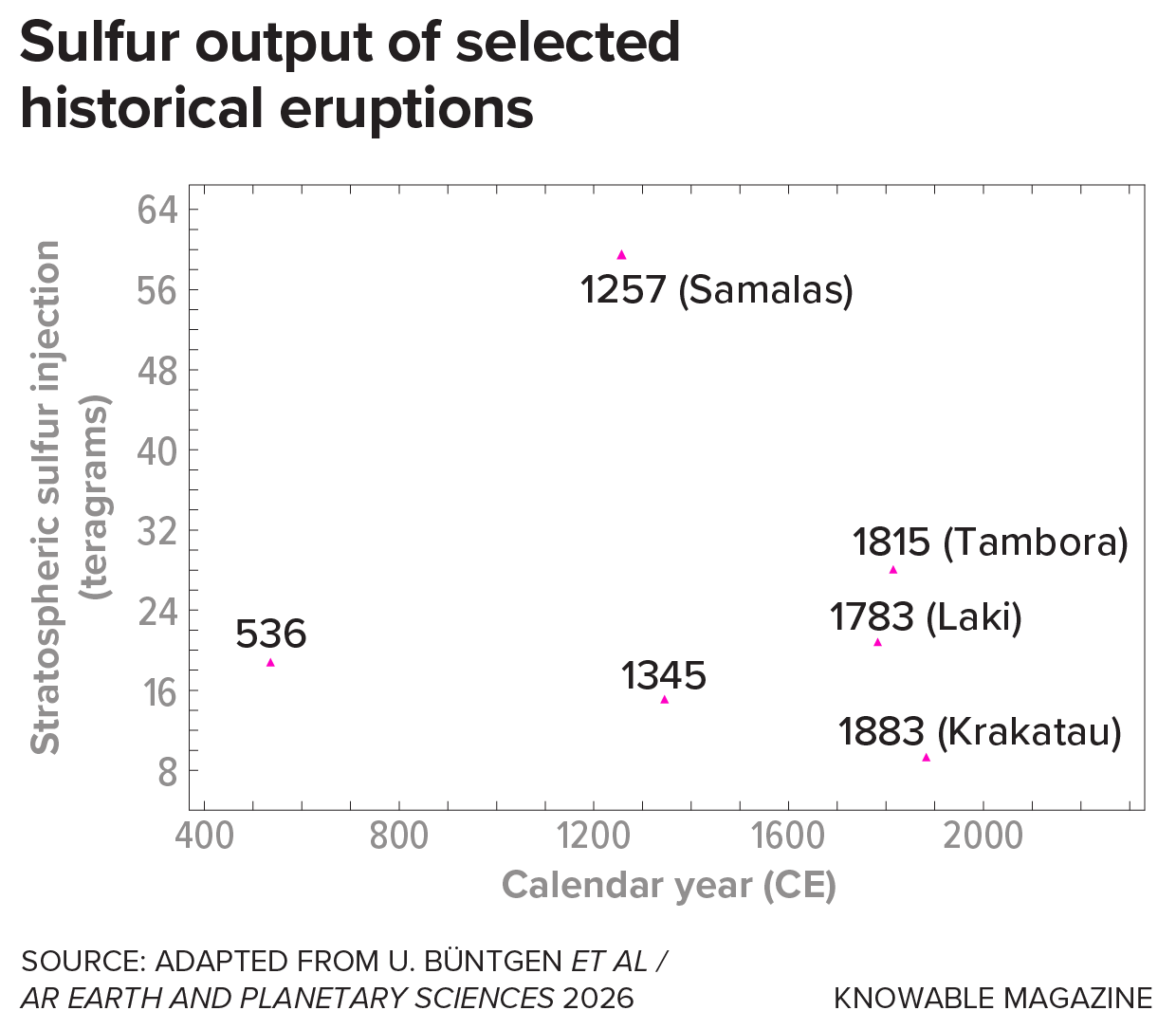
Large volcanic eruptions cool Earth’s climate by injecting tiny particles of sulfur high into the atmosphere, where they reflect a portion of incoming sunlight back into space for periods of months or years. The 1257 eruption of the Samalas volcano in Indonesia dwarfed others in recent history as measured by sulfur output, and has been shown to have chilled the climate across the Northern Hemisphere for several years afterward. Other significant eruptions shown have also influenced Earth’s climate enough to affect human societies.
Large volcanic eruptions cool Earth’s climate by injecting tiny particles of sulfur high into the atmosphere, where they reflect a portion of incoming sunlight back into space for periods of months or years. The 1257 eruption of the Samalas volcano in Indonesia dwarfed others in recent history as measured by sulfur output, and has been shown to have chilled the climate across the Northern Hemisphere for several years afterward. Other significant eruptions shown have also influenced Earth’s climate enough to affect human societies. Credit: Knowable Magazine
Empire falls
There is better evidence pinpointing the volcano that may have helped topple the Mongol Empire seven centuries later. Until 2013, researchers knew only that some eruption—the biggest in the last few millennia as measured by sulfur output—occurred in 1257. In 2013, an interdisciplinary team radiocarbon-dated the ash, pumice, and other deposits around Samalas, a volcano in Indonesia, tying it to the 1257 eruption.
Tree-ring studies, which analyze annual growth layers on trees to determine which years had good and bad growing weather, show extensive cooling across North America and Eurasia from 1257 to 1259. Among other impacts, bad harvests led to starvation in England, and wet, cool summer weather in Japan damaged rice production.
Some researchers have speculated that it was the Samalas eruption that helped seal the fate of the Mongol Empire, which ended after its last ruler perished in a 1259 epidemic in China that could have been linked with the eruption-caused climate changes.
The Black Death
A century after Samalas, volcanologists have found, there was yet another intriguing eruption-disease connection. Between 1346 and 1352, perhaps half of Europe’s population died in the Black Death plague, from infection by the flea-borne bacterium Yersinia pestis.
Historical records from Europe and Asia suggest that skies were darker than usual around that time, perhaps because of a volcanic haze. Ice-core records support that interpretation, documenting a big eruption, or perhaps several, around the year 1345—though the location remains unknown.
To see how this volcanic activity might have affected climate, an interdisciplinary team led by Ulf Büntgen, a tree-ring specialist at the University of Cambridge, used tree-ring data to confirm that the summers of 1345, 1346, and 1347 were unusually cold and wet in southern Europe.
Büntgen and his colleagues note that as crops failed in the bad weather, Europeans imported grain from farther east. The grain ships arrived with rats harboring Y. pestis, leading the researchers to argue that the mystery volcano erupting in 1345 may have set off a chain of events that ultimately killed tens of millions of people.
Iceland’s toxic fogs
Connecting volcanoes to human events may be a challenge even today, but in 1784 an American ambassador to France named Benjamin Franklin was astute enough to link a strange haze that rolled across the countryside in the previous year to a distant eruption.
The source turns out to be Laki, an Icelandic fissure that spewed lava for eight months starting in June 1783. The eruption killed at least one-fifth of Iceland’s people, and much of its livestock, through toxic fog and climate changes that ruined harvests. Though the event was well-documented in Iceland, observers in England, France and elsewhere across Europe who saw the volcano’s haze and sometimes smelled its foul odor could only guess what was going on in a disconnected, pre-electronic world.
“They wouldn’t get news alerts on their phone, they wouldn’t see livestreams of this eruption — they would have no idea,” says Kleemann, who has studied the eruption.
Connections grow clearer
Though it happened just a few decades after Laki, one of the largest eruptions in recorded human history offers a much more detailed picture of how a volcanic climate shock can change history. In 1815, a mountain in Indonesia named Tambora exploded, sending sulfur into the upper atmosphere and triggering broad climatic changes.
Tambora’s eruption caused cooling across much of Europe and North America, where crops failed and 1816 was dubbed the “year without a summer.” The volcanic weather that year kept the writer Mary Shelley cooped up while traveling in Switzerland, where she wrote the novel Frankenstein.
The bad weather brought famine to Switzerland, Ireland, and elsewhere; grain prices and malnutrition soared in parts of Europe, prompting tens of thousands of people to emigrate to North America. Eastern Europe and western Russia, in contrast, had relatively better growing conditions under the post-volcanic climate and enough grain to export it to other nations. Port cities like London and Hamburg enjoyed greater access to imported grains, while prices rose sharply in the hinterlands. Those bright spots show how access to transportation and trade networks can make societies more resilient in the face of disaster.
“Human society has a lot of susceptibilities and vulnerabilities,” says Clive Oppenheimer, a volcanologist at the University of Cambridge who coauthored a 2026 Annual Review of Earth and Planetary Sciences paper on volcanoes, climate and society with Büntgen. “Some climate shocks will come and go…. At other times, the climate shock will come … when there are greater societal vulnerabilities.”
These lessons may hold particular relevance today, because researchers see the historical fallout of past eruptions as a clue to how humanity might respond to present-day climate change. Big volcanic eruptions cool the planet rather than warm it, but they represent the same sort of rapid planetwide shocks that societies are coping with now as Earth heats up.
And as historical volcanology teaches, it is only a matter of time before the next big blast. In the era of satellites and social media saturation, the whole world will know the moment it happens—but it is only by studying past events like Krakatau and Tambora that we can have an idea of what will happen next.
This story originally appeared in Knowable Magazine.

Knowable Magazine explores the real-world significance of scholarly work through a journalistic lens.