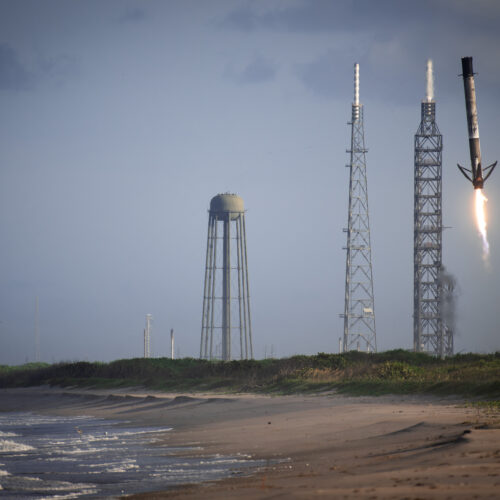
The government will also identify potential locations for additional launch facilities in the United States, improve integration of space launch and reentry operations into airspace and air traffic control modernization efforts, and designate “priority airspace for critical space launch corridors.”
More specifically, the White House is directing the Department of the Interior to identify federal lands to serve as an additional designated federal land reentry site. This comes after the Interior Department’s Bureau of Ocean Energy Management issued a request for public comment last month regarding the potential use of submerged lands and abandoned offshore oil rigs for sea-based space launches and reentry activities.
Geographic resiliency
This section of the directive appears to endorse the results of a recent Pentagon study that identified the need for the government to have a third heavy-lift launch site in the United States. The report hasn’t been released, but Air Force Secretary Troy Meink described the finding in a May hearing before the House Armed Services Committee.
“At a high level, what it says is we probably need another site that’s capable of heavy and super heavy launch capability, both from a resiliency perspective and just, even at the Cape, limitations on how much space we’ve got,” Meink said.
“We’re going to have to increase the capacity,” said Gen. Chance Saltzman, the Space Force’s top general, in the same hearing in May. “And then, maybe connected to that, is the geographic resiliency that you might need to have separate launch locations and not be so tied to just the two specific launch ports that we have.”
Another element of the new space transportation policy aims for more responsive launch operations, such as putting high-priority payloads into orbit within 48 hours of need, potentially from “expeditionary locations” far away from conventional launch ranges. Some companies, like Rocket Lab and Astra, are already working on portable launch infrastructure.
The memo also supports NASA’s ongoing work on commercial transportation to and from the Moon, and directs the agency to support future commercial robotic and human expeditions to Mars.
The government is already pursuing other tenets of the national space transportation policy, such as facilitating more access for commercial users at federal ranges, expediting permitting and environmental reviews, and charging user fees to commercial launch companies operating out of NASA or US military spaceports.